


Few walks capture the atmosphere of modern Istanbul as vividly as the route from Galata Tower up to Istiklal Avenue and onward toward Taksim Square. In just over a kilometer you move from a medieval Genoese tower through steep music‑shop lanes, past the historic Tünel funicular and into the city’s busiest pedestrian boulevard. This guide walks you step by step, highlighting real places to pause for coffee, where to browse for instruments and vinyl, and how to navigate crowds as you continue toward Taksim.
Get the latest updates straight to your inbox!
Orientation: From Galata Tower to the Start of Galip Dede Street
Begin at the base of Galata Tower in the compact square of the Galata neighborhood. The tower itself is one of Istanbul’s most visited landmarks, and the small plaza around it fills early with tour groups and school visits. If you plan to climb the tower for the panoramic view, it is worth doing this first thing in the morning to avoid long queues that can easily stretch 30 to 60 minutes by late morning in high season. Once you are ready to start walking, face the tower, then turn so that you have the tower behind your right shoulder and follow the narrow street that slopes slightly upward toward Istiklal Avenue.
Very quickly, this street becomes Galip Dede Caddesi, your main route uphill. There is no formal sign announcing the change right at the tower square, but you will know you are on the right path when you see the gradient steepen and the mix of souvenir shops, café corners and the first music stores appear. The street is paved with worn stone and cobbles, so comfortable shoes with good grip make a noticeable difference, especially if the surface is damp after rain. This stretch is technically open to occasional vehicle access, but for most of the day it feels like a pedestrian lane, with delivery vans only edging through in the mornings.
Before you leave the immediate tower area, it can be wise to buy a bottle of water or pick up a simit from one of the nearby street carts. The climb is not long, but it is steady, and on a warm summer afternoon the combination of incline and crowds make people surprisingly grateful for a quick drink stop. There are small groceries on the corners around Galata Tower where water and soft drinks are usually cheaper than at the cafés directly on the main tourist path.
Climbing Galip Dede: Music Shops, Cafés and Everyday Street Life
As you begin to climb Galip Dede, the character of the neighborhood changes block by block. Within a couple of minutes, you enter the most atmospheric section, lined with music shops displaying traditional Turkish instruments such as saz, oud and darbuka in their windows. Stores like Zuhal Müzik and smaller independent workshops showcase guitars, keyboards and amplifiers, while others focus almost entirely on hand‑crafted lutes and percussion. Even if you do not play an instrument, stepping inside one or two of these shops is a quintessential local experience, with staff often happy to demonstrate the sound of a particular saz or to let you feel the weight of a darbuka.
Prices here vary widely. A simple beginner’s Turkish saz can cost the equivalent of a modest dinner for two, while higher‑quality hand‑made instruments climb into the several‑hundred‑euro range. The same applies for guitars and keyboards: you will find both entry‑level instruments suitable for travelers who want a light souvenir and professional equipment aimed at local musicians outfitting their studios. Many shops will wrap purchases securely for flights and arrange basic cases; asking directly for a simple gig bag or padded cover is normal and expected.
Between the instrument stores, you will notice a series of small cafés and patisseries squeezed into former residential buildings. A common pattern is a narrow ground‑floor bar serving Turkish tea, espresso and soft drinks, with a few stools on the sidewalk. Slightly larger places may offer light meals such as menemen, gözleme or grilled sandwiches. For example, a typical Galip Dede café might serve a Turkish coffee for a price comparable to a mid‑range European city, with slightly higher prices at venues with rooftop terraces or Bosphorus glimpses. These are good spots to catch your breath midway up the hill, especially if you have luggage or a stroller.
The soundscape on Galip Dede is part of the appeal. On a typical late afternoon you might hear a shopkeeper tuning a guitar, a busker playing a ney flute at a corner, and the murmur of conversations in Turkish, English, Arabic and European languages all at once. Delivery motorbikes occasionally rumble past, but walking remains the dominant rhythm. The street narrows in places, so it is common courtesy to step into a doorway to let a hand truck or a group coming downhill slip by.
Side Streets, Galata Mevlevi Lodge and Tünel Square
Roughly halfway up Galip Dede you reach one of the most intriguing side diversions: the Galata Mevlevi Lodge Museum, known in Turkish as Galata Mevlevihanesi. Set just off the main street behind gate walls, this former dervish lodge offers a quieter, contemplative contrast to the bustle outside. The modest entry fee provides access to the sema hall where whirling dervishes once performed, as well as exhibits on Sufi music, calligraphy and devotional culture. Because it is slightly hidden from casual passersby, the museum is often calmer than the tower itself, making it an appealing stop for travelers who want to fold a bit of history and spirituality into their walk.
Beyond the lodge, Galip Dede continues to climb until it meets a broader intersection where tram tracks start to appear. This upper point of the hill is effectively the approach to Tünel Square. Here, the buildings open up slightly, and you will notice the entrance to the Tünel funicular, one of the world’s oldest underground urban rail lines. The funicular connects this hilltop with the waterfront district of Karaköy far below, covering the short distance in around 90 seconds. Even if you are not riding it at this moment, its presence is a useful landmark confirming that you are about to join the southern end of Istiklal Avenue.
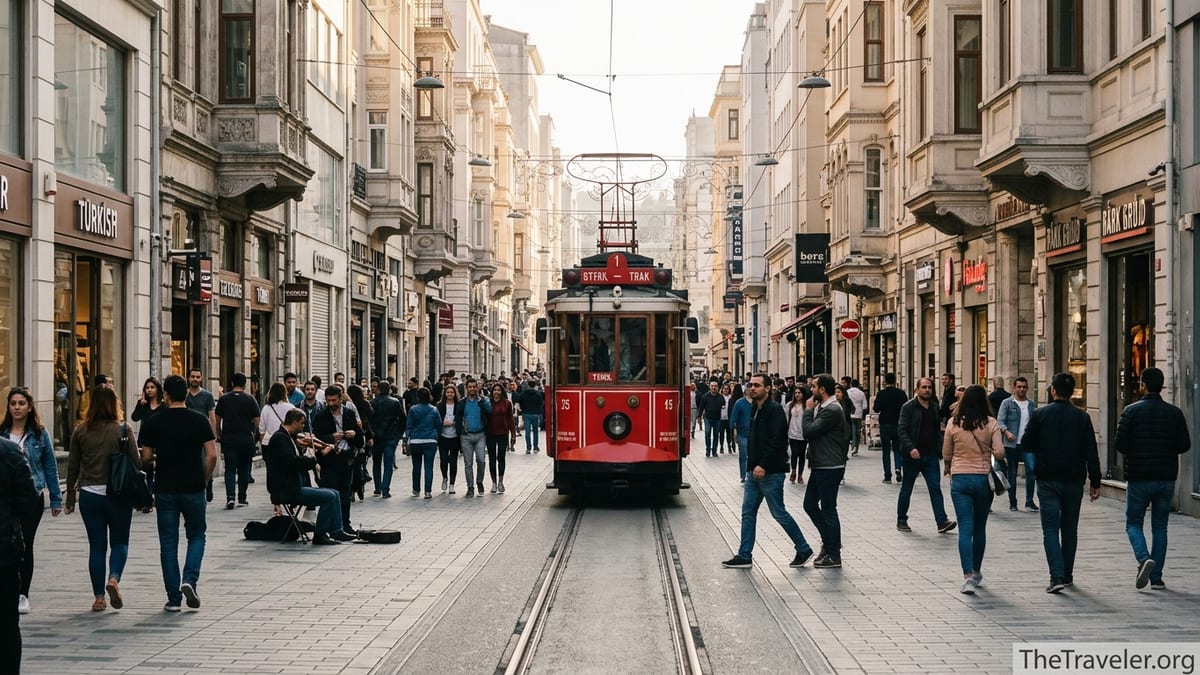
Tünel Square itself has a compact but lively feel. Street musicians frequently set up here, performing anything from Turkish folk standards to jazz instrumentals as pedestrians flow past. A small cluster of cafés, wine bars and meyhanes surrounding the square make this a natural place to pause if you began your walk later in the day and are ready for an early drink or shared plates of meze. This is also where you will see the red nostalgic tram that runs along Istiklal Avenue from Tünel to Taksim, a single‑car heritage line that has become one of the symbols of modern Istanbul.
Before you step fully onto Istiklal, it is worth orienting yourself. Standing in Tünel Square with your back to the funicular building, Istiklal Avenue stretches away uphill ahead of you. To your right and left are short side streets filled with bars, jazz clubs and small theaters. Many locals use these side alleys around Asmalımescit and Şişhane for their evenings out, preferring them to the main avenue’s chain stores. If you have time, detouring a block or two off the central route now can reward you with quieter coffee shops and neighborhood bakeries where prices can be noticeably lower than directly on Istiklal.
Entering Istiklal Avenue: Crowds, Atmosphere and Practical Tips
Stepping from Tünel Square onto Istiklal Avenue, you immediately feel the scale shift. The street widens into a broad pedestrian boulevard, surfaced mostly with smooth paving stones with the nostalgic tram tracks running up the middle. Shopfronts become taller, with late Ottoman and Art Nouveau facades framing international brands, Turkish clothing chains, bookstores and patisseries. The crowd density changes with the day and hour: on a weekday morning you might share the avenue with local commuters, delivery workers and a steady but manageable flow of visitors, while on a Saturday evening the crowd can become so dense that walking speed slows to a shuffle.
If you are sensitive to crowds or traveling with small children, aim to do this walk in the earlier part of the day. Late morning to early afternoon on weekdays typically offers the most breathable conditions, with shops already open but nightlife venues not yet drawing big groups. Wheelchair users and those pushing strollers generally find the main surface smooth enough, though maneuvering through peak crowds can be tiring. Many side alleys and passages have small steps or uneven stones at their entrances, so choosing your detours with an eye on accessibility is important.
Noise levels along Istiklal can be high. You will encounter street musicians with amplifiers, sellers calling out from midye dolma and chestnut carts, and the constant hum of conversation. If you prefer a quieter experience, consider stepping into enclosed passages, courtyards or cafés every so often. Arcades such as Çiçek Pasajı, Atlas Passage or smaller, less famous arcades provide partial shelter from the flow and a chance to rest. Prices for food and drink on Istiklal are typically higher than in adjacent neighborhoods: a simple Turkish tea at a seated café can cost more than it would in a backstreet tea house a few blocks away. Using side streets for longer breaks helps your budget stretch further.
Safety along Istiklal and around Taksim is generally good, especially in the evenings when there are many people and a visible police presence. Still, normal city precautions apply. Keep wallets and phones zipped or in inside pockets in dense sections, and avoid engaging with overly friendly strangers who insist on guiding you to specific bars or clubs. These approaches are rare but still reported in the area, and it is easier to decline firmly and keep walking than to extricate yourself later from an overpriced venue.
Continuing Toward Taksim: Landmarks, Side Streets and Food Stops
From Tünel to Taksim, Istiklal runs for roughly a kilometer uphill. Many visitors choose to ride the nostalgic tram for part of this distance, especially if they are tired from the Galata climb. The tram is slow and often crowded, but it offers a distinctive vantage point at the center of the street. You can hop on near Tünel, paying with your transport card at the small stop, and ride as far as Galatasaray Square or all the way to Taksim Square. For those who prefer to walk, the incline is steady but manageable, taking around 20 to 30 minutes at a relaxed pace with photo stops.
As you progress, watch for key landmarks that help you gauge your advance. Galatasaray Square, roughly halfway, is marked by an open plaza and the historic Galatasaray High School with its distinctive gate set back from the street. Nearby passages spill off Istiklal on both sides, housing everything from meze restaurants to antique dealers and small cinemas. Slightly beyond, churches such as the Catholic Church of St. Antoine stand behind ornate facades, their courtyards open to the public and offering a brief respite from the traffic of people outside.
Food options multiply as you near the center of the avenue. İstiklal is famous for its street food: trumpet‑shaped ice cream scooped by playful vendors, grilled corn sold from red carts, and kokoreç stands where seasoned offal is sliced onto bread. Prices on the main drag are often marked openly on the carts. While they may be a touch higher than in less touristed districts, grabbing a cone of maras ice cream or a serving of midye dolma here is still a relatively affordable way to experience local flavors. For a sit‑down meal, side alleys such as Asmalımescit or the lanes around Nevizade feature clusters of meyhanes and kebab houses at varied price points; many display menus with approximate per‑person costs posted outside.
As you approach Taksim Square, the buildings open up again, and the density of chain cafés, dessert shops and international fast‑food brands increases. The nostalgic tram terminus and the Republic Monument in the center of the square serve as clear visual anchors. This is also a key transport hub, with metro, buses and airport shuttles fanning out in multiple directions. If you do not wish to retrace your steps downhill, you can easily end your walk here and connect to other parts of the city via the metro or funiculars down to Kabataş and Karaköy.
Navigating Crowds, Slopes and Time of Day
Because this route combines a steep neighborhood hill with Istanbul’s busiest pedestrian artery, choosing your timing matters. In summer, midday heat can make the Galip Dede climb feel more strenuous than its length suggests, so an early start not only reduces temperatures but also eases navigation through tour groups. Winter brings a different mood: light rain and slick stones on Galip Dede require more careful footing, but the cooler air and softer light lend the facades around Istiklal a cinematic quality that many photographers appreciate.
Crowd patterns shift across the week. Weekday mornings generally see more locals on their way to work, with calmer traffic and easier access to shop windows and café tables. By late afternoon and into evening, especially Thursday through Sunday, both Galip Dede and Istiklal fill with shoppers, students, families and visitors out for the night. At peak times it can take twice as long to cover the same distance simply because you are weaving around groups, pausing for trams and waiting at narrow pinch points. Planning your walk so that the busiest stretch from Galatasaray to Taksim falls before late evening can make the experience feel more relaxed.
For those with mobility concerns, it is worth breaking the journey into segments. One option is to ride the Tünel funicular up from Karaköy to Tünel Square, then walk only the relatively flat portion between there and Galatasaray before taking the tram or metro to Taksim. Another variation is to start at Taksim and walk downhill instead, following the natural flow of many pedestrians from the square toward Tünel and Galata. Downhill walking still demands attention on smoother cobbles but reduces the cardiovascular effort of the climb.
If you are traveling with children, consider allowing more time for spontaneous stops. Instrument shops, ice‑cream vendors and street performers are all magnets for younger visitors who may want to linger. Setting a simple meeting point such as the front gate of Galatasaray High School or the base of Galata Tower is wise if you have teenagers who might dart into shops separately. Mobile reception is usually strong throughout the route, but in extremely crowded sections it is still easier to rely on clearly agreed landmarks.
The Takeaway
The walk from Galata Tower up Galip Dede Street, through Tünel Square and along Istiklal Avenue toward Taksim offers more than just a change of scenery. It links several layers of Istanbul’s story: the Genoese fortifications around the tower, the artisan culture of the instrument makers, the 19th‑century innovation of the Tünel funicular and the modern energy of Istiklal as a social and commercial spine. Done at a comfortable pace with room for detours, it can fill half a day without ever stepping into a museum queue.
What makes this route so memorable is the density of real, lived‑in detail you encounter along the way. You can watch a luthier adjust a saz bridge, chat with a café owner about the best time to visit the Princes’ Islands, or listen to a busker’s cover of a pop song spilling down a side street. At the same time, well‑developed public transport at either end means you are never far from a tram, funicular or metro line home.
Whether you are a first‑time visitor using Galata Tower as your starting point, or a returning traveler who wants to see beyond the postcard view, this uphill walk toward Taksim remains one of the most rewarding urban strolls in Istanbul. A pair of sturdy shoes, a bit of patience with the crowds and a willingness to slip down side alleys for unexpected discoveries are all you really need to make it your own.
FAQ
Q1. How long does it take to walk from Galata Tower to Taksim Square?
For most visitors, walking from Galata Tower up Galip Dede, through Tünel and along Istiklal to Taksim takes around 40 to 60 minutes at a relaxed pace with short stops.
Q2. Is the route from Galata Tower to Istiklal Avenue very steep?
The steepest section is Galip Dede Street between the tower and Tünel Square, which is a steady uphill climb; Istiklal Avenue itself has a gentler incline toward Taksim.
Q3. Are there many music shops on Galip Dede Street?
Yes, Galip Dede is known for its concentration of music stores selling guitars, traditional instruments like saz and oud, percussion, and accessories catering to both locals and visitors.
Q4. Can I visit the Galata Mevlevi Lodge on the way?
Yes, the Galata Mevlevi Lodge Museum is located just off Galip Dede Street and makes an easy cultural stop, with exhibits on Sufi music, calligraphy and dervish traditions.
Q5. When is Istiklal Avenue least crowded for walking?
Weekday mornings and early afternoons are usually the calmest, while evenings and weekends, especially Saturday nights, bring the heaviest crowds along Istiklal.
Q6. Is the nostalgic tram a good alternative to walking toward Taksim?
The nostalgic tram is slower than walking but offers a pleasant ride and a different perspective; it is useful if you are tired or want to skip a crowded section.
Q7. Are there safe places to eat along this route?
Yes, there are many cafés, bakeries and restaurants on Galip Dede, around Tünel and all along Istiklal, ranging from simple street food carts to sit‑down meyhanes on side streets.
Q8. Is the route safe to walk in the evening?
The area between Galata, Tünel, Istiklal and Taksim is typically busy and well lit in the evening, though normal big‑city precautions with belongings are still advisable.
Q9. What should I wear for this walk?
Comfortable closed shoes with good grip are strongly recommended because of the incline and occasional slick stones, and layers help with changing temperatures between shade and sun.
Q10. Can I avoid the uphill climb but still experience this route?
Yes, you can ride public transport up to Taksim or Tünel and then walk downhill toward Galata Tower, which offers similar views with less physical effort.