


More news on this day
Germany’s rail regulator has moved to rein in Deutsche Bahn’s dominance on heavily used long distance lines, ordering the state owned operator to reserve a fixed share of track capacity for rival high speed services in a bid to boost competition and improve the passenger experience.
Get the latest news straight to your inbox!
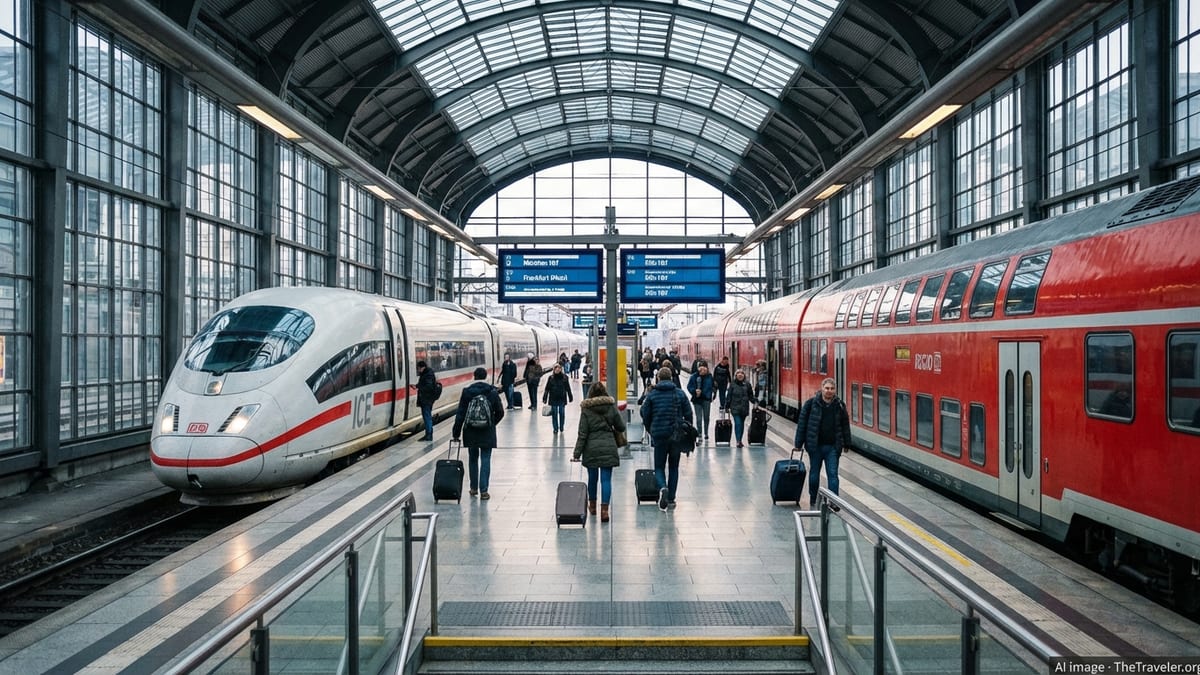
Regulator caps Deutsche Bahn’s share on congested lines
According to publicly available information from Germany, the Federal Network Agency has adopted a new rule for the country’s long distance rail network that requires Deutsche Bahn to leave at least 25 percent of train path capacity on so called highly congested routes to competing operators. The decision applies to timetable planning where demand for fast passenger services exceeds available infrastructure, a situation that has become common on high frequency corridors linking major German cities.
The intervention aims to reduce the near monopoly position of Deutsche Bahn on prime intercity routes while keeping the company in place as the dominant network user. Rather than mandating a full restructuring of the market, the regulator has chosen to ring fence a minimum slice of capacity for new entrants whenever bottlenecks occur. The measure is framed as a way to give competitors predictable access so that new services can be financed and ordered years in advance.
German media coverage indicates that the rule will become particularly important from the 2028 timetable year, when additional high speed operators are planning to enter the market. The regulator’s approach is designed to be technology neutral, focusing on capacity allocation rather than dictating which brands or service concepts may run on a given line.
Italo and FlixTrain plan high speed challenge to ICE
The decision follows lobbying from prospective competitors such as Italian operator Italo, which has announced plans to launch open access services on German high speed lines later this decade. Public reports describe an investment program worth several billion euros, including an order for new Siemens trains to operate connections such as Munich to Berlin and Munich to Dortmund, mirroring some of Deutsche Bahn’s flagship ICE routes.
FlixTrain, which already runs a small number of long distance trains in Germany, is also regarded as a potential beneficiary. The company has so far focused on less congested routes and off peak paths, where access has been easier to secure. A guaranteed minimum share of capacity on the busiest lines could allow it to expand into denser, higher yielding markets that have until now been largely closed to rivals.
For these operators, the core issue has been planning certainty. Ordering high speed rolling stock and building up a new long distance brand typically requires lead times of several years. Without assurances that train paths will actually be available on the most attractive routes once the trains are delivered, investors have been reluctant to commit. The new German rules seek to remove that barrier by embedding an explicit competition clause into the capacity allocation process.
Potential benefits and trade offs for travelers
For passengers, the shake up could bring more choice on key domestic corridors, with multiple brands competing on speed, comfort and price. Experiences from other European countries where more than one high speed operator runs on the same route suggest that fares can fall and service frequencies increase when newcomers appear, while innovations such as new onboard services or differentiated classes often emerge as operators try to distinguish themselves.
However, travel industry observers are also highlighting trade offs. Deutsche Bahn has argued in public statements that a stricter competition mandate on trunk routes could make it harder to cross subsidize long distance links to smaller cities and regions, which are less profitable but politically important for national connectivity. If rivals concentrate on the most lucrative city pairs at peak times, the incumbent’s overall revenue base could weaken, raising questions over how to sustain a dense network of less busy services.
There are also operational concerns. Germany’s rail infrastructure is already heavily used, and disruption on one busy line can quickly cascade across the wider network. Running more competing services from different operators on the same track may increase complexity for the system operator, although the regulator stresses in its published material that the new quota is conditional on not blocking capacity needed for other traffic types such as freight or regional trains.
Part of a wider European push for rail competition
The move in Germany comes as several European countries open their long distance rail markets to greater competition under European Union liberalization rules. In Italy, Spain and France, rival high speed operators have entered established markets and helped drive passenger growth on routes where trains compete directly with airlines. Industry analyses point to falling average fares and higher seat occupancy on corridors where competition has taken hold.
Germany has historically been more cautious, with Deutsche Bahn retaining a near exclusive presence on domestic long distance routes even as the market was formally opened on paper. The new capacity limit for the incumbent on congested lines signals a shift toward a more interventionist regulatory stance that actively promotes new entrants instead of assuming they will appear under existing rules.
Travel analysts note that the decision also aligns with broader climate and transport objectives. German and European climate targets envisage a significant shift of travelers from cars and planes to rail, especially on medium haul journeys of a few hundred kilometers. More intense competition, combined with large scale investment in infrastructure, is seen as one way to make rail travel more attractive and to persuade passengers to switch.
What international visitors can expect on German rails
For international travelers planning European rail itineraries in the coming years, Germany’s decision could eventually translate into a more diverse range of booking options and onboard experiences. Instead of a single national operator dominating the timetable on core routes, visitors may be able to choose between different brands, fare structures and levels of comfort on the same line, in a way that is already familiar on some Spanish or Italian corridors.
In the short term, the practical impact will be limited, as the new capacity rules apply to future timetable periods and incoming operators still need time to order trains, secure safety certification and establish sales channels. Deutsche Bahn’s ICE network will therefore remain the backbone of long distance rail travel in Germany for several years, and travelers can continue to expect the existing mix of high speed and intercity services linking major hubs.
Over the longer term, however, the regulator’s decision marks a structural shift in how access to Germany’s most desirable rail corridors is organized. For a country that has long relied on a single dominant operator for long distance rail, the introduction of a hard cap on that operator’s share of capacity on congested lines signals that a more competitive era is on the horizon, with potential ripple effects for ticket prices, service quality and route planning across Europe’s rail map.