


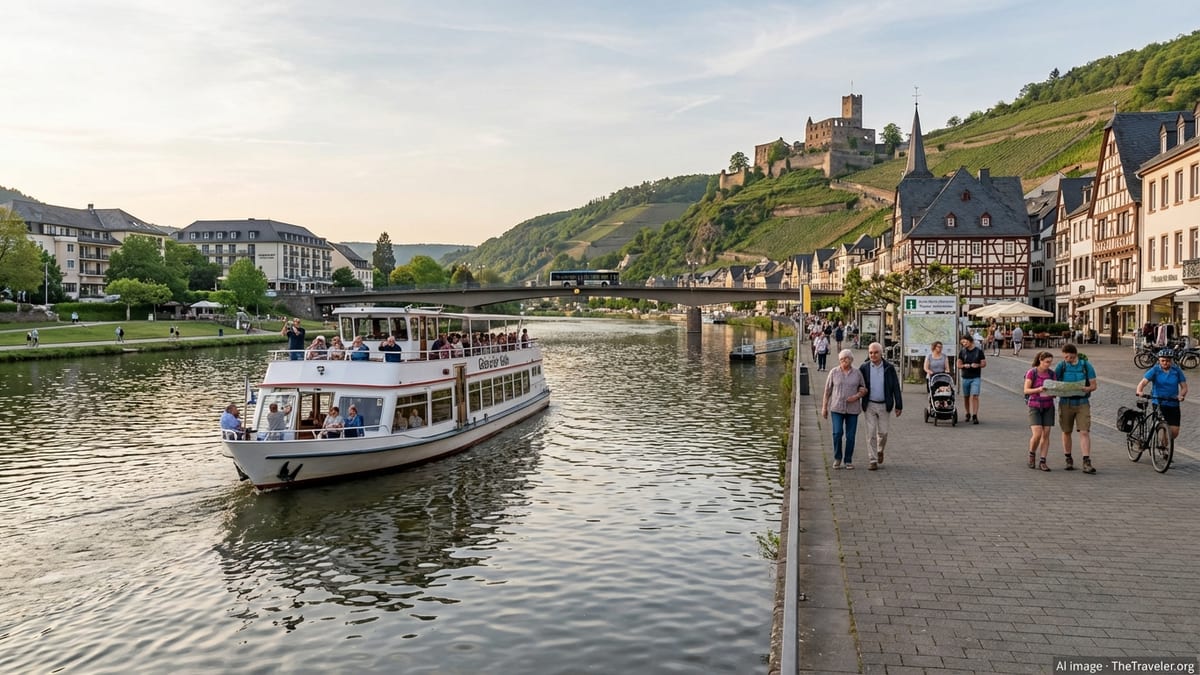
Bernkastel-Kues is one of those rare places where getting around is as memorable as the sights themselves. Hugging a bend of the Moselle River and wrapped in steep vineyards, the twin towns are compact enough to explore on foot, yet well connected by buses and boats to neighboring wine villages and regional hubs. With medieval lanes, riverside promenades, hiking paths and seasonal river cruises, the challenge is not moving from A to B, but deciding which scenic route you prefer.
Understanding the Layout of Bernkastel-Kues
Before planning how to move around, it helps to picture the basic geography of Bernkastel-Kues. The Moselle runs roughly east to west at this point, with Bernkastel on the right bank and Kues on the left. The historic half-timbered core and main market square sit on the Bernkastel side, while most larger hotels, clinics and some residential areas cluster in Kues. Linking the two is a road bridge for cars, buses and pedestrians, plus a riverside promenade on each bank that makes orientation easy.
Rising directly above Bernkastel, the hill crowned by the ruins of Landshut Castle forms the town’s most prominent landmark. Vineyard slopes climb up behind both Bernkastel and Kues, threading into forested ridges and long-distance hiking trails. This sloping terrain means that moving around at river level is flat and gentle, while any route that climbs toward the vineyards quickly becomes more demanding. For most visitors, the day naturally divides into slow exploration in the riverside quarters and targeted climbs to one or two viewpoints.
The Moselle Guest Center and tourist information office in Bernkastel acts as a practical anchor point. From here, signposted walking routes, city walks and regional hiking trails set off in several directions. The main Moselle promenade and the larger parking areas are a short stroll away, so even if you arrive by car, you can easily switch to walking for the rest of the day.
On the Kues side, the spa park, clinics, and a selection of hotels give that bank a quieter, more residential feel. Public buses run along both banks, but the rhythm of daily life at street level is gentle. Once you understand that everything important lines up along the river, with climbs up to the castle and vineyards, navigating Bernkastel-Kues becomes intuitive.
Exploring on Foot: Old Town Lanes and Vineyard Walks
Walking is by far the best way to experience Bernkastel-Kues. The medieval market square, Graacher Straße, the Moselle embankment, and the narrow side alleys are all pedestrian friendly and compact. From the bridge in the center of town, you can cross from one bank to the other in a few minutes, making it easy to link a stroll through Bernkastel’s historic core with a quieter loop through Kues and the spa gardens.
One of the most atmospheric walks begins at the medieval market place and leads through the tangled streets toward the river, passing half-timbered facades, wine taverns and small courtyards. Because distances are small, you can wander without a strict route, knowing that you will either hit the river, the main street or the base of the castle hill within a few minutes. The surfaces are mostly cobbled, so comfortable shoes are important, but gradients at river level are very mild.
For a short but steep outing, the Burgberg-Rundweg city walk climbs from the market square up to Landshut Castle and back. At around 1.9 kilometers with more than 100 meters of ascent, it is a compact circuit that rewards the effort with superb views over the Moselle valley and the tiled rooftops of Bernkastel. The recommended anti-clockwise direction takes you via Karlstraße and Schlossweg into the vineyards, then up a narrow, very steep serpentine path. The route circles the castle and returns via the castle access road and a gentler descent along the mountain spur, bringing you back into the old town.
If you prefer a somewhat longer but more moderate vineyard experience, the Doctor-Rundweg or Doctor circular route is ideal. Starting near the Moselle Guest Center and ending at the Graacher Tor, this approximately 4 kilometer city walk combines historical interest with landscape views. It leads past St. Joseph’s Chapel and then climbs through rows of vines above the famous Bernkasteler Doctor vineyard. Panels along the way explain the legend of the Doctor wine and its role in local history, while detours to viewing platforms offer wide panoramas of the Moselle bend and the town below.
Riverfront Promenades and Flat Walking Routes
Not every visitor wants or is able to tackle steep climbs, and in Bernkastel-Kues that does not mean missing out. The riverfront promenades on both banks provide long, flat walking routes with constant views of the water and vineyards. Benches, small green spaces and terraces line the embankments, giving plenty of options to rest or simply sit and watch boats slide past on the Moselle.
On the Bernkastel side, the promenade runs parallel to the old town, passing boat piers, ticket kiosks and moorings where passenger ships and smaller excursion boats tie up. This stretch is busy during peak season, particularly on weekends and festival days, but it remains an easy, level route that suits casual strolls and families with strollers. The views across to Kues and up to Landshut Castle are especially photogenic in late afternoon and evening as the light softens on the vineyards.
On the Kues bank, the riverside is quieter, with more open lawns and the feel of a resort promenade. Here you find the spa park and some modern hotels set a little back from the river. The walking experience is more relaxed and less commercial, making it appealing for longer, meditative walks. Continuing upstream or downstream from the town center, both embankments gradually give way to towpaths and paths along the dike, linking Bernkastel-Kues with neighboring wine villages for those who enjoy longer flat walks.
These low-level promenades are also practical connectors between other parts of town. You can, for example, start in the Kues spa park, walk along the river to the bridge, cross to Bernkastel, explore the market square, and then either return the same way or circle back at a slightly higher level through the lanes. Because the river is ever-present as a reference point, orientation even without a map is straightforward.
Using Local Buses and Guest Tickets
While the heart of Bernkastel-Kues is best explored on foot, local and regional buses expand your range considerably. The town lies within the area of the Trier Region Transport Association, and several bus lines link it to nearby villages, regional train stations and attractions along the Moselle. For visitors, this is most convenient when combined with a guest or holiday ticket that includes public transport.
Many accommodations in and around Bernkastel-Kues provide a VRT GuestTicket to their guests. Issued as a personalized paper card at check-in, this ticket allows free use of buses and regional trains within the transport association’s network for the duration specified. In practice, this means you can base yourself in Bernkastel-Kues and make day trips to other Moselle wine villages, Trier or smaller towns along the valley without a car. The ticket must be shown to drivers or conductors, and some properties now also reference a digital component, but on buses the QR code is not scanned; visual inspection is sufficient.
The town also levies a small guest contribution per night, and in return, many visitors receive the Bernkastel-Kues guest card from their host. This card is tied to local benefits such as discounts on attractions, guided tours or cultural events. In some arrangements, the local guest card and the wider transport GuestTicket complement each other, with one focused on free or reduced mobility on buses and trains and the other on tourism services within the municipality and immediate surroundings. Easy mobility makes it more enjoyable to cover the main things to do in Bernkastel-Kues.
For travelers combining walking and buses, an efficient pattern is to take a bus out to a neighboring village in the morning and then walk back along the Moselle or the vineyards in the afternoon. Thanks to the GuestTicket, you do not have to worry about individual fares, and bike transport on buses and trains is free after certain hours, subject to capacity. These transport options also open up popular day trips from Bernkastel-Kues.
Boat Trips on the Moselle: From Short Cruises to Full-Day Excursions
The Moselle itself is both a scenic backdrop and a practical route. From spring through late autumn, passenger boats connect Bernkastel-Kues with upstream and downstream towns, operating a mix of scheduled services and round-trip excursions. The main local operator for regular cruises in this stretch of the river is the Gebrüder Kolb passenger boat company, whose vessels are a familiar sight on the water.
From Bernkastel, you can board short panoramic cruises that simply loop along the river and return to the same pier after about an hour. These trips are ideal if you want to rest your feet and still continue sightseeing, as they glide past vineyard slopes, small villages and landmarks such as Machern Monastery or castle ruins along the banks. Commentary onboard typically highlights points of interest, but the real attraction is the layered landscape of vineyards, forested ridges and the ribbon of water.
For longer outings, seasonal services link Bernkastel-Kues with towns such as Alf, Leiwen and Traben-Trarbach. The Alf–Bernkastel–Alf route, for example, operates between early July and early October on select days. Starting from Alf, the boat winds along the Middle Moselle, passes through two locks and arrives in Bernkastel around early afternoon, leaving visitors roughly an hour and a half ashore before returning downstream. A similar pattern exists on the Leiwen–Bernkastel–Leiwen cruise, where day visitors have a few hours in Bernkastel before heading back upriver.
It is important to note that when you board these services in Bernkastel for a one-way trip to Alf, Leiwen or Traben-Trarbach, there is often no same-day boat returning in the opposite direction. In that case you will need to return by bus or train, which is where a regional GuestTicket or an understanding of local bus timetables becomes essential. Tickets for most cruises are purchased at the Moselufer ticket kiosks in Bernkastel, with separate published timetables that change seasonally and may include additional special cruises at festival times.
Seasonal Special Cruises and Events on the River
Beyond the standard sightseeing and shuttle routes, the Moselle at Bernkastel-Kues hosts a varied program of special cruises tied to the seasons and local festivals. These range from evening cruises with DJs to winter and Advent sailings that highlight the valley’s quieter charms once the vineyards have lost their leaves.
During the warmer months, evening cruises departing from Bernkastel offer two-hour journeys timed with sunset. Passengers watch the changing colors on the river and vineyards as dusk falls, often accompanied by live or DJ music onboard. These cruises typically operate on specific days of the week, most commonly Saturdays between early June and early October, and they appeal to visitors who want to combine a relaxed onboard atmosphere with night-time views of the illuminated town and castle.
In late autumn and early winter, Moselle cruises shift focus to holiday themes. One-hour winter round trips from Bernkastel showcase the valley under low, often misty light, with optional mulled wine, punch and seasonal pastries on board. Separate Advent cruises connect Bernkastel-Kues with Traben-Trarbach, allowing passengers to visit both the atmospheric old-town Christmas market in Bernkastel and the underground cellar markets in Traben-Trarbach in a single day. Again, however, these tend to favor one direction for a same-day return, so starting from the advertised origin town is key if you want to come back by boat.
Major events in Bernkastel-Kues, particularly the annual wine festival, also have dedicated boat offerings. Some river cruise companies running multi-day itineraries on the Moselle and Rhine schedule their calendars to coincide with these festivities, anchoring in Bernkastel so guests can go ashore for parades, music and the large fireworks displays. For independent travelers, local boats may offer special sails timed with the fireworks, providing a dramatic vantage point from the water as the castle and old town are illuminated above the river.
Hiking Connections and Regional Routes from Bernkastel-Kues
For those with hiking shoes and plenty of energy, Bernkastel-Kues is not just a town to explore but a gateway to a wider network of trails. Foremost among these is the Moselsteig long-distance trail, which threads along the length of the Moselle valley, often high above the river on terrace paths that link viewpoints, chapels and forested ridges. Sections of the Moselsteig intersect with local city walks near Bernkastel, including at points such as the Kallenfelsbach crossing reached on the Doctor circular route.
In addition to the Moselsteig, several side routes and themed paths surround the town. These include regional hiking loops like the Maria Zill trail and other Ferienland circuits that weave in and out of vineyards and woodland. For many visitors, the appeal lies in stitching together a half-day hike that begins or ends directly in Bernkastel’s old town. You might, for example, start with the Burgberg-Rundweg to Landshut Castle, then continue along a higher-level path that eventually descends into a neighboring village, returning by bus or boat.
Waymarking on these routes is typically good, but gradients are not to be underestimated. The steepness of the vineyard slopes creates short but intense ascents and descents, and surfaces can be uneven or slippery in wet weather. Proper footwear and attention to weather forecasts are essential. At the same time, the proximity of forest and town means that you are rarely far from shelter or a lower-level alternative if conditions change.
Hikers who stay for several days often combine different styles of movement: a city walk one day, a shorter vineyard loop the next, followed by a more ambitious ridge path on day three and a relaxing boat cruise on day four. The fact that bus stops and Moselle landing stages are embedded in small villages along the way makes point-to-point hiking feasible. With a GuestTicket covering regional transport, you can improvise, knowing that a bus or train will bring you back to Bernkastel-Kues after your hike.
Practical Tips for Getting Around Without a Car
Although many visitors arrive in Bernkastel-Kues by car, once you are in town it is easy to shift to a car-free rhythm. Because parking near the old town is concentrated in large Moselle-side car parks and can be subject to charges between April and December, there is a strong incentive to leave the vehicle for the day and move mainly by foot, bus and boat. In the winter months, some parking areas on the riverfront are free, but the narrowness of the old town streets still favors walking.
If you are staying in local accommodation, ask in advance whether a Bernkastel-Kues guest card or VRT GuestTicket is included, and clarify what each card covers. The local guest card often brings discounts on guided tours, cultural events, museums and attractions in Bernkastel-Kues itself. The VRT GuestTicket focuses on free mobility across the transport association’s area by bus and train. Understanding this distinction helps you plan how to combine local walking with wider excursions, and whether it is worth choosing a property that participates in one or both schemes.
When using buses, plan for a slower, rural rhythm. Services may be frequent at commuter times and sparser in the middle of the day or late evening, particularly on weekends and public holidays. If you have a tight connection with a boat departure or return, check current bus timings locally through the tourist information office or the regional transport association’s channels. For spontaneous short hops along the Moselle between villages, however, the system works well, and drivers are generally accustomed to tourists asking for the correct stop.
Finally, consider your own mobility and the season when planning routes. In high summer, steep vineyard paths can be hot and exposed, making early morning or late afternoon walks more comfortable. In shoulder seasons, boat timetables and bus frequencies adjust to lower demand, with some cruises operating only on certain days of the week. The compact layout of Bernkastel-Kues means that you can always fall back on a simple formula: explore the old town and riverfront on foot, save the climbs for the days when you feel strong, and let buses and boats handle the longer distances.
The Takeaway
Getting around Bernkastel-Kues is less about logistics and more about choosing your preferred blend of walking, buses and boats. The town’s compact structure invites exploration on foot, from leisurely promenades along the Moselle to short but vigorous climbs up to Landshut Castle and the Doctor vineyard. For longer distances and regional day trips, local buses backed by guest and transport tickets provide convenient, often free mobility across the wider Moselle valley.
On the water, a mix of short cruises, day excursions and seasonal special boats transform the river itself into a scenic thoroughfare. Whether you board for an hour-long loop past vineyards, a full-day link between distant wine villages or an evening sailing timed with festival fireworks, the experience of movement becomes part of the holiday’s charm. With a little planning and a willingness to walk, you can comfortably leave the car behind, navigate Bernkastel-Kues like a local and let the river and hills guide your days.
FAQ
Q1. Is Bernkastel-Kues small enough to explore entirely on foot?
Yes. The historic cores of Bernkastel and Kues, the bridge between them, the riverfront promenades and the main sights such as Landshut Castle are all within walking distance for visitors of average fitness. The only challenging parts are the steep paths up to the vineyards and castle, which you can skip if you prefer to stay on flat routes along the river.
Q2. Do I need a car to visit neighboring Moselle villages from Bernkastel-Kues?
No. Regional buses and, in season, passenger boats connect Bernkastel-Kues to neighboring wine towns. If your accommodation provides a VRT GuestTicket, you can use buses and regional trains across the wider transport network at no extra cost during your stay, making car-free day trips entirely practical.
Q3. How difficult is the walk up to Landshut Castle?
The Burgberg-Rundweg city walk to Landshut Castle is short but steep. It covers around 1.9 kilometers with more than 100 meters of ascent, including a narrow, very steep serpentine section through the vineyards. Most reasonably fit visitors can manage it with sturdy shoes and a steady pace, but those with limited mobility may prefer to enjoy the castle views from below or look for alternative access options when available.
Q4. What is the Doctor-Rundweg, and is it suitable for casual walkers?
The Doctor-Rundweg, or Doctor circular route, is a signed city walk of about 4 kilometers that starts near the Moselle Guest Center and finishes at the Graacher Tor. It combines moderate climbs through the vineyards above the famous Bernkasteler Doctor site with forest sections and viewpoints. It is rated as a medium-difficulty hike, suitable for casual walkers who are comfortable with some uphill sections and uneven surfaces.
Q5. Can I use a guest card to ride local buses for free?
It depends on the specific card. The Bernkastel-Kues guest card primarily offers discounts on local attractions and services, while the VRT GuestTicket issued by participating hosts allows free travel by bus and regional train within the Trier Region Transport Association’s network. Some accommodations provide both, so it is important to check what is included and what area of validity applies to each card.
Q6. How do I buy tickets for Moselle boat trips in Bernkastel-Kues?
Tickets for local river cruises are generally sold at kiosks and ticket offices along the Moselle embankment in Bernkastel, near the boat landings. You can purchase same-day tickets for short round trips and many scheduled excursions directly there, while some special cruises linked to festivals or multi-day packages may require advance booking through the operating company.
Q7. Are there boat services that let me travel one way and return by bus or train?
Yes. Several seasonal routes such as those connecting Bernkastel with Alf, Leiwen or Traben-Trarbach allow you to travel in one direction by boat and return by land. However, timetables are structured so that full round trips by boat often work best when you start from the advertised origin town. If you board in Bernkastel for a one-way sailing, plan your return via regional buses or trains.
Q8. Is cycling a good way to get around Bernkastel-Kues?
Cycling works very well along the Moselle cycle paths, which follow the river on largely flat routes. Within the old town itself, narrow cobbled streets and pedestrian zones make slow riding or walking your bike more appropriate. Many regional buses and trains accept bicycles, often free after certain hours and on weekends, but carriage always depends on available space and priority is given to wheelchairs and strollers.
Q9. What is the best season for combining hiking with boat trips in Bernkastel-Kues?
Late spring through early autumn offers the widest choice. From around May to October, most river cruise services operate regular schedules, vineyards are green, and hiking trails are usually in good condition. Early summer and early autumn are particularly attractive, combining pleasant temperatures for walking with full river timetables and, in autumn, the added atmosphere of harvest and wine festivals.
Q10. Where should I go first when I arrive to plan my movements in and around town?
The Moselle Guest Center and tourist information office in Bernkastel is the best starting point. There you can pick up current hiking maps, boat and bus timetables, and detailed information on guest and transport tickets. Staff can suggest appropriate walking routes based on your fitness and time, and help you match boat or bus departures with your sightseeing plans.