


More news on this day
Switzerland’s Glacier Express, often described as the world’s slowest express train, is drawing renewed global attention for its eight-hour panoramic journey across 291 bridges and through 91 tunnels between Zermatt and St. Moritz.
Get the latest news straight to your inbox!
An Alpine Route Engineered for Spectacle
The Glacier Express links the Valais resort of Zermatt with the Engadin hub of St. Moritz on a 291 kilometre line that threads through the heart of the Swiss Alps. Publicly available information from operators and tourism bodies indicates that the train maintains a leisurely pace over roughly eight hours, turning what might be a simple transfer into a full-day immersion in high mountain scenery.
The route climbs from the valley floor near the Matterhorn, passes along the Mattertal and Rhone valleys, and then weaves over to the Reuss and Rhine systems before reaching the Engadin lakeland. Reports highlight that along the way the train traverses 291 bridges and viaducts and passes through 91 tunnels, many of them carved from steep rock faces or spanning deep gorges.
According to current route descriptions, the Glacier Express runs over infrastructure managed by both the Matterhorn Gotthard Bahn and the Rhaetian Railway. This collaborative network allows a single continuous journey across multiple linguistic regions and landscapes, from German-speaking Valais and central Switzerland into the Romansh and German-speaking canton of Graubünden.
Timetables for the 2026 season show multiple daily services in peak periods, with trains typically operating in both directions between Zermatt and St. Moritz. Seasonal variations influence the schedule, but the full eight-hour, end-to-end journey remains the flagship experience that draws rail enthusiasts and casual visitors alike.
Panoramic Cars and Elevated Alpine Views
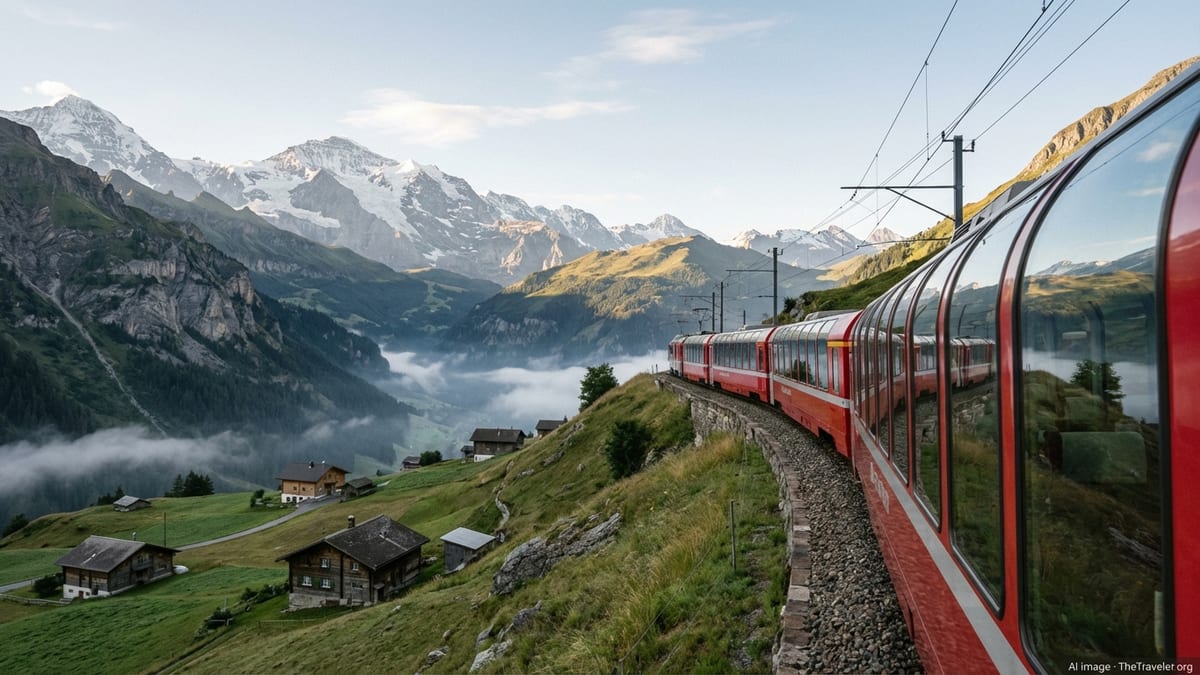
One of the defining features of the Glacier Express is its dedicated panoramic rolling stock. Large floor-to-ceiling windows line the carriages, with glass panels extending into the roofline in many cars so that passengers can look straight up at cliffs, peaks and forests as the train winds through the mountains. Seating is configured to maximise outward views, with both first and second class offering direct sightlines to the landscape.
Onboard information and marketing materials describe the train as a moving observation lounge. Table service dining brings regional Swiss dishes directly to passengers’ seats, while an audio commentary system in multiple languages provides background on key landmarks, engineering works and villages along the route. The atmosphere is closer to that of a scenic cruise than a typical point-to-point rail service.
Travel reports indicate that the slow average speed, around 35 to 40 kilometres per hour, is deliberate. The leisurely pace gives passengers time to photograph landmarks, linger over meals and watch subtle shifts in vegetation and architecture from region to region. For many visitors, the extended duration is part of the appeal, turning the Glacier Express into a full-day highlight rather than a mere transfer between resorts.
With climbing gradients, tight curves and high passes, the route also showcases specialist Alpine rail technology, including rack-and-pinion sections and carefully engineered alignments that maintain comfort even as the train negotiates steep terrain.
Route Highlights From Matterhorn to Engadin
The journey traditionally begins or ends in Zermatt, the car-free village beneath the Matterhorn that has become one of Switzerland’s signature alpine destinations. From here, the train descends the valley to Brig, offering views of steep vineyards, traditional wooden houses and the high peaks of the Pennine Alps. Public descriptions of the route note that this segment forms part of a heavily travelled scenic corridor even for regular regional services.
Beyond Brig, the Glacier Express heads towards Andermatt and the Oberalp Pass, the highest point of the journey at 2,033 metres above sea level. Here, the landscape opens to broad high meadows and snow fields for much of the year. A red lighthouse, installed as a symbolic marker of the nearby source of the Rhine, has become one of the more unexpected visual elements on an Alpine rail line more often associated with rock, ice and forest.
From the pass, the train drops into the Rhine Gorge, sometimes referred to as the “Swiss Grand Canyon” in tourism coverage. Sheer limestone walls, sweeping river curves and dense forests create a very different atmosphere from the open high plateau. Panoramic windows allow passengers to watch the gorge unfold gradually as the line follows the river’s course toward Chur, often cited as the oldest town in Switzerland.
In its final section, the Glacier Express enters the Albula region and the Engadin. Although some of the most famous structures of the Rhaetian Railway network, such as the Landwasser Viaduct, are technically associated with connecting routes, the same valley systems and UNESCO-listed rail landscapes frame the last leg into St. Moritz. Here, lakes, larch forests and wide plateau views contrast with the tight gorge scenery earlier in the journey.
Practical Details for 2026 Travelers
Recent booking information for the 2025 to 2026 seasons indicates that travel on the Glacier Express requires both a valid ticket or rail pass and a mandatory seat reservation. The reservation fee is charged in addition to standard fares or national passes such as the Swiss Travel Pass, and it varies by season, with higher charges typically applying in peak travel months.
Schedules published for the current timetable period show that most passengers opt for the full Zermatt to St. Moritz route or the reverse, but it is also possible to board at intermediate stops such as Brig, Andermatt, Disentis or Chur. Independent travel guides note that some visitors combine a partial Glacier Express segment with regional trains along the same line to create more flexible itineraries or to avoid the busiest departures.
Seating categories on the Glacier Express range from standard second class to enhanced first class and a premium product known as Excellence Class. Publicly available descriptions of Excellence Class detail a bundled service that includes a guaranteed window seat, multi-course fine dining, bar access and dedicated hosts, reflecting a growing trend toward luxury rail offerings in Europe.
Advance booking is widely recommended, particularly for travel during summer and winter holiday peaks, when scenic conditions and resort events drive strong demand. Travel advisories also encourage passengers to check seasonal operating calendars, as maintenance work, weather conditions or timetable adjustments can affect departure times and route options.
A Symbol of Slow Travel in the High Alps
In recent years, the Glacier Express has been increasingly framed as an emblem of “slow travel,” aligning with broader interest in lower-impact, experience-focused tourism. Rather than racing between ski resorts or city hubs, passengers commit a full day to observing changing terrain, architecture and local life along one of Europe’s highest and most intricate rail networks.
Tourism data and media coverage suggest that the train attracts a diverse mix of visitors, from first-time international tourists to repeat rail enthusiasts who return in different seasons to see the landscape under summer light or winter snow. The ability to step off at resort towns along the way and continue by regional services or other scenic trains has helped integrate the Glacier Express into wider Alpine itineraries.
The combination of precise Swiss rail engineering, dramatic natural setting and curated onboard service has turned the Glacier Express into a flagship experience in the country’s tourism portfolio. With its eight-hour timetable, 291 bridges and 91 tunnels, the journey offers both a feat of infrastructure and a lingering window onto some of the most recognisable landscapes in the Alps.