


More news on this day
Greece’s Hellenic Civil Aviation Authority is challenging recent Eurocontrol data on aviation punctuality, arguing that the network manager’s figures exaggerate the level of flight delays attributed to Greek airspace.
Get the latest news straight to your inbox!
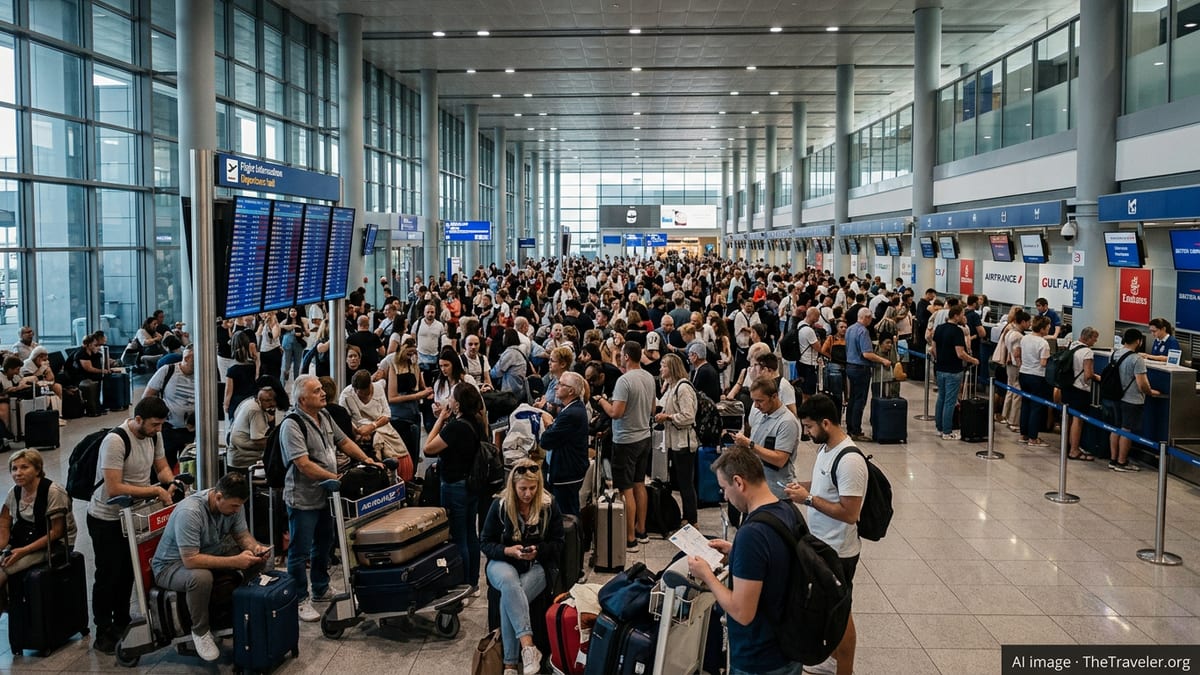
Different Readings of the Same Summer Skies
Recent performance reports from Eurocontrol have drawn attention to rising delays across Europe, identifying Greece as one of several airspace hotspots during peak summer travel. These assessments, based on aggregated network data, suggest that traffic growth combined with capacity and staffing constraints has pushed delay minutes higher for flights operating to, from and over Greece.
The Hellenic Civil Aviation Authority (HCAA) is pushing back on that narrative. According to publicly available information from the agency and domestic coverage of the dispute, Greek regulators argue that Eurocontrol’s network statistics overstate the burden of delays attributable to Greece and do not fully reflect local operational improvements in recent seasons.
The disagreement does not concern the fact that passengers have endured disruptions, particularly in busy July and August periods, but rather how those disruptions are counted and where responsibility is assigned in the European network. As a result, two official datasets are now painting different pictures of Greece’s punctuality performance.
The issue comes at a sensitive time for the country, which is preparing for another heavy summer schedule after several years of rapid traffic growth at major gateways such as Athens, Heraklion and Rhodes.
How Eurocontrol Measures Delay
Eurocontrol, the intergovernmental organisation that coordinates air traffic management across much of Europe, compiles extensive statistics on both en route and airport delays. Its network operations and performance review reports track the number of delayed flights, the minutes of delay per flight and the causes, ranging from weather and air traffic flow management regulations to airport capacity constraints and airline-related issues.
In these reports, a delay can be registered at several points in a flight’s lifecycle. For example, an aircraft departing from a Greek airport with an air traffic flow management slot restriction elsewhere in the network may still see the delay recorded against the Greek segment of the journey. Greek officials argue that this approach can result in more disruption being associated with Greece than is directly caused by local infrastructure or staffing conditions.
Eurocontrol’s publications emphasise the need to look at the network as a whole rather than at individual states in isolation. From this perspective, Greece sits on a busy south east axis that has seen strong traffic growth, with knock-on effects from bottlenecks across neighbouring regions. The methodology is designed to capture those system-wide effects, but it can be at odds with national regulators’ own monitoring frameworks.
This methodological gap is at the heart of the disagreement. While Eurocontrol data show elevated average delay per flight in parts of the network including Greece, HCAA materials highlight more moderate figures when measured against domestic benchmarks.
HCAA’s National Metrics Tell a Different Story
The Hellenic Civil Aviation Authority compiles its own statistics on delays and punctuality at Greek airports and in Greek-controlled airspace. Publicly available summaries indicate that these national figures are framed around actual operations under the control of Greek service providers, excluding disruptions that originate elsewhere in the network.
Greek reporting typically distinguishes between delays arising from local air traffic management or airport capacity and those caused by upstream factors such as weather or congestion in other parts of Europe. When only local causes are counted, the average delay per flight can be significantly lower than in Eurocontrol’s network-wide tallies for the same period.
According to Greek coverage of the current dispute, the HCAA points to its recent data to argue that, although traffic has risen sharply at major Greek airports, locally generated air traffic flow management delays remain comparatively contained. The authority maintains that investments in systems and procedures, along with scheduling coordination with airlines, have limited the impact of congestion during peak hours.
This stance underpins the claim that Eurocontrol’s all-causes figures do not give passengers or policymakers an accurate picture of how Greek infrastructure is performing, especially when compared with other parts of Europe where local constraints contribute more heavily to delay minutes.
What the Discrepancy Means for Travelers
For passengers planning holidays or business trips to Greece, the divergence between Eurocontrol and HCAA data may appear technical, but it has practical implications. Network-level statistics can shape airline scheduling, route planning and contingency measures, while national figures guide infrastructure priorities at specific airports.
If airlines base their planning on Eurocontrol’s more conservative outlook, they may add extra buffer time to rotations involving Greek airports or reassign capacity to other hubs perceived as less congested. That in turn could influence departure times, connection windows and even fare structures on popular leisure routes.
At the same time, the HCAA’s argument that local performance is better than implied by network averages may bolster the case for continued investment in Greek tourism infrastructure rather than emergency restrictions on growth. Regulators and airport operators are likely to use national punctuality indicators when assessing whether runways, terminals and staffing are keeping pace with demand.
For individual passengers, rights to care and compensation in the event of delays remain governed by European rules such as Regulation 261, which are enforced in Greece by the HCAA’s dedicated air passenger rights unit. Those rules hinge on the length and cause of the delay on a specific journey, regardless of how national or European statistics assign responsibility within the wider network.
Pressure for Clearer, Comparable Delay Statistics
The dispute between Greece’s HCAA and Eurocontrol over delay levels comes amid broader scrutiny of aviation performance data across Europe. As capacity tightens and extreme weather episodes become more frequent, airlines, regulators and consumer groups are increasingly focused on transparency around punctuality and disruption.
Observers note that differing methodologies can complicate efforts to compare countries and airports on a like-for-like basis. Network managers need to understand how delays propagate across borders, while national authorities seek to highlight what is under their direct control. When these perspectives are not aligned, passengers may receive mixed messages about how reliable particular destinations or hubs really are.
Calls are emerging in policy discussions for more harmonised reporting standards or at least clearer explanations of how various delay indicators are constructed. That could help ensure that headline figures about congested regions or airports are interpreted correctly and that performance assessments do not inadvertently penalise states that sit at busy junctions in the European network.
As another peak summer season approaches, Greece’s challenge to Eurocontrol’s delay figures underscores the difficulty of measuring punctuality in a tightly interconnected system. For now, travelers weighing a trip to the Greek islands or the mainland will be navigating not only crowded airports, but also competing narratives about just how delayed Europe’s skies really are.