


More news on this day
Greece is heading into another record summer for tourism just as its aviation system shows signs of strain, with recent radar failures, air traffic control bottlenecks and surging demand combining to cause mounting delays at Athens International Airport and popular holiday islands.
Get the latest news straight to your inbox!
Record Tourism Puts Greek Airports Under Pressure
Greece is entering the 2026 peak season on the back of three consecutive years of record tourism, a trend that is driving sustained pressure on airports and airspace. Bank of Greece data and recent analytical reports indicate that international arrivals and travel receipts in 2025 reached all-time highs, with close to 43 million visitors and more than 23 billion euros in tourism revenues. Industry observers note that early 2026 figures point to another strong year, especially on the country’s most popular islands.
The growth is most visible at Athens International Airport, which has consolidated its position among Europe’s busier hubs while also serving as the main gateway to the Greek islands. Airport financial disclosures and sector analysis highlight that expansion works are under way on new apron and terminal facilities, but these projects are not yet complete. As a result, airlines are operating into a system where demand has risen faster than available capacity on the ground and in the skies.
Regional airports serving key summer destinations such as Santorini, Mykonos, Rhodes, Heraklion and Corfu are also seeing sustained traffic growth. Many of these facilities have short runways, limited stands and constrained terminal space, making them especially vulnerable to knock-on delays when schedules are tightly packed. Publicly available performance data and local press coverage suggest that some island airports experience pronounced peaks around midday and late evening, when aircraft rotation times become critical.
Sector analysts point out that while overall European aviation performance improved in 2025 compared with earlier summers, delay levels remained above pre-crisis targets. Greece has consistently featured among the network’s more delay-prone regions during peak weeks, reflecting both its tourism dependence and structural bottlenecks in air traffic management.
Air Traffic Control Bottlenecks and Technical Failures
Beyond sheer demand, Greece’s airspace has emerged as a significant source of delays. Eurocontrol network briefings for 2025 and early 2026 show that Greece has accounted for a notable share of total air traffic flow management delays in Europe, driven primarily by capacity and staffing issues at the Athens Area Control Center. Additional pressure has come from rerouted flights linked to geopolitical tensions in the wider region, which increase traffic density on some east–west corridors.
These systemic challenges have been compounded by recent technical incidents. Local media reports describe a communications outage in early January that temporarily disrupted traffic management over large portions of Greek airspace, as well as repeated issues with radar and navigation equipment serving the Athens region. This week, a failure of an approach radar near Athens led to a reduction in arrival rates, triggering long delays and aircraft holding patterns as controllers reverted to more conservative procedures for safety reasons.
Professional associations representing air traffic controllers have publicly raised concerns about aging infrastructure and the pace of equipment upgrades. Statements and open letters cited in Greek press coverage refer to repeated technical faults and warn that overtime restrictions during the summer could limit the system’s flexibility to absorb spikes in demand. While contingency plans exist, the combination of heavy seasonal traffic, limited staffing reserves and fragile systems increases the likelihood that even minor problems may escalate into significant operational disruptions.
For travelers, these conditions translate into a higher risk of departure slot restrictions, airborne holding and missed connections, particularly at busy times of day. Delays originating in Greek airspace can also propagate across airline networks, affecting flights that merely transit the region en route between other countries.
Where and When Delays Are Hitting Hardest
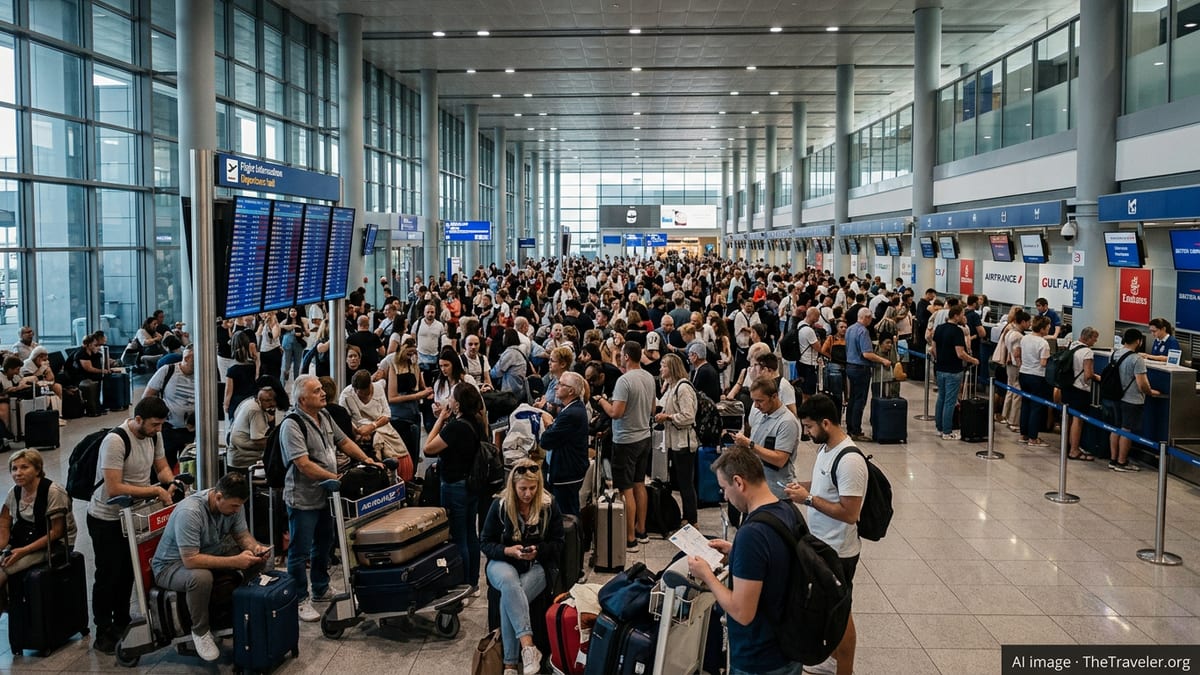
So far this summer, the most visible disruptions have centered on Athens International Airport, which concentrates a large share of Greece’s arrivals, departures and domestic connections. Recent days have seen unusually long waiting times at departure gates and passport control, with some flights departing significantly behind schedule after being held for air traffic flow management reasons linked to the radar outage and ongoing capacity caps.
Island airports are also feeling the effects, although in a different way. Because many operate close to their physical limits during peak hours, any upstream delay in Athens or on inbound European flights makes it harder to turn aircraft around on time. Reports from local tourism outlets and traveler accounts point to aircraft waiting for available parking stands, queues for buses to and from remote stands, and congestion at baggage reclaim areas when several flights land in quick succession.
Time of day is emerging as a critical factor. Morning waves tend to see comparatively smoother flows, while late-morning and early-afternoon periods are most exposed to saturation, especially at the height of the July and August holiday rush. Evening bank departures from Athens toward northern Europe and late-night returns to the islands can also encounter bottlenecks if earlier rotations have run late. Travelers connecting through Athens on tight itineraries are therefore particularly vulnerable.
Weather adds another layer of unpredictability. While Greek summers are generally stable, occasional heatwaves, strong Meltemi winds in the Aegean or localized thunderstorms can force runway configuration changes or temporary suspensions of operations at constrained island airports. In a system already operating near capacity, such disruptions can rapidly generate long backlogs.
What Travelers Should Do Before Leaving Home
Given the mounting signs of strain, travelers heading to Greece this summer are being advised by airlines and travel intermediaries to treat schedules as indicative rather than guaranteed. One practical step is to build extra buffer time into itineraries, particularly for connections through Athens and onward ferry transfers from island airports. Booking at least three hours between an international arrival and an onward domestic flight, and avoiding same-day last-ferry connections where possible, can significantly reduce the risk of missed links.
Travel planners also recommend favoring earlier flights in the day, when feasible. Morning departures are statistically less likely to be affected by accumulated delays, and they provide greater rebooking options if something goes wrong. For itineraries involving multiple Greek islands, it may be wise to anchor the tightest timing at the middle of the trip rather than on the inbound or outbound legs, when disruption is more likely to affect international journeys.
Passengers are further encouraged to monitor their flights closely via airline apps and airport information channels, as Greek airports and carriers generally push schedule changes, gate updates and estimated departure times through these platforms. Completing online check-in early, ensuring contact details are correct and travelling with carry-on luggage only where practical can help make rebooking faster if plans are disrupted.
Travel insurance is another key consideration. Policies that include coverage for missed connections, extended delays and additional accommodation costs can provide a financial safety net in the event of significant disruption. Travelers should review policy terms carefully, noting conditions related to air traffic control strikes, technical failures and weather-related issues, and retain documentation such as boarding passes and delay notifications.
How to Navigate Delays on the Ground in Greece
Once in Greece, a few on-the-ground strategies can help soften the impact of congestion and delays. At Athens International Airport, arriving earlier than the minimum recommended time, especially during peak summer weekends, can reduce stress at check-in and security. Travelers connecting from non-Schengen to Schengen flights, or vice versa, should be prepared for passport control queues and factor walking times between piers into their plans.
On the islands, smaller terminals generally mean shorter distances but less redundancy. When delays arise, facilities such as seating, air conditioning and food outlets can quickly become crowded. Packing water, light snacks and any essential medication in cabin luggage is prudent, particularly when traveling with children or older passengers. Keeping power banks charged helps ensure access to digital boarding passes and real-time updates even if delays stretch into several hours.
Ground transport plans may also need flexibility. Travelers relying on taxis, private transfers or rental cars should communicate updated arrival times as soon as new information is available, as local providers often juggle multiple pick-ups tied to specific flights. For those connecting to ferries, local port authorities and operators typically publish schedule adjustments, but tight turnarounds between delayed flights and fixed maritime departures remain risky.
Finally, travelers are encouraged to stay alert to any changes in operating procedures, such as temporary use of remote stands requiring bus transfers or altered boarding processes during high congestion periods. Remaining patient and informed in an overstretched system can make the difference between a stressful experience and a manageable inconvenience during what remains one of Europe’s most popular summer escapes.