


More news on this day
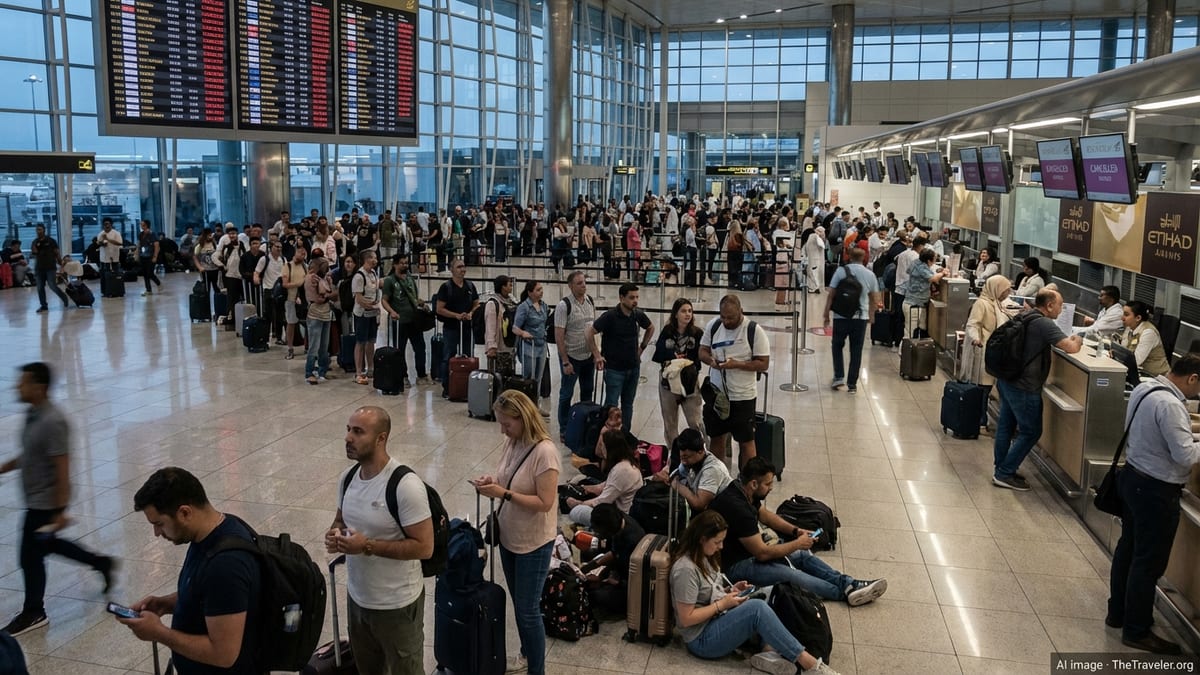
Months after sudden airspace closures and missile strikes upended aviation across the Gulf, travelers passing through Dubai, Jeddah and other Middle Eastern hubs are still facing disrupted schedules, longer routings and lingering uncertainty.
Get the latest news straight to your inbox!
Regional Conflict Keeps Pressure on Gulf Aviation
Commercial aviation across the Middle East has been reshaped this year by the conflict involving Iran, the United States and regional states, which triggered sweeping airspace shutdowns in late February and March. Published reports describe stretches of largely empty skies over Iran and neighboring countries, with Bahrain, Kuwait, Qatar, the United Arab Emirates and others temporarily closing their airspace to civilian traffic as a safety precaution.
Industry analysis indicates that at the height of the crisis in early March, a large majority of scheduled flights to and from Gulf airports were canceled or rerouted. International carriers suspended many services into the region, while Middle Eastern airlines sharply cut operations as key corridors between Europe, Asia and Africa became unavailable. The disruption affected some of the world’s busiest long-haul connections, forcing airlines to redesign routings almost overnight.
Subsequent assessments of the economic fallout suggest that the aviation impact ranks among the most severe shocks since the pandemic period. Analysts point to several intertwined pressures: airspace closures over multiple countries, higher fuel consumption on detours via the Caucasus or southern Mediterranean, and reduced airport capacity as hubs coped with displaced aircraft, crew and passengers.
Dubai: Global Superhub Under Strain
Dubai International Airport, which typically ranks among the busiest global hubs for international passengers, has been a focal point of the turmoil. Publicly available timelines show that Dubai’s airspace was closed more than once in March following Iranian missile and drone activity, with flights temporarily suspended and arriving aircraft diverted to alternative airports in the UAE and beyond.
Data referenced in aviation briefings and air traffic studies indicate that Gulf carriers, including the Dubai-based giant Emirates, saw daily flight movements collapse from well over a thousand combined departures and arrivals to a fraction of normal levels in the first days after the closures. Separate analysis from airline and freight specialists notes that all major UAE airports, from Dubai International to Al Maktoum, Abu Dhabi and Sharjah, have remained operational but are subject to routing constraints, congestion and heightened security procedures.
By early summer, reports from travelers and operational summaries suggest that Dubai has clawed back a large portion of its network, yet schedules remain more fragile than before the crisis. Flight paths between Europe and Asia often trace elongated arcs around restricted zones, adding time in the air and narrowing turnaround windows on the ground. Airlines are also working with shorter planning horizons, revising timetables as regional risk assessments change.
Saudi Gateways Face Rolling Disruptions
Saudi Arabia’s main international airports, including Jeddah, Riyadh and Dammam, have also been swept up in the regional aviation shock. Freight and logistics snapshots describe Saudi airspace as open but emphasize that all major airports have been affected by shifting routings and capacity constraints linked to the broader Middle East crisis.
Jeddah, a key entry point for religious travel and a growing transfer hub, has faced intermittent disruption as airlines thread flights through approved corridors and adjust connections that once relied heavily on overflying neighboring states. Passenger-facing accounts describe rapidly changing departure boards, with some services departing on time while others are delayed, re-timed or consolidated as carriers juggle aircraft and crew.
Saudi-based airlines have generally maintained more of their scheduled capacity than some Gulf peers, according to humanitarian logistics and industry monitoring documents, but often with modified routings and reduced frequencies on sensitive sectors. International airlines serving Jeddah and other Saudi gateways continue to recalibrate their presence, balancing demand for essential travel with operational and insurance constraints linked to flying near conflict zones.
Airspace Corridors, Rerouting and Longer Journeys
One of the most visible consequences for passengers transiting Dubai, Jeddah and other regional hubs has been the lengthening of many long-haul journeys. With airspace over Iran and several neighboring countries restricted or closed for extended periods, airlines have rerouted flights via alternative corridors over the Caucasus, Central Asia or the eastern Mediterranean, or by hugging the southern rim of the Arabian Peninsula through Saudi and Egyptian airspace.
Aviation consultancy reports detail how the loss of direct Gulf overflight options has forced carriers to adopt more fuel-intensive paths, increasing operating costs at a time when jet fuel prices are already elevated. The cumulative impact is reflected in longer block times and tighter aircraft utilization, which can cascade into delays when rotations are interrupted by weather, crew duty limits or renewed security alerts.
The squeeze on capacity has also spilled into cargo markets. Freight bulletins for the Middle East describe tight belly-hold space on the passenger flights that are still operating, combined with higher demand for dedicated freighters to maintain supply chains linking Asia, Europe and Africa. While Gulf carriers have restored a significant share of their pre-crisis operations, these publications caution that schedules remain “variable” and subject to late changes.
Recovery Still Uneven as Summer Travel Peaks
As the peak northern summer travel season unfolds, publicly available data and traveler reports point to a patchy recovery across the region’s airports. Some hubs, including Dubai, Doha and Riyadh, have regained much of their connectivity but continue to operate under dynamic routing rules and heightened security postures. Others, such as airports in Iraq and parts of the Levant, remain heavily constrained or offer only limited commercial services.
Industry bodies note that forward schedules into the broader Middle East have been reduced, with airlines trimming planned capacity for the summer months compared with pre-crisis projections. At the same time, carriers based outside the region have added seats on alternative routings to partially compensate for lost Gulf connectivity, contributing to high load factors and limited last-minute availability on many Europe–Asia and Europe–Australia itineraries.
For travelers, the result is a more unpredictable experience when itineraries touch Dubai, Jeddah or other Gulf hubs. Public guidance from airlines and travel advisories stresses the importance of checking flight status frequently, allowing extra time for connections, and being prepared for rerouting on relatively short notice as airspace conditions and security assessments evolve.