


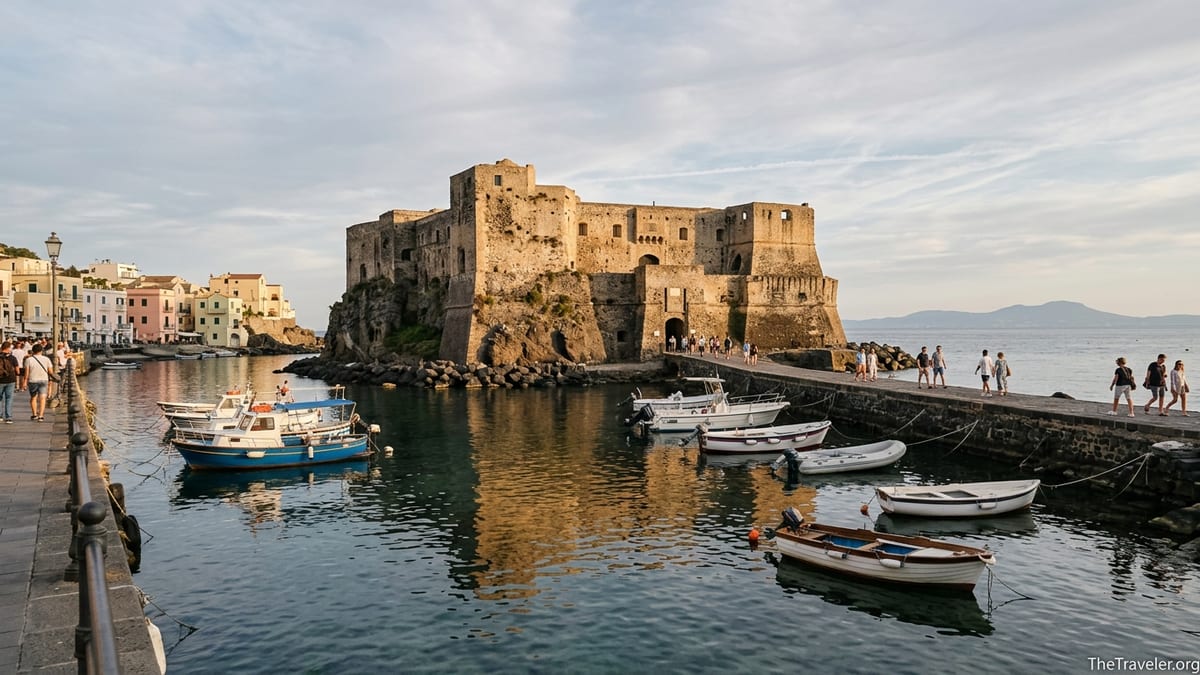
Rising from a rocky islet at the eastern edge of Ischia and linked to the main island by a narrow stone causeway, Castello Aragonese is the island’s most recognizable landmark. For many travelers planning a few days between Naples, Capri and the Amalfi Coast, the question is not whether the castle looks impressive in photos, but whether it actually deserves half a day of a hard-won itinerary. The short answer: for most visitors, yes, Castello Aragonese is absolutely worth it, but the value of the visit depends on your interests, mobility and how much time you have on Ischia.
Get the latest updates straight to your inbox!
What Makes Castello Aragonese Special
Castello Aragonese is not just a single fortress but a fortified mini-city on a volcanic rock, with layers of history stacked on top of one another. The first fortifications date back over 2,000 years, with Greek and later Roman settlements on the islet, while the structure you see today was largely shaped by Alfonso of Aragon in the 15th century. Walking up from the causeway, it quickly becomes clear that this was once a self-contained world with churches, convents, gardens, prison cells and defensive bastions, all squeezed into about 2 kilometers of pathways.
The sense of isolation is part of the appeal. Although Ischia is already quieter than Capri or Positano in high season, the moment you step onto the stone bridge to the castle the traffic and beach clubs feel distant. Once inside, long stretches of the route are open-air, with stone stairways winding between terraces, small chapels and thick medieval walls. For many travelers, it feels less like touring a single monument and more like exploring a vertical village carved into rock.
Another reason the castle stands out is that it anchors the view in almost every postcard of Ischia. From the seafront at Ischia Ponte you see the islet framed by fishing boats and small cafes; from the castle walls you look back toward pastel houses, anchored yachts and the green flanks of Monte Epomeo. If you are someone who appreciates both history and landscape in one experience, it is difficult to find a more concentrated symbol of Ischia than Castello Aragonese.
Travelers who have visited recently often describe it as the single most memorable stop on the island, outranking even famous thermal parks, precisely because it offers such a strong sense of place. You will not find luxury boutiques or glamorous beach clubs inside; what you get instead is raw stone, sea air and views that explain why Ischia has attracted settlers and invaders for millennia.
Practical Details: Opening Hours, Tickets and How Long to Allow
From a practical perspective, Castello Aragonese is easy to fit into most itineraries. The official site states that the castle is open seven days a week all year from 9 a.m. until sunset, with the last ticket typically issued about an hour and a half before closing. Closing time changes with the season, so in June and July you can generally stay until early evening, while in late autumn the site closes earlier. There is an annual maintenance closure beginning around 7 January and running until early March, so winter travelers should check dates carefully before planning a visit.
Standard adult admission is around 15 euros at the ticket office at the foot of the causeway. Reduced tickets are available for children and teens aged roughly 10 to 18, and travelers over 70 often pay a slightly lower senior rate. Young children under 10 usually enter free with an adult. Residents of Ischia and school groups benefit from further discounts, but for most international visitors planning a short stay, budgeting 15 euros per person is realistic.
In terms of timing, expect the visit to take at least 90 minutes if you move steadily. The official visitor route is close to 2 kilometers long and includes multiple staircases and detours to terraces and chapels. Travelers who like to linger for photos, stop for a coffee or light lunch at the terrace cafe, or read interpretive panels should set aside 2 to 3 hours. A common pattern for visitors staying in Ischia Porto is to arrive mid-morning, spend a couple of hours exploring, then walk back along the waterfront for lunch in Ischia Ponte or by the port.
There is no strict need to prebook standard entry; you buy your ticket at the base of the bridge and then take a lift carved into the rock up to the main level before continuing on foot. Guided tours in Italian or English may be available at fixed times or on request for groups, though schedules and languages vary by season. If having in-depth commentary is important to you, it is worth contacting the castle’s information office a few days in advance or asking your hotel to check local tour providers.
Highlights Inside: Views, Chapels, Gardens and Dark Corners
Most visitors come for the views, and those start early. After the elevator ride, you emerge onto terraces that offer sweeping panoramas across the Bay of Naples, with Capri often visible on clear days, and Procida and Vivara closer at hand. Looking down, you see tiny beaches and coves that wrap around the base of the rock and the arc of Ischia’s eastern shoreline. Photographers often choose late afternoon for the soft side light that textures the stone walls and makes the pastel houses of Ischia Ponte glow.
Beyond the views, the route threads past several historic and atmospheric sites. These include the Cathedral of the Assumption, which still shows damage from a British naval bombardment in the early 19th century, and the convent of the Poor Clares with its striking circular chamber where deceased nuns were once laid out to decompose. There is also a small but intense exhibition of torture instruments that some visitors find disturbing but historically revealing, especially for teens studying medieval or early modern Europe.
Light and shadow shape the experience. One moment you are walking through sun-bleached courtyards, the next you are ducking into cool stone passageways or small chapels lined with memorials. Several gardens, including terraces planted with Mediterranean shrubs and flowers, soften the severity of the fortifications. In spring and early summer, bougainvillea, geraniums and aromatic herbs create a more romantic atmosphere than the bare stone might suggest.
For travelers who enjoy slower travel, simply finding a quiet bench and listening to the wind and sea can be a highlight. Because the route is largely one-way and spread out, even on busy August afternoons you can usually step aside from the main flow of visitors and find a pocket of calm. Many travelers say they left feeling they understood Ischia better, having seen not just the beaches and spas but also the island’s role as a defensive outpost and shelter during centuries of conflict.
Is It Worth It Compared With Other Things to Do on Ischia?
Whether Castello Aragonese is “worth it” depends partly on what draws you to Ischia. The island is famous for its thermal parks such as Poseidon, Negombo or Castiglione, as well as seaside villages like Sant’Angelo and hikes up Monte Epomeo. If you are on Ischia for three or four days, it makes sense to balance at least one half day of history and views at the castle with thermal bathing and time by the sea.
Travelers who have visited in recent seasons often rank the castle in their top two or three experiences on the island. A typical itinerary for a two-day stay might include a full day at a thermal park, then a second day split between the castle and exploring the lanes and waterfront of Ischia Ponte, with dinner overlooking the causeway at sunset. In that scenario, the effort to reach and explore Castello Aragonese usually feels more than justified, especially as you can combine it with relaxed cafe time nearby rather than racing from sight to sight.
If you are only on Ischia as a day trip from Naples, Sorrento or Capri, you will need to be more selective. A common pattern is to arrive at Ischia Porto late morning, head straight to Castello Aragonese by bus or taxi, spend a couple of hours exploring, then return to the port area or another nearby beach before catching an afternoon or early evening ferry. In that case, the castle essentially becomes the centerpiece of your brief time on the island. If your primary interests are history, landscape and a distinct sense of place, this is likely to feel like the right call. If you are more drawn to spas and swimming, you might instead choose to spend your limited hours at a thermal complex.
From a cost perspective, the castle is reasonable compared with other major attractions in the region. A single day at a full-service thermal park with pools, loungers and sea access can easily cost 45 to 60 euros per person in high season, while a castle visit will often come to less than 20 euros including a coffee or snack at the onsite terrace cafe. Weighing the relative cost, time and type of experience can help clarify what “worth it” means for your particular trip.
Access, Mobility and When It Might Not Be Ideal
The castle is reachable from Ischia Porto in about 15 minutes by local bus or taxi, or roughly 25 to 30 minutes on foot along the seafront promenade. Once you reach the base of the rock, an elevator inside the cliff face carries you up to the main level. From there, however, the route includes a significant number of steps, slopes and uneven stone paths. Signage and information from the castle’s management emphasize that the walking route is almost 2 kilometers long and that comfortable shoes are strongly recommended.
For visitors with limited mobility, this is where the experience may be less rewarding. People who use wheelchairs can access only certain areas, such as the Terrace of the Immaculate Conception and the Church of the Immaculate Conception, and only with staff assistance that must be booked at least 24 hours in advance. Admission for wheelchair users and their companion is generally free, which is a thoughtful policy, but the restricted access and challenging terrain mean that those with serious mobility issues should carefully consider whether the visit will be enjoyable.
Families with young children often find the castle manageable but need to be mindful of steep drops, low walls and the lack of shade in some sections. Lightweight strollers can be difficult to push up long stone ramps and stairs; many parents choose to use carriers instead and allow older children to walk. On hot days, the exposed terraces can feel intense by midday, so visiting early morning or late afternoon reduces both heat and crowds.
Weather also plays a role in how worthwhile the visit feels. On clear days, the views are superb, and the open-air design is a major plus. During heavy rain or strong winds, however, walking the exposed ramparts can be uncomfortable. In shoulder season months like April or October, bring a light jacket, as wind on the terraces can make it feel cooler than the town below.
Planning Your Visit: Timing, Food and Realistic Expectations
To get the most value from your time at Castello Aragonese, think about timing first. Morning visits work best if you are staying nearby in Ischia Ponte or Ischia Porto. You can have breakfast at your hotel or a cafe by the harbor, walk or bus to the castle for a 9 or 9:30 a.m. entry, and be finished around lunchtime. This approach avoids the heat, especially in July and August, and typically means less crowding on the narrow paths.
Late afternoon is ideal if you are chasing golden light and atmospheric photos. In summer, you might enter around 4 or 5 p.m., explore the complex as the sun lowers over the bay, then watch the town lights flicker on as you descend. Keep an eye on the posted closing time at the entrance, since the last tickets are sold about 90 minutes before sunset, and the staff will gently shepherd visitors out as closing approaches.
Food and drink options inside the castle are simple but scenic rather than gourmet. The terrace cafe near the top of the accessible area offers light lunches, salads, panini, desserts and drinks beneath a pergola with extensive sea views. Prices are higher than in a basic bar in Ischia Ponte but broadly in line with Italy’s tourist sites: you might pay a few euros more for a glass of local wine or a plate of bruschetta in return for the setting. Many travelers choose to have a coffee or aperitivo there, then enjoy a more substantial meal back in town.
Set expectations accurately and the visit is far more likely to feel “worth it.” Castello Aragonese is not a polished museum with interactive displays in every room. Instead, it is a mix of ruins, restored spaces, simple exhibits and raw landscape. Information panels provide context, but much of the enjoyment comes from wandering, pausing at viewpoints and imagining the lives of the people who once lived here. If you arrive ready to explore at your own pace rather than expecting a tightly curated experience, you are more likely to leave satisfied.
Who Will Love Castello Aragonese Most
History enthusiasts will naturally get a lot from a visit. The castle’s long timeline, from ancient Greek settlement through medieval fortification and early modern sieges, makes it a compact case study in Mediterranean history. Students and curious travelers can stand in the cathedral and trace the impact of 19th century naval warfare, or wander through cloisters and think about monastic life on an isolated rock. The small areas devoted to prison cells and torture devices, while somber, give a visceral sense of the harsher parts of that history.
Photographers and landscape lovers are another group who rarely regret the trip. The stone causeway leading to the castle is a natural leading line, and changing tides and light conditions mean that even a short visit yields a variety of compositions. From the upper terraces, long views across the sea toward Capri, Procida and the distant mainland reward anyone willing to linger for shifting clouds and boats passing below.
Couples often choose the castle as a romantic backdrop, particularly around sunset. It is not unusual to see small wedding photo shoots or elopement ceremonies on the terraces. If you are staying in Ischia for a honeymoon or anniversary, timing a visit for late afternoon and then walking back to Ischia Ponte for dinner by the water can be a memorable way to structure a day.
On the other hand, travelers who are primarily interested in shopping, nightlife or beach clubs may find the castle less compelling than Ischia’s other offerings. There are no designer boutiques within the walls, and while the site is atmospheric after dark in photos, it typically closes around sunset rather than staying open late into the evening. For such visitors, a brief photo stop from Ischia Ponte might suffice, leaving more time for the island’s bars, restaurants and seaside promenades.
The Takeaway
Castello Aragonese is one of those places where the reality matches, and often exceeds, the photographs. It offers a vivid blend of history, landscape and atmosphere at a relatively modest cost and with straightforward logistics from anywhere on Ischia. For most travelers who can comfortably manage stairs and uneven paths, the castle will be a highlight of their time on the island, weaving together stories of monks, soldiers and islanders with soaring views over the Bay of Naples.
That said, the site is not ideal for everyone. Travelers with serious mobility issues, those visiting in harsh weather, or visitors whose interests center almost entirely on spa comforts and nightlife may come away feeling they could have used their hours differently. The key is to be honest about your priorities and physical comfort level before committing your limited vacation time.
If your image of Ischia is more than just sun loungers and thermal pools, and you want at least one experience that connects you to the island’s deeper past, then yes, Castello Aragonese is very much worth including in your trip. Plan around the heat, wear good shoes, bring a camera and a bit of curiosity, and the rock-bound castle at the edge of Ischia will almost certainly reward the climb.
FAQ
Q1. How much time do I need to visit Castello Aragonese in Ischia?
Most visitors are satisfied with 1.5 to 2 hours, but history and photography enthusiasts often stay closer to 3 hours to explore at a relaxed pace.
Q2. What does it cost to visit Castello Aragonese?
Standard adult tickets are around 15 euros, with reductions for children, teenagers and visitors over 70, and free or discounted entry for young children and local residents.
Q3. Is Castello Aragonese suitable for visitors with limited mobility?
The main route includes many steps and slopes. Wheelchair users can access only limited areas with staff assistance booked in advance, so it may not be ideal for all.
Q4. Can I visit Castello Aragonese all year round?
The castle is generally open daily from 9 a.m. until sunset throughout the year, but it usually closes from early January until early March for annual maintenance.
Q5. Do I need to book tickets for Castello Aragonese in advance?
For standard entry, advance booking is usually unnecessary. You can buy tickets at the entrance, though guided tours or group visits may require prior arrangements.
Q6. What is the best time of day to visit Castello Aragonese?
Early morning is best for cooler temperatures and fewer crowds, while late afternoon offers the most atmospheric light and beautiful sunset views over the bay.
Q7. Are there places to eat or drink inside Castello Aragonese?
Yes, there is a scenic terrace cafe inside the complex serving light meals, snacks and drinks, though many visitors choose to have a main meal in nearby Ischia Ponte.
Q8. Is Castello Aragonese good for children?
Children who enjoy exploration and views often like the visit, but parents should be prepared for stairs, uneven paths and some exhibits that may be too intense for younger kids.
Q9. How do I get to Castello Aragonese from Ischia Porto?
You can walk along the seafront in about 25 to 30 minutes, or take a local bus or taxi, which usually takes around 10 to 15 minutes depending on traffic.
Q10. Is a visit to Castello Aragonese worth it on a short day trip to Ischia?
If your interests lean toward history, architecture and panoramic views, the castle is one of the most rewarding single stops you can make during a brief visit.