


Combining Haarlem’s historic streets with the wide sandy beach at Zandvoort aan Zee makes an ideal independent day trip from Amsterdam. Fast trains mean you can stroll Haarlem’s Grote Markt in the morning and have your feet in the North Sea sand by early afternoon, all without a car.
Get the latest updates straight to your inbox!
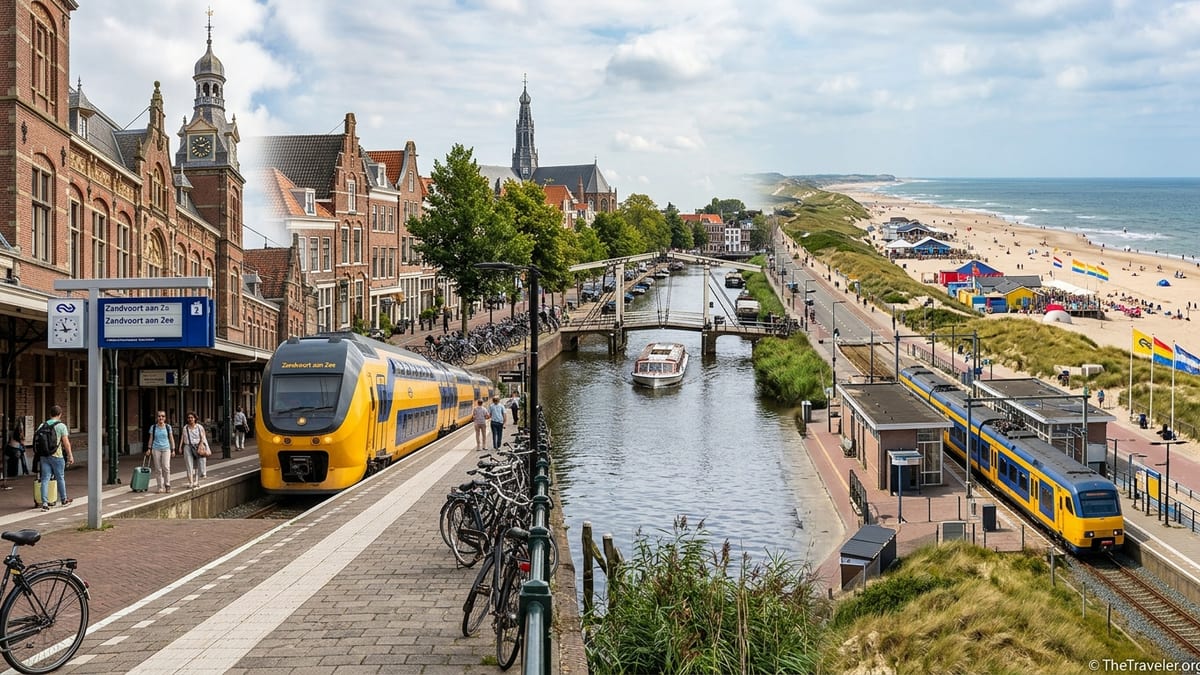
Train logistics from Amsterdam to Haarlem and Zandvoort aan Zee
Fast Nederlandse Spoorwegen (NS) trains run frequently from Amsterdam Centraal to Haarlem, with the journey taking roughly 15 to 20 minutes on Intercity and Sprinter services. From Haarlem to Zandvoort aan Zee the direct Sprinter continues in around 10 to 15 minutes. This makes it realistic to see both Haarlem and the seaside in one day, even with a relaxed pace.
On a typical weekday daytime schedule, there are usually at least four trains per hour from Amsterdam Centraal to Haarlem, often more when you include both Intercity and Sprinter options. Between Haarlem and Zandvoort aan Zee, Sprinters usually run two times per hour outside the peak summer period. Timetables can change, so for travel after November 2026 it is important to check exact departure times and platform information using the official NS travel planner or station departure boards before you travel.
Travel times are similar during the day and in the evening, although late-night frequency may drop. If you are returning to Amsterdam after dinner in Haarlem or Zandvoort aan Zee, expect slightly fewer trains later in the evening, particularly from Zandvoort. Always allow a buffer of at least one train when catching a last connection back to Amsterdam Centraal.
Both Haarlem and Zandvoort aan Zee stations are small and easy to navigate. Haarlem station is a historic Art Nouveau building with clear signage for trams and buses outside, while Zandvoort aan Zee station is just a short walk straight down to the beach. Accessible lifts or ramps are present at Amsterdam Centraal and Haarlem, and there are low-floor trains on most services, which helps travelers with luggage, strollers or mobility impairments.
Tickets, OVpay, off-peak savings and NS ticket types
NS offers several ways to pay for the relatively short journeys between Amsterdam, Haarlem and Zandvoort aan Zee. The simplest for many visitors is OVpay, which lets you check in and out with a contactless bank card, credit card or mobile wallet directly at the gate or card reader. You hold the same card to check in at the start and check out at your destination. This charges you standard second class fares without needing to buy a paper ticket or OV-chipkaart.
Traditional OV-chipkaarten are still accepted. These are reloadable smartcards that must have a minimum balance loaded before you can travel. For most short-term visitors who do not already own a card, OVpay or an NS e-ticket on your phone is usually more practical than buying a personal OV-chipkaart. NS e-tickets are bought online or via the official NS app and are tied to a specific journey or day. You display a barcode on your phone when passing gates or during inspections.
For pricing, a one-way journey from Amsterdam Centraal to Haarlem in standard second class is typically under 10 euros for an adult when paid via OVpay or a standard full-fare ticket. Haarlem to Zandvoort aan Zee is cheaper again as the distance is shorter. Exact prices change periodically due to fare revisions, so you should check current fares in the NS journey planner by entering your exact travel date. Off-peak discount tickets, such as NS off-peak day deals purchased in advance or used with Dutch subscription products, can reduce costs substantially for people who can avoid weekday rush hours.
Return versus separate journeys is less important on NS than in some countries because fares are mostly calculated per single trip. You will usually pay roughly the same total whether you buy two singles or a same-day return, especially when paying with OVpay. For couples or small groups, it can be cost effective to look for NS group ticket promotions or off-peak group e-tickets that allow several people to travel together after the morning rush hour. These often require everyone in the group to take the same trains and at least one member to register online, so read the specific conditions before committing.
Summer service increases, Circuit Zandvoort events and disruptions
In warm weather, particularly during school holidays or on very hot weekends, NS often increases the number of Sprinter services on the Haarlem to Zandvoort aan Zee line. Additional trains help cope with large numbers of beachgoers traveling from Amsterdam and elsewhere in the Randstad region. You may see more frequent departures and longer trains on days when the forecast promises strong sunshine and higher temperatures.
Circuit Zandvoort, the Formula 1 racetrack near the town, can significantly influence timetables when major racing events or festivals are held. On race weekends such as a Dutch Grand Prix, NS typically runs extra trains to Zandvoort aan Zee and crowds at Haarlem and Zandvoort stations are far heavier than normal. At the same time, temporary access restrictions, one-way walking routes or last-minute timetable changes may be introduced to manage safety and capacity.
Because of this, anyone planning a relaxed beach and Haarlem day trip should check the event calendar for Circuit Zandvoort for their travel dates. If a major event is scheduled, you may prefer a different day or be ready for crowded trains, queues at ticket gates and busy platforms. There can also be temporary rail works on the Zandvoort branch line, occasionally replaced by buses. NS announces planned engineering works well in advance, but details can change, so always re-confirm close to your date of travel.
On extremely busy summer days, staff at Amsterdam Centraal or Haarlem may direct passengers to specific platforms or carriages to spread crowds more evenly. Factor in a few extra minutes to pass ticket gates and navigate the station, especially if you are traveling with a family or luggage. If your priority is a quieter trip, consider traveling on weekdays outside Dutch school holidays or arriving at the beach earlier in the day when trains and sand are less crowded.
Haarlem walking route: Grote Markt, churches, streets and museums
From Haarlem station it is roughly a 10 to 15 minute walk into the historic center. A pleasant route follows Stationsplein and Kruisweg before narrowing into pedestrian streets leading to Grote Markt, the main square. Here you will find the imposing St Bavo Church, the town hall and a cluster of cafe terraces that make a logical coffee stop before you explore further.
St Bavo Church, officially the Grote of St Bavokerk, usually keeps visitor opening hours on most days, with a modest admission fee that is often just a few euros per adult, while children may be discounted or enter free up to a certain age. Exact times and prices vary by season and weekday, so you should check close to your visit, but it is realistic to plan a short visit inside to admire the organ that once impressed Mozart and the vaulted Gothic ceiling. Services and concerts can limit tourist access at certain times.
From Grote Markt you can wander into the narrow shopping streets around Gouden Straatjes, the so-called Golden Streets of Haarlem, where small boutiques and cafes line cobbled lanes. A short walk brings you to the canals at Spaarne, where you can follow the water for attractive views of historic warehouses and gabled houses. If you are interested in Haarlem’s famous hofjes, or hidden courtyards, some are open to quiet visitors during the day, provided you respect that they are residential spaces and observe any posted rules.
Haarlem’s main museums reward a bit of planning. The Frans Hals Museum focuses on Dutch Golden Age portraiture and often combines its historic collection with modern or thematic exhibitions. Admission is in the range of a mid-teens euro price for adults. Teylers Museum, near the Spaarne, is one of the oldest museums in the Netherlands and presents art, fossils, scientific instruments and period interiors, usually at a similar price level. Both museums offer free or reduced access for children and discount cards such as the Museumkaart. Opening hours are generally from late morning until late afternoon, but specific times differ by day and season, so check official information for your exact date.
From Haarlem to Zandvoort: station access, beach clubs and dunes
When you are ready to leave Haarlem, Sprinter trains depart from the main station to Zandvoort aan Zee in roughly 10 to 15 minutes. The journey is short, and there is no need to reserve seats. Simply check in at the gates with OVpay or present your ticket, then ride the Sprinter through the dunes until it terminates at Zandvoort aan Zee station. From the station, it is a straight walk of just a few minutes down wide streets to the main beachfront promenade and sand.
The beachfront is lined with a mix of permanent buildings and seasonal beach clubs, known locally as strandpaviljoens. These pavilions often open in early spring and stay up until autumn, though the exact dates depend on municipal rules and individual businesses. Many operate on a seasonal permit system that requires them to remove their structures during the winter, so earlier in the year you may find fewer facilities open. In the main summer season, you can expect a dense row of options where you can rent a sunbed, order drinks and meals, or simply enjoy table service with sea views.
Public access to the beach itself is free. You can spread a towel on the sand at no cost, though you pay extra if you wish to rent loungers or windbreaks from beach clubs. Behind the main beachfront, signposted paths lead into the surrounding dune areas, which form part of protected nature reserves. Cycling and walking routes wind through these dunes, but there are restrictions on leaving designated paths and on bringing dogs or lighting fires. Signs at access points explain local rules in Dutch and often in English or with pictograms.
In addition to the main beach, quieter stretches lie slightly north or south of the central area. If you walk 10 to 20 minutes along the coast, you will generally find more space, at the cost of being further from facilities and lifeguard posts. This suits travelers who want a more tranquil feel, although families with young children may prefer staying closer to the main pavilions and supervised zones.
Seasonal swimming conditions, safety and practicality of renting bikes
The North Sea at Zandvoort is swimmable in summer, although water temperatures remain cooler than Mediterranean resorts. In high season, typical surface temperatures might reach the high teens in Celsius on warmer days, but conditions can change quickly with wind direction and weather systems. Even in August the water often feels brisk to those used to warmer seas, so many swimmers limit themselves to shorter dips.
Safety flags and lifeguard posts line the main beach during the official bathing season, which usually runs from late spring into early autumn. Lifeguards monitor rip currents and may advise people to move to safer areas on windy days. Red, yellow and other warning flags indicate whether swimming is allowed, discouraged or prohibited. Strong westerly winds can create waves that are fun for confident swimmers and surfers but may be challenging for small children.
Bicycle rentals are available both in Haarlem and Zandvoort, including at or near the main train stations. Typical rental prices often fall in the range of around 10 to 20 euros per day for a basic city bike, with higher prices for e-bikes. A deposit or identification document is commonly required, and some shops may place a temporary hold on a credit card. Locks are always provided, and it is essential to use them, as bicycle theft remains a risk in popular urban and coastal areas.
Designated cycling paths lead from Haarlem into the surrounding dunes and towards the coast, and there is an extensive network in the Zandvoort area as well. However, for a simple day trip that combines city sightseeing and beach time, a bike is not essential. Trains between Haarlem and Zandvoort aan Zee are frequent and fast, and distances inside each town are walkable for most visitors. Renting bikes makes more sense if you want a longer ride through the dunes, visit nearby villages or prefer cycling over walking for several hours.
One-day and two-day itineraries with budgets and accommodation
A realistic one-day itinerary could start with a morning train from Amsterdam Centraal around 9:00, arriving in Haarlem by about 9:20. You might spend the late morning exploring Grote Markt, visiting St Bavo Church and walking the canals. After lunch at a cafe in the center, perhaps between 12:00 and 13:30, you can continue with a museum visit, such as the Frans Hals Museum or Teylers Museum, allowing 1.5 to 2 hours. Around mid-afternoon, take a Sprinter to Zandvoort aan Zee for beach time until early evening, before returning to Haarlem or directly back to Amsterdam.
For a couple traveling in standard second class without discounts, a sample budget for this one-day trip might include return train fares between Amsterdam and Haarlem plus Haarlem and Zandvoort totaling a few tens of euros, two museum admissions in Haarlem at mid-teens per person each, a cafe lunch and a simple dinner near the beach, plus optional sunbed rental. This can easily come to a low hundreds of euros by the time you add drinks and incidental costs. A family with two children might spend more on food but save on museum tickets if children qualify for free or reduced admission.
A two-day version allows a slower pace and an overnight stay. One approach is to spend the first day entirely in Haarlem, including multiple museums and an evening meal, then sleep in Haarlem and dedicate the second day to Zandvoort’s beach and dunes. Alternatively, you could stay in Zandvoort for a seaside evening and sunset after a day in Haarlem. Accommodation prices in Haarlem and Zandvoort generally undercut central Amsterdam, but during peak summer and major events, Zandvoort hotel and guesthouse rates can rise sharply, sometimes approaching Amsterdam levels.
As a rough guide, mid-range hotels in Haarlem might cost less than comparable rooms in Amsterdam’s canal belt on the same summer weekend, while basic guesthouses and bed and breakfasts in Zandvoort can offer better value outside the high season. In late July and August, or on race weekends, both Haarlem and Zandvoort see prices climb. Booking earlier and avoiding peak event dates can keep costs more manageable. For budget-conscious travelers, pairing a hotel in Haarlem with day trips by train to Zandvoort can deliver a coastal experience without paying top rates for a beachside room.
Accessibility, winter trips and who this combined route suits best
For accessibility, this route has several advantages. NS trains serving Amsterdam, Haarlem and Zandvoort usually include low-floor coaches and designated spaces for wheelchairs and strollers. Stations provide elevators or ramps and tactile paving, though it is still wise to check station facilities in advance if you have specific mobility needs. In Haarlem’s old town, cobblestones and uneven paving can make progress slower, but most main streets and squares are reachable, and larger museums are equipped with lifts and accessible toilets.
Weather can reshape your plans. On rainy or windy days, you might shift more time to Haarlem’s indoor attractions: extended visits to the Frans Hals Museum or Teylers Museum, longer coffee breaks around Grote Markt, or a canal-side restaurant lunch. If beach weather fails to materialize, Zandvoort still offers dune walks and seafront strolls, but swimming and sunbathing will be less appealing. Bringing a light waterproof jacket and extra layers, even in summer, is sensible along the North Sea coast.
In winter, combining Haarlem and Zandvoort in a single day is still feasible from a transport perspective, but the experience changes. Beach pavilions are fewer or entirely removed, swimming is not realistic for most people due to water temperature, and strong winds are common. A winter trip might focus almost entirely on Haarlem, with only a short side visit to Zandvoort for a bracing walk on the sand and views of the rough sea before returning inland. Short daylight hours also affect how much you can comfortably fit into one day.
For beach lovers, a summer day anchored around Zandvoort with a shorter morning or evening stop in Haarlem works well. Families might appreciate starting with Haarlem’s compact, walkable center and ending with a few hours of sandcastle building or paddling at Zandvoort, while keeping travel times short for tired children. Culture-focused travelers could base themselves in Haarlem, devoting serious time to its museums and architecture while adding Zandvoort as a light, scenic contrast. For anyone seeking a quieter alternative to Amsterdam, staying in Haarlem or Zandvoort with day trips to the capital can offer the best of both worlds: access to big-city sights and nightlife combined with calmer evenings and lower accommodation costs.