


Hyogo Prefecture rarely tops first-time Japan itineraries, yet it sits in a pivotal position between Osaka, Kyoto and western Japan, combining major cities, World Heritage landmarks, mountain temples, hot spring towns and a long coastline on both the Seto Inland Sea and the Sea of Japan. Well-connected by shinkansen and limited express trains, Hyogo can be a simple day-trip destination from Osaka or Kyoto, or the backbone of a week-long regional journey that feels far removed from the crowds of central Kyoto.
Get the latest updates straight to your inbox!
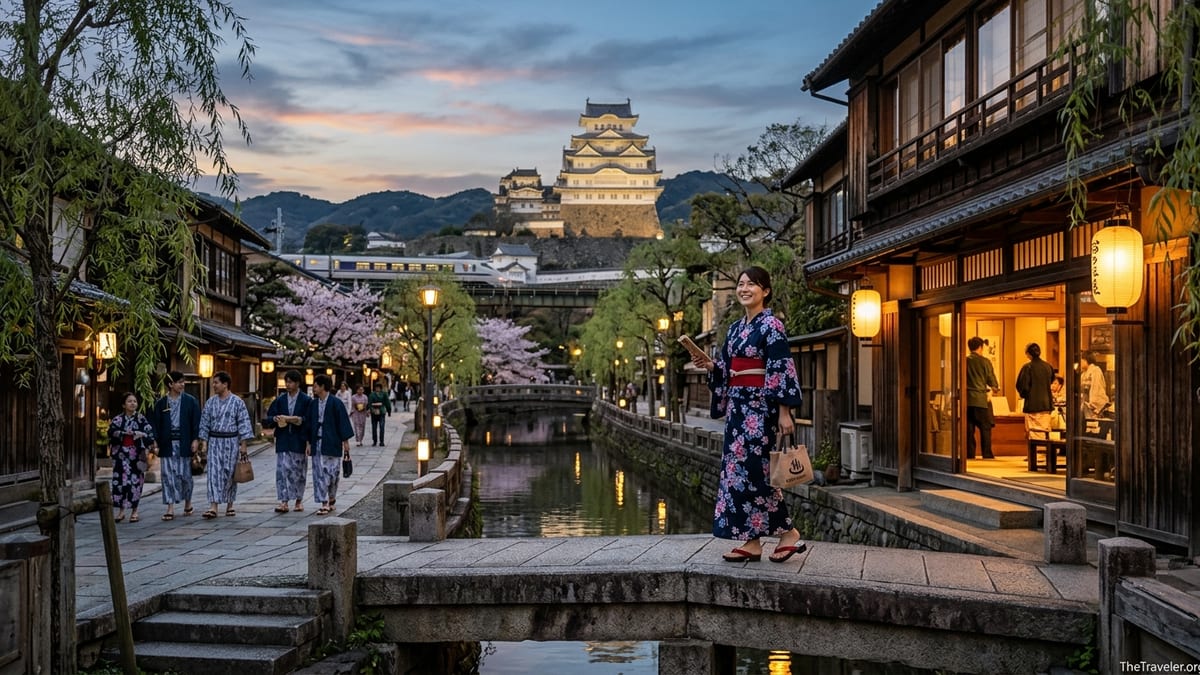
Getting Oriented: Why Hyogo Matters on a Kansai Itinerary
Hyogo lies immediately west of Osaka and north of Awaji Island, touching both the Seto Inland Sea in the south and the Sea of Japan in the north. Himeji sits about 60 to 70 minutes by JR Special Rapid Service from Osaka Station, while Kobe is less than 30 minutes from Osaka and around 50 minutes from Kyoto by direct JR trains. To the north, Kinosaki Onsen is roughly two and a half to three hours by limited express from Osaka or Kyoto, putting classic hot spring scenery within realistic reach even on short trips.
The prefecture’s geography makes it unusually varied. Around Kobe and Himeji you find dense urban districts, port developments and a major World Heritage castle. Inland, the mountains around Mount Rokko, Mount Shosha and the Tajima region offer hiking, temples and winter snow. On the coasts, you can watch ships pass through the Akashi Strait in the south or walk quiet beaches near Takeno and Hamasaka in the north. This mix allows travelers to balance culture, food and nature without long internal flights or overnight buses.
For first-time visitors who base themselves in Osaka or Kyoto, Hyogo works well as a series of focused day trips: Himeji Castle and Koko-en Garden in one day, Kobe’s Kitano and Harborland in another, or a long excursion to Kinosaki Onsen with an overnight stay. Repeat visitors often find it rewarding to flip the script and sleep in Hyogo itself, using Kobe as a base for Kansai day trips, or building an itinerary that strings together Himeji, Takeda Castle ruins, Kinosaki, the Tajima coast and Awaji Island before continuing west to Okayama or Hiroshima.
Transport is straightforward. The Sanyo Shinkansen links Shin-Osaka with Shin-Kobe, Nishi-Akashi, Himeji and onward to Okayama and Hiroshima, while JR conventional lines and private railways connect inland towns and onsen areas. Several JR West passes, including the Kansai Wide Area Pass and Sanin-Okayama Area Pass, can reduce costs if you plan multiple long-distance rides, though individual tickets are often more economical for a single day trip.
Himeji: Castle, Garden and Mount Shosha
Himeji Castle is Hyogo’s best-known landmark and one of Japan’s most important castles. The official site lists admission at around 1,000 yen for adults, with a combined ticket including nearby Koko-en Garden at approximately 1,050 to 1,100 yen for adults according to recent city publications, with discounts for children and local residents. Opening hours are generally from 9:00 to 17:00, with last entry at 16:00, though extended hours apply in peak seasons. Tickets are sold on site at the main gate and at automated machines, and you rarely need to pre-book outside of holiday periods.
Visiting the castle involves quite a bit of walking and stair climbing. The main keep rises six stories, connected by steep, narrow wooden staircases that can be challenging for travelers with mobility issues or young children. From Himeji Station the walk to the castle gate takes about 15 to 20 minutes along a straight, pedestrian-friendly boulevard. Most visitors should plan at least two hours to tour the grounds and main keep, plus another hour if combining with Koko-en Garden, which adjoins the castle’s west side and offers nine different walled garden areas arranged around ponds, tea houses and seasonal plantings.
Seasonal crowds at Himeji are strongest during cherry blossom season in late March and early April, when the inner moat is framed by pink trees, and again in mid-November when autumn foliage peaks in Koko-en and the castle grounds. On weekends in these periods, lines to enter the main keep can stretch to 30 to 60 minutes. Arriving at opening time or in the last two hours of the day can significantly reduce waiting. Summer afternoons can be extremely hot inside the unairconditioned keep, so morning visits are more comfortable.
Mount Shosha and Engyoji Temple, about 6 kilometers northwest of the castle, provide a quiet counterpoint. From Himeji Station, a Shinki Bus runs to the Mount Shosha Ropeway terminal in around 25 minutes. The ropeway itself takes roughly four minutes to reach the upper station. Recent official information indicates a round-trip ropeway fare of around 1,000 to 1,200 yen for adults, plus a separate Engyoji temple admission fee of about 500 yen collected at the temple entrance. From the upper ropeway station you can either walk 15 to 20 minutes uphill through cedar forest to the temple’s Nio-mon gate, then another 10 to 15 minutes to the main Mani-den hall, or take a small internal shuttle bus for an additional fee. A relaxed visit including ropeway rides, walking between the halls and a simple temple meal can easily fill half a day.
Exploring Kobe: Neighborhoods, Views and Food
Kobe stretches in a narrow strip between the sea and the Rokko mountain range, so distinct districts sit just minutes apart by train or subway. The Kitano area, north of Sannomiya Station, is known for its preserved “ijinkan” foreign residences from the late 19th century. Several offer paid entry with interior exhibits for a few hundred yen each, or you can wander the steep streets and small cafes for an hour or two at no cost besides occasional admission. From Kitano, city buses and a short walk connect to the Shin-Kobe area, where the Nunobiki waterfalls and the Kobe Nunobiki Herb Gardens ropeway begin right behind Shin-Kobe Shinkansen Station.
The Kobe Nunobiki Ropeway carries visitors up to the herb gardens and panoramic viewpoints above the city. According to the garden’s official fare table for 2026, a daytime adult round-trip ropeway and garden ticket costs around 2,500 yen, with discounts for children; separate evening fares are slightly lower. Operating hours vary seasonally, with last uphill rides around late afternoon in winter and later hours on weekends and in summer. Facilities sometimes close for scheduled maintenance in late summer or winter, so checking dates in advance is important. At the top you can stroll terraced flowerbeds, greenhouses and cafes while looking over Kobe Port, often making this a good pairing with a morning in Kitano.
Down at the waterfront, Harborland and adjacent Meriken Park show Kobe’s maritime side. Harborland’s shopping malls and ferris wheel occupy converted docklands across from JR Kobe Station, while Meriken Park extends east toward the iconic red Kobe Port Tower. The tower has been undergoing a long-term renovation and in 2026 is gradually reopening upper observation decks; current admission when fully open is expected to be in the 1,000 yen range for adults. Even without paying for viewpoints, walking the piers around sunset offers views toward Awaji Island and the Akashi Kaikyo Bridge in the distance.
Kobe’s food culture is anchored by its beef, but the city also has a strong coffee and bakery scene. Genuine Kobe beef is a tightly controlled regional brand that must meet specific Tajima cattle standards and be certified at auction. In central Kobe, lunch sets using small portions of certified Kobe beef at reputable teppanyaki restaurants often start around 6,000 to 8,000 yen, while full-course dinners can easily exceed 15,000 to 20,000 yen per person. If you see “Kobe-style beef” steaks for 2,000 to 3,000 yen in tourist-heavy zones, they are almost certainly not using certified Kobe beef, even if the menu implies a connection. Look for restaurants that clearly show the official Kobe beef logo in Japanese, list specific cuts and grades, and can produce a certificate or tag number if asked. For travelers on a tighter budget, many local steakhouses serve Tajima or other wagyu cuts in the 3,000 to 5,000 yen range that offer excellent quality without Kobe-brand pricing.
Onsen Culture in Kinosaki: Baths, Ryokan and Yukata
Kinosaki Onsen, on Hyogo’s northern Sea of Japan coast, is one of Japan’s most atmospheric hot spring towns. From Osaka or Kyoto, limited express trains such as the Kounotori and Kinosaki reach JR Kinosaki Onsen Station in roughly two and a half to three hours with no transfers. Many travelers arrive around midday, check into a ryokan in the afternoon, then spend the late afternoon and evening strolling the willow-lined canal in yukata and visiting the town’s seven public bathhouses, known locally as soto-yu.
The town is notable for its welcoming approach to tattoos. Official tourism materials and recent confirmations state that all seven public bathhouses currently allow tattoos of all sizes without requiring guests to cover them, a rare policy in Japan. Some individual ryokan still post their own rules for in-house baths, but even guests who cannot use a ryokan’s communal tub can almost always bathe in the public baths. Standard admission to each public bath is usually a few hundred yen for day visitors, while most ryokan stays include a pass or QR code granting unlimited access during opening hours. Not all seven baths operate every day, as some close on rotation for maintenance, so checking signage or with your ryokan before bath-hopping is wise.
Onsen etiquette in Kinosaki follows the national norm. You remove shoes at the entrance, store clothes in lockers or baskets, wash thoroughly at the shower stations before entering the tub, and keep towels, phones and swimsuits out of the water. Bath temperatures are commonly around 41 to 42 degrees Celsius, and many visitors limit each soak to 10 or 15 minutes, resting and hydrating between baths. Families with children are common in the evenings, particularly on weekends, but mixed-gender bathing is not standard in the public baths; they are separated by gender, with some switching sides daily.
Ryokan are central to the Kinosaki experience. Midrange ryokan with two meals included (dinner and breakfast) usually start from around 25,000 to 35,000 yen per person in busy seasons, while simpler inns with breakfast only can sometimes be found under 15,000 yen per person on off-peak weekdays. Many ryokan provide colorful yukata that guests wear throughout town, along with geta sandals and large coats in colder months. Dinner typically features Tajima beef, crab in winter, and local sashimi, and is served in-room or in private dining spaces. Although a day trip from Osaka or Kyoto is technically possible, the travel time and evening-focused town atmosphere make at least one overnight stay strongly recommended. An overnight also lets you see the quieter morning streets and enjoy a final bath before departure.
Beyond the Obvious: Takeda, Izushi, Awaji, Akashi and Tajima
Hyogo’s appeal becomes clearer once you step beyond Kobe and Himeji. Inland from Himeji and the Tajima coast sits the Takeda Castle ruins, sometimes called the “castle in the sky” when morning mist encircles the mountaintop. The nearest station is JR Takeda on the Bantan Line, about 90 minutes by local or rapid train from Himeji and around two and a half hours from Osaka with a transfer. From the station, visitors either hike steep mountain trails for 40 to 60 minutes or take a local bus and then walk the final section. The castle site is managed as a paid attraction; recent local information indicates admission in the 500 yen range for adults when the site is open, typically from spring through late autumn, with winter closures or restricted access for safety when snow and ice are present.
Nearby Izushi is a compact former castle town in the Tajima region, accessible by bus from JR Toyooka Station in roughly 30 minutes. The town is known for its Izushi sara soba, small servings of buckwheat noodles presented on stacks of white plates, and for the low stone ruins of Izushi Castle and its vermilion torii-lined hillside approach. Travelers often combine Takeda and Izushi in a car-based day trip, but public transport users may find it more realistic to visit Izushi together with Kinosaki and Toyooka, using bus connections and planning around less frequent rural timetables.
On Hyogo’s southern coast, Akashi and Awaji Island offer sea views and lighter crowds than more famous Kansai seaside spots. JR Akashi Station is about 15 minutes by train from Kobe and around 40 minutes from Osaka. From there, the coastline and fish market sit just a short walk south, with views of the Akashi Kaikyo Bridge, one of the world’s longest suspension bridges. Buses from central Kobe and Akashi cross the bridge to Awaji Island in 30 to 60 minutes depending on the route, serving attractions such as roadside parks, flower gardens and coastal viewpoints. While many resorts on Awaji assume visitors arrive by car, it is still possible to plan a day trip using highway buses combined with local taxis for the final legs.
The wider Tajima region, stretching along the Sea of Japan west and east of Kinosaki, rewards slower travel. Small seaside towns like Takeno have sandy beaches used by Kansai families in July and August, while inland valleys host rice paddies and sake breweries. Public transport is thinned out compared with the Kobe–Himeji corridor, and many local buses run only a few times per day. Travelers with a rental car can more easily link spots such as Takeda Castle ruins, Izushi, Kinosaki and lesser-known hot springs in a loop over two or three days, while those relying on trains and buses should plan conservatively and avoid backtracking.
Transport, Passes, Luggage and When a Car Helps
Hyogo’s main spine is the JR Sanyo Main Line, running from Osaka through Kobe, Akashi and Himeji. Faster Special Rapid Service trains connect Osaka and Himeji in about one hour without an extra fee beyond the base fare, which is roughly 1,520 yen one way in 2026. The Sanyo Shinkansen shortens some segments but costs more. For example, a reserved seat on a Hikari or Sakura between Shin-Osaka and Himeji costs in the region of 3,000 to 4,000 yen, but saves about 20 minutes and guarantees seating. Northbound, limited express trains like the Kounotori and Hamakaze connect Osaka, Himeji and Kinosaki Onsen or Tottori via the Fukuchiyama and Sanin main lines. These require limited express surcharges, so a one-way ticket from Osaka to Kinosaki can approach or exceed 5,000 yen depending on seat class.
Regional JR West passes are worth evaluating. The Kansai Area Pass covers non-shinkansen JR lines around Osaka, Kyoto, Kobe and Himeji. The Kansai Wide Area Pass extends north to Kinosaki and west toward Okayama on limited express and some shinkansen services at a fixed price over several days, which can quickly pay off if you plan return trips between Osaka and Kinosaki plus Himeji. Specific prices are revised periodically but tend to hover in the mid-teen thousands of yen for five days. Travelers who plan only a single day trip to Himeji or Kobe often find individual tickets cheaper, while those sequencing Osaka–Kinosaki–Himeji–Okayama over four or five days can save substantially with a pass.
Local buses fill the gaps around Mount Shosha, Takeda Castle ruins, Izushi and parts of Awaji Island. Fares in rural Hyogo usually start around 200 yen for short hops and increase with distance. Service can drop to only a handful of buses per day outside main school and commuter routes. This low frequency is one of the biggest sources of stress for visitors who underestimate transfer times, particularly when trying to connect a morning at Himeji Castle with an afternoon trip to Takeda or Izushi. Timetable apps and station information counters are invaluable for confirming the last return bus or train of the day.
Luggage management is relatively straightforward. Major stations like Kobe, Himeji and Kinosaki Onsen have coin lockers, with small units often around 400 to 500 yen per day and larger suitcase-sized lockers around 700 to 1,000 yen. In addition, nationwide luggage-forwarding services operated by companies such as Yamato Transport and Japan Post allow travelers to send suitcases between hotels or from city hotels to ryokan for next-day delivery for around 2,000 to 3,000 yen per piece within Honshu. This is particularly helpful when heading to Kinosaki or rural inns, where dragging large bags along narrow streets or onto buses would be inconvenient.
Renting a car becomes genuinely useful once you venture beyond the Sanyo and Sanin rail corridors. For example, a driver starting in Himeji can reach Mount Shosha, Takeda Castle ruins and Izushi flexibly in one long day, stopping at viewpoints and rural cafes along the way, something that is difficult on public transport. Likewise, exploring southern Awaji Island’s coastal shrines and viewpoints is more relaxed by car than by bus. However, driving in central Kobe or around major stations is rarely necessary given dense rail coverage and expensive parking. Winter driving in northern Hyogo requires caution, as snow and icy roads are common from December to March, and rental agencies often equip cars with studless tires only in this season.
Where to Stay, Seasonal Timing and Sample Itineraries
Choosing a base depends on your priorities. Kobe works well for travelers wanting an urban feel with easy day trips; business hotels around Sannomiya and Motomachi often start from 8,000 to 12,000 yen per room for two on weekdays, scaling up for boutique and luxury properties with harbor views. Himeji has a cluster of chain hotels near the station in a similar or slightly lower price range, plus a few small ryokan closer to the castle. Kinosaki offers mainly ryokan, where per-person pricing with meals makes stays more expensive on paper but includes the town’s signature experiences.
In rural Tajima, Izushi and smaller onsen areas, family-run inns and pensions may charge from around 10,000 to 15,000 yen per person with breakfast or one meal, with higher rates during holidays and winter crab season. Budget-conscious travelers sometimes mix accommodation types, spending a few nights in Kobe’s business hotels and allocating one or two nights to a higher-priced ryokan in Kinosaki or along the Tajima coast. When comparing costs, remember that a 15,000 yen hotel room without meals in Kobe may end up similar in total outlay to a 25,000 yen ryokan stay that includes an elaborate dinner and breakfast.
Seasonal timing can reshape a Hyogo itinerary. Cherry blossoms around Himeji Castle and Kobe typically bloom from late March into early April, with peak viewing often lasting about a week. Autumn foliage is strongest from early to late November, first in higher elevations around Mount Rokko and Mount Shosha and then in city parks. Northern Hyogo experiences significant winter snow; Kinosaki and the Tajima region can receive snowfall from late December through February, which adds charm to bath-hopping but may disrupt transport. Coastal weather on both the Seto Inland Sea and Sea of Japan sides tends to be humid in summer with daytime highs over 30 degrees Celsius, and the Sea of Japan coast can be windy and rough in winter.
Major seasonal draws include winter crab season in Kinosaki and Tajima, when ryokan dinners feature matsuba crab at premium prices, and various summer and autumn festivals in Kobe and Himeji. Some attractions impose seasonal restrictions: the Takeda Castle ruins limit access or close certain paths in winter, and ropeways such as Nunobiki Herb Gardens and Mount Shosha sometimes suspend service for maintenance or high winds. Checking operating calendars a few days before a planned visit helps avoid surprises, especially if your itinerary hinges on one scenic viewpoint.
Concrete travel times help with planning. From Osaka to Kobe, JR trains take roughly 25 minutes, while Osaka to Himeji on a Special Rapid Service is about one hour. Shin-Osaka to Himeji by shinkansen can be around 30 to 40 minutes including station transfers. Kyoto to Kobe is usually 50 to 60 minutes by JR Special Rapid. Kinosaki Onsen lies about two and a half to three hours from both Osaka and Kyoto on direct limited express trains. From Hiroshima to Himeji, the Sanyo Shinkansen covers the distance in roughly 60 to 70 minutes. Kansai International Airport connects to Kobe via a combination of JR trains and a transfer at Osaka, or via bay shuttle boat services, typically taking around 70 to 90 minutes door to door depending on connections.
In terms of budget levels, a frugal two-day Hyogo side trip from Osaka might involve a day return to Himeji on JR rapid trains, plus an overnight in Kobe at a business hotel and simple meals, totaling perhaps 25,000 to 35,000 yen per person including transport, lodging and food. A midrange four-day loop Osaka–Himeji–Kinosaki–Kobe with a JR regional pass, one night in a Kinosaki ryokan with half board and three nights in city hotels can easily land in the 80,000 to 120,000 yen range per person. At the higher end, a week-long journey with private-room ryokan stays, Kobe beef dinners and occasional taxis can exceed 200,000 yen per person, especially if timed with peak cherry blossom or autumn foliage weeks.
Common Pitfalls and How Hyogo Compares to Other Kansai Destinations
Several recurring mistakes affect Hyogo itineraries. One is underestimating rural transfer times and bus frequency. Trying to visit Himeji Castle, Mount Shosha and Takeda Castle ruins in a single day using only public transport almost always leads to rushed sightseeing or missed connections. Another is attempting to fit Kinosaki Onsen into a day trip from Osaka or Kyoto while also imagining time for Takeda or Izushi; the three-hour train each way plus onsen time leaves little margin. A third misconception is assuming every hot spring in Hyogo accepts day visitors and tattoos. While Kinosaki’s public baths are unusually open and many ryokan offer non-staying guest plans at specific hours, plenty of rural onsen remain overnight-guest only or maintain stricter rules.
Seat reservations on longer limited express and shinkansen journeys are another overlooked detail. During peak holiday periods such as Golden Week, Obon and New Year, unreserved cars between Osaka, Kobe, Himeji and Kinosaki can fill quickly. Paying the small surcharge for a reserved seat, often a few hundred yen, removes anxiety and is especially worthwhile after an evening of onsen baths or a long day of castle staircases. Likewise, travelers who travel with large suitcases sometimes struggle to fit them into overhead racks on limited express trains; booking seats near luggage areas or forwarding bags in advance can prevent last-minute scrambling.
Compared with Kyoto and Nara, Hyogo offers fewer headline temples and gardens but balances its cultural sites with more varied landscapes and stronger onsen options. Himeji Castle and Engyoji can comfortably stand alongside Kyoto’s top historical attractions in terms of atmosphere and significance, yet Himeji’s streets feel less saturated with souvenir shops and tour buses. Kobe rivals Osaka for food and nightlife on a smaller scale, with the added appeal of mountain and harbor views just minutes apart. Kinosaki provides a more concentrated and traditional hot spring experience than anything in central Kyoto or Osaka, especially if you want an entire town built around yukata-clad strolling.
For travelers with only three or four days in Kansai, Kyoto and Nara remain the more obvious choices for classic temples and shrines. However, adding at least one full day in Hyogo for Himeji or Kobe brings diversity to any itinerary. For those with a week or more, Hyogo becomes a compelling alternative core region. You might spend two nights in Kyoto, then shift to a Hyogo base such as Kobe or Kinosaki for the remainder, catching castles, mountain temples, seascapes and hot springs in a way that feels integrated rather than piecemeal.
Practically, Hyogo rewards travelers willing to slow down slightly and link destinations thoughtfully. Two focused days might see you based in Osaka, with one day for Himeji Castle and Koko-en and another for Kobe’s Kitano, herb gardens and harbor. A four-day route could run Osaka–Himeji–Kinosaki–Kobe–Osaka, with one night in Kinosaki for onsen immersion. A seven-day journey might string Kyoto, Himeji, Mount Shosha, Takeda, Izushi, Kinosaki and Kobe together, potentially using a regional rail pass and a short rental-car segment around Takeda and Izushi. In each case, the key is recognizing Hyogo not as a single castle or a famous steak, but as a cohesive region where urban comfort, historic sites and quiet rural corners sit within a few hours of one another.