


More news on this day
British families heading to Europe for the October half-term break are being urged to plan for longer journeys, as new EU biometric border checks combine with a volatile backdrop of strike threats and autumn weather disruption across popular destinations.
Get the latest news straight to your inbox!
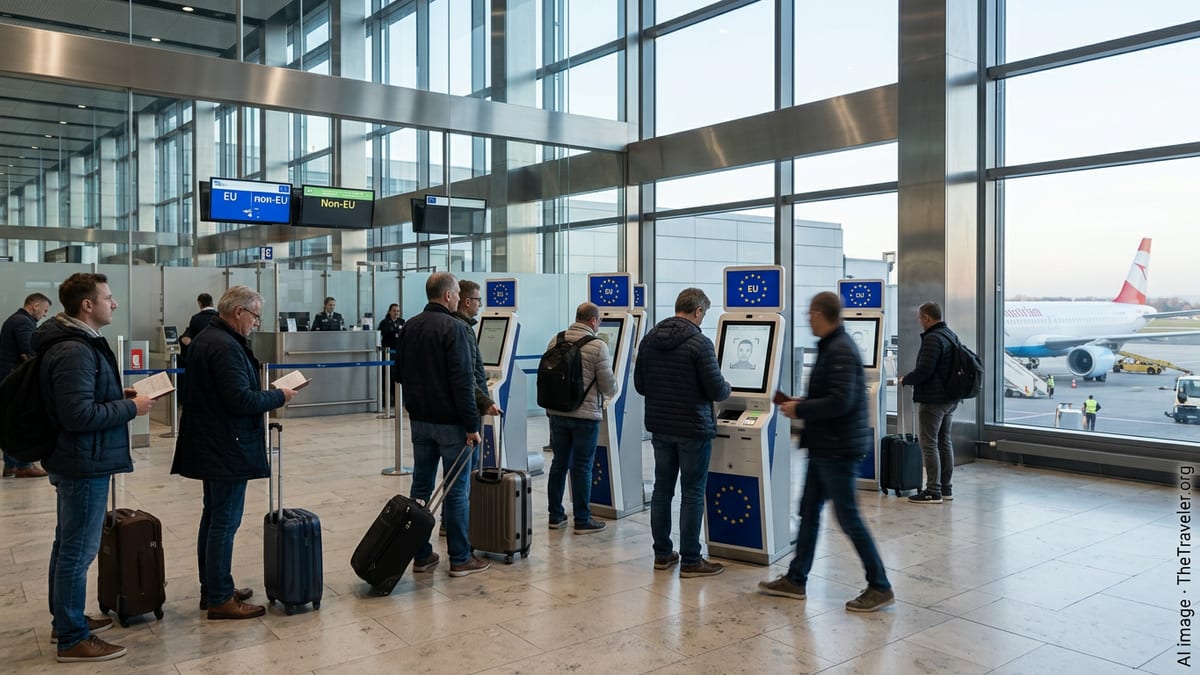
New EU border checks meet half-term crowds
This October is the first school half-term since the European Union’s Entry/Exit System, or EES, has been fully in use through a peak holiday period. The scheme, which began operating on 12 October 2025, replaces manual passport stamping with a digital log of each non-EU traveller’s entries and exits, including UK visitors.
Publicly available information from EU institutions indicates that every adult and child who is not an EU or Schengen national must have their fingerprints and facial image captured on their first trip after EES went live. That “enrolment” happens at the border, which means initial crossings can take noticeably longer than previous holidays for families who have not yet used the system.
UK government guidance and consumer travel briefings note that, while a standard EES check is designed to take around one to two minutes per person, the cumulative effect during busy periods can be significant. At peak times such as half term, relatively small delays per passenger can translate into long queues at ferry ports, railway terminals and airports handling large numbers of British holidaymakers.
The EU has allowed member states some flexibility to pause biometric capture temporarily when queues become excessive, but that automatic leeway expired in early September. Industry commentary ahead of half term suggests that ports and airports may now find it harder to suspend checks, increasing the risk of bottlenecks if staffing or equipment issues arise at short notice.
Where queues are most likely for UK travellers
Families heading to France, Spain, Italy and other Schengen countries by car, coach or train are expected to be among those most exposed to any half-term congestion. These routes funnel large volumes of UK nationals through a limited number of border posts where biometric kiosks must now be used for each first-time EES registration.
At the Port of Dover, the Eurotunnel terminal at Folkestone and the Eurostar hub at London St Pancras, French border officers check passports on UK soil before departure. Parliamentary briefings and recent government statements highlight ongoing work with French authorities to increase staffing and lane capacity at these sites ahead of busy periods, but they also acknowledge that processing times for non-EU nationals are now fundamentally longer than before Brexit.
Airports serving popular half-term destinations, including Malaga, Palma de Mallorca, Faro, Alicante, Nice and Rome Fiumicino, are also adjusting to the new regime. Travel industry advice indicates that the first trip under EES is likely to be the slowest for each traveller. Those who enrolled during summer 2026 should find that subsequent crossings are quicker, as their biometric record is already stored, but families travelling abroad for the first time since last year may encounter the full registration process at arrival.
Some Mediterranean countries have intermittently reintroduced internal border controls within the Schengen area for security reasons, meaning that checks can vary not only by country but also by region and date. Public travel advisories therefore stress the importance of checking local airport and port updates close to departure, rather than relying solely on experiences from earlier in the year.
ETIAS still not required, but more checks ahead
Alongside EES, many British holidaymakers have heard about the upcoming European Travel Information and Authorisation System, known as ETIAS, and are unclear whether they need to apply this autumn. Official European Commission material confirms that ETIAS has not yet been launched and is scheduled to start in the final quarter of 2026, after the current half-term period.
When ETIAS does open, UK nationals visiting Schengen countries for short stays will need to complete an online application and pay a small fee before travel. However, travel organisations emphasise that no such pre-clearance is required for trips taking place this October, and that airlines, ferry companies and train operators are not yet asking passengers for an ETIAS approval number.
The coexistence of an operational EES and a forthcoming ETIAS has generated confusion in consumer forums and on social media, with some travellers mistakenly preparing documents that do not yet exist. Government and EU FAQs underline that, for now, British tourists only need a valid passport meeting Schengen entry rules, plus any visa that might be required for non-tourist stays, in addition to standard transport tickets and insurance documents.
Experts in passenger rights also note that the obligations of transport operators have not changed because of EES. Airlines and ferry firms remain responsible for checking that travellers meet existing entry conditions, but they are not currently required to verify any ETIAS-style authorisation before boarding UK passengers to continental Europe.
Strike risks add uncertainty to holiday plans
Half-term travel is also taking place against a background of industrial tensions in parts of Europe’s transport sector. Recent months have seen a series of air traffic control and airport worker disputes in France, Italy and other countries, which have periodically led to reduced flight schedules, delays and cancellations.
Analysis by Eurocontrol and national aviation authorities over recent years shows that French air traffic control walkouts can disrupt large numbers of flights that are simply passing through French airspace, not just services landing in France. As a result, UK travellers flying to Spain, Portugal, Italy, Greece or beyond can find their journeys affected even when their destination country is not involved in industrial action.
Consumer-rights guides on European flight compensation explain that strikes by air traffic controllers are generally treated as an “extraordinary circumstance” for the purposes of EU and UK air passenger regulations. That means airlines are usually not required to pay cash compensation for knock-on delays or cancellations, although they must still provide care such as refreshments and hotel accommodation when passengers are stranded overnight.
Separate disputes involving ground handlers, security staff or cabin crew trigger different rules, and some recent actions have been suspended at short notice while unions ballot members on revised pay offers. Publicly available timetables show that, as of the week before half term, most UK and European carriers intend to operate full schedules, but travel experts warn that last-minute calls for action remain a risk during busy holiday periods.
Practical steps for families travelling this half term
Given the combination of new border technology and potential strike disruption, travel bodies are advising British families to build extra time into their journeys and to prepare documents carefully. Official guidance for travelling to Europe recommends arriving at the airport earlier than usual for school holiday departures, particularly for morning flights when security and check-in queues can be longest.
Parents are encouraged to ensure that passports for all family members meet EU rules on validity and blank pages, as EES does not remove the need for standard checks. Having booking confirmations, accommodation details and return-flight information readily available can also help border officers process travellers more efficiently when questions arise about the length and purpose of a stay.
For those driving to Europe, port operators and motoring organisations suggest monitoring live traffic updates for Dover, Folkestone and key motorway approaches, as congestion at peak times can build quickly when border processing slows. Many cross-Channel operators now provide real-time queue information and advice on staggered arrival times, which can reduce unnecessary waiting at terminals.
Travel insurance specialists highlight the importance of checking policies for coverage related to delays caused by strikes or long queues at border control. While compensation for missed departures linked solely to congestion is often limited, some policies include benefits for additional accommodation or alternative transport if travellers can demonstrate that they allowed reasonable time for check-in and security. Families are being urged to read the small print carefully before setting off, as half-term trips are often short and less flexible to rebook if plans go wrong.