


Walk ten minutes away from the cocktail bars of Little Venice and Mykonos Town changes character. The music fades, the shop signs thin out and the lanes twist back into the working Cycladic port that existed long before DJs and day beds. For travelers willing to step off Matogianni Street and wander without a map, Chora still has quiet courtyards, little museums and sea views that feel almost private, even in the peak of August.
Get the latest updates straight to your inbox!
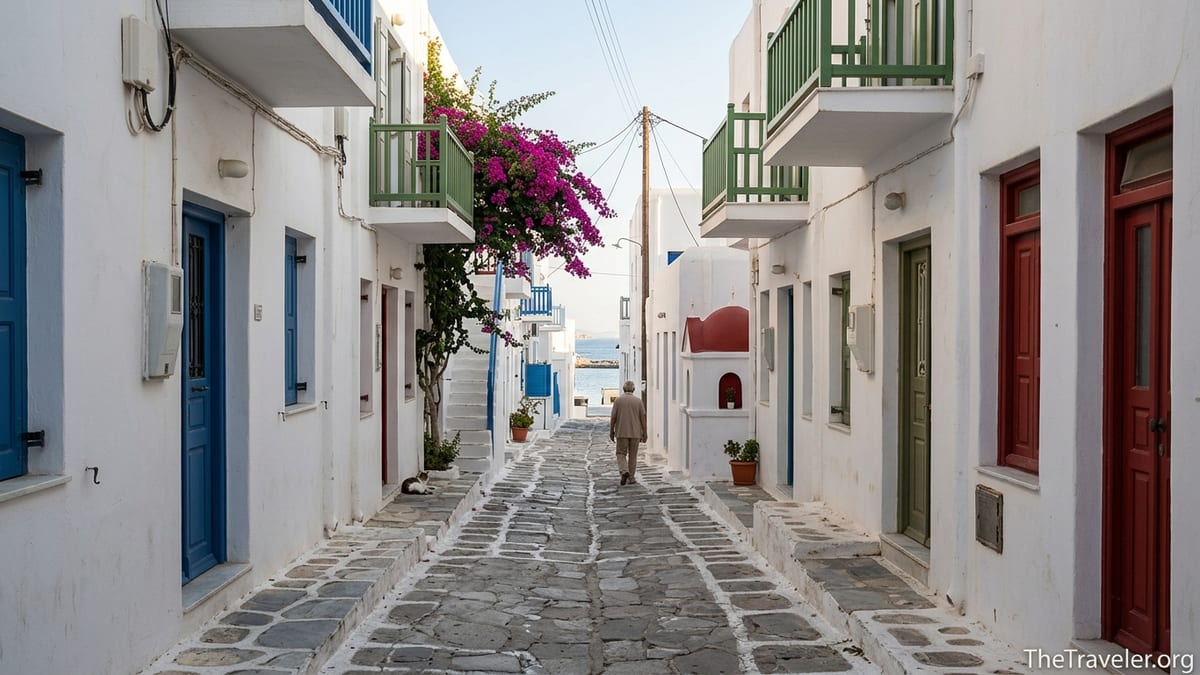
The Art of Getting Lost in Chora’s Backstreets
The biggest hidden corner in Mykonos Town is not a single place but a state of mind. Most visitors follow the same loop between the waterfront, Little Venice and the famous windmills. The alleys one or two blocks behind that loop are where Chora breathes at a slower pace. Here the bougainvillea is just as bright and the whitewashed houses just as photogenic, but the only soundtrack is a radio from an upstairs kitchen or the echo of your own footsteps.
A practical way to find these streets is to use Matogianni Street as a reference point and then deliberately avoid it. Start at the top of Matogianni near the taxi square, then slip into any narrow lane heading uphill or toward the interior of town rather than the sea. Within five minutes you are in a residential grid of nameless alleys, low houses with blue doors and tiny shrines on street corners. Cruise ship crowds rarely make it this far because there is little shopping, yet for photographers and early risers it is a quiet dream.
These backstreets are also where small, family-run rooms and modest apartments survive between designer boutiques. You may pass a ground-floor studio with laundry hanging above the door, or a courtyard where an elderly couple is cleaning fish for lunch. Prices change year to year, but travelers who book simple rooms in this part of town often pay noticeably less than the seafront addresses, and they gain the bonus of stepping out into peaceful lanes rather than the late-night bar scene.
Walk these alleys just after sunrise or around midday when most visitors are on the beaches. The light is soft, cats stretch across warm stone steps and a bakery cart might rattle through delivering bread. You are still only a few minutes from the waterfront, yet it feels like a different island entirely.
Boni’s Windmill and the Agricultural Museum Above the Crowds
Almost every visitor photographs the line of windmills above Little Venice, but very few continue uphill to Boni’s Windmill and the Agricultural Museum. Perched on a low hill known as Apano Mili, roughly a ten-minute walk from the old port, this restored 19th century mill showcases the island’s agricultural past with a view that many people never realize they missed.
The agricultural museum is an open-air annex of the Mykonos Folklore Museum, with original milling mechanisms, a traditional wine press, a stone oven and the miller’s simple house arranged around a small courtyard. Exhibits are modest but tangible: heavy wooden tools, iron ploughs, woven baskets and grain sacks that give a sense of how Mykonos functioned before it became a party destination. In summer the site usually opens in the late afternoon and early evening, and entry fees are typically just a few euros, far less than a cocktail on the waterfront.
What makes this hilltop a true hidden corner is that most tour groups stop at the lower windmills and seldom bother climbing higher. That leaves the viewpoint around Boni’s Windmill relatively calm even in high season. From here you can see the whole amphitheater of white houses spilling to the harbor, the ferries arriving from Piraeus and the sunset sinking behind Delos. It is an excellent place to bring a takeaway gyro or bakery snack, sit on the low dry-stone wall and watch the town below light up one building at a time.
To reach the windmill, follow the main road that leads uphill from the old port, then take any of the small stairways branching left between houses. The climb is short but moderately steep, so flat sandals or sneakers are more comfortable than beach flip-flops. On the walk back down, you re-enter the maze of lanes above Little Venice from an angle that most visitors never see, discovering small squares and back doors of houses that face away from the sea.
Kastro and the Quiet Side of Panagia Paraportiani
The whitewashed mass of Panagia Paraportiani, arguably the most photographed church in Mykonos, sits at the edge of the Kastro quarter. Buses and boat excursions deposit visitors here in brief waves, but the secret is that the crowds usually gather on the sea-facing side of the church for quick photos, leaving the inland approaches through Kastro almost empty.
For a different experience, approach Paraportiani from the interior of Kastro rather than from the waterfront. Start from the Town Hall or the Archaeological Museum and head uphill toward the old castle streets, where medieval stone lanes, low arches and small doorways survive among later whitewashed houses. This northern part of the old town sees much less foot traffic because it lies just outside the shopping axes, yet it preserves some of the most atmospheric architecture in Chora.
As you descend from the top of Kastro toward Paraportiani, you pass small houses with red or green doors, external staircases leading to upper floors and tiny yards where locals store fishing gear. The inland wall of the church complex is plain and almost severe compared with the sculpted sea side, but at quiet times you may find yourself alone here, listening to waves you cannot yet see. If you time your walk for early morning, the soft light turns the white walls a muted pink and the only people around might be a local priest or a delivery driver wheeling crates toward the harbor.
Nearby, the small churches of Agios Nikolaos at the old port and Zoodochos Pigi at the Alefkandra square both merit a slower visit. Agios Nikolaos, with its simple blue dome and position beside the fishing boats, is easy to photograph in passing, yet few visitors step inside or pause long enough to watch fishermen repair nets on the quay. Alefkandra itself, at the edge of Little Venice, is busy at sunset but much quieter at noon, when you can sit on a shaded bench in front of Zoodochos Pigi and watch the rhythms of deliveries, schoolchildren and locals going about daily life.
Hidden Churches and Everyday Devotion in the Lanes
Mykonos Town is famously dotted with chapels; locals sometimes say there are hundreds of churches on the island in total. Many of them are in plain sight yet overlooked because visitors are hurrying to more famous sights. Tucked into corners of residential streets or set back behind low walls, these small churches offer a window into the island’s everyday spirituality.
One example is Agia Eleni, once the island’s cathedral, which sits a short stroll inland from the waterfront. Its white walls and simple bell tower do not shout for attention, and many visitors unknowingly pass within meters of it on their way between the port and the shopping district. Step inside on a hot afternoon and you may find a cool, dim interior decorated with post-Byzantine icons, silver vigil lamps and embroidered cloths placed by local families. Entry is free, though modest dress and quiet behavior are appreciated.
As you wander farther from the port, look for tiny chapels with red or ochre domes wedged between houses. Some are locked outside service times, but most have small courtyards where locals light candles or leave flowers for nameday celebrations. You might come across a courtyard where a family is setting up folding tables for a celebration, or an elderly woman polishing brass candle stands. These moments are not scheduled experiences; they are glimpses of a living town that continues parallel to the tourist economy.
Photography is generally welcomed in exteriors, but it is polite to ask or gesture for permission before photographing interiors or people. If a service is underway, step back and watch from a respectful distance rather than entering. Bringing a small scarf or light shirt to cover shoulders when you step into any church helps you move easily between sightseeing and local custom without drawing attention.
Folklore, Lena’s House and Museums Most People Skip
On a hot afternoon when the lanes feel crowded, most visitors retreat to their hotels or the nearest beach. That is when a trio of small museums within Mykonos Town becomes a quiet refuge. Together they form a picture of the island’s history that you will not get from beach clubs or souvenir shops.
The Mykonos Folklore Museum occupies an 18th century sea captain’s house in the Kastro area, with low-ceilinged rooms filled with carved furniture, handwoven textiles, household tools and maritime memorabilia. An annex known as Lena’s House, near the Tria Pigadia (Three Wells) in the town center, preserves a 19th century bourgeois home exactly as it was lived in, right down to embroidered pillowcases and framed family photographs. These museums are usually open in the late afternoon and evening in summer, often with very modest entrance fees that are comparable to the price of a bus ticket into town.
Because they lack the dramatic facades of major European museums and many guidebooks mention them only briefly, these sites are rarely crowded. You may share the rooms with just a handful of other travelers or find yourself alone with the creak of old floorboards. Docents, often local volunteers or long-term staff, are usually happy to answer questions about specific objects or customs if you show genuine interest, making these visits feel more like stepping into someone’s family history than touring an institution.
Close to the old port, the Archaeological Museum of Mykonos adds another layer, housing artifacts from nearby Delos and Rhenia, especially funerary items recovered from ancient burial sites. The building is simple and low-key compared with the island’s bars and boutiques, but cool, quiet rooms filled with marble reliefs and pottery provide a stark contrast to the noise outside. Together, these museums help connect the whitewashed lanes of Chora with the deeper history of the Cyclades.
Local Life Around the Old Port and Morning Markets
By late afternoon, the old port fills with excursion ticket sellers and groups heading to Delos. In the early morning, however, it is one of the most authentic corners of Mykonos Town. Fishing boats unload their catch, small trucks back up to the quay and local cafe tables fill with workers drinking strong coffee before the day’s shift.
If you walk down to the old harbor shortly after sunrise, you will often see fishermen sorting nets, mending lines and washing decks. Seabirds gather in noisy crowds, and island cats line the low quay walls waiting for scraps. A simple coffee at one of the older, less polished cafes around the harbor costs a fraction of a beach-bar cocktail and comes with front-row seats to the daily logistics of an island that must feed thousands of visitors each day.
Behind the waterfront, modest bakeries and grocery shops supply locals year-round. These places are where you will find reasonably priced koulouri rings with sesame, cheese pies and still-warm loaves instead of the heavily stylized pastries in Instagram-friendly dessert shops. Prices shift with the season, but a light breakfast from a local bakery near the port is typically inexpensive compared with anything on the main shopping streets, and the staff are often more relaxed, with time for small talk or a quick tip about which beach is less windy that day.
Plan one morning of your stay without beach or boat commitments and give yourself two unhurried hours around the old port. Have coffee at a simple cafe, watch the ferries arrive, then wander one or two blocks inland to see where locals buy vegetables and household goods. It is not spectacular in a postcard sense, yet this low-key choreography of deliveries, gossip and errands reveals the island behind the luxury marketing.
Simple Food, Old Cafes and Quieter Corners to Eat
Dining in Mykonos Town has a reputation for being expensive, and there is truth to that on the main seafront and in the heart of Little Venice. Yet just a few streets away, there are traditional bakeries, gyros counters and tiny tavernas where you can eat well for far less than the launch prices of cocktails on the water.
One strategy is to look for old-school bakeries or grill houses on the streets linking the old port to the bus station, or just behind the glamorous boutiques. These places often have plain metal chairs, handwritten menus in Greek and locals queuing for takeaway souvlaki, skewers and simple oven dishes. Portions are usually generous, and a counter-service meal might cost not much more than a scoop of gelato near the waterfront. Such venues rarely advertise in glossy magazines, but they stay open long hours to serve workers and budget-conscious travelers.
Traditional kafeneia, or Greek coffee houses, are another layer that many visitors miss. Tucked into side streets or small squares, they cater mainly to local men playing tavli backgammon, reading the newspaper or watching football on a muted television. As a respectful traveler you are welcome to sit for a coffee, an iced frappe or a small glass of ouzo, provided you accept the unhurried rhythm and perhaps the occasional curious glance. Do not expect design-forward interiors or branded cocktails; instead you get conversation, radio music and the sense that this is how parts of Mykonos looked before beach bars arrived.
To find these quieter places, follow where workers go at the end of a shift: lanes leading inland from the bus station, narrow streets behind the main square and small corners beneath external staircases. If a place is full of locals speaking Greek, with modest signage and no host urging you inside, chances are good that prices are more reasonable and the experience more authentic than on the main drag.
The Takeaway
Mykonos Town’s global image is built on crowded bars, luxury shopping and famous sunset views, but its character does not end there. Hidden among the alleys are quiet churches, modest museums, backstreet bakeries and hilltop viewpoints where the island’s older rhythms are still visible. These corners are not secret in the sense of being unknown; they are simply passed by as visitors follow a narrow circuit between iconic photo stops.
By rising early, walking uphill rather than to the water, stepping into small museums and watching the working port at dawn, you can experience a version of Chora that feels more human and less choreographed. It does not require insider connections or luxury budgets, only comfortable shoes, a willingness to wander without constant phone navigation and a bit of curiosity about how Mykonos functions beyond its nightlife.
Balance one party night with one evening on the hill by Boni’s Windmill, one high-end dinner with a simple gyros eaten on a quiet bench near a small church. Combine the postcard views with a few unscripted hours in the backstreets, and you will leave with memories of Mykonos Town that center not on queues and cover charges, but on small, surprising moments of calm.
FAQ
Q1. Is it still possible to find quiet places in Mykonos Town in peak summer?
Yes. Even in July and August, early mornings, the Kastro backstreets, uphill lanes around Boni’s Windmill and small churches away from the waterfront remain relatively calm.
Q2. How much time should I set aside to explore the hidden corners of Chora?
Plan at least half a day. A relaxed morning in the backstreets and around the old port, plus an evening visit to Boni’s Windmill and the Folklore Museum areas, gives you a good feel.
Q3. Do I need a guide to find these lesser-known spots?
No. A simple offline map and a sense of direction are usually enough. In fact, leaving the main streets and wandering without a strict route is part of the experience.
Q4. Are the small museums in Mykonos Town worth visiting if I only have one day?
If you enjoy history or architecture, yes. The Folklore Museum, Lena’s House and the agricultural museum at Boni’s Windmill provide context that balances the town’s nightlife image.
Q5. What should I wear when visiting chapels and churches in the backstreets?
Dress modestly with covered shoulders and shorts or skirts that are at least mid-thigh. Carrying a light scarf makes it easy to adapt if you decide to step inside.
Q6. Can I take photos in the quieter residential lanes?
Street and architecture photography is generally fine, but avoid pointing your camera directly into homes or at people without permission. Discretion is appreciated in residential areas.
Q7. Are there affordable food options in Mykonos Town away from the main tourist strip?
Yes. Look for bakeries, gyros counters and small grill houses just behind the waterfront and around the bus station, where many locals eat and prices are more reasonable.
Q8. Is it safe to explore the backstreets of Mykonos Town at night?
Mykonos Town is generally considered safe, but at night stick to lit streets, avoid very late solitary walks after heavy drinking and keep usual city travel precautions in mind.
Q9. How do I reach Boni’s Windmill from the old port?
From the old port, walk inland and uphill following the main road, then use the small stairways between houses toward Apano Mili. The climb is about ten minutes at a steady pace.
Q10. What time of day is best for seeing the old port without crowds?
Go shortly after sunrise. Fishermen are working, cafes serve locals starting their day and cruise ship passengers have not yet arrived, so the harbor feels authentically low-key.