


Mykonos Town, or Chora, is one of the most photographed places in the Cyclades. Whitewashed lanes, blue doors, bougainvillea, and that famous sunset over the windmills draw thousands of visitors a day in peak season. If your priority is beautiful images and a calmer atmosphere, timing your trip is just as important as choosing your hotel. This guide breaks down when to visit Mykonos Town for better photos and smaller crowds, with practical, real-world examples you can use to plan your dates and daily schedule.
Get the latest updates straight to your inbox!
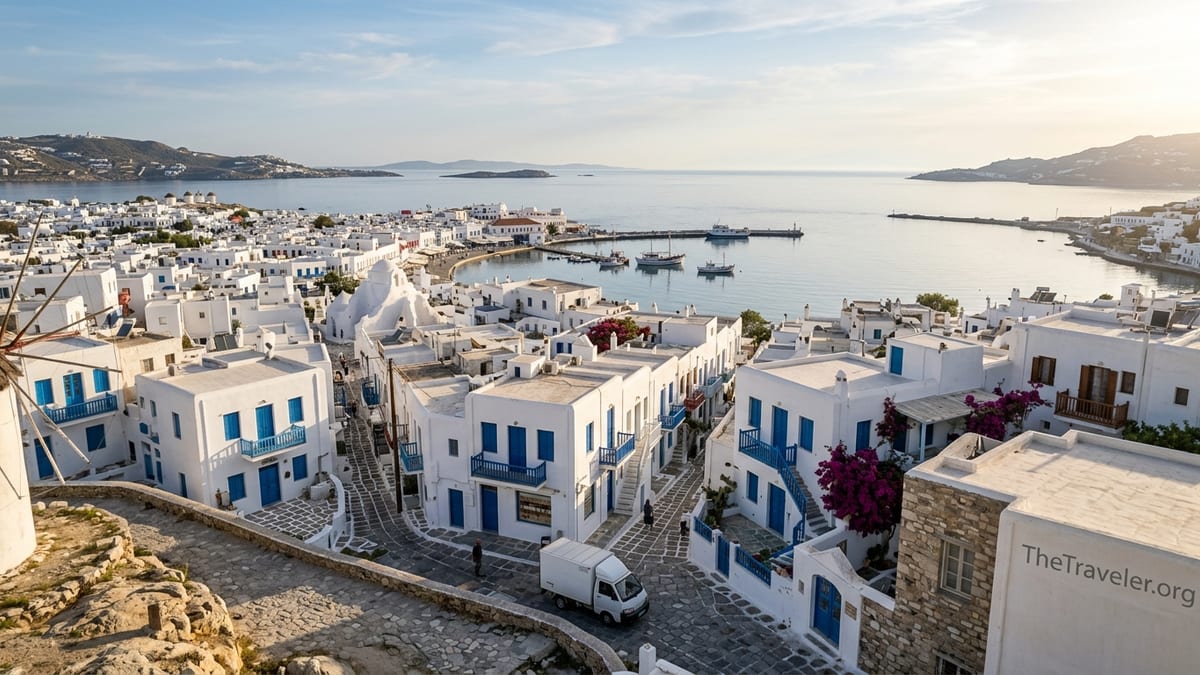
Understanding Mykonos Town’s Seasons for Photographers
Mykonos has a long visitor season compared with many Greek islands, now running roughly from late March through early December as cruise traffic has expanded shoulder months. Summer brings hot, dry days, intensely clear light and the gusty Meltemi wind that keeps temperatures bearable. Winter is milder, cooler and far quieter, but many hotels, restaurants and beach clubs close, and ferry schedules thin out, which can limit your options for sunrise or blue-hour shoots if you are relying on public transport between islands.
For photographers and travelers who value space in the streets, the key trade-off is this: July and August give you postcard-perfect blue skies and buzzing nightlife, but they also bring peak cruise ship traffic and room rates that can easily double compared with May or October. In July, it is normal for several large ships to anchor just offshore, sending thousands of day visitors into Mykonos Town between about 10 am and 4 pm. In contrast, a weekday in early May or mid-October might see only one small ship or none at all, meaning you can photograph the waterfront without a constant stream of tour groups.
Average daytime temperatures in May and October are usually in the low to mid 20s Celsius (upper 60s to mid 70s Fahrenheit), warm enough for al fresco dinners and strolls through Chora, but cool enough that climbing up to the windmills for sunset or hiking around the old harbor with a camera bag feels comfortable. In July and August, daytime highs around the upper 20s to low 30s Celsius (low to upper 80s Fahrenheit) can make midday shooting a hot, sweaty experience, especially in narrow stone streets that reflect heat.
Because of these patterns, photographers typically target three main windows: late April to early June for spring light and fresh flowers; mid-September to mid-October for warm seas and softer sun; and, for those prioritizing emptiness over open venues, selected winter weeks when flights and ferries still run but tourism is at a minimum. Each comes with distinct pros and cons for crowd levels and images.
Best Months and Weeks for Smaller Crowds
If you want Mykonos Town relatively empty but do not want to sacrifice too much in terms of services, the sweet spots tend to be late April, May, early June, late September and October. By late April, many boutique hotels in Chora such as small family-run guesthouses and design-led properties in the old lanes are reopening. Restaurant terraces along the harbor are setting out their chairs, but the laneways behind them remain walkable without needing to shoulder past slow-moving tour groups every few meters.
May in particular is appealing if you are coming primarily for photography. The island is green from winter rains, climbing bougainvillea is in full color, and rental rates are still relatively moderate. A simple double room in a guesthouse inside Chora that might cost roughly 300 euros per night in late July can be closer to 150 to 200 euros in mid-May, depending on location and demand. That price difference often covers the cost of a scooter rental or a few private taxi transfers that let you move quickly between viewpoints at sunrise and sunset.
June is a transition. In the first half of the month, you often still find manageable crowds midweek, especially in the early morning and after 10 pm when day-trippers have left. By late June, however, cruise-ship arrivals climb and popular alleys like Matoyianni Street start to feel busy for most of the day. Similarly, the back half of September is usually calmer than early September, once European school holidays finish and some of the party crowd shifts elsewhere, yet the sea remains warm enough for a swim after a sunrise shoot at the windmills.
In winter months from November through March, Mykonos Town can feel like a different place. Many shops and bars close, and public buses run less frequently, but if you are content with quieter evenings, a limited restaurant choice and potentially unsettled weather, you may have entire corners of Little Venice or side alleys to yourself in the golden hour. Photographers traveling on a tight budget can sometimes find simple town rooms under 100 euros per night, a fraction of peak-season rates.
How Cruise Ship Schedules Shape Daily Crowds
Even during shoulder season, crowd levels in Mykonos Town vary dramatically within a single day because of cruise ship schedules. The local port authority and cruise trackers report that Mykonos can receive hundreds of ship calls per year, with arrivals concentrated from April to October and peaking in the high summer months. On busy days in July or August, three or more ships may anchor off the coast, each carrying several thousand passengers who are tendered ashore to the old harbor or shuttled from the new port just north of town.
For you, that means the same alley can feel like two different cities depending on the hour. At 8 am, you might stand in front of the Paraportiani Church with only a couple of other early risers setting up tripods. By 11 am on a three-ship day, the small square in front of the church can be clogged with organized walking tours, each guide raising a colored sign. If you are planning a shot that needs empty steps or a long exposure without too many moving figures, you will want to shoot before 9 am or after 5:30 pm on days with heavy cruise traffic.
You can get a sense of which days will be busiest by glancing at the port’s published cruise schedule for your intended week. For example, if you see that a Tuesday in early September has only one medium-sized ship scheduled versus a Thursday with three large vessels, structured photographers might plan their sunrise-to-noon town shoot on Tuesday and reserve Thursday for exploring quieter inland villages or beaches away from Chora. Those on land-based holidays sometimes even time their arrival or departure days around quieter port schedules, coming in on a relatively ship-free Wednesday rather than a fully booked Saturday.
Cruise schedules are not infallible: strong winds occasionally force ships to skip Mykonos altogether or adjust tender operations. However, as a planning tool, they are quite useful. Travelers serious about crowd avoidance often screenshot the schedule before their trip and loosely mark in a notebook which mornings they want to be in the old town versus out on a coastal path or at beaches like Agios Sostis, where ship passengers are less likely to go.
Light, Weather and the Meltemi: When Photos Look Their Best
Light quality in Mykonos changes noticeably through the year. In mid-summer around the June solstice, sunrise is just before 6 am and sunset a little after 8:30 pm, giving very long days with harsh midday light. Winter days are much shorter, with the sun lower in the sky, which softens shadows but also increases the likelihood of clouds and rain. Photographers accustomed to northern Europe often appreciate how quickly Mykonos transitions from night to usable dawn light, allowing for compact blue-hour sessions before the town wakes up.
The famous Meltemi wind is a defining feature of summer. These are strong, dry northerly winds that pick up most often from late June through August. On the plus side, the Meltemi scours the air of haze, leading to extremely crisp visibility. This is wonderful for telephoto shots of the windmills from the waterfront or for compressing layers of white houses against the sea. On the downside, 30 to 40 kilometer-per-hour gusts can shake tripods on exposed spots like the windmill hill or the new port promenade, and they can make lens changes risky if dust and salt spray are whipping around.
In the shoulder months of May and October, the wind pattern is typically milder. You may get occasional breezy days, but there are also more calm mornings when reflections in the old harbor are glassy, creating pleasing mirror images of fishing boats and waterfront facades. For example, a photographer arriving in early October might enjoy a still, pastel sunrise at 7:15 am, with smooth water and soft pink light on the buildings, something less common in the more windswept peak months.
From a practical standpoint, pack for both sun and wind. A circular polarizing filter helps cut glare from the white walls and the sea, especially in late spring and summer, while a lens hood reduces flare during daytime walks along Little Venice. If you plan to shoot long exposures around sunset, consider a small but sturdy travel tripod and, in Meltemi season, hanging your camera bag from the center column for extra stability.
Planning Your Day: Best Times in Mykonos Town for Photos
Regardless of the month you visit, the most photo-friendly hours in Mykonos Town are early morning and the hour around sunset into blue hour. For sunrise, streets start almost eerily empty. Local bakeries and small supermarkets may open around 7 am, but the main shopping lanes do not really fill until mid-morning. If you leave your hotel at 6 or 6:30 am in May or September, you can often photograph iconic corners like the narrow stone steps off Matoyianni Street or the waterfront near Little Venice with only a cat or two as foreground subjects.
Late afternoon into sunset is ideal for color and atmosphere, but this window can be busy in high season, particularly at the windmills and the bars cantilevered over the water in Little Venice. To get both good light and manageable crowds, many photographers adopt a two-step strategy. First, they watch sunset from a slightly less famous vantage point, such as the lanes just behind the windmills looking west, or a rocky stretch of shore between the old port and Little Venice. Then, once the sun has dipped and some people have drifted away to dinner, they walk back into the narrow streets for blue hour shots under warm shop lights.
Midday is the toughest time for both photography and crowds. In July and August, direct sunlight on whitewashed walls can blow out highlights, and the tight alleys trap heat. If you must shoot then, look for shaded courtyards, alleyways where buildings block the sun, or interiors of churches where stained glass and candles create interesting contrasts. Otherwise, treat midday as a break: retreat to your hotel pool, head to a less crowded beach, or take a siesta so you have energy for a late-night wander with your camera after most cruise passengers have reboarded their ships.
Night photography offers its own charm. In peak summer, the town does not truly quiet until after midnight, but between about 11:30 pm and 1 am you can still find side streets where bar signs glow and bougainvillea spills over balconies without dense foot traffic. In shoulder months, even 10 or 10:30 pm can be peaceful. A fast prime lens, such as a 35 mm or 50 mm with a wide aperture, is useful here to keep ISO manageable while handholding shots of tavernas and lantern-lit alleys.
Choosing Where to Stay for Quieter Mornings and Evenings
Where you sleep in or near Mykonos Town has a big impact on how easy it is to access quiet photo windows. Staying in the heart of Chora, in one of the traditional cube-shaped houses converted into boutique hotels or guesthouses, lets you step outside your door at dawn and be at key viewpoints within minutes. For example, a room just off Matoyianni Street means the windmills are a 10-minute walk, while Paraportiani Church might be less than 5 minutes away, making pre-sunrise scouting simple.
The trade-off is noise. In high season, late-night bars pump music into the early hours, and even in shoulder months the main lanes can echo with rolling suitcases and chatter until late at night. Photographers who want quieter nights often book on the edge of town instead, in small hotels around the School of Fine Arts area or the roads leading up to the hill above the old port. From there, a 10 to 15 minute downhill stroll brings you into town for morning shoots, and at night you are far enough from the core bar district to sleep.
If your budget allows, another approach is to stay at a property that offers its own elevated view of Chora, such as hillside hotels with sea-facing balconies. This gives you the option of capturing sunrise or dusk over the town without leaving the property, useful on days when strong winds or fatigue make climbing to the windmills less appealing. It also means you can keep your camera gear nearby instead of carrying everything out each evening.
Travelers on cruises, who may be in Mykonos Town only for a few hours, should factor tendering times into their plans. On a typical summer call, first tenders to shore might not begin until 7:30 or 8 am, and lines to return in the afternoon can stretch to 45 to 60 minutes. If you are serious about photography and want quieter conditions, it may be worth skipping the first rush of tenders, enjoying a leisurely breakfast on board, and coming ashore slightly earlier or later than the main excursion departure times.
Practical Tips to Keep People Out of Your Frame
Even if you cannot completely avoid peak season, there are techniques to minimize crowds in your images. One of the simplest is to explore off-axis from the most popular photo points. For every packed corner in Mykonos Town, there is often a side lane one or two turns away that offers similar architecture with far fewer people. For example, instead of shooting straight down the busiest stretch of Matoyianni Street, wander parallel lanes uphill, where you can often find equally photogenic blue doors, potted geraniums and cats, but only occasional passersby.
Using your camera settings creatively also helps. In busy alleys, a neutral density filter combined with a small aperture can allow longer exposures during golden hour, turning moving crowds into soft blurs while static elements like buildings and flags remain sharp. This can give a sense of motion without specific faces dominating the frame. Alternatively, shooting with a moderately wide lens at a low angle, using a foreground element like a stair or potted plant to block the lower part of the frame, can help hide clusters of tourists further down the alley.
Timing your presence matters too. Many organized tours follow similar circuits, often clustering around the windmills, Paraportiani Church and key shopping streets between about 10 am and 1 pm. If you scout their routes on your first day, you can plan to be one stop ahead or behind the main flow on subsequent mornings. For instance, you might start at Paraportiani at 8 am, move to the windmills by 9, and then shoot inland lanes while tour groups congregate near the waterfront. In the late afternoon, reversing the order can work just as well.
Finally, consider the human element as part of your story rather than a problem to eliminate. In some frames, a single local carrying shopping bags, a fisherman mending nets at the harbor, or a couple walking hand in hand through an alley can add scale and context. The key is to be respectful: avoid intrusive close-ups without consent, especially of children, and always be mindful when photographing people dining or inside small churches.
The Takeaway
For better photos and smaller crowds in Mykonos Town, timing is everything. At the broadest level, late April to early June and mid-September to mid-October hit a sweet spot of pleasant weather, open businesses and more manageable visitor numbers, with May and early October particularly attractive for photographers. Within those months, checking cruise schedules lets you choose quieter days in the old town, while planning your shooting around sunrise, sunset and blue hour will reward you with softer light and emptier streets.
Where you stay and how you move also shape your experience. A room in or just above Chora makes pre-dawn walks to the windmills or Paraportiani easy, while travelers arriving by cruise should be realistic about tender timings and consider skipping the busiest mid-morning windows. Add in some simple photography strategies, from using side streets and long exposures to embracing the Meltemi-cleared skies, and you can capture Mykonos Town at its most atmospheric.
Ultimately, there is no single perfect week that suits every traveler. But by favoring shoulder seasons, tracking ship arrivals and leaning into early mornings and late evenings, you give yourself the best chance of coming home with the kind of images that first made you dream of Mykonos: quiet white lanes, pastel sunsets over the windmills and a town that, at least for a few moments each day, feels like it belongs just to you.
FAQ
Q1. What is the single best month to visit Mykonos Town for photography and fewer crowds?
Many photographers favor May, when most hotels and restaurants are open, flowers are in bloom, the weather is mild and cruise traffic is lighter than in July and August.
Q2. Are July and August always too crowded for good photos?
Not necessarily, but you will need to work around crowds. Focus on early mornings before 9 am, late evenings after most cruise passengers leave, and quieter backstreets rather than only the main alleys.
Q3. Is winter a good time to photograph Mykonos Town?
Winter offers very small crowds and softer light, but weather is less predictable, many businesses close and transport options can be reduced, so it suits flexible travelers who prioritize emptiness over amenities.
Q4. How early should I go out for sunrise shots in Mykonos Town?
Plan to be in position about 30 to 45 minutes before the published sunrise time to capture blue hour and first light, and to enjoy key spots like the windmills with minimal people.
Q5. Do cruise schedules really affect how busy Mykonos Town feels?
Yes. On days with several large ships, thousands of passengers may come ashore, making the town feel crowded from late morning to mid-afternoon. Checking port schedules helps you choose quieter days and times.
Q6. Where should I stay if I want easy access to photo spots but still sleep well?
Look for small hotels or guesthouses on the edge of Chora or slightly uphill above the old port. You will be within a 10 to 15 minute walk of main sights but away from the loudest nightlife.
Q7. Is the Meltemi wind a problem for photographers?
It can shake tripods and kick up dust in summer, especially on exposed viewpoints, but it also clears haze and creates very crisp visibility. A sturdy tripod and careful lens changes usually solve the main issues.
Q8. Are sunsets from the windmills always crowded?
In peak season and on cruise-heavy days, yes. To avoid the densest crowds, arrive early, consider watching from slightly off to the side, or return to the windmills just after sunset when some people have left.
Q9. Can I still get good photos at midday?
Midday light is harsh, but you can focus on shaded alleys, interior spaces and detail shots. A polarizing filter helps manage glare on white walls and the sea, though most photographers still favor early and late hours.
Q10. Is it worth renting a vehicle if I mainly want to photograph Mykonos Town?
If your focus is strictly Chora, you may not need one, as most locations are walkable. However, a rental car, ATV or regular taxi rides can help you escape town on busy cruise days and return when it is calmer.