


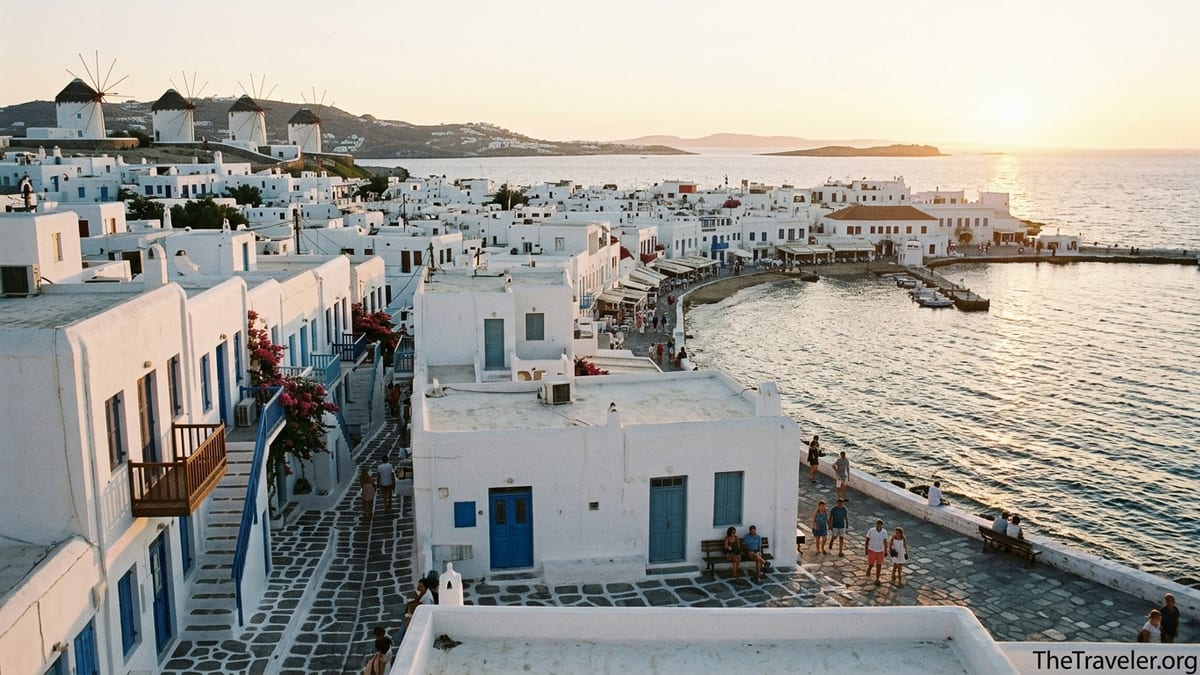
Ask a local on Mykonos where the island’s real magic lives and they will almost always point you toward Chora, better known as Mykonos Town. Beyond the glossy beach clubs and day-trip crowds, this compact, whitewashed maze is where islanders still run errands, meet friends at twilight and pause to watch the sky burn orange over the Aegean. The tangle of lanes and the nightly ritual of sunset are not just pretty backdrops but part of a lived landscape that locals return to again and again.
Get the latest updates straight to your inbox!
Why Mykonos Town Feels Like Home To Locals
To visitors, Mykonos Town can feel like a postcard come to life: cubic white houses stacked above the harbor, blue doors and shutters, cascades of bougainvillea and a web of alleys that seem designed for getting lost. For locals, this is less a stage set and more a familiar neighborhood that has grown with them. Children walk to school through these same marble-paved lanes, older residents sit on low doorsteps chatting in the afternoons, and shopkeepers sweep the same thresholds their grandparents did.
Because the town is mostly car free, sound carries differently. You hear the thud of fishing boats against the quay in the Old Port, the hum of conversation from a kafeneio, and the clink of cups in a café before you ever see them. Many Mykoniots will tell you they prefer to park on the edge of town and walk in, even if they own a car, because the act of crossing those narrow alleys is how they bump into friends and stay connected to daily life.
Practical routines are still woven through the prettiness. Locals might stop at a tiny bakery near the Old Port for a spinach pie on the way to work, or slip into a family-owned grocery tucked behind Matoyianni Street to gather supplies before dinner. This continuity is part of why the town’s whitewashed streets are so loved: despite the seasonal boom of tourism, the core of everyday life has not disappeared.
The Whitewashed Maze: More Than Just A Pretty Backdrop
The whitewashed aesthetic that defines Mykonos Town is not just for photographs. Houses follow the vernacular Cycladic style, with cubic forms, flat roofs and thick walls that keep interiors cooler in summer and warmer in winter. Many buildings are still limewashed at least once a year, often in spring, both to refresh their bright appearance and for practical reasons of hygiene and heat reflection. Blue and red doors, shutters and stair rails add contrast and help distinguish one home from another in the dense fabric of the town.
Walk along the back lanes off Matoyianni Street and you will see how deeply this architecture is lived in. Wooden staircases lead up to compact upper-floor apartments where laundry flaps on lines over the street. Tiny chapels are wedged between houses, their white domes and red or blue roofs barely clearing the surrounding rooftops. Low benches built into the walls, known locally as “pezoules,” become informal seating in the evenings as neighbors sit outside to catch the breeze and greet passersby.
Locals often talk about the town as a labyrinth that protects them. The irregular street plan, shaped centuries ago to break the force of strong northerly winds, means no single road runs straight to the sea. That layout also creates endless corners and tiny squares where people can tuck a café table or a flower pot, and where children can play safely away from traffic. Islanders learn these shortcuts early, knowing exactly which alleys stay shaded at midday and which stairways give the quickest access from the Old Port up toward the windmills.
Matoyianni And The Backstreets: Everyday Life Behind The Boutiques
Matoyianni Street, a narrow pedestrian lane that curves through the heart of the old town, is often described as the commercial soul of Mykonos. In summer it fills with visitors browsing jewelry stores, Greek designer boutiques and souvenir shops that stay open late into the night. For locals, Matoyianni is also where they duck into long-running family businesses for everything from handmade leather sandals to a quick espresso at a bar they have frequented for years.
Prices here can be high in peak season, especially for international brands and luxury watches, but step a few meters off Matoyianni onto a side alley and you find a different rhythm. A small minimarket might sell loose oregano and local capers for only a few euros, while a no-frills gyros stand offers a filling pita for less than the price of a waterfront cocktail. Residents know to shop early in the morning or late at night, when the cruise-ship crowds have thinned and the lane feels once again like the small-town main street it once was.
Locals also use Matoyianni as a barometer for the season. When the first shop shutters roll up in April and new seasonal staff appear on the street, it signals the start of spring openings. By late October, when more stores begin to close and evenings grow cooler, islanders talk about the town returning to itself. During these shoulder months, if you wander Matoyianni around sunset, you will often see local families strolling with children and grandparents, enjoying the quieter pace along the same polished paving stones that hundreds of thousands of visitors passed over weeks earlier.
Little Venice And The Old Port: Sunset On The Water’s Edge
Ask where to watch the sunset and many Mykonos locals will suggest heading toward Little Venice, the neighborhood where old sea captains’ houses have balconies that lean daringly over the water. Here, bars and cafés line the edge of the sea, with tables pressed close together so guests can watch the sun drop directly into the horizon. Popular spots like Caprice or Galleraki are known for their sunset cocktails, and by around 30 to 60 minutes before sundown the coveted waterfront seats are usually taken, especially in July and August.
Locals tend to approach this ritual differently. Some will book a table at one of these bars once or twice a season for a special occasion, knowing a single drink can easily cost in the range of 15 to 20 euros in high season. Many others skip the premium prices and simply walk along the sea wall between Little Venice and the Old Port, leaning on the stone parapet as the sky changes color for free. From this vantage point, you get the same silhouettes of the famous windmills and the warm glow on the white houses, along with the sound of waves slapping at the rocks below.
The Old Port itself, just a short walk from Little Venice, is another favored local viewing point. Fishing boats and small excursion vessels moor here, and in the evenings the quay is dotted with locals finishing work, teenagers sharing ice creams, and grandparents taking a slow stroll. When cruise ships anchor offshore, you may see tenders shuttling passengers back, but the mood around the harbor at sunset often remains relaxed, with soft light reflecting off the water and the town’s white façades turning shades of gold and pink.
The Windmills And Hilltop Vantage Points Locals Cherish
The cluster of traditional windmills on the low hill above Little Venice is one of Mykonos Town’s most recognizable images. Once used to grind grain powered by the Aegean winds, these round white towers now serve mostly as landmarks and viewpoints. At sunset, the slope around Boni’s Windmill and the nearby mills fills with people who come to watch the sky fade over the sea and the town below spark to life with lights. Many locals still consider this the most iconic angle on their town, where you can see both the old houses and the harbor in a single sweep.
On busy summer evenings, the hill can be crowded, so residents sometimes walk a little further inland to find quieter spots. A short climb up through backstreets behind the mills brings you to residential terraces and small lanes that open onto unexpected panoramas. From here you see laundry lines, rooftop water tanks and small rooftop gardens in the foreground, all silhouetted against the wide sea. The view may not be as polished as from a hotel rooftop bar, but it is exactly this rough-edged perspective that locals appreciate.
In recent years, several hotels and bars above town have also become sought-after sunset vantage points. A rooftop lounge on the northern edge of Chora might charge for signature cocktails, but it rewards guests with broad views over the harbor, cruise ships and the ribbon of white houses hugging the coast. Locals sometimes visit these spots for special occasions, yet on most evenings they remain loyal to the public hillsides and simple benches that have framed their sunsets since childhood.
Sunset As A Daily Ritual, Not Just A Photo Opportunity
For many islanders, sunset in Mykonos Town is less about chasing the most dramatic view and more about marking the transition between day and night. Restaurant staff step outside for a brief pause, gaze west for a moment, and then slip back in to prepare for the dinner rush. Shopkeepers might lean in their doorways, watching the sky while greeting customers. Families time their evening walk along the harbor so that children can watch the sun disappear behind the low hills of Delos and Rhenia in the distance.
Even outside peak season, this ritual endures. In April and May, when days are longer and crowds lighter, locals often have their pick of benches along the waterfront. A simple paper cup of takeaway coffee from a kiosk near the Old Port may be all they carry, yet the act of sitting and watching the changing colors remains the same. In late autumn, when cool winds pick up, the sunset crowd thins to a handful of residents in jackets and scarves, still pausing to look west before heading home.
Travelers can tap into this local rhythm by resisting the urge to rush from one famous viewpoint to another. Instead, consider choosing a single place in town and returning there several evenings in a row. You might stand on the same step near the old church of Panagia Paraportiani, for example, watching how the golden light picks out its irregular white forms differently each night, or sit at the same section of sea wall below Little Venice as the waves and clouds change. This simple repetition mirrors the local experience and often yields more meaningful memories than chasing the most photographed angle.
Living History: Churches, Museums And Quiet Corners
Part of what binds locals to Mykonos Town is the presence of living history woven through its alleys. The church complex of Panagia Paraportiani, near the old Kastro district, is a prime example. Rather than a single structure, it is a cluster of small white chapels built between the 15th and 17th centuries, fused over time into one sculptural form. Islanders still attend services here, particularly on feast days, and many speak of the nearby square as a place where generations of their family have gathered for processions and celebrations.
Close to the Old Port, the Archaeological Museum of Mykonos displays pottery and artifacts from the surrounding islands, including finds from nearby Rhenia. While most tour groups pass quickly through or skip it altogether, local schoolchildren come here on field trips to learn about the island’s deeper past. For residents, knowing that this history is housed right by the everyday fishing docks and ferry piers reinforces a sense of continuity between the ancient and modern town.
Scattered through the lanes are also more modest historical corners: an old well incorporated into a courtyard, a former captain’s house now converted to a gallery, or a tiny chapel whose door is left open for quiet reflection. These spaces provide shade and stillness amid the busier commercial streets. Locals often recommend that visitors step into whichever church doors they find open, not only for religious reasons but to appreciate the cool, incense-scented interiors and the way small windows frame slivers of dazzling white walls outside.
How Travelers Can Experience Mykonos Town Like A Local
To understand why locals love Mykonos Town, it helps to slow down and match their pace. Plan at least one full day and evening focused only on Chora, rather than treating it as a quick photo stop between beaches. Start early with a morning walk through the nearly empty lanes, when delivery carts rumble through and café owners arrange chairs and wipe down tables. At this hour, even Matoyianni Street feels like a small village, and you can take photographs of the polished stone alleys without crowds.
Around midday, when the light is hard and temperatures rise, take a break in a shaded café on a side street where local workers eat. Simple dishes like a plate of fava with capers, a Greek salad or grilled sardines are often more affordable here than on the waterfront, and the atmosphere is quieter. After lunch, let yourself get lost in residential alleys behind the Old Port, noticing small details such as latticework balconies, traditional wooden shutters and homemade signs for rooms to rent. These details reveal the town as a lived-in place, not only a backdrop for visitors.
As sunset approaches, choose your viewpoint with intention. If you want the full drama of waves crashing below you and windmills in silhouette, head toward Little Venice and the mills at least 45 minutes early, accepting that drink prices will reflect the location. If you prefer a more local-feeling experience, stroll the harborfront of the Old Port with a takeaway coffee or ice cream instead, joining the mix of residents and visitors who cluster along the sea wall. Later in the evening, return to the quieter backstreets, where cats doze on doorsteps and the whitewashed lanes glow softly under warm streetlights.
The Takeaway
Mykonos Town is more than the sum of its famous images. Locals cherish its whitewashed streets because they are the setting for their everyday routines, from morning errands to late-night conversations on doorstep benches. They love its sunsets not only for the spectacle over Little Venice, but for the small daily pause those colors create in a busy season. For travelers willing to look beyond the surface, walking the town slowly, visiting in the shoulder months or venturing into less polished corners can reveal a place that is still deeply rooted in local life.
Spend time in Chora and you begin to understand why many islanders who work in beach resorts all day choose to live in or near the old town. The protective maze of alleys, the layered history in its chapels and museums, and the shared ritual of watching the sun sink over the Aegean create a sense of belonging that outlasts seasonal trends. If you let Mykonos Town be more than a backdrop for photos, you may find yourself, like the locals, drawn back to its whitewashed streets and western horizon evening after evening.
FAQ
Q1. When is the best time of year to enjoy Mykonos Town without heavy crowds?
Late May and June, as well as late September and early October, usually offer warm weather, open businesses and fewer day-trippers compared with July and August.
Q2. Are the whitewashed streets of Mykonos Town open to cars?
The central part of Mykonos Town is largely pedestrian, with cars and scooters restricted to the edges, so most exploring is done on foot through the narrow alleys.
Q3. Do I need to reserve a table to watch the sunset in Little Venice?
In peak season it is wise to reserve if you want a waterfront table at a popular bar, or arrive 30 to 60 minutes before sunset to try for a walk-in spot.
Q4. Is it expensive to have a drink at a sunset bar in Mykonos Town?
Prices vary, but in Little Venice and similar hotspots you can expect to pay a premium, often around the mid-teens in euros for a cocktail in high season.
Q5. Where can I watch the sunset in Mykonos Town if I am on a budget?
Free viewpoints include the sea wall between Little Venice and the Old Port, the area around the windmills, and sections of the harborfront where locals gather.
Q6. Are there quieter streets in Mykonos Town away from the main shopping lanes?
Yes, if you step away from Matoyianni Street toward the backstreets behind the Old Port or uphill behind the windmills, you will find more residential, peaceful alleys.
Q7. What should I wear when exploring the whitewashed streets and sunset viewpoints?
Comfortable walking shoes with good grip are important on smooth stone lanes, and a light layer or scarf helps after sunset when sea breezes can feel cool.
Q8. Are local churches in Mykonos Town open to visitors?
Many small churches welcome respectful visitors outside service times; modest dress and quiet behavior are appreciated if you step inside to look around.
Q9. Can I find reasonably priced food in Mykonos Town, or is everything upscale?
Alongside upscale restaurants there are still bakeries, simple tavernas and gyros stands on side streets where locals eat and where prices remain more moderate.
Q10. How long should I plan to spend in Mykonos Town to get a local feel for it?
Allow at least one full day and two evenings in Chora so you can see the town in morning calm, daytime bustle and during sunset, as locals experience it.