


I landed in Mykonos with a familiar plan: power-walk through town, tick off the famous windmills and Little Venice, grab a coffee, and move on to the beaches. Within an hour of actually wandering Mykonos Town, I realized that would have been a mistake. The island’s capital, officially called Chora, is not a backdrop for a few hurried photos. It is a place that rewards anyone willing to slow down, linger, and let the lanes pull you along at their own pace.
Get the latest updates straight to your inbox!
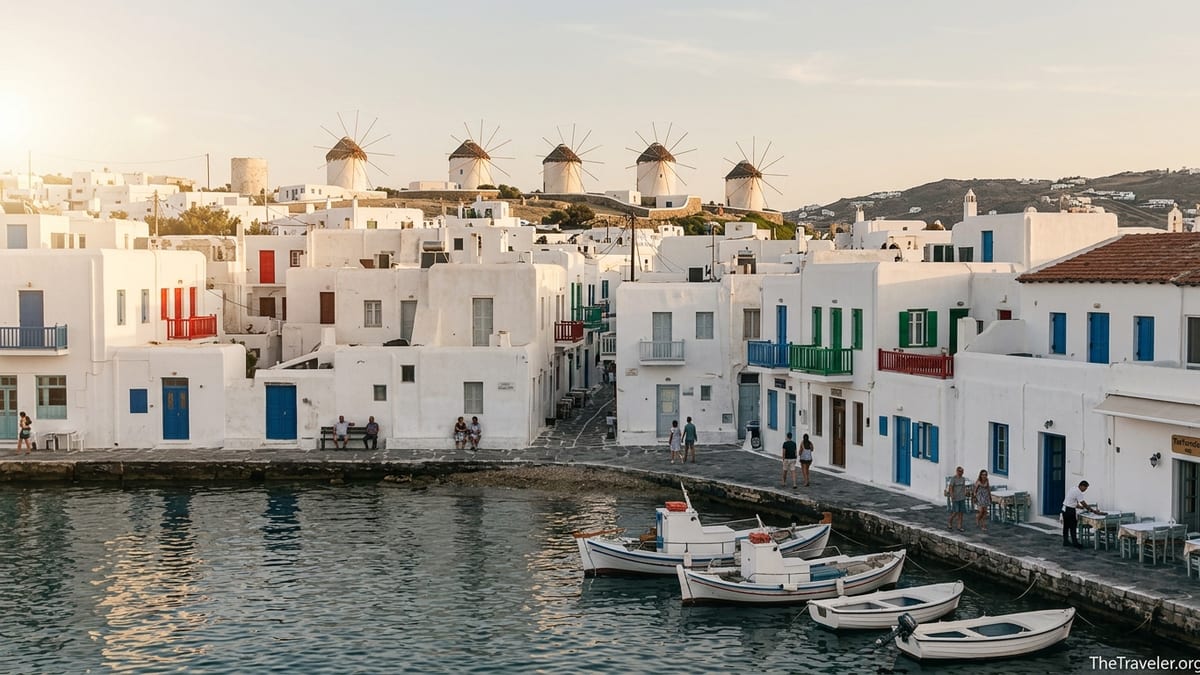
The Rush That Almost Ruined Mykonos Town
My first glimpse of Mykonos Town was from the shuttle bus that runs from the new port into the old harbor area, a five minute ride that costs roughly 2 to 3 euros each way. Many cruise passengers stayed glued to their seats, asking the driver how quickly they could get out to Paradise or Super Paradise beach instead. I was tempted to join them. The plan was to “do” town in an hour and then chase the party scene.
That mindset lasted until I stepped off the bus at the waterfront and walked into the old harbor square. Fishing boats bobbed in the water, a fisherman cleaned his nets next to a kiosk selling boat tickets to Delos, and a late morning hush still hung over the cafes. The town’s white cube houses looked almost too perfect. I told myself I would just cut straight up to Matogianni Street, the main commercial spine, get a feel for it, and move on.
Instead, one side street led to another. A lane lined with bougainvillea opened into a tiny church square. A glimpse of blue shutters pulled me down an alley that dead-ended at a local bakery where a spinach pie cost around 3 euros and the owner insisted I try a small piece of almond amygdalota on the house. My hurried schedule quietly fell apart, replaced by something better: the simple act of being in the maze rather than sprinting through it.
By early afternoon I understood that the greatest mistake visitors make in Mykonos Town is assuming it is a gateway to somewhere else. For a few hours, possibly for an entire day, Chora itself is the destination.
Reading the Town: A Maze Built to Get Lost In
Mykonos Town is often described as a labyrinth, and that is not a marketing line. The streets were deliberately built in a tangle to confuse pirates that once raided the island. Today, that same twisted grid confuses rushed tourists instead. Those staring at the blue dot on their phones miss the pleasure of letting the streets decide their route.
Starting from the harbor, I ducked under a line of drying laundry and found myself near the Kastro neighborhood, the old fortress quarter. Here, the buildings still feel slightly more fortified and austere, with thick whitewashed walls catching the sunlight. In the middle of it all stands the Church of Panagia Paraportiani, a cluster of small white chapels that has become one of Greece’s most photographed churches. In person, it feels less like a postcard and more like a sculpted cliff, its curves softened by centuries of sea wind.
Just a few minutes’ walk away, the mood changes completely in Little Venice. This stretch of former sea captains’ houses sits right over the waves, their balconies hanging above the water. Many have become cocktail bars and restaurants where an Aperol spritz or Greek beer typically costs between 10 and 18 euros at sunset. From the outside, the area is chaotic and crowded in peak season. From the narrow stone path that runs along the back, though, there are quiet moments where you can watch waves slap the foundations and see cats slipping between doorways.
The true character of Mykonos Town is found in the in-between spaces: a shade-drenched corner where an elderly local sits outside a workshop, a blue-domed chapel wedged between designer boutiques, a bench at the edge of the old port where teenagers gather after dark. These are scenes that only reveal themselves if you stop trying to “cover” the town and instead give yourself permission to wander without a checklist.
Beyond the Instagram Shots: Everyday Mykonos in the Lanes
Many visitors arrive with a mental shot list: windmills at sunset, cocktails in Little Venice, a white alley with bougainvillea, perhaps a glimpse of the iconic resident pelican if they are lucky. You can capture all that in an hour. What you miss when you rush is the everyday life happening just a lane or two back from those scenes.
On my first afternoon, I turned off Matogianni Street, where international fashion labels sit next to Greek jewelry designers and minimalist boutiques. Prices here run the gamut from 5 euro fridge magnets to 300 euro linen dresses. One block away, I found a tiny grocery with stacked crates of tomatoes and peaches, selling picnic supplies to locals and seasonal workers. A baguette, some local cheese, and a bottle of water came to under 7 euros, a reminder that Mykonos is not uniformly expensive if you look beyond the glossy shopfronts.
Further inland I stumbled into a small square where a few elderly men were discussing politics over Greek coffee at around 3 euros a cup. A priest walked past with a bag from the local bakery; a child rode his bicycle in circles, the training wheels rattling on the flagstones. This was not the Mykonos of brochure covers, but it felt like the town’s actual heartbeat. If I had kept rushing, I would have missed it entirely.
Even in the height of summer, when cruise ship tenders unload hundreds of passengers at the old port, it only takes a minute or two of walking away from the waterfront to find quiet backstreets. Simple guesthouses advertise rooms, laundries air freshly washed sheets, and tiny chapels remain open for passersby to light candles. This Mykonos is still very much a working town as well as a resort.
Time Well Spent: A Slow Day Itinerary in Mykonos Town
Giving Mykonos Town a full day does not mean ticking off more attractions at high speed. It simply allows you to space things out so the place can breathe. With the benefit of hindsight, this is how I would structure a slow day in Chora that balances sights, food, and aimless wandering.
Arrive early, ideally by 9 am, before the day trips and cruise passengers pour in. From the harbor, wander first through the quieter backstreets, working your way toward the upper windmills above town. Known as Kato Mili, this row of white cylindrical windmills was built in the 16th century and used for grinding grain. Today they are mostly restored landmarks, but the hill they sit on offers a sweeping view over town and the Aegean. Climb up when the light is still soft, and you will share the spot with just a few photographers and local dog walkers.
From there, follow the slope down toward Little Venice and loop through Kastro to see Panagia Paraportiani. Then slip into the shade of the lanes for a late morning coffee break. A cappuccino and pastry at a traditional cafe typically costs around 4 to 6 euros, and the cool interior of an old stone building can feel like a sanctuary from the midsummer sun.
After lunch, when the light is harsh and crowds at their thickest, is a good time to duck into small museums such as the Aegean Maritime Museum or the Folklore Museum, where entry is usually around 5 euros or donation-based. Later, as temperatures ease, stroll back to the harbor and find a spot on the low seawall. Watching the late afternoon ferries come and go while the sky warms toward gold is an experience that costs nothing at all, yet often becomes a lasting memory.
Practical Ways to Slow Down and Still Stay on Budget
Mykonos has a well earned reputation for high prices, especially in its beach clubs and upscale restaurants. That reputation can make visitors feel as if they need to rush through town before they accidentally overspend. In reality, it is entirely possible to slow down in Chora without constantly watching your wallet, if you know where to focus your time and money.
First, take advantage of what is free. Walking the lanes, visiting most of the island’s churches, and climbing to the windmills cost nothing. The best views, from the harbor promenade at sunset to the narrow passages draped in bougainvillea, are open to everyone. Instead of committing to a multi course dinner every night, you can graze through affordable options: a souvlaki wrap from a gyro stand for around 4 to 6 euros, a slice of cheese pie or spinach pie for 3 to 4 euros, or a scoop or two of gelato in the evening for about 3 euros.
Second, be intentional with your “splurge” moments. Maybe you decide that one evening cocktail in Little Venice at 15 or 18 euros is worth it for the view of the sun dropping behind the windmills, but you balance that with a more modest taverna dinner inland on another night where grilled sardines and a Greek salad for two can stay under 40 euros. By choosing a few standout experiences rather than defaulting to the priciest terrace every time, you can stretch both your budget and your time in town.
Finally, consider where you sleep. Staying in a simple guesthouse within walking distance of the old town might mean a smaller room, but it also lets you experience Chora early in the morning and late at night without having to rely on taxis. Those off hours, when streets are almost empty and cafe owners are setting up or closing down, are when the town feels most like itself.
Seeing Mykonos Town in Different Lights
One of the strongest arguments for not rushing through Mykonos Town is how differently it feels throughout the day. If you only pop in for an afternoon, you experience just one version of it: hot, crowded, and brightly lit. Give it a full day or stay nearby for a night, and you will see at least three distinct moods.
In the early morning, the lanes smell of baking bread and fresh coffee. Delivery trucks squeeze cautiously through streets that feel too narrow for them. Shop owners wash down the pavements, and the light bounces softly off the white walls, creating a gentle glow. This is the best time to photograph details without jostling crowds: a blue door framed by red bougainvillea, a cat curled on a stoop, a fisherman mending his nets by the old port.
By midday the town is at its most intense. Day trippers flood in from nearby islands, organized walking tours circle the main sights, and the air carries the mixed scents of sunscreen, sea salt, and grilled octopus. This is the time to move slowly, seek shade, and perhaps retreat indoors for a while. Stopping for a long lunch or an extended coffee break can turn the hours that feel overwhelming into something pleasant and restorative.
As evening approaches, Mykonos Town shifts again. The sun lowers, washing Little Venice and the windmills in warm light as people gather for the nightly ritual of sunset watching. Later, shop shutters clatter down, bar music rises, and the crowd skews younger and more nocturnal. Wandering the backstreets at 11 pm, I passed locals chatting outside their doorways, bartenders on cigarette breaks, and late diners lingering over dessert. It felt like an entirely different town from the one I had rushed into a few hours earlier.
The Takeaway
Mykonos Town is easy to underestimate. It can appear, from a distance, to be little more than a whitewashed backdrop for photos before the real fun begins on the beaches and in the clubs. That was certainly how I thought of it as my shuttle bus rolled into the harbor that first morning. A few hours later, walking home long after sunset with my camera forgotten in my bag, I knew I had misjudged it.
Chora rewards people who treat it as a place to inhabit rather than a checklist to complete. The curve of Panagia Paraportiani against the sky, the quiet of a backstreet square at midday, the sound of waves slapping at the foundations of Little Venice at dusk, the squeak of laundry lines in the night breeze: these details only reveal themselves when you slow down. If you are planning a visit to Mykonos, resist the urge to rush through town on your way to somewhere else. Stay for breakfast, for sunset, for a late night stroll. Let the maze keep you a little longer. You might find, as I did, that the most memorable part of Mykonos is not a beach or a bar at all, but the town you nearly hurried past.
FAQ
Q1. How long do I really need to see Mykonos Town properly?
Most travelers can see the main sights in two or three hours, but a full day or an overnight stay lets you experience the town in different lights and at a more relaxed pace.
Q2. Is Mykonos Town walkable for most visitors?
Yes, the center of Mykonos Town is compact and fully walkable, though streets are often uneven and narrow, so comfortable shoes and a relaxed pace are important.
Q3. What are the must see spots if I have limited time?
If time is short, prioritize the harbor promenade, the windmills above town, Little Venice, Panagia Paraportiani, and a wander along Matogianni Street and its side lanes.
Q4. Is it expensive to eat and drink in Mykonos Town?
Prices vary widely. Waterfront cocktails and fine dining are costly, but you can still find affordable options like gyros, bakery snacks, and simple tavernas away from the main squares.
Q5. When is the best time of day to explore Mykonos Town?
Early morning and late afternoon to evening are the most pleasant, with softer light and fewer crowds. Midday can be very hot and busy in peak season.
Q6. Can I visit Mykonos Town from a cruise ship without booking a tour?
Yes, many cruise passengers simply take the shuttle bus or a short taxi ride into town and explore independently, as the main sights are close together and easy to find.
Q7. Are there quieter, less touristy corners of Mykonos Town?
Stepping just a few streets back from the harbor or Little Venice quickly brings you to quieter residential lanes, small chapels, and local cafes with fewer visitors.
Q8. Is Mykonos Town suitable for families with children?
Families often enjoy the car free lanes, small squares, and harbor area. Parents should watch young children near the sea walls and in crowded streets during peak hours.
Q9. What should I wear for a day exploring Mykonos Town?
Light, breathable clothing, sturdy sandals or sneakers for uneven pavements, a hat, and sunscreen are recommended, along with a light layer for breezier evenings.
Q10. Is it worth staying overnight in or near Mykonos Town?
Staying overnight lets you experience dawn calm and lively evenings without worrying about transport, and often becomes a highlight of a trip to Mykonos.