


Lufthansa’s own lounges are some of the most recognizable in Europe, but access is tightly controlled. Unless you are flying business or first class or hold Miles & More or Star Alliance status, you will usually be turned away at the door. That does not mean you have to spend your layover in a crowded gate area. With the right strategy, you can unlock a surprisingly good range of alternative lounges when flying Lufthansa, often at a lower cost than you might expect.
Get the latest updates straight to your inbox!
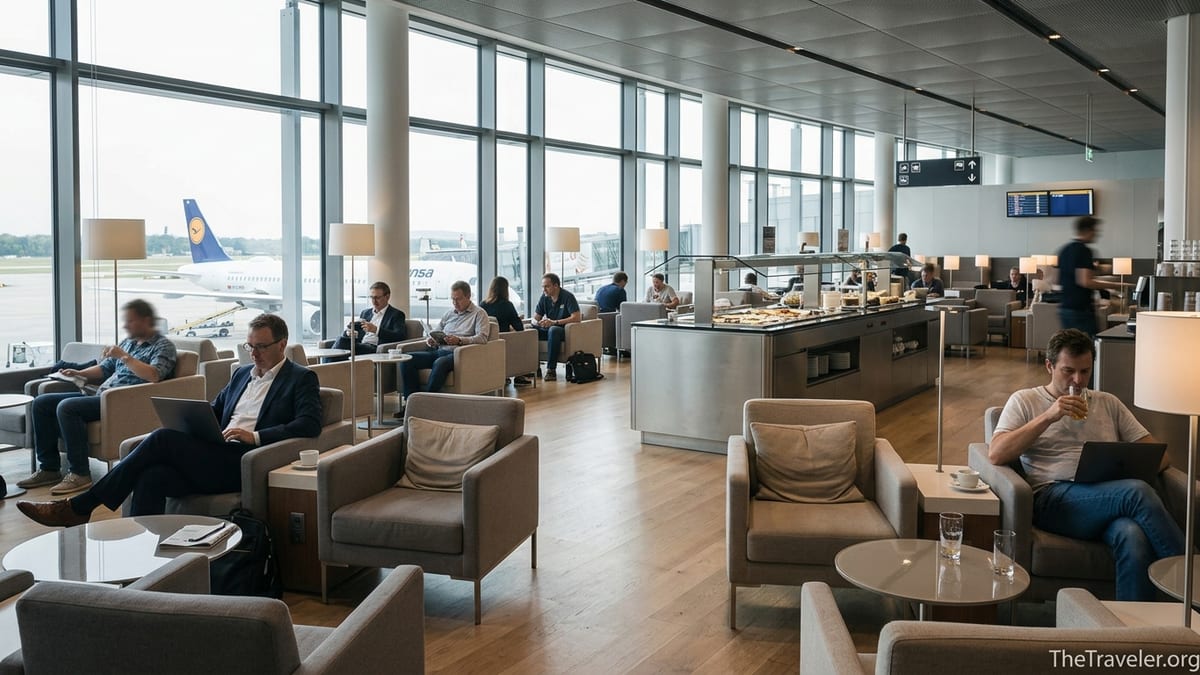
Why You Need Alternatives to Lufthansa’s Own Lounges
Lufthansa operates a large network of branded lounges across Europe, including Business, Senator and First Class lounges, plus a Welcome Lounge in Frankfurt. Access is based on a mix of cabin class and status: premium cabins, Miles & More elites and Star Alliance Gold members are the main groups invited inside. Economy passengers without status are generally excluded, even on long-haul routes, unless they can buy access in specific cases or are on a paid upgrade that includes lounge entry.
That rules out a lot of travelers. Someone flying Lufthansa economy from New York to Frankfurt with no status, for example, will not be allowed into a Lufthansa Business or Senator Lounge upon arrival or departure unless they have separate eligibility. Even passengers on award tickets in premium cabins are subject to the same rules, and relying on an agent to “make an exception” is not a realistic strategy.
The other complication is that Lufthansa frequently uses contract lounges operated by third parties at outstations where it does not run its own facilities. In many of these locations, Lufthansa reserves access to premium cabins and elites, while the same lounge might also sell access to walk-up guests or admit holders of independent lounge memberships. This split access model is what creates real opportunities for travelers who lack status but are willing to plan a bit ahead.
Understanding where Lufthansa’s rules stop and where independent lounge policies begin is key. Once you separate the airline’s branded lounges from the wider ecosystem of contract, third-party and card-based spaces, a lot more doors open, especially at big Lufthansa hubs like Frankfurt and Munich and at common gateway cities across Europe.
Independent Lounges at Lufthansa Hubs: Frankfurt and Munich
Frankfurt is Lufthansa’s primary hub and home to its flagship First Class Terminal, multiple Business and Senator Lounges, and the Welcome Lounge for arriving premium passengers. That can make it feel like there is nothing available if you do not have status. In reality, several independent lounges operate alongside Lufthansa’s spaces and can be accessed with memberships like Priority Pass or by purchasing a day pass. For example, Frankfurt Airport features lounges such as LuxxLounge in Terminal 1 and several non-Lufthansa lounges in Terminal 2 that welcome third-party visitors on paid or membership access.
A common path for non-status travelers at Frankfurt is to rely on a Priority Pass membership obtained through a credit card. With that card, an economy passenger flying Lufthansa to, say, Madrid can clear security, follow signs to an eligible contract lounge and use the space for a few hours before departure, with food, drinks and Wi‑Fi similar to what Lufthansa’s own Business Lounges provide. Typical independent lounge day-pass pricing at Frankfurt, bought online in advance through lounge aggregators or directly at reception, often runs in the region of 25 to 40 euros for a two- or three-hour stay, which can be good value on a long layover.
Munich, Lufthansa’s secondary hub, offers a similar pattern. The airline operates its own lounges, but the airport also runs common-user spaces like Airport Lounge Europe in the Schengen area and Airport Lounge World on the non-Schengen side. These are explicitly designed to be open to any passenger, regardless of airline, on payment of an additional fee after security. In practice, that means an economy traveler connecting on Lufthansa through Munich can pay at the door or use a membership card and enjoy a quieter space with hot food, showers and work areas that compete well with many airline-branded lounges.
The main limitation at both hubs is location. Many independent lounges are clustered in specific terminals or piers, which may not line up perfectly with every Lufthansa departure. If you are connecting from a non-Schengen to a Schengen flight in Frankfurt, for example, moving between concourses can involve additional passport checks and walking time. Building an extra 20 to 30 minutes into your connection if you plan to use an off-pier lounge is a smart move.
Priority Pass and Other Memberships: The Most Flexible Path
For most travelers who fly a mix of airlines and do not hold elite status, an independent lounge membership such as Priority Pass is the single best alternative to Lufthansa-operated lounges. Priority Pass provides access to a global network of more than a thousand lounges and airport experiences. These include many of the contract lounges used by Lufthansa at outstations across Europe, Asia and the Americas, as well as lounges that operate entirely independently of any airline.
From a practical standpoint, this means that a Lufthansa economy passenger flying from Lisbon to Frankfurt could use a Priority Pass-enabled lounge in Lisbon before departure, even though Lufthansa itself would only invite business-class and status customers into its partner space. Another example: a traveler based in the United States who often flies Lufthansa from smaller airports such as Orlando or Denver might find that the only lounge in the terminal is a Priority Pass partner. Their membership becomes the de facto key to a preflight drink, snacks and Wi‑Fi when the airline does not operate its own lounge there.
Many premium credit cards issued in the United States, Europe and Asia include some form of Priority Pass membership as part of the annual fee. Typically, these cards either provide a fixed number of free visits per year or unlimited access for the cardholder and sometimes guests. When you factor this into the calculation, lounge access can be effectively “free” on marginal trips once you hold the card for other reasons, such as bonus points or travel protection. Even if you pay out of pocket, standalone Priority Pass memberships are often worthwhile if you travel internationally a few times per year, because day passes at individual lounges can quickly add up.
It is important to remember that Priority Pass does not grant access to Lufthansa-branded lounges themselves. A card will not get you into the Lufthansa Business Lounge in Frankfurt or Munich unless that specific location is also contracted as an independent lounge for third parties, which Lufthansa-branded lounges typically are not. Instead, treat Priority Pass as your gateway to the “parallel universe” of third-party lounges at Lufthansa airports, which can still provide a comparable level of comfort.
Pay-Per-Use and Contract Lounges on Lufthansa Routes
Another effective strategy is to target contract lounges that sell access directly to passengers, either in advance or on the day of travel. Many airports served by Lufthansa, particularly in Southern and Eastern Europe, the Middle East and secondary German cities, operate lounges that welcome any traveler willing to pay a fee at the door. These lounges often double as the contract lounges used by Lufthansa for its premium passengers, which means you may be sitting in the same space as business-class guests even if you entered with a day pass.
For example, in cities like Prague, Budapest or Porto, the main airport lounge is typically a third-party operation that serves multiple airlines. Lufthansa sends its business-class and status passengers there, but the operator also sells individual entry, usually priced somewhere in the 30 to 50 euro range for a few hours’ access. Booking ahead via a lounge booking platform can sometimes reduce this cost by a few euros and lock in your spot during busy times.
At Lufthansa’s own hubs, day-pass style access is more limited for its branded lounges but still exists in some contexts. Certain contract lounges in terminals used by Lufthansa may sell walk-up access during quieter periods. A traveler might, for instance, arrive early for a Frankfurt departure and find a non-Lufthansa lounge in the same terminal offering a posted walk-in rate around 35 euros, including buffet food and drinks. While prices fluctuate by airport and operator, these figures give a realistic sense of what you might pay compared with a full independent lounge membership.
Pay-per-use lounges are particularly useful for occasional travelers who do not want to commit to an annual membership or premium credit card. If you only take one or two international trips a year and value a shower, a glass of wine and a quiet workspace, planning to buy a lounge pass selectively at airports where Lufthansa uses contract lounges can be more economical than signing up for a global program you will rarely use.
Credit Card Lounges and Partner Networks
Premium travel credit cards have built their own ecosystems of lounges, many of which operate entirely separately from airline-branded spaces. American Express, for example, has rolled out its Centurion Lounge network in key global hubs, while banks such as Capital One and Chase are opening branded lounges in select airports. Although you will not find a bank-branded lounge in every city Lufthansa serves, these spaces can be a strong alternative in markets where they overlap with Lufthansa routes.
Consider a Lufthansa passenger connecting through a U.S. gateway like New York or Washington. At those airports, a premium cardholder might be able to use a bank-operated lounge before boarding a Lufthansa flight to Europe. The quality of these lounges is often high, with freshly prepared food, showers and well-designed seating areas. For a traveler in Lufthansa economy, this setup effectively replaces the airline’s own lounge even though the space is not affiliated with Lufthansa or Star Alliance.
In addition to proprietary bank lounges, several airline clubs maintain reciprocal access agreements or accept certain credit-card-based memberships. While Lufthansa’s own lounges typically do not recognize foreign bank cards for entry, you may find that non-Lufthansa lounges at shared terminals do. For instance, a common scenario is a lounge that serves as a contract facility for multiple carriers, welcomes Priority Pass and also allows access to holders of specific co-branded airline credit cards from other alliances. This mash-up of access rules can work in your favor if you happen to hold one of the recognized cards.
The key when flying Lufthansa is to think of lounge access as independent from the airline brand. If your premium credit card offers a lounge network or membership, check in advance whether those lounges exist in the terminals from which Lufthansa operates at your departure and transit airports. You may find that the best option is not a “Lufthansa” lounge at all but an unrelated bank or independent space that simply happens to be in the right location.
Smart Booking Strategies to Maximize Lounge Access
Even without status, the choices you make when booking Lufthansa flights can significantly influence your lounge options. One straightforward tactic is to prioritize airports and connection points with strong independent lounge coverage. For example, if you have flexibility routing from North America to Central Europe, you might choose a connection through an airport where your lounge membership has multiple participating lounges rather than one where options are sparse.
Cabin class also matters. While this article focuses on alternatives to Lufthansa-operated lounges, booking a premium cabin on any Star Alliance carrier can unlock lounge access before your Lufthansa segment. A traveler flying business class on a partner airline into Lufthansa’s hub will normally have access to a business-class lounge at their departure airport, regardless of which airline actually operates that lounge. This does not guarantee access to Lufthansa’s own lounges on arrival, but it can transform the ground experience at the start of your trip.
You should also consider layover length. Many lounges cap visits at three hours during busy times, and some independent lounges may impose surcharges or refuse entry during peak congestion. Booking an itinerary with an excessively long layover under the assumption that you can camp in a lounge all day is risky. A balanced connection of two to four hours is usually ideal: long enough to clear formalities and enjoy the lounge, but short enough that you will not overstay any posted time limit.
Finally, always verify terminal and pier information once your booking is ticketed. Lufthansa and its partners sometimes adjust departure gates between Schengen and non-Schengen areas or switch terminals for operational reasons. If your preferred independent lounge is located airside in a different concourse, you may need extra buffer time or a backup plan, such as using a landside lounge that can be accessed before security if you arrive particularly early.
The Takeaway
If you are flying Lufthansa without status, you are not locked out of airport comfort. The airline’s own Business and Senator Lounges may be off limits, but a parallel ecosystem of independent, contract and card-based lounges can effectively replace them in many airports. At hubs like Frankfurt and Munich, common-user and independent lounges offer solid food, drinks and workspaces, while across the broader network, third-party lounges at outstations often welcome walk-up guests or membership-card holders on the same terms as premium-cabin passengers.
The most versatile tools are independent lounge memberships such as Priority Pass and premium credit cards that bundle lounge access as a perk. For occasional travelers, selectively buying day passes at contract lounges on Lufthansa routes can be more economical, especially if you target airports where the same lounge doubles as the space used by business-class guests. Combine these options with smart routing and realistic layover times, and you can enjoy many of the on-the-ground benefits of status without ever holding a Lufthansa or Star Alliance elite card.
FAQ
Q1. Can I buy access directly to a Lufthansa-branded Business or Senator Lounge?
In general, Lufthansa’s own Business and Senator Lounges do not sell open day passes to economy passengers without status. Access is usually limited to eligible status holders and premium-cabin travelers, though at some airports Lufthansa may use contract lounges that do sell day passes separately from airline rules.
Q2. Does a Priority Pass membership get me into Lufthansa lounges?
No. Priority Pass does not provide access to Lufthansa-branded lounges. It gives you entry to independent and contract lounges that participate in the Priority Pass network, some of which may operate in the same terminals that Lufthansa uses.
Q3. Are there independent lounges at Frankfurt where I can go when flying Lufthansa economy?
Yes. Frankfurt Airport offers several independent lounges that can be accessed with memberships like Priority Pass or by paying a day fee. These lounges are separate from Lufthansa’s own facilities but often provide similar amenities such as snacks, drinks, Wi‑Fi and work areas.
Q4. What about Munich Airport if I do not have status?
Munich has common-user lounges that can be accessed by any passenger for an additional fee after security, regardless of airline. Lufthansa economy passengers can use these spaces by paying at the door or using eligible lounge memberships, making them a practical alternative to Lufthansa’s own lounges.
Q5. Do premium travel credit cards help with lounge access on Lufthansa trips?
Yes. Many premium cards include access to a bank-owned lounge network, Priority Pass or similar memberships. While these benefits rarely cover Lufthansa-branded lounges directly, they can open doors to independent lounges in the same airports where Lufthansa operates.
Q6. If I book business class on a Star Alliance partner, will that help?
Booking business or first class on a Star Alliance carrier usually grants lounge access before departure on that leg, even if you have no status. This may not guarantee access to Lufthansa’s lounges at every connection point, but it can significantly improve the ground experience at airports where partner lounges or shared facilities are available.
Q7. Are paid day passes at independent lounges worth it compared to a membership?
For occasional travelers taking one or two international trips a year, paying 25 to 50 euros for a day pass at a good independent lounge can be more cost-effective than buying an annual membership. Frequent travelers who pass through multiple airports annually may find that a membership pays for itself after just a few trips.
Q8. Can I use lounges at arrival when I land on a Lufthansa flight?
Arrival lounge access is limited. Lufthansa’s dedicated Welcome Lounge in Frankfurt is primarily reserved for arriving premium passengers under specific conditions. Most independent lounges focus on departing passengers after security, so if lounge access after landing is important, check the rules and locations carefully before you travel.
Q9. Does Star Alliance Gold status guarantee alternatives if a Lufthansa lounge is full?
Star Alliance Gold status provides access to designated alliance lounges, but availability can still be restricted during peak times. If a Lufthansa lounge is at capacity, staff may direct you to a partner or contract lounge where your status or membership is accepted, but this is subject to local policies and space.
Q10. How far in advance should I plan lounge access for a Lufthansa trip?
It is wise to check lounge options and access rules as soon as your itinerary is ticketed, especially for long-haul journeys or tight connections. This allows you to decide whether to buy a membership, rely on existing card benefits, prebook a day pass or adjust your routing to airports with better independent lounge coverage.