


Set on a quiet hill above central Nice, the Marc Chagall National Museum looks modest from the street. Yet inside this low, white modernist building you will find one of the world’s most concentrated collections of works by Marc Chagall, the visionary painter of dreamlike color, biblical stories, and floating lovers. For many travelers to the French Riviera, a visit here becomes the most memorable cultural stop of their trip.
Get the latest updates straight to your inbox!
What Exactly Is the Marc Chagall National Museum?
The Marc Chagall National Museum in Nice is a French state museum dedicated largely to the spiritual and biblical works of Marc Chagall, the Belarusian‑born, naturalized French artist who became one of the 20th century’s most distinctive painters. Opened on July 7, 1973, during Chagall’s lifetime, it was the first French national museum created for a living artist. The museum was originally called the National Museum of the Biblical Message of Marc Chagall and was built specifically to house his cycle of large canvases inspired by the Hebrew Bible.
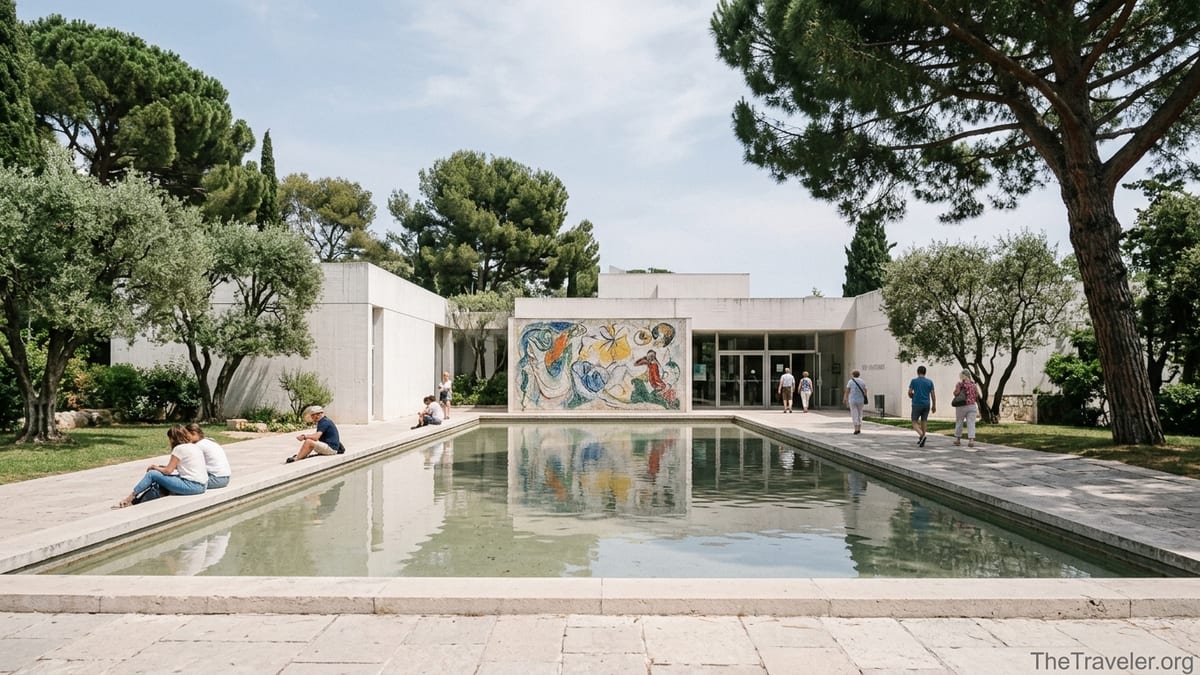
The museum sits in the Cimiez district, a leafy residential area a short bus ride uphill from Nice’s seafront and Old Town. From the outside, visitors see a low, angular white structure set within a Mediterranean garden of pines and olive trees. Inside, natural light, pale walls, and simple lines create a contemplative atmosphere that lets Chagall’s saturated reds, blues, greens, and yellows dominate every room.
Unlike larger encyclopedic museums such as the Louvre or the Metropolitan Museum of Art, the Marc Chagall National Museum is intimate. Many travelers spend about 60 to 90 minutes exploring its permanent collection, plus extra time for any temporary exhibition. That human scale is part of its charm. Rather than overwhelming visitors with thousands of works, the museum invites you to spend real time with a focused body of paintings, drawings, stained glass, and sculpture.
For the French state, the museum is not only a repository of art but also a symbol of the close relationship between France and Chagall. He donated the core “Biblical Message” cycle to France on the condition that a dedicated museum be built in Nice, where he had settled after World War II. Visiting the museum today means stepping into a space that the artist actively shaped, from the hanging of his canvases to the design of a mosaic and stained‑glass windows made specially for the building.
The Biblical Message: The Heart of the Collection
The most important reason this museum matters is the “Message Biblique,” a cycle of monumental paintings that Chagall created between the mid‑1950s and mid‑1960s. These works reinterpret key episodes from the Hebrew Bible using his unmistakable visual language: floating figures, animals, fragments of villages from his native Vitebsk, and intense, emotional color. They are arranged in a series of galleries that form the core of the permanent collection and give the museum both its original name and its unique identity.
On a practical level, this means that a visitor can see, in one place, 17 major canvases that are usually discussed individually in art books or scattered as reproductions in catalogs. In Nice they hang together, so you might move from “The Sacrifice of Isaac” to “Jacob’s Dream” to “Moses Receiving the Tablets of the Law” in a single slow circuit. Many travelers describe sitting on one of the central benches, quietly turning in place to follow the biblical narrative around the walls, almost like reading a visual Torah.
The scale of these works is striking in person. Where a postcard barely hints at their impact, standing a few feet from an enormous composition of Noah and the rainbow, painted in luminous blues and reds, can feel almost cinematic. The museum’s neutral architecture deliberately recedes, so that visitors are surrounded by color fields rather than architectural distractions. Staff often encourage people to take their time, and it is common to see visitors closing their eyes for a moment or leaning forward to examine a small goat, angel, or village tucked into the corner of a canvas.
For students of art history, the cycle is important because it unites several strands of Chagall’s identity: his Jewish heritage, his experience of exile and war, and his lifelong search for spiritual meaning expressed through modern painting. For casual travelers, it offers something more intuitive: a deeply personal, emotional response to stories many have heard but rarely seen visualized with such tenderness and imagination.
A Museum Chagall Helped Design
Another reason the Marc Chagall National Museum stands out is that the artist himself was closely involved in its creation. The building was designed by French architect André Hermant, a modernist who had previously worked with Auguste Perret and Le Corbusier. Hermant conceived a simple, almost austere complex of low volumes organized around patios and a reflecting pool, leaving generous wall space and soft natural light for the works. Chagall supervised how his paintings would be hung and created several major pieces specifically for the museum.
Visitors see this collaboration the moment they step into the courtyard, where a large mosaic depicting the prophet Elijah overlooks a shallow pool. The mosaic’s blues and golds shimmer in the Mediterranean sun, reflected in the water at its base. On a warm afternoon in June or September, it is common to see small groups of visitors sitting along the pool’s edge, listening to the audio guide while the mosaic glows behind them. This integration of art, water, and garden is central to the museum’s atmosphere.
Inside, one of the most memorable spaces is the auditorium, which Chagall envisioned as a place where music and painting would meet. Large stained‑glass windows, known as “The Creation of the World,” fill the hall with deep blues and vibrant fragments of red and yellow. Even if there is no concert scheduled, you can usually enter the hall and sit quietly while the colored light washes over the seats and walls. For many visitors, this room alone justifies the detour from the beach.
The museum complex also includes a small chapel‑like space with a tapestry woven at the Gobelins Manufactory in Paris after a design by Chagall, plus a library and educational rooms used for workshops with school groups. When you walk through on a weekday morning, you might encounter a group of local children sketching a detail from one of the paintings, an everyday reminder that this is a living cultural institution rather than a static monument.
Beyond the Bible: A Rich and Varied Collection
Although the Biblical Message cycle is the museum’s heart, the collection goes far beyond these 17 canvases. Over the years, the French state, Chagall’s family, and close collaborators such as his master printer Charles Sorlier have donated additional works, so the museum now holds hundreds of pieces including oils, gouaches, pastels, drawings, lithographs, and ceramics. For travelers, this means a rare chance to see the full range of Chagall’s creativity in one visit.
In practice, the galleries typically include more intimate, secular works that balance the grand biblical scenes. You might come across portraits of Chagall and his wife, village scenes that evoke his childhood in Vitebsk, or whimsical animal figures that feel closer to folklore than scripture. These pieces help visitors connect the spiritual intensity of the large canvases with the everyday details of the artist’s life: his love for music, his attachment to memory, and his fascination with the circus and theater.
The museum also preserves and sometimes displays Chagall’s work as a printmaker, especially lithographs produced with the famed Mourlot studio. Travelers interested in graphic arts often pause here to compare the texture and line quality of lithographs to the thick, almost sculptural paint surfaces of the major oils. In some seasons, the museum mounts focused exhibitions that highlight Chagall’s work in a particular medium or period, such as his illustrations for literature or his collaborations on stained glass.
This breadth matters because it corrects the popular image of Chagall as simply a painter of dreamy lovers and floating animals. By showing his drafts, studies, and more experimental pieces, the museum reveals an artist who was constantly refining his visual language, trying out new compositions and techniques while remaining faithful to certain core symbols and colors.
Why the Museum Is So Important Culturally
The Marc Chagall National Museum occupies a special place in both French cultural policy and international modern art. When it opened in 1973, it signaled a new willingness on the part of the French state to honor a modern artist not just posthumously, but as a living partner. For Chagall, who had experienced antisemitism in the Russian Empire, exile during the Second World War, and the devastation of European Jewry, this official recognition from France carried profound symbolic weight.
From an art historical perspective, the museum safeguards one of the few large‑scale, coherent cycles of biblical painting created in the 20th century by a major modernist. Many church and synagogue commissions from this era focused on stained glass or single murals. In Nice, you find an entire narrative sequence conceived for a secular museum setting, where people of any or no faith can encounter the stories as universal meditations on love, exile, suffering, and hope.
For the city of Nice and the wider Côte d’Azur, the museum strengthens the region’s identity as a hub of modern art. Travelers who come for the beaches often discover an unexpectedly rich cultural scene that includes the Matisse Museum, the Museum of Modern and Contemporary Art (MAMAC), and, a short train ride away, the Picasso Museum in Antibes and the Fondation Maeght in Saint‑Paul‑de‑Vence. The Chagall Museum forms a vital part of this network, attracting visitors who might otherwise skip Nice’s hillside neighborhoods altogether.
On a more personal level, the museum matters because it offers a quieter, more introspective experience than many blockbuster institutions. Reviews from recent visitors often mention feeling unexpectedly moved, even if they arrived with only a vague idea of who Chagall was. Couples on a Riviera honeymoon, solo travelers on a winter city break, and families with teens who enjoy art all report that the museum provided a calm counterpoint to the busy Promenade des Anglais below.
Planning Your Visit: Practical Tips and Visitor Experience
For most travelers, visiting the Marc Chagall National Museum is relatively straightforward. The museum is located on Avenue du Docteur Ménard in northern Nice. From the city center, many visitors either walk uphill for about 25 to 30 minutes from the main train station, take a local bus such as line 5 to the stop named for the museum, or use the hop‑on hop‑off sightseeing bus, which also stops nearby. Taxis and ride‑share services can bring you from the seafront in roughly 10 to 15 minutes, depending on traffic.
Opening hours can vary slightly by season and on public holidays, so it is wise to check the official museum information shortly before your visit. As of mid‑2026, adult tickets for the permanent collection and most temporary exhibitions typically cost in the low to mid‑teens in euros, with reduced rates for visitors under 26, students, and certain cardholders. Children from European Union countries and some other categories may benefit from free entry. The museum sometimes participates in combined or “twin” ticket offers with the nearby Fernand Léger National Museum, which can be attractive for art‑focused travelers planning a day of museum visits along the coast.
Inside, expect a calm and orderly experience rather than crowds on the scale of major capital‑city museums. Weekday mornings outside peak summer tend to be especially tranquil, while rainy afternoons in July and August can be busier as beachgoers seek indoor alternatives. Audioguides are often available in several languages for an additional modest fee, and they can greatly enrich your understanding of the biblical cycle and Chagall’s symbolism. Many visitors also appreciate the small but well‑stocked bookshop, where you can find reproductions, postcards, and catalogs that are difficult to source outside France.
If you are planning a longer day out, you can combine the museum with a visit to the Matisse Museum in the nearby Cimiez neighborhood, set in a villa overlooking olive groves and Roman ruins. Some travelers start at Chagall in the late morning, stroll or bus across to Matisse for the afternoon, then head back down via the Monastery of Cimiez gardens for sunset views over Nice. This makes for a full but manageable art‑and‑history day without leaving the city.
How Long to Spend and Who Will Enjoy It Most
Most travelers find that 60 to 90 minutes is enough time to visit the Marc Chagall National Museum at a comfortable pace. This includes a slow walk through the Biblical Message rooms, a look at other galleries and any temporary exhibition, a short rest in the garden or by the reflecting pool, and perhaps a browse in the shop. Art enthusiasts or visitors using the audioguide often stretch their visit to two hours or more.
The museum is especially rewarding for travelers who enjoy color‑driven modern art, spiritual or symbolic themes, or quieter museum environments. Fans of artists such as Matisse, Kandinsky, or Paul Klee often respond quickly to Chagall’s palette and poetic approach. Visitors interested in Jewish heritage or biblical narratives may find additional layers of meaning in the way familiar stories are transformed into modern visual metaphors.
Families with older children or teenagers can also have a positive experience here, particularly if they keep the visit focused and interactive. Chagall’s floating animals, angels, and village scenes can spark imaginative conversations, and the museum often offers family‑friendly materials or workshops during school holidays. Very young children might find the visit short on hands‑on elements, so parents sometimes pair the museum with time in a nearby park or an ice cream stop in the Old Town afterward.
Travelers with limited mobility should be aware that the museum building is relatively compact and mostly on a single level, although the approach from the bus stop involves mild slopes. Inside, benches in the galleries and in the courtyard offer several places to rest. If accessibility is a priority, it is wise to review the latest information from the museum shortly before your trip, as facilities and services can evolve over time.
The Takeaway
The Marc Chagall National Museum in Nice is far more than a small hillside gallery devoted to a single artist. It is a purpose‑built environment where architecture, garden, light, and sound work together to showcase one of the 20th century’s most personal and poetic responses to biblical stories. For visitors, this means an experience that feels both intimate and profound, even if they arrive with little prior knowledge of Chagall or the Hebrew Bible.
Its importance lies in several overlapping roles: a national tribute to a major modern artist, a guardian of a unique cycle of religious paintings, a cornerstone of the Riviera’s rich museum landscape, and a rare space where travelers can slow down and contemplate themes of love, exile, and hope. Whether you are spending a week on the Côte d’Azur or just passing through Nice for a day, setting aside a few hours for this museum can add a deeply memorable cultural dimension to your trip.
FAQ
Q1. Where is the Marc Chagall National Museum located in Nice?
The museum is in the Cimiez district of Nice, on Avenue du Docteur Ménard, a short bus ride or uphill walk from the city center and main train station.
Q2. Why was the Marc Chagall National Museum created?
It was created in the early 1970s to house Marc Chagall’s monumental “Biblical Message” paintings, which he donated to France on the condition that a dedicated museum be built in Nice.
Q3. How long should I plan for a visit?
Most visitors spend between 60 and 90 minutes exploring the permanent collection, plus extra time if they use the audioguide, browse the shop, or see a temporary exhibition.
Q4. Is the museum suitable for children?
Yes, particularly for older children and teenagers. The vibrant colors and imaginative figures can be engaging, and during school holidays the museum often offers family‑oriented activities or materials.
Q5. Do I need to book tickets in advance?
Advance booking is not always essential, but in busy summer periods or during popular special exhibitions it can be wise to secure tickets ahead of time using the official channels.
Q6. What makes the museum architecturally special?
The building, designed by André Hermant with input from Chagall, uses simple modernist forms, white walls, and natural light, along with a garden, mosaic, and stained glass created specifically for the site.
Q7. Is photography allowed inside the museum?
Photography policies can change, but non‑flash photography for personal use is often allowed in many areas. Visitors should always check current rules on arrival and follow staff instructions.
Q8. Are there temporary exhibitions as well as the permanent collection?
Yes. In addition to the core Biblical Message cycle, the museum regularly hosts temporary exhibitions that explore different aspects of Chagall’s work or present dialogues between his art and that of other modern artists.
Q9. Can I combine a visit with other nearby museums?
Many travelers pair the Chagall Museum with the Matisse Museum in Cimiez or, on a longer day, with other Côte d’Azur institutions such as the Picasso Museum in Antibes or the Fondation Maeght in Saint‑Paul‑de‑Vence.
Q10. Why is the Marc Chagall National Museum considered so important?
It is important because it preserves a unique cycle of modern biblical paintings, honors Chagall’s close relationship with France, and offers one of the most focused and emotionally resonant museum experiences on the French Riviera.