


I thought I knew Marc Chagall before I walked up the quiet hill to his museum in Nice. I had seen the floating lovers on postcards in Paris bookshops, glimpsed his stained-glass windows reproduced in art history slides, and absorbed the usual shorthand for his work: dreamlike, poetic, whimsical. It was only after spending an unhurried afternoon inside the Marc Chagall National Museum that those clichés fell away and the work, in all its scale and gravity, finally rearranged how I saw his art.
Get the latest updates straight to your inbox!
Arriving Above the City: A Different Kind of Pilgrimage
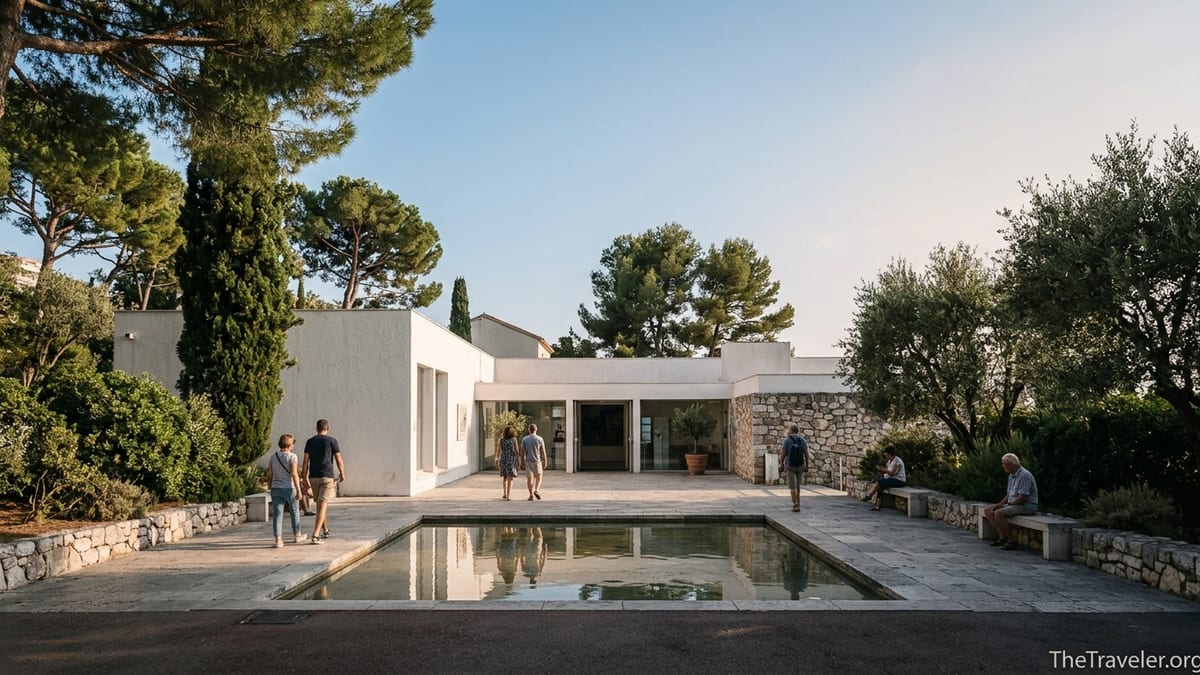
The Marc Chagall National Museum sits in the quiet Cimiez district, above the traffic and beach clubs of central Nice. From the tram stop at Libération, I followed residential streets past apartment blocks with laundry on balconies, then turned onto avenue du Docteur Ménard. The city noise thinned out. By the time I reached the low, white modernist building, framed by pines and olive trees, it felt less like entering a major national museum and more like arriving at a private sanctuary.
That modest setting is intentional. The museum was created in the early 1970s with Chagall’s direct involvement and opened in 1973, designed specifically to house his most important biblical paintings. The complex curves around a central garden with a shallow pool, more villa than institution. On a typical morning you might share the courtyard with a handful of visitors and a school group, not tour buses. For travelers used to queuing for big-hitters like the Louvre or the Vatican Museums, the calm here is disarming.
Practicalities are refreshingly straightforward. As of 2026, the museum is open daily except Tuesday, generally from 10 a.m. to 6 p.m. in the high season and closing an hour earlier in the cooler months, with ticket sales stopping about half an hour before closing. A standard adult ticket costs in the ballpark of 8 to 10 euros and includes access to the permanent collection along with a multilingual audio guide, which you pick up just beyond the entrance desk. Combined tickets with other nearby national museums, like the Fernand Léger museum along the coast, are sometimes available, so it is worth checking on the day.
What struck me, even before I saw a single painting, was the scale: this is not an encyclopedic museum trying to do everything. It is tightly focused on one artist and, at its heart, on a single, cohesive cycle of 17 biblical canvases that Chagall donated to the French state. That concentration creates an unusually intimate rhythm for a visit. Instead of racing from room to room, you slow down, revisit the same works from different angles, and start to notice how the pieces speak to one another.
The Biblical Message: Encountering Chagall at Full Scale
The first major gallery, devoted to what the museum calls the Biblical Message, is where my understanding of Chagall shifted. Reproductions never quite convey that these are not minor devotional pictures; they are monumental oils, some nearly wall-sized, painted across the 1950s and 1960s and arranged like chapters in a story: Genesis, Exodus, and the Song of Songs. Many travelers drift in expecting light, dreamy images and instead find a room pulsing with saturated reds, blues, and emerald greens.
Facing “The Paradise” and “Adam and Eve Expelled from Paradise” side by side, the narrative becomes visceral. On one canvas, animals, angels, and humans coexist in a luminous, almost fragile harmony; on the other, a diagonal slash of red and the hunched bodies of Adam and Eve signal rupture. Standing back, you see how Chagall uses color as moral temperature. The audio guide points out recurring motifs: goats, fiddlers, and floating figures that tether these Bible scenes to the artist’s memories of his childhood in Vitebsk, in what is now Belarus.
In another section of the cycle, Moses cradles the Tablets of the Law against a storm of blue. Up close, the brushwork is surprisingly rough, almost impatient, with areas of thin, sketchy paint left visible. I had always assumed Chagall’s surfaces were delicately layered, but the physicality of the paint here, viewed from less than a meter away, gives the work a muscular urgency that reproductions flatten out. You see not just the dream, but the labor of making it.
Here, too, the museum’s design guides your response. Benches in the middle of the room face several canvases at once, encouraging you to sit as you might in a chapel and let the images work on you. On a weekday in spring, I sat for nearly twenty minutes watching a French couple discuss the paintings in low voices while a child moved from canvas to canvas, tracing animals with her finger in the air. In that slow, shared looking, Chagall’s Bible felt less like an art historical topic and more like a lived, evolving story.
Light, Glass, and Sound: The Museum as Total Artwork
What makes this museum unusual is that Chagall did not just hang his canvases here; he shaped the environment. Nowhere is that clearer than in the small auditorium, which doubles as a performance space and a work of art. Step inside between concerts and you find yourself bathed in the shifting blues and yellows of stained-glass windows illustrating the Creation. The glass is not incidental décor. The light they cast alters how you feel in the room, especially on a bright Mediterranean afternoon when the sun angles through the panes.
The auditorium still hosts chamber music concerts in partnership with the Nice Philharmonic Orchestra, along with recitals and contemporary music series. On one evening visit, I attended a trio performance where the sounds of violin and piano unfolded while the colored light slowly moved across the floor and walls. It was a modest event by big-city standards, with tickets priced not much higher than a local cinema, but it revealed another layer of Chagall’s world: an artist for whom music was always close, from fiddlers in village squares to stage designs for ballets and operas.
This interplay of media continues in the more recent temporary exhibitions, which have explored Chagall’s relationship with music and his experiments with mosaic and stone. In one show focused on glass and architecture, sketches for large-scale projects were displayed alongside photographs of finished stained-glass windows in churches and public buildings. Seeing the Nice auditorium’s windows in that broader context turned the museum itself into a fragment of a larger, international project.
For travelers, the takeaway is practical as much as poetic: if your schedule allows, check whether a concert, talk, or special exhibition is running during your stay. Even a daytime guided tour, which costs only a few euros on top of admission, can change how you experience the building, drawing attention to details like the specific shade of blue Chagall favored or the way skylights have been positioned to avoid glare on the canvases.
From “Whimsical” to Witness: Grappling With Chagall’s Themes
Before my visit, I instinctively placed Chagall alongside the more playful side of modernism. His floating brides and violinists seemed charming, even a little sentimental. Walking through the museum, that impression shifted toward something weightier. The biblical cycle, painted after the traumas of two world wars and the Holocaust, reads as a deliberate act of witness and hope from a Jewish artist who had seen his hometown community in Eastern Europe effectively erased.
This context is not hammered home with dense wall texts. Instead, the museum favors concise labels and lets the works carry the emotional load. In one room, a canvas of a crucified Christ, wrapped in a tallit, glows with icy light while burning villages smolder in the background. It is not an image of doctrine so much as an image of shared suffering, where Christian and Jewish symbols intermingle. Nearby, visions of lovers hovering above rooftops or animals serenading the moon soften the register, reminding you that joy and tenderness persist even in dark times.
Moving from gallery to gallery, I began to notice how the same motifs kept resurfacing: goats, roosters, fiddlers, pairs of lovers, prophets, and angels. In a secular context, these might feel merely folkloric. Within the concentrated environment of the museum, they register more like a personal alphabet, a visual language through which Chagall revisits questions of exile, memory, and belonging. The bright colors and dreamlike compositions are not an escape from reality but a way of reframing it.
For a traveler, especially someone encountering Chagall seriously for the first time, this is where the museum leaves its mark. It quietly requires you to revise the shorthand labels you may have carried in with you. Instead of just “poetic” or “naive,” you come away thinking of Chagall as a stubbornly hopeful artist, one who insists on the possibility of beauty and faith without glossing over rupture and loss. That recalibration lingers when you later spot his work in other cities, from the ceiling of the Opéra Garnier in Paris to stained-glass windows in Reims or New York.
Practical Ways to Make the Most of Your Visit
The museum rewards slow looking. Budget at least two hours, ideally a full morning or afternoon, to avoid rushing. Ticket lines are usually manageable, and it is often easy to walk up and buy entry on the spot, especially outside peak summer weekends. In July and August, or during school holidays, arriving close to opening time at 10 a.m. helps you enjoy the biblical rooms before they fill with tour groups.
The included audio guide is worth using, particularly if you are not already familiar with the biblical narratives. It offers concise, three- to five-minute tracks for key works, in multiple languages, giving just enough context to anchor what you are seeing without overwhelming you. If you prefer human interaction, scheduled guided tours in French and English usually run on certain days, at a supplement of around 5 euros. These can be especially useful for solo travelers who appreciate hearing live commentary and asking questions.
Photography is generally allowed without flash for personal use, but the staff will remind you to keep a respectful distance from the canvases. There is a small bookshop near the entrance selling postcards, posters, and catalogues. Prices for reproductions vary widely, from a few euros for a postcard of the biblical cycle to more substantial sums for large-format posters printed on quality paper. If you are traveling light, a slim bilingual guidebook offers a portable way to revisit the collection after you leave.
Logistics are straightforward. Local bus routes stop near the museum entrance, and from the city center a taxi or rideshare typically costs about the same as a casual lunch on the Promenade des Anglais, depending on traffic. Combined with a visit to the nearby Matisse Museum, located in a villa a fifteen-minute walk away across the olive groves of Cimiez, you can easily build a full cultural day in this quieter quarter of Nice.
Letting the Museum Change Your Eye
Emerging from the cool galleries into the courtyard, the Mediterranean light feels sharper, as if the blues in the sky had been turned up a notch. It is a small but telling aftereffect: once you have spent time immersed in Chagall’s chromatic world, ordinary colors outdoors briefly seem more intense. Sitting on a bench beside the central pool, listening to the soft splash of its fountain, I watched other visitors step out blinking into the sun, clutching guidebooks and postcards as if they needed proof of what they had just seen.
In the days after my visit, I kept noticing Chagall all over Nice and beyond. A poster in a café advertising a past exhibition, a paperback art book in an English-language bookshop near Place Masséna, a print hanging above the reception desk in a small hotel. Yet each new encounter felt altered. Having seen the biblical cycle up close, those “floating lovers” now carried the weight of exile and memory behind them. The fiddler dancing on the roof was not simply whimsical; he was an emissary from a vanished world, still playing.
That is the quiet power of the Marc Chagall National Museum: it shifts your frame of reference. Instead of treating Chagall as a minor sidestep off the main path of modernism, the visit positions him as a central voice wrestling with 20th-century history through a deeply personal visual language. For travelers, it is a reminder of why we seek out smaller, focused museums alongside the famous blockbusters. They are the places where one artist’s vision can fully surround you, long enough to change the way you see.
If you plan a stay in Nice of more than a day or two, give this museum an unhurried afternoon. Walk there slowly, take the audio guide, sit longer than feels necessary in front of one painting, and step into the auditorium even if no concert is scheduled. You may come out, as I did, with the sense that an artist you thought you knew has just properly introduced himself.
The Takeaway
Walking through the Marc Chagall National Museum in Nice transforms familiar postcard images into something far more complex and moving. The purpose-built setting, shaped with the artist’s involvement, turns the visit into an encounter with a complete universe: paintings, stained glass, architecture, light, and sometimes music. Seen together, Chagall’s biblical cycle and related works reveal a vision that is not simply dreamy or decorative, but grounded in the hard history of the 20th century and in a determined, almost defiant hope.
For travelers, this means the museum is not just another stop on a checklist of Riviera attractions. It is a compact, accessible place where you can slow down, recalibrate your eye, and reconsider what you thought you knew about a major modern artist. With modest ticket prices, manageable crowds, and easy connections to other cultural sites in Cimiez, it offers one of the most rewarding half-days you can spend in Nice. You may arrive curious about the floating lovers; you are likely to leave seeing, in their colors and their flight, an entire life story compressed into paint.
FAQ
Q1. Where is the Marc Chagall National Museum located in Nice?
It is in the Cimiez district, on avenue du Docteur Ménard above the city center, in a quiet residential area accessible by local bus, tram plus a short walk, or taxi.
Q2. How much time should I plan for a visit?
Most visitors are comfortable with about two hours, but art lovers often spend half a day, especially if they linger in the biblical galleries or attend a tour or concert.
Q3. What are the typical opening hours?
The museum is usually open daily except Tuesday, from 10 a.m. to 6 p.m. in the warmer months and closing an hour earlier in winter; ticket sales stop about 30 minutes before closing.
Q4. How much does admission cost?
Standard adult tickets are generally in the range of 8 to 10 euros, with reductions available for certain categories; prices may change, so check current details on arrival or with local tourist information.
Q5. Is an audio guide available, and in which languages?
Yes. A multilingual audio guide is typically included in the ticket price, with core languages such as French and English and often other major European languages.
Q6. Can I visit without knowing the Bible or religious stories?
Absolutely. The audio guide and concise wall texts give enough narrative background, and many visitors appreciate the paintings simply as powerful, poetic images without detailed religious knowledge.
Q7. Are photos allowed inside the museum?
Non-flash photography for personal use is usually allowed in the permanent collection, but tripods, flashes, and commercial shoots are not; always follow on-site staff instructions and posted signs.
Q8. Is the museum suitable for children?
Yes. While the themes are serious, many children respond strongly to the bright colors, animals, and storytelling, and families often find it a manageable, not overwhelming, museum visit.
Q9. Can I combine this with other museums in the area?
Yes. The Matisse Museum and a Roman archaeological site are within walking distance in Cimiez, making it easy to plan a full cultural day in this quieter part of Nice.
Q10. Do I need to book tickets in advance?
For most of the year you can usually buy tickets on arrival, but during peak summer weeks or for special events and concerts, advance booking or early arrival is advisable to avoid queues.