


On a quiet hill above central Nice, far from the glamour of the Promenade des Anglais, the Marc Chagall National Museum offers a very different Côte d’Azur experience. Purpose built around a single monumental series of paintings, this small museum holds the world’s largest public collection of Marc Chagall’s work and one of the most personal artist-designed museums anywhere in France. For travelers, it is both an intimate encounter with Chagall’s spiritual imagination and a calm, light-filled pause from the city below.
Get the latest updates straight to your inbox!
A Museum Born From Chagall’s Own Vision
The Marc Chagall National Museum, originally called the Museum of the Biblical Message, opened in Nice in 1973 during the artist’s lifetime. Unlike many museums built after an artist’s death, this one grew from Chagall’s explicit wish to gather his most important biblical works in a single, purpose-designed space. He had begun donating paintings to the French state in the 1960s, and his gifts eventually formed the core of this dedicated museum, which became part of the network of French national museums.
Chagall had settled in the hills of nearby Saint-Paul-de-Vence in the mid 1960s, and the light, vegetation, and colors of the Mediterranean deeply marked his late work. Choosing Nice for his museum was not an accident. The city already had a strong modern-art presence with the Matisse Museum on the same Cimiez hill, and the surrounding Riviera landscape echoed the luminous skies and intense blues that dominate his Bible-inspired canvases. Visitors today will notice how the building opens onto gardens planted with olive and cypress trees that mirror motifs appearing throughout his paintings.
When the museum was inaugurated in July 1973, Chagall attended the opening and reportedly described his work not as “the dream of one people but of all humanity.” That idea is still palpable in the galleries. Rather than being arranged as a traditional chronological retrospective, the museum is built around a spiritual narrative. From the moment you walk into the main room, you are not just looking at individual works; you are stepping into a sequence of stories carefully arranged by the artist himself.
For travelers used to big encyclopedic museums, the scale is pleasantly manageable. Most visitors spend one to two hours here, often pairing it with the Matisse Museum a 15 to 20 minute walk away. Yet within this compact building lies one of the most concentrated encounters with a single artist that you can have anywhere on the Riviera.
The “Biblical Message” Cycle: Heart of the Collection
The museum’s central treasure is the Biblical Message cycle, a group of large paintings based mainly on the Book of Genesis, Exodus, and the Song of Songs. Chagall donated the initial set of 17 canvases in 1966, then expanded the gift in 1972 to include preparatory works, drawings, and related pieces. Today, these monumental oil paintings fill the main gallery, arranged in a way that encourages you to walk slowly around the room as if reading a visual book.
One of the most striking canvases is often “The Creation of Man,” where a luminous figure seems to emerge from swirling blues and greens. Chagall’s Adam does not stand stiffly in a classical garden; he floats, surrounded by animals and vegetal forms, as if creation were an ongoing movement rather than a finished event. Travelers familiar with Chagall’s other works in Paris or New York will recognize his signature motifs here: upside-down figures, animals turned into witnesses, and villages hovering like memories on the horizon.
Nearby, the paintings devoted to the story of Moses and the crossing of the Red Sea are saturated with deep reds and intense blues. Instead of a literal historical scene, Chagall offers a sense of collective deliverance: crowds of tiny figures, a moonlit sea, and shafts of light that cut diagonally across the canvas. Many travelers pause in front of these works longer than in front of any explanatory text. You do not need to know every biblical reference to feel the emotional weight of exile, escape, and hope.
The lyric paintings inspired by the Song of Songs form a sort of visual counterpoint to the drama of Genesis and Exodus. Here, lovers embrace among bouquets, animals, and architectural fragments. For a visitor arriving from the flower markets of the Cours Saleya or the colorful façades of Old Nice, these canvases feel unexpectedly close to the city outside: the same bouquet-like explosions of color, the same sense that love, memory, and place are knotted together.
Reading Chagall’s Symbolic Language
Chagall’s style can puzzle travelers who come expecting traditional biblical illustration. Figures float, goats climb across the sky, villages tilt at odd angles, and colors seem to carry their own symbolic weight. The Nice museum is an ideal place to learn how to “read” this visual language, because the works are tightly focused around a single theme and the atmosphere is relatively calm compared to major capital-city museums.
Notice, for example, Chagall’s use of blue. In the Biblical Message cycle and in the stained-glass windows of the museum auditorium, blue is rarely just sky. It suggests the realm of the divine, the space where earthly figures brush against transcendence. Stand back from any of the large canvases and you will often see human and animal forms almost dissolving into blue: prophets with faces turned toward a blue halo, angels whose wings merge with the night. This repeated use makes a visit to the museum feel like entering a continuous, chapel-like environment.
Animals also carry deep meaning. Roosters, goats, birds, and fish appear in unexpected locations: perched above a couple, balanced on rooftops, or hovering at the edge of a biblical scene. They are fragments from Chagall’s childhood in Vitebsk and from Eastern European Jewish folklore, smuggled into biblical narratives. When you walk through the museum after having strolled through Nice’s North African and Middle Eastern groceries around the main station, the layering of cultures feels surprisingly contemporary: an artist born in the Russian Empire, naturalized in France, painting Hebrew scriptures through the lens of Mediterranean light.
Travelers unfamiliar with the Bible often worry that they will “miss” the meaning of these works. In practice, most visitors experience them intuitively. A couple seated on a bench might discuss the way a mother holds her child, how a color makes them think of sunset over the Baie des Anges, or how a figure turned upside down creates a sense of vertigo. The museum’s wall texts provide context in French and usually English, but the most rewarding approach is often to stand quietly and let the images trigger your own associations.
Architecture, Gardens, and the Light of Nice
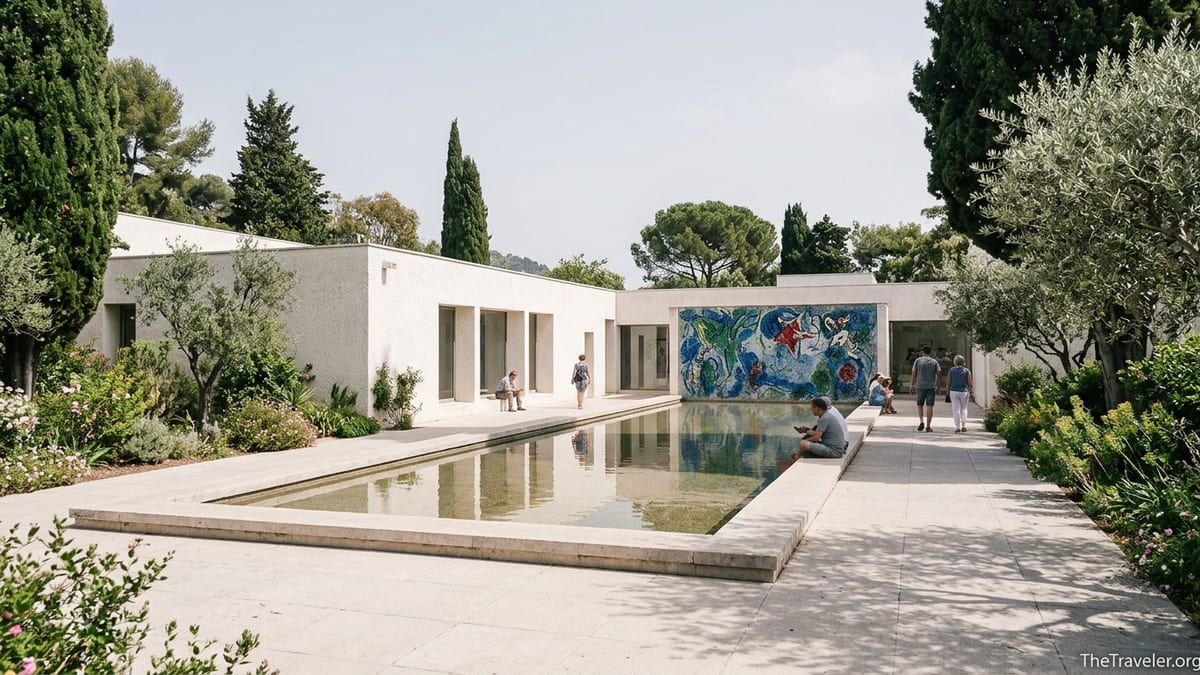
The Marc Chagall National Museum is intentionally modest from the outside. Set in a residential neighborhood below Cimiez, it is a low, white modernist building surrounded by Mediterranean vegetation. The architecture avoids grand gestures, allowing Chagall’s works to dominate. Large windows frame garden views without exposing the delicate canvases to too much sunlight, and the main gallery is arranged around an interior patio and reflecting pool.
That small pool, lined with stone and overlooked by a mosaic designed by Chagall, is a highlight for many visitors. In the late morning, the water reflects both the blue sky and the pale façades of the museum, creating a shimmering surface that quietly echoes the blues in the paintings inside. On a typical summer visit, you might see a handful of travelers sitting on the low wall around the pool, leafing through guidebooks or waiting for the next concert in the auditorium, the sound of cicadas filtering in from the nearby gardens.
Inside, the architecture supports slow looking. The main Biblical Message room is almost chapel-like, with high white walls and uncluttered floors. Benches are strategically placed in the center so that you can sit and view several canvases at once. Side rooms hold prints, drawings, and later works, often in more intimate spaces with lower ceilings. Travelers used to selfie-driven museum visits often remark on how unhurried this one feels, even in high season.
The surrounding area also shapes the experience. The museum stands about 15 minutes on foot uphill from Nice Ville train station, or a short ride on the number 5 bus that stops directly at “Musée Chagall.” Many visitors combine it with a walk through the Roman ruins and gardens of Cimiez or continue on to the Matisse Museum. In practical terms, this means that a day spent exploring Chagall, Roman Nice, and Matisse offers a compact but rich itinerary without crossing the entire city.
Beyond the Bible: Prints, Tapestries, and Stained Glass
Although the Biblical Message paintings are the star attraction, the museum’s collection extends well beyond them. Over the years, Chagall’s donations grew to include gouaches, preparatory drawings, more than one hundred Bible-related engravings, and a substantial group of lithographs. Temporary exhibitions also regularly present other aspects of his career or show the work of artists in dialogue with him, so repeat visitors often encounter new material.
In one of the side galleries, travelers usually find sets of small, intensely worked prints in black and white that contrast with the explosive color of the main room. These Bible engravings show how Chagall rethought the same subjects across different media. A scene of Jacob wrestling with the angel might appear in a huge blue canvas in the main hall, and then in a small, dense etching where the struggle feels more physical and immediate. For visitors interested in artistic process, these juxtapositions turn the museum into a kind of studio-in-reverse.
The building also contains remarkable examples of Chagall’s work in other large-scale formats. In the auditorium, deep blue stained-glass windows bathe the space in colored light. From a practical travel perspective, this room is used for concerts and events, but even on a quiet midweek visit it tends to be open, and you can sit for a few minutes on one of the seats just to watch the shifting reflections. It is one of the few places in Nice where you can experience the effect of stained glass at eye level without church crowds.
There are also mosaics and tapestries based on his compositions, showing how his images were adapted for architectural settings. For example, outdoor mosaics around the pool pick up themes and colors from the interior paintings, creating a dialogue between water, stone, and pigment. Travelers who have seen Chagall’s stained glass in Metz Cathedral or his ceiling at the Paris Opera will recognize the same theatrical sense of color distilled into more intimate surroundings.
Planning Your Visit: Practical Tips and Realistic Expectations
For planning, it is worth checking current hours before you go, as the museum operates a split schedule typical of many French institutions. In 2026, opening times from early May to late October are generally 10:00 to 13:00 and 14:30 to 18:00, with the museum closed on Tuesdays and some public holidays. Last ticket sales usually end about 30 minutes before closing, so arriving at 12:30 or 17:30 can mean a rushed visit. In the quieter months from November to April, hours shift slightly earlier and the museum tends to be even calmer.
Ticket prices for adults as of mid 2026 are in the same range as other French national museums on the Riviera, typically in the teens of euros, with concessions for young adults and free entry on the first Sunday of the month. Travelers who also plan to visit the Fernand Léger National Museum in Biot can look for a combined ticket valid over several weeks, which often represents good value if you are touring modern-art sites along the coast. Families with small children sometimes appreciate that the Chagall museum is compact enough to visit in under an hour if attention spans are short.
Getting there is straightforward from central Nice. Many visitors arrive by bus from the city center or by walking up from Nice Ville station. The walk climbs gently through residential streets; on a hot day, bringing water and a hat is sensible, especially in July and August when temperatures regularly push into the high twenties or low thirties Celsius. Taxis and ride-hailing services also know the museum well, and the drop-off area is just outside the entrance gate, which can be convenient for those with reduced mobility.
Inside, facilities are relatively simple but practical. There is a small bookshop where you can buy reproductions of the Biblical Message works, postcards, and catalogues, and basic amenities such as restrooms and a cloakroom. You will not find a full café, but vending machines or small kiosks sometimes provide drinks. Many travelers choose to picnic afterward in the nearby gardens of Cimiez or head back down toward the city for lunch in the Liberation neighborhood, where markets and bistros offer more local atmosphere than the seafront.
Chagall in Context: Nice, the Riviera, and a Life in Exile
Understanding a little of Marc Chagall’s biography can deepen a visit. Born in 1887 in Vitebsk, in what is now Belarus, he grew up in a Jewish community that would later be destroyed during the Second World War. After studying and working in Russia and then Paris, he fled Nazi-occupied France for the United States in 1941, returning only after the war. These experiences of exile, displacement, and survival inform much of the emotional undercurrent in the Biblical Message cycle, even when the subject matter appears serene.
Settling in the South of France in the late 1940s and 1950s, Chagall became part of a broader Riviera art scene that included Matisse in nearby Cimiez and Picasso further along the coast. The decision to build his national museum in Nice was shaped by that artistic environment as much as by practical considerations. For today’s travelers, this means you can trace a kind of informal route through modern art on the Côte d’Azur: Chagall and Matisse in Nice, Picasso in Antibes, Léger in Biot, and the Maeght Foundation in Saint-Paul-de-Vence.
Within this context, the Chagall museum stands out for its explicit spiritual dimension. While the Matisse Museum focuses on the evolution of form and color and the Maeght Foundation on avant-garde experimentation, the Chagall National Museum centers on questions of faith, humanity, and storytelling. Many visitors who are not religious still respond to its mood of quiet reflection. It is not unusual to see people simply sitting in front of a single canvas, absorbed, even after touring faster through other museums.
Finally, the museum offers a glimpse into how an artist chooses to present his own legacy. Because Chagall was directly involved in the design and donations, this is less a neutral institution and more a deliberate self-portrait at monumental scale. When you step back into the bright Nice sunlight afterward, the city’s beaches and cafés can feel strangely grounded by what you have just seen: a reminder that beneath the Riviera’s surface pleasures, artists have long used this same light and landscape to grapple with questions of memory, suffering, and joy.
The Takeaway
The Marc Chagall National Museum in Nice is not a box to tick but a space to inhabit for a while. Conceived by Chagall as a home for his Biblical Message cycle, it offers travelers a rare chance to walk through a world entirely shaped by one artist’s imagination, from the layout of the galleries to the mosaic above the reflecting pool. It is intimate yet monumental, rooted in ancient stories yet inseparable from the light and vegetation of the Mediterranean outside.
For visitors planning time on the Côte d’Azur, the museum rewards anyone willing to slow down. A morning here, followed by a stroll through the olive groves of Cimiez or a quiet lunch in a nearby café, can balance the sensory overload of Nice’s seafront and Old Town. Whether you come with extensive knowledge of Chagall or simply curiosity, you will leave with images that are difficult to forget: floating lovers, midnight-blue prophets, and a sense that, in this corner of Nice, painting still speaks directly to questions of hope and belonging.
FAQ
Q1. Where is the Marc Chagall National Museum located in Nice?
The museum is in a residential area below the Cimiez hill, a short bus ride or about a 15-minute uphill walk from Nice Ville train station.
Q2. How long should I plan for a visit?
Most travelers spend between one and two hours, depending on how long they linger in front of the Biblical Message paintings and the stained-glass windows.
Q3. What are the typical opening hours?
From roughly early May to late October, hours are usually 10:00 to 13:00 and 14:30 to 18:00, with slightly shorter hours in the cooler months and closure on Tuesdays.
Q4. Do I need to book tickets in advance?
Advance booking is not always essential, but in peak summer or on free first Sundays it can reduce waiting times and help you avoid arriving near last entry.
Q5. Is the museum suitable for children?
Yes. The museum is compact, the colors and animals in Chagall’s works often appeal to children, and families can comfortably visit in under an hour if needed.
Q6. Can I combine the visit with other sights nearby?
Many visitors pair the Chagall museum with the Matisse Museum and the Roman ruins in Cimiez, creating a full art-and-history day within a small area of Nice.
Q7. Are there guided tours available?
Guided tours are offered periodically, often in French and sometimes in other languages, and audio or written guides provide additional context if you prefer exploring alone.
Q8. Is photography allowed inside the museum?
Non-flash photography for personal use is often permitted in many areas, but rules can change, so check signage and follow staff instructions on the day of your visit.
Q9. Is the museum accessible for visitors with reduced mobility?
The main spaces are on a few levels connected by gentle ramps, and staff can advise on the easiest routes; the entrance and key galleries are generally accessible.
Q10. What is the best time of day to visit?
The late morning and mid-afternoon tend to be busiest; arriving right at opening or in the first hour after the afternoon reopening often provides a calmer experience.