


Most travelers step into Florence’s Baptistery of San Giovanni, tilt their heads up toward the golden vault, whisper “beautiful,” snap a quick photo and move on to the Duomo. Yet this octagonal jewel, older than the cathedral it faces, rewards anyone willing to slow down and look closer. Beneath the shimmer of mosaics and the souvenir crowds is an interior dense with symbolism, re‑used Roman stone, scientific experiments and even an active conservation site you can climb into. Here is what most visitors never notice, and how to see it on your next trip.
Get the latest updates straight to your inbox!
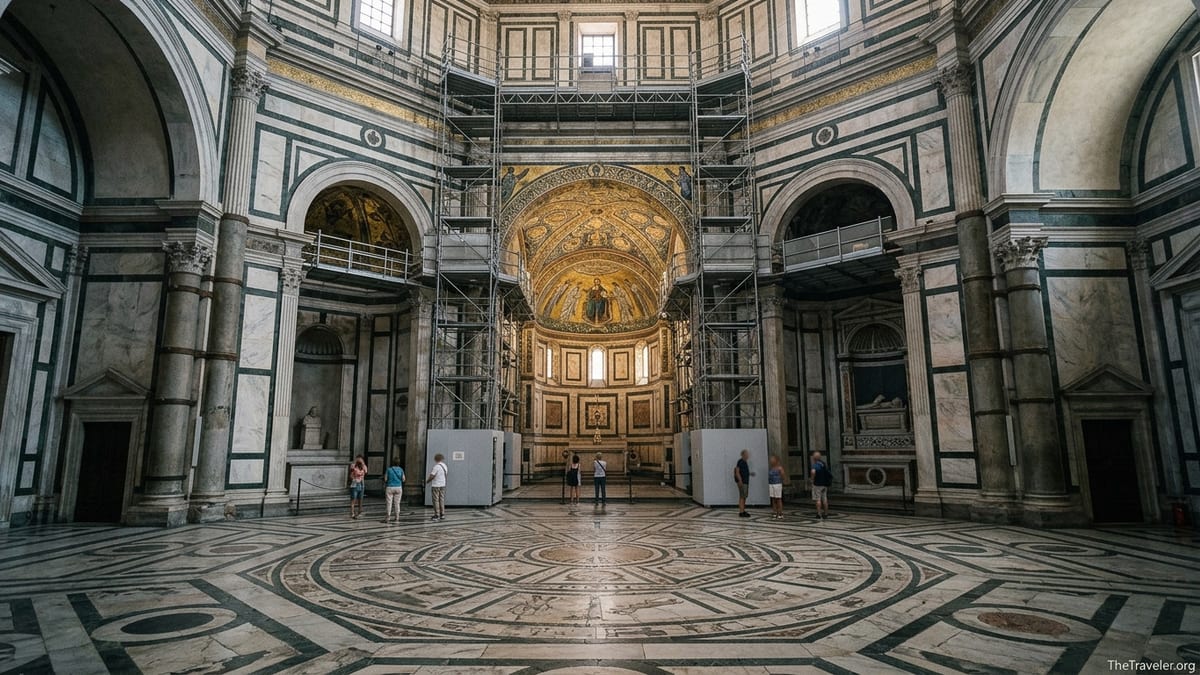
An Interior Currently Wrapped in Scaffolding
Walk through the heavy doors of the Baptistery today and you will not find the unobstructed dome that appears in guidebook photos. Since 2021, a major restoration of the thirteenth century mosaic vault has filled the interior with towering scaffolding, metal walkways and bright work lights. The Opera di Santa Maria del Fiore, the body that looks after Florence’s cathedral complex, expects the campaign to continue in phases until around 2028, which means most of this decade’s visitors are seeing the building in a once in a lifetime state of undress. Instead of a single soaring void, you encounter a vertical maze that reveals how thin the line is between fragile medieval glass cubes and twenty first century engineering.
For many, that first glimpse is a disappointment. The official information panels at the ticket office warn that the mosaics of the vault “are not fully visible,” and some tourists choose to skip the interior once they learn the ceiling is under wraps. Yet those who go inside discover an unexpected bonus. On select days, the Opera offers small group tours, bookable through the same ticketing system as the Duomo climb, that take visitors up onto the scaffolding platforms. Wearing a hard hat, you stand just a couple of feet from the colossal Christ of the Last Judgment, close enough to see individual tesserae and nineteenth century patch repairs that are invisible from ground level. For travelers used to admiring mosaics from afar in Ravenna or Venice, this close encounter can be the single most memorable art experience of a Florence trip.
Even if you do not join a special tour, the construction site alters the way you perceive the interior. Harsh white LED lights pick up details of the walls, matroneum galleries and apse mosaics that usually dissolve into the golden glow. Temporary walkways channel foot traffic differently, giving you odd vantage points into side corners and chapels. What feels at first like an intrusion quickly becomes an opportunity: this is the only time you are likely to see exactly how the building is put together, from the ribs of the vault to the metal reinforcement rings that hold cracked columns in place.
The Mosaic Program Most Visitors Glance Past
Even under restoration, large parts of the Baptistery’s mosaic cycle remain visible if you know where to look. Completed over several campaigns between the early 1200s and fourteenth century, the interior decoration wraps around the dome, apse and upper walls in narrative bands. Most visitors pick out the enormous seated Christ in the main vault, arms spread over scenes of heaven and hell, and perhaps a few angels or devils in the compartments below. Then they lower their heads again without realizing they have just walked under one of the most ambitious storytelling programs of the Middle Ages.
Take a few minutes against the outer wall to let your eyes adjust and trace the stories. Starting from the apse and reading around the octagon, you can pick out episodes from Genesis, Joseph, the life of Christ and John the Baptist, all arranged in horizontal registers like a comic strip for a largely illiterate congregation. In the zone closest to the apse you may see the Creation, with small, lively scenes of God forming Adam from the earth, or the building of Noah’s Ark. Another band is filled with the life of Joseph, his brothers bent over sacks of grain or bowing before the Egyptian ruler. Higher still are angels and prophets that frame the celestial hierarchy. Knowing this, even a partial view suddenly becomes richer; instead of a generic golden ceiling you are surrounded by an illustrated Bible in glass and stone.
Equally overlooked are the apse mosaics in the small rectangular chapel known as the scarsella. Here, work carried out between 1225 and 1228 introduced a dense arrangement of apostles, evangelists and decorative bands that many art historians link to Roman mosaic workshops. Because the space is narrower, you can stand almost underneath the half dome and inspect the faces, hands and cloak patterns at relatively close range. Seek out the tiny inscriptions at the corners, which record the dates and authorship of this campaign, something most churches of the period do not preserve. It is a quiet pocket where you can appreciate the fine gradations of color in the drapery and the shimmering gold that conservative lighting still manages to animate.
A Marble Floor That Doubles as Cosmic Map
While almost everyone looks up inside the Baptistery, very few look down beyond the immediate spot where they are standing. That is a mistake. The marble pavement, laid out in a mosaic of geometric schemes and figurative inlays, is one of the most intricate and intriguing elements of the interior. Instead of a single unified pattern, the floor is a patchwork of circular medallions, starbursts, meanders and panels of interlacing lines, each section likely designed at a different moment between about the eleventh and thirteenth centuries. To modern eyes it can appear purely decorative, but medieval viewers would have read echoes of cosmology, the four elements and the ordered harmony of God’s universe.
The most famous feature is the zodiac roundel, currently protected and partially cordoned off due to conservation work. At its center a stylized sun face once blazed in warm colored stones, surrounded by the twelve signs of the zodiac in a circle. Historians once believed it functioned as a working sundial, designed by a local figure called Strozzo Strozzi around the year 1000, with a light beam marking the summer solstice on the feast of Florence’s patron saint in late June. Recent research suggests the astronomical precision may have been more symbolic than practical, but the idea of the cosmos inscribed underfoot remains powerful. To spot it in person, look for a slightly lower section of floor near the eastern side of the octagon, where museum style barriers usually signal something important under protection.
Elsewhere on the pavement, patches of serpentine and white marble imitate twisting rosettes and braids, while darker stones are slowly flaking due to centuries of foot traffic and moisture. If you visit on a rainy day in February, you may see conservators checking salt deposits or measuring microfractures in the stone. These quiet scientific rituals are part of an ongoing campaign to stabilize the pavement that began in the early 2000s, and they reinforce how fragile the floor really is. When staff remind visitors not to drag suitcases or stroller wheels across the marble, it is not out of fussiness but because this elaborate visual map of heaven and earth is literally wearing away beneath modern shoes.
Reused Roman Stone Hiding in Plain Sight
One of the strangest sensations inside the Baptistery is the feeling that parts of it are older than the building itself. That instinct is not wrong. In the twelfth century, when the exterior and interior were being refaced with green and white marble, Florentines raided ancient Roman buildings and quarries for ready made columns, capitals and blocks, a practice known as spolia. Many visitors notice the mismatched marbles on the outside, but few pause inside to examine the dark green “Saracen” columns that support the matroneum gallery or the heavy bases around the walls. Look closely and you will see that some shafts are ringed with iron or bronze clamps. Local tradition says these were added after one column fell and cracked, a reminder that even stone has a breaking point.
Stand near one of these supports and compare the carving on the capitals with those in the nearby cathedral or in later Renaissance churches like San Lorenzo. The foliage inside the Baptistery feels slightly different, with deeper drilling and curling leaves that recall late Roman Corinthian designs. Art historians believe at least some of these pieces were salvaged from Roman baths or civic halls that once stood in the area, giving the Christian monument an intentional link to the imperial past. For a modern visitor who has just come from the ruins of the Roman Forum in Rome or from the amphitheater in Lucca, the continuity becomes tangible. You are literally leaning against columns that may have framed pagan statues before they were reassembled here to flank a Christian font.
Even the thick marble revetment on the lower walls contains recycled fragments. In a few spots, especially where conservation has replaced missing pieces with neutral stone, older blocks reveal faint traces of earlier moldings. The impression is of a medieval jigsaw puzzle built from whatever high quality stone could be found and cut down to size. Noticing these seams and differences of texture turns a quick visit into a kind of archaeological treasure hunt without leaving the city center.
Spaces of Power: The Font, Tombs and Civic Identity
Most guidebook descriptions mention that the Baptistery was where generations of Florentines, including Dante Alighieri, received baptism. Yet the interior still surprises visitors who expect a single monumental basin dominating the octagon. The original large font that once stood in the center, probably a multi sided structure for full immersion, was dismantled in the sixteenth century to make more liturgical space. What you see today is a smaller modern font, usually covered, tucked closer to the apse. Discovering that the historic centerpiece is gone changes the way you read the building. Floors that now seem open would once have been crowded with a giant pool, curtains, clergy and sweating, nervous families waiting their turn.
Against the walls, funerary monuments underline how tightly intertwined the Baptistery was with civic and religious power. One of the most significant is the tomb of the deposed Pope John XXIII, real name Baldassarre Cossa, a controversial figure who died in 1419. His monument, designed by Donatello and Michelozzo, shows the former pope lying in repose under a delicately carved arch, armor peeking out from under his robes. Many visitors barely glance at this niche in their rush to the exit, but it is an extraordinary document of Florence’s early Renaissance sculpture and of the city’s willingness to honor a disgraced pontiff in such a prominent place. When you stand before it, you are not only looking at an artwork; you are standing where Quattrocento mourners once gathered to negotiate politics and memory.
The building’s role as a civic symbol surfaces in other, subtler ways. The octagonal plan echoes early Christian martyria and perhaps the Roman Pantheon, but in Florence it also came to represent the city’s identity as “daughter of Rome,” a phrase that recurs in local chronicles. When a Florentine child was baptized here, especially during the city’s medieval boom in wool and banking, the event was not just a private family moment; it was an act of entry into the political community. Standing in the center of the floor, imagine the noise on a feast day when dozens of babies cried at once and members of the merchant guild crowded the matroneum above. The interior becomes less a silent museum and more a living stage for identity that still matters to many locals today, especially on the feast of Saint John the Baptist each June.
Light, Sound and the Unexpected Senses
Visitors often remember the Baptistery interior as dark, but that impression depends greatly on when you enter. On a bright winter morning around 10 a.m., low sunlight hits the windows of the lantern and scatters across the mosaic tesserae in a fluttering, almost liquid pattern. On a cloudy November afternoon, the same dome can look flat and bronze, the figures of angels and devils receding into shadow. Because the windows are small and the walls largely covered in marble rather than fresco, the interior reacts dramatically to small changes in light. Standing still for even five minutes can reveal how golden tones shift toward green or red depending on the angle of the sun and the warmth of artificial lamps used during restoration.
Sound is another aspect most visitors overlook. The Baptistery’s octagonal form and marble surfaces create a pronounced echo that once amplified Gregorian chant and the liturgy of baptism. Today, the murmur of tour groups, the shuffle of shoes on stone and the occasional cry of a child bounce up into the vault and return in softened form. If you visit very early or close to closing time, you may catch a rare quiet interval when a custodian’s cough rings out across the whole space. Some small guided groups demonstrate the acoustics by singing a brief, simple chord; it hangs in the air like a haze before dissolving. Without disrupting others, you can clap lightly near a wall and hear a quick, crisp reply that reveals how precisely the octagon shapes sound.
Other senses come into play too. The interior smells cool and mineral, especially in summer when outside air shimmers over the hot piazza. Step in from the July heat and you feel an almost immediate drop in temperature, a reminder of how thick the Baptistery’s masonry really is. If conservation is in full swing during your visit, you may detect faint traces of lime, solvents or protective wax, subtle cues that the building is constantly being worked on. Noticing these non visual details helps you experience the Baptistery as a physical environment rather than just a backdrop for photographs.
Planning Your Visit to Notice What Others Miss
Because the Baptistery sits directly opposite the Duomo and Giotto’s bell tower, it is wrapped into most combined tickets for the cathedral complex. Many visitors, especially day trippers with tight schedules, give it only ten minutes on their way between the dome climb and the cathedral interior. To see the little known details described above, plan at least thirty to forty five minutes inside. Choose an early morning entry time if you want calmer conditions, or late afternoon in winter if you prefer softer light. Tickets are typically timed on busy days, and security staff regulate the flow in and out so the octagon does not become dangerously crowded.
Once inside, resist the urge to walk the perimeter in a quick loop. Instead, divide your time into three “stations.” First, stand roughly in the center, recognize the outline of the missing font and take in the overall shape, from pavement to mosaics. Second, circle slowly around the outer walls, stopping at each bay to examine specific features: a reused column, a tomb, a section of the mosaic program or an area of damaged floor. Finally, end in the scarsella apse, where you can sit or stand quietly and let the apse mosaics and the modern altar settle into view together. This simple structure turns a hurried look into a layered experience without requiring specialized art historical knowledge.
If you are particularly interested in conservation, check the official cathedral museum information in advance to see whether restoration site tours are running during your visit. These tend to be offered in limited numbers, often in Italian and English, and can sell out in high season. Prices are usually a modest supplement on top of the standard complex ticket, comparable to a mid range lunch in the city center. Given the uniqueness of walking among scaffolding at eye level with medieval mosaics, many travelers find it a worthwhile splurge compared with yet another generic group tour. Even without the add on, knowing that you are visiting during an active, long term restoration will change how you look at every crack, patch and scaffold joint under the glittering dome.
The Takeaway
At first glance, the Baptistery of San Giovanni can seem almost too familiar. Its striped marble exterior and golden interior mosaics appear on postcards, coffee table books and countless social media feeds. Yet the reality inside, especially during the current restoration years, is far stranger and richer than the usual snap and go visit suggests. A floor that doubles as an abstract cosmos, Roman columns reused as Christian supports, intimate apse mosaics, resonant acoustics and the haunting absence of the original baptismal font all contribute to a complex story that blends art, science, politics and devotion.
If you give yourself time and approach the interior with curiosity, the scaffolding and barriers stop feeling like obstacles and start acting as guides. They draw your eye to structural details, prompt questions about how and why this space was built and remind you that even the most venerable monuments are living, changing objects. When you step back out into the sunlit square after such a visit, the famous bronze doors and the Duomo’s huge dome will look different too. You will have seen the small, often ignored elements that knit Florence’s monumental center together, and you will carry with you not just images of gold and marble, but a deeper sense of how generations of Florentines have experienced their “bel San Giovanni.”
FAQ
Q1. Can I still see the Baptistery’s mosaics during the current restoration works?
The large dome mosaics are partially obscured by scaffolding, but many parts remain visible, especially in the apse and upper walls, and special tours sometimes take visitors up close to the vault.
Q2. Is it worth visiting the interior if I have already seen the Baptistery’s bronze doors?
Yes. The doors are replicas and stand outside; the interior offers completely different experiences, from the marble zodiac floor to reused Roman columns and Renaissance tombs that most travelers overlook.
Q3. How much time should I plan inside the Baptistery to notice these details?
Plan at least thirty minutes, and ideally forty five, so you can study the floor, apse mosaics and funerary monuments without rushing, especially when the space is busy.
Q4. Are there special tickets for the restoration scaffolding tours?
When offered, scaffolding tours are usually booked as an add on through the cathedral complex ticketing system, with limited slots and a small surcharge compared with the standard combined ticket.
Q5. Where exactly is the famous zodiac floor inside the Baptistery?
The zodiac roundel forms part of the marble pavement near the eastern side of the octagon; it is often protected by low barriers, so look for a slightly cordoned off circular section underfoot.
Q6. What happened to the original baptismal font Dante would have known?
The large central font was dismantled in the sixteenth century to create more liturgical space, so only the surrounding floor patterns and written sources hint at its original scale.
Q7. Why do some of the interior columns have metal rings around them?
Those rings reinforce ancient stone shafts, likely reused from Roman structures; tradition says they were added after a column fell and cracked, and they remain visible as structural “bandages.”
Q8. Does the Baptistery still host baptisms today?
Yes, though not on the mass scale of the Middle Ages. Ceremonies are more occasional and carefully scheduled, and modern visitors are unlikely to witness one unless they attend a specific service.
Q9. When is the best time of day to appreciate the light inside?
On clear days, mid to late morning often brings the most dramatic light through the lantern windows, setting the mosaics aglow, while late afternoon offers gentler, more atmospheric illumination.
Q10. Can I visit the Baptistery with the same ticket as the Duomo and bell tower?
Typically, admission is included in combined tickets for the cathedral complex, but it is wise to check current details and time slot requirements when planning your visit, as policies can change.