


Stepping into the Baptistery of San Giovanni in Florence, the city’s history suddenly feels less like something you read in a guidebook and more like a living presence hovering just above your head in gold. The moment your eyes adjust to the dim light, the glittering mosaics, worn marble floor and hushed whispers of fellow visitors combine into a powerful reminder that this small octagonal building has shaped Florentine life for nearly a thousand years.
Get the latest updates straight to your inbox!
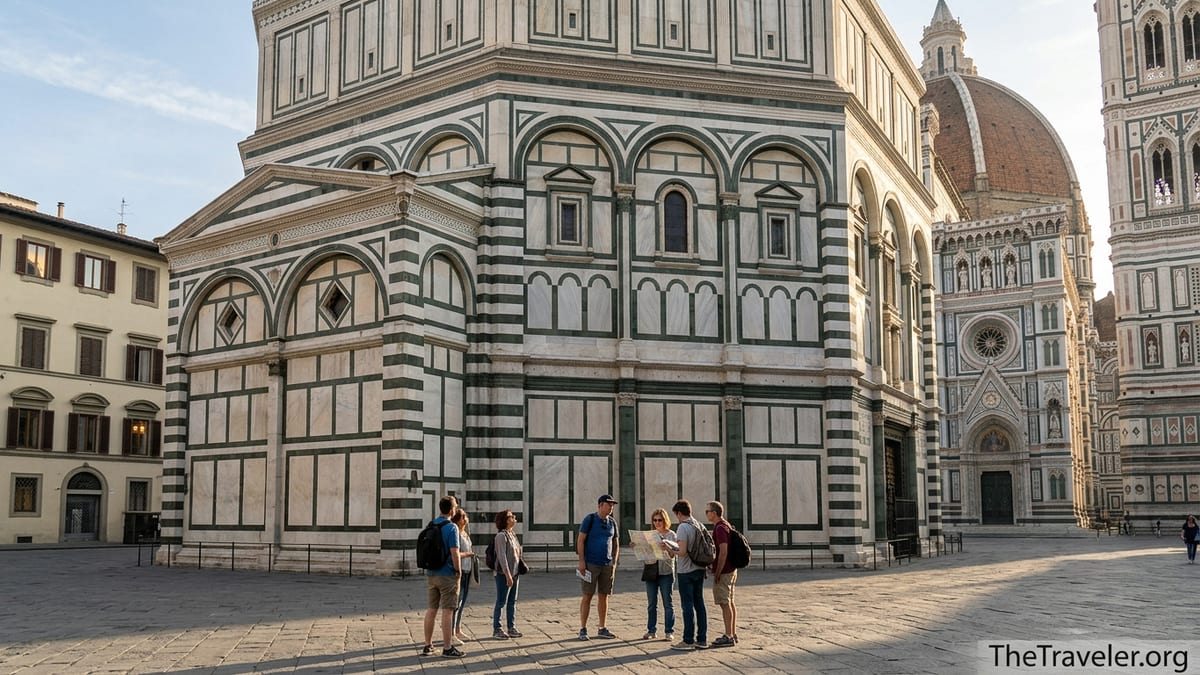
First Impressions: Crossing the Threshold of a Medieval Florence
From outside, the Baptistery of San Giovanni can almost be overshadowed by the colossal dome of Santa Maria del Fiore and the height of Giotto’s Campanile. But as you cross Piazza del Duomo and stand in front of its green-and-white marble façade, you are looking at a structure that predates both neighbors by centuries. The baptistery’s current form dates largely from the 11th and 12th centuries, though it stands on foundations of an earlier religious building, and it is one of the core monuments in the UNESCO-listed historic centre of Florence. In practice, that means you are entering a space that was already ancient by the time the Renaissance began.
Today, access is controlled through combination tickets managed by the Opera di Santa Maria del Fiore. As of 2026, most visitors enter with a timed pass such as the Brunelleschi, Giotto or Ghiberti Pass, which covers different combinations of the cathedral dome, bell tower, museum and baptistery. Prices shift periodically, but you can expect to pay in the region of several dozen euros for a multi-site ticket rather than a standalone baptistery entry, and time slots for the baptistery itself tend to be more flexible than the strictly timed dome climbs. Security staff scan your ticket at the door, and dress codes are lightly enforced, so it is wise to avoid bare shoulders and very short shorts.
Once you step through the heavy doors, the temperature drops and the city noise softens. The first thing that hits you is the scent: a cool mix of old stone, incense from occasional services, and the faint polish of centuries of cleaning. Unlike the cathedral, which often echoes with long lines and tour groups, the baptistery interior feels surprisingly intimate; there is enough space for people to spread out along the walls or sit quietly on the benches placed around the octagonal hall.
It is in this first minute inside that Florence’s history starts to feel real. You are standing where generations of Florentines, including figures like Dante Alighieri, were baptized. For medieval and Renaissance residents, this was not just an architectural monument but the place where their civic and spiritual identity began.
Looking Up: The Golden Mosaics and the Last Judgment
Almost every visitor has the same instinct once they step inside: they look up. The baptistery’s vault is covered with an immense cycle of mosaics, created between about the mid-13th and early 14th centuries, laid out over an octagonal dome and the smaller apse above the altar. Glass tesserae backed with gold cover more than a thousand square meters, catching even the weakest daylight and scattering it over the stone walls and floor.
At the center of this glittering cosmos, facing the entrance, is the colossal figure of Christ the Judge in the Last Judgment. His arms are outstretched, one hand turned palm-up toward the blessed rising from their tombs, the other directed toward the damned twisted in the jaws of a horned Satan. Early Florentine masters, associated with artists such as Coppo di Marcovaldo, helped shape this vision. The scene is not polite or abstract; hell is gruesomely explicit, with demons torturing the proud, the greedy and the lustful. For a medieval Florentine parent presenting a newborn at the font directly beneath this image, the message would have been visceral: baptism was a matter of eternal consequence, not just a family celebration.
The other segments of the dome are stacked with narrative bands. Starting near the entrance and moving clockwise, you can pick out scenes from Genesis at the top: the creation of Adam and Eve, the temptation, the expulsion from Eden. Below them, the stories of Joseph unfold with camels, desert tents and dream sequences. In another wedge, episodes from the life of Christ appear, including the Nativity and Crucifixion, while yet another band recounts the life and beheading of John the Baptist, Florence’s patron saint. Even if you are not religious, there is an almost cinematic quality to the way the stories unfold that helps you read the building like an illuminated manuscript you happen to be standing inside.
At the time of writing, sections of the mosaic cycle may be under restoration, scaffolding rising partway up the dome and certain areas covered in protective fabric. The Opera del Duomo has been working on a long-term conservation project to safeguard these fragile medieval surfaces. Practically, this means you might not see every scene clearly, but you will gain something else: the sense that this is a living monument still being cared for. Watching conservators at work, gently cleaning and resetting tesserae with surgical tools, drives home just how precarious the survival of this medieval masterpiece really is.
The Floor Beneath Your Feet: Geometry, Symbols and Wear
Most people’s gaze remains glued to the ceiling, but if you drop your eyes and take a slow walk around the room, the marble floor tells a parallel story. Laid in complex patterns of white, green and red stone, the pavement forms a giant geometric puzzle. Octagons nest inside circles; stars unfold from interlaced rhombuses. In one section you may notice a pattern that looks like an enormous labyrinth or astrological chart, echoing medieval interests in cosmology, mathematics and the order of the universe.
The floor is not roped off like a museum display. You walk directly on the same inlaid marble over which Florentine families processed for baptisms, weddings and civic ceremonies. Centuries of use have smoothed the stone to a soft sheen, especially around the central area where the original baptismal font stood. The current font is more modest, but the scars on the pavement still trace out the footprint of the vast octagonal basin that once dominated the space before later changes in liturgy and architecture.
If you look closely, you can see how different stones have aged differently. The dark green serpentine has chipped in some places, while white Carrara marble has dulled to cream and shows hairline cracks. These imperfections do more to make the building feel authentic than any polished restoration could. You are literally seeing time under your shoes. For travelers used to “don’t touch” museum rules, the ability to move freely across such an ancient surface adds a physical dimension to understanding Florence’s past.
Practical tip: wear shoes with decent grip. In wet weather or on extremely hot days, when condensation can form inside after crowds have been streaming in, the polished marble can become slightly slick. It is not hazardous for most visitors, but if you are climbing the nearby dome or tower on the same day, your feet will thank you for planning comfortable, non-slip footwear.
Baptisms, Dante and Civic Identity
It is easy to treat the baptistery as a beautiful but static monument. Yet for most of its history, it was not primarily a tourist attraction, it was a working baptistry at the heart of the city’s spiritual life. For centuries, baptisms were celebrated here in groups, often on major feast days such as Easter and the feast of St John the Baptist in late June, when Florentines still hold historic parades and fireworks along the Arno. The idea that “every true Florentine is baptized in San Giovanni” took hold in the city’s collective imagination.
Dante Alighieri, born in 1265, almost certainly received his baptism here. Later, in the Divine Comedy, he speaks of the baptistery with obvious affection and describes personally damaging one of its marble basins to save a drowning child. Whether the exact incident is factual or partly literary, the passage captures how intertwined this building was with Florentine identities. When you stand under the same mosaics, you are sharing the spatial experience that shaped one of Europe’s greatest poets.
This overlap between civic and religious identity still surfaces today. On June 24, Florence celebrates its patron with events that start in and around the baptistery: historical reenactments in Renaissance costume, flag-throwing performances in Piazza della Signoria and a special Mass. Even if you visit at a quieter time of year, local guides often point out how many famous Florentines began life in this building, from Medici princes to artists and merchants who financed the city’s rise.
Understanding this helps explain why the baptistery features on almost every combined ticket and why restoration campaigns receive strong local support. When you buy a pass that includes the baptistery, a portion of that cost feeds directly into preserving this space where religious ritual, political power and family memory still intersect.
Planning Your Visit: Tickets, Timing and What to Expect
Most travelers encounter the baptistery as part of a broader day around Piazza del Duomo. In recent years, individual tickets have largely been replaced by package passes that might include the cathedral dome climb, Giotto’s Campanile, the Duomo Museum and the baptistery. As of 2026, it is common to see passes named for Brunelleschi, Giotto or Ghiberti, each with slightly different combinations and validities. Prices can fluctuate seasonally and with policy updates, but you should budget approximately the cost of a mid-range museum ticket in a major European city for one of these passes, with the baptistery included.
Entry to the baptistery usually does not require a strict time slot, but the number of people inside is limited for safety and conservation reasons. At peak hours in May through September, visitors often find a short line forming on the piazza in late morning and late afternoon. If you prefer a quieter experience, aim to arrive soon after opening time or in the early evening. Winter visits, particularly in January and February, tend to be calmer, with a cooler but often beautifully clear light filtering through the small windows high in the drum.
Inside, expect low light levels; the baptistery was never designed for bright electric illumination. Photography is generally permitted without flash, but rules can change, and staff may occasionally limit tripods or large equipment. Plan for about 20 to 30 minutes if you are doing a quick look, but set aside 45 minutes to an hour if you want to study the mosaics, read the interpretive panels and simply sit a while. Because seating is limited, consider pausing on one of the benches early in your visit to let your eyes adjust and your neck rest before you begin scanning the whole dome.
Dress is modest but not strict. Shoulders covered with a light scarf or shirt and knee-length shorts or skirts are usually acceptable. Large backpacks may need to be worn on the front or left at your accommodation; lockers are more commonly associated with the dome climb than with baptistery entry. If you have mobility issues, note that the baptistery floor is flat, but some stone thresholds at the entrance can be slightly raised; staff are generally helpful with strollers and wheelchairs, though it is wise to allow a little extra time.
Connecting the Baptistery With the Rest of the Duomo Complex
The baptistery does not exist in isolation. When you step outside and turn in a slow circle, you face one of the densest clusters of landmark buildings in Europe: the cathedral’s polychrome façade and towering brick dome, Giotto’s Campanile, and the Opera del Duomo Museum just a short walk away. Understanding their relationship deepens the impact of your visit inside San Giovanni.
Historically, the baptistery functioned as the threshold to the Christian community, while the cathedral represented the fully initiated body of the faithful. In practice, families would bring infants to the baptistery for their ritual washing, then years later those same children would attend Mass across the piazza. The bronze doors of the baptistery, especially the gilded east doors known as the Gates of Paradise designed by Lorenzo Ghiberti, once stood as celebrated entrances to the realm of faith. Today, the originals are safeguarded in the museum, with high-quality replicas installed on the building. Seeing the replicas in situ and then the originals in the museum, often visited on the same ticket, helps you appreciate the level of craftsmanship that surrounded worshippers even before they crossed the threshold.
Many travelers pair a quiet visit inside the baptistery with a more physically demanding experience in the same morning or afternoon, such as the 400-plus-step climb up the cathedral dome or the ascent of Giotto’s bell tower. One effective sequence is to start with the baptistery, where you absorb the symbolism of baptism and judgment, then climb the dome, where you can view a later frescoed Last Judgment encircling the cupola. Comparing the medieval mosaic vision below with the 16th-century fresco above turns your day into an art history lesson in motion, tracing how Florentine ideas about salvation, fear and glory evolved over three centuries.
When hunger hits, it is tempting to settle into one of the cafés directly facing the piazza. The view is unbeatable but the prices reflect it. If you walk a few minutes down nearby side streets toward Via dei Servi or Via del Campidoglio, you will find more local bakeries and coffee bars where a cappuccino and pastry cost closer to what a Florentine might pay on a weekday, giving you a more authentic break while you process everything you have just seen.
Moments That Make History Feel Tangible
Every traveler has a slightly different turning point, the moment when the baptistery stops being another “sight” and becomes a vivid connection to the past. For some, it happens while listening to a guide explain that, in earlier centuries, Florence’s entire political elite would gather inside these very walls during significant religious festivals, surrounded by the same gold mosaics. For others, it is the realization that thousands of everyday people once stood here, in bare feet or simple leather shoes, anxious about their children’s future or grateful for surviving an illness.
One powerful way to make the experience more concrete is to bring along a small, printed diagram of the dome program or use a museum-approved app. As you match each section of the mosaic to its story, the dome becomes less of a generalized glittering canopy and more of a visual encyclopedia. That process of decoding is exactly what medieval and Renaissance preachers encouraged: they used images like these to teach biblical narratives to congregations who could not read Latin texts.
If you are traveling with children, the baptistery can be unexpectedly engaging. Ask them to find the most frightening demon they can see in the Last Judgment scene or to spot camels and ships in the Joseph stories. These small challenges turn what might otherwise feel like an austere religious space into a treasure hunt, making the building memorable for younger visitors who might be reaching their limit on churches and museums.
For solo travelers or couples, consider visiting late in the day, when the crowds have thinned and the staff are preparing to close. Standing quietly near the center and letting the subtle echo of footsteps and murmured voices rise under the dome, you can almost imagine the splash of water in the old font and the murmur of prayers in medieval Tuscan. In that compressed silence, Florence’s layers of time stack up: Etruscan settlement, Roman colony, medieval republic, Renaissance powerhouse. All those eras still converge here, in a space small enough to hold in your peripheral vision.
The Takeaway
It is entirely possible to visit Florence, tick off the Duomo, the Uffizi and Michelangelo’s David, and treat the Baptistery of San Giovanni as a quick add-on, a pretty building you glance at while queuing for something else. Yet stepping properly inside, taking the time to look up and then down, transforms it from a side note into the emotional key to the whole city.
In one compact volume of marble and gold, the baptistery gathers Florence’s deepest preoccupations: salvation and judgment, civic pride and family memory, artistic ingenuity and the fragility of beauty over time. Whether you spend fifteen minutes or a full hour inside, it has the power to turn Florence’s history from a list of dates and names into something tangible, something that shimmers in front of you and crunches softly under your shoes.
When you walk back into the bright light of Piazza del Duomo, the great dome and bell tower may catch your eye first, but it is often the baptistery that lingers longest in your mind. More than almost any other building in the city, it makes Florence’s long story feel like something you have briefly stepped into yourself.
FAQ
Q1. Do I need a separate ticket to enter the Baptistery of San Giovanni?
In most cases you will enter with a combined Duomo complex pass, which also covers other sites; separate baptistery-only tickets are less common and policies can change.
Q2. How long should I plan to spend inside the baptistery?
Many visitors stay about 20 to 30 minutes, but allocating 45 minutes to an hour allows time to study the mosaics and soak up the atmosphere.
Q3. Are the mosaics always fully visible, or are there restorations in progress?
Long-term conservation work means parts of the dome may be scaffolded or covered at times, so expect some sections to be under restoration during certain visits.
Q4. Is there a dress code for visiting the baptistery?
Yes, modest clothing similar to other churches in Italy is expected, with covered shoulders and hemlines roughly to the knee, though enforcement is usually gentle.
Q5. Can I take photos inside the Baptistery of San Giovanni?
Photography without flash is generally allowed, but rules on tripods, flashes and commercial equipment can change, so always follow the guidance of on-site staff.
Q6. Is the baptistery accessible for visitors with limited mobility?
The floor inside is essentially flat, but door thresholds and crowding can pose minor challenges; staff are usually helpful, and it is wise to allow extra time.
Q7. When is the least crowded time to visit the baptistery?
Early morning soon after opening and late afternoon outside peak summer months typically offer the calmest conditions, with shorter lines on the piazza.
Q8. What is the connection between the baptistery and Dante Alighieri?
Dante was almost certainly baptized here, and he later wrote fondly of the building, helping to cement its role as a symbol of Florentine identity.
Q9. Are the bronze doors on the baptistery originals or replicas?
The famous gilded doors known as the Gates of Paradise on the east side are high-quality replicas, while the fragile originals are preserved in the nearby museum.
Q10. Can I attend a religious service inside the baptistery?
Most visitors experience the baptistery as a monument, but occasional liturgies or special celebrations, particularly around the feast of St John, are sometimes held there.