


Few artworks in Florence are as instantly memorable as the shimmering bronze doors of the Baptistery of San Giovanni, facing the cathedral’s marble facade in Piazza del Duomo. For centuries, pilgrims, popes and everyday Florentines have entered this octagonal building to be baptized, passing through portals that tell the story not only of the Bible, but of the birth of the Renaissance itself. Understanding how these doors were made, what they represent and how they shaped Florence’s identity will deepen any visit to this compact yet extraordinary monument.
Get the latest updates straight to your inbox!
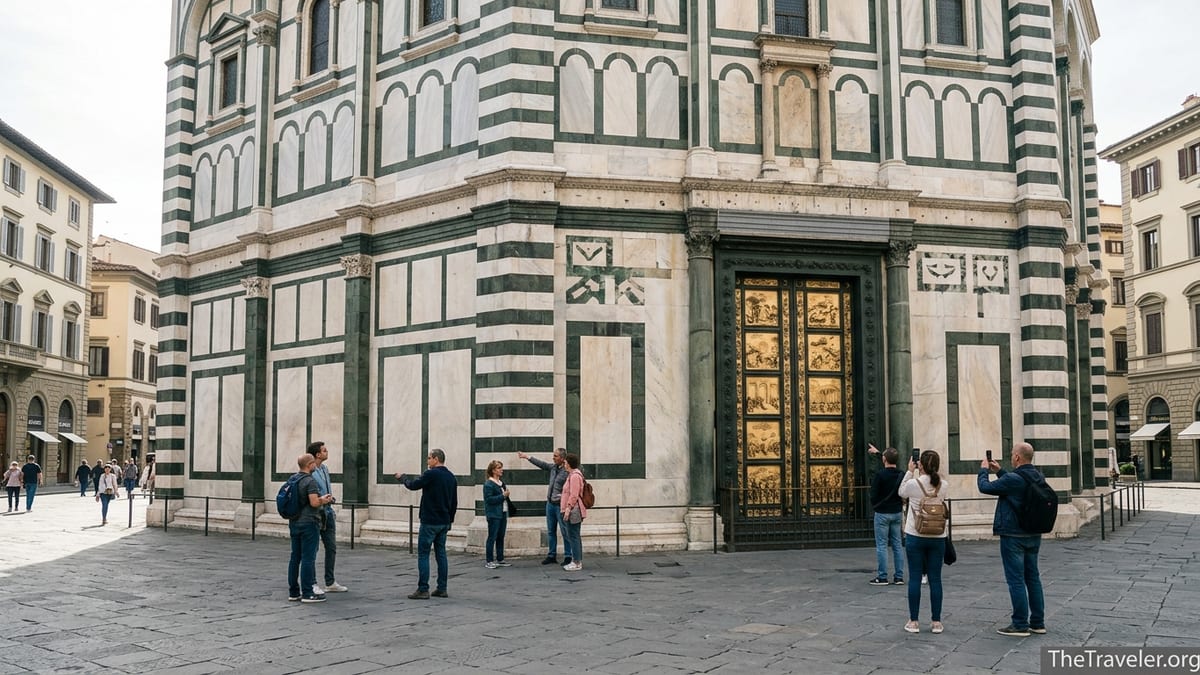
The Baptistery of San Giovanni in Context
The Baptistery of San Giovanni stands directly opposite Florence’s cathedral, Santa Maria del Fiore, in the heart of the historic center. Its current Romanesque appearance dates largely to the 11th and 12th centuries, though archaeologists believe the core may go back to late antiquity. Clad in bands of white Carrara and dark green Prato marble, the octagonal structure feels ancient even by Florentine standards and was long considered by locals to be a former Roman temple re-dedicated to Christianity.
The building is dedicated to John the Baptist, Florence’s patron saint, whose feast day on 24 June still brings parades, fireworks and historic football matches to the city. In medieval Florence, being baptized in “beautiful San Giovanni,” as Dante called it, was a civic as well as a religious act. Until the late Middle Ages, many Florentines received baptism here rather than in their parish churches, which meant that almost every citizen’s life formally began beneath its golden mosaic ceiling.
Today, visitors typically encounter the Baptistery as part of a broader Duomo complex ticket that may also include the cathedral dome, bell tower and the nearby museum. Inside, you can still see the ancient baptismal font site and the shimmering mosaics of Christ in Majesty overhead. Outside, however, the three bronze doorways have become the Baptistery’s greatest attraction. Although the doors many people admire in the piazza are high-quality copies, the originals, displayed in the Museo dell’Opera del Duomo a short walk away, remain some of the most important bronzes in European art.
Understanding how these three sets of doors came to be, why they were commissioned and how they differ from one another offers a concise, compelling introduction to the evolution from Gothic to Renaissance art in Florence.
Andrea Pisano and the First Bronze Doors
The story of the Baptistery doors begins in the early 14th century with sculptor Andrea Pisano. Around 1330, the powerful cloth merchants’ guild, known as the Arte di Calimala, which held patronage over the Baptistery, commissioned a new monumental bronze portal. Bronze was an exceptionally expensive material, roughly an order of magnitude more costly than marble, and the decision to invest in large gilded doors signaled Florence’s economic confidence and artistic ambition.
Pisano created a set of doors originally installed on the east side, now placed on the south. Organized into 28 quatrefoil panels framed by decorative borders, the reliefs narrate the life of John the Baptist, from the Annunciation to his father Zechariah to John’s beheading. The lower panels depict personifications of the Christian virtues. Observant visitors can still pick out individual scenes: the energetic figure of John preaching to the crowds, or the tender moment when he baptizes Christ in the Jordan River.
Stylistically, Pisano’s work straddles Gothic and the emerging naturalism associated with Giotto, with whom he was closely linked. Figures stand in relatively shallow relief, with simple architectural backdrops and clear, legible gestures that read easily even from a distance in the square. When you stand by the south entrance today, notice how each panel functions almost like a stand-alone miniature altarpiece, contained within its quatrefoil frame.
The technical challenge behind Pisano’s doors is easy to underestimate when you are simply queuing with other travelers outside. Each panel had to be modeled in wax, cast using the lost-wax process, chased and then gilded, all while ensuring that the doors would hang correctly and withstand centuries of opening and closing. The project established a standard so high that later generations would treat these doors not just as decoration but as civic symbols equal in importance to Florence’s palaces and public squares.
The 1401 Competition: A Turning Point in Art History
The creation of the second set of doors in the early 15th century marked a decisive break with the medieval world. In 1401, just as the new century began, the Arte di Calimala launched a prestigious competition for another pair of bronze doors. The commission attracted leading artists from across central Italy. Each was asked to submit a single trial panel depicting the same Old Testament subject: the Sacrifice of Isaac.
The most famous rivals were Lorenzo Ghiberti, a young goldsmith in his early twenties, and Filippo Brunelleschi, a more experienced sculptor and architect. Their two surviving competition panels, now displayed side by side in Florence’s museum, are a staple of art-history textbooks. Brunelleschi emphasized dramatic action and emotional tension: Abraham lunges forward with knife in hand as the angel intervenes, bodies twist in complex poses and the composition feels almost cinematic.
Ghiberti’s panel, by contrast, is more graceful and economical. His figures move with a lyrical, almost classical elegance, and he handled the bronze so efficiently that his relief is significantly lighter, and therefore cheaper, than his rival’s. For a fiscally minded merchant guild, artistic beauty and technical economy were a winning combination. After deliberation that reportedly involved leading citizens like Giovanni de’ Medici, the judges awarded the commission to Ghiberti.
For modern visitors, a useful way to appreciate this turning point is to visit the museum first, where the two panels are displayed with good lighting and explanatory labels, then walk outside to look at the north doors Ghiberti eventually produced. You can almost trace the seeds of the Renaissance in the way he integrated classical calm, narrative clarity and a budding sense of three-dimensional space into what began as a single experimental relief.
Ghiberti’s North Doors: From Gothic Frames to Emerging Renaissance
Ghiberti worked on the second set of Baptistery doors from about 1403 to 1424. These doors, now installed on the north side, still follow the basic quatrefoil framework established by Andrea Pisano, with 28 panels surrounded by a decorative border. Instead of John the Baptist, their main cycle depicts scenes from the life of Christ, from the Annunciation through the Resurrection, accompanied below by the four Evangelists and the Doctors of the Church.
Standing in front of the north doors today, you will notice how much more animated and spatially convincing Ghiberti’s scenes are compared with Pisano’s. Limbs extend beyond the confines of the frames, architectural settings create a suggestion of deep space, and draperies cling to bodies in ways that recall ancient Roman sculpture. In one panel, “Christ Among the Doctors,” figures gather in a semi-circular arrangement that guides your eye into the background like a stage set, a clear step toward the mathematical perspective that would soon transform painting and sculpture.
The surrounding frame, completed with help from Ghiberti’s workshop after the doors were later moved from east to north, is richly decorated with foliage, animals and small heads of prophets and sibyls. Look closely and you may spot birds pecking at fruit, lizards hidden in leaves and expressive faces emerging at the intersections of the panels. For a traveler familiar with Gothic cathedrals in northern Europe, the overall format of framed narrative scenes will feel familiar, yet the softness of modeling and increasing attention to believable space mark these doors as very much part of the Florentine Quattrocento.
These doors were such a success that Ghiberti almost immediately received a second, even more ambitious commission from the same guild. That next project would produce the most celebrated portal of all and profoundly influence later masters from Donatello to Michelangelo.
The “Gates of Paradise”: Ghiberti’s Masterpiece
In 1425, the Arte di Calimala commissioned Ghiberti to design a new set of doors for the Baptistery’s east side, facing the cathedral facade. These would eventually become known as the “Gates of Paradise,” a nickname attributed to Michelangelo, who is said to have declared them worthy of heaven itself. Ghiberti worked on this commission, with a large workshop, until around 1452, devoting a quarter century to refining every panel and detail.
Unlike the earlier doors, the east doors abandon the quatrefoil grid in favor of ten large rectangular panels. Each panel contains multiple scenes from the Old Testament unified within a continuous landscape or architectural space. For example, the “Story of Joseph” panel combines Joseph being sold by his brothers, his interpretation of Pharaoh’s dreams and his recognition by his brothers in Egypt into a single, flowing composition.
These reliefs showcase one of the earliest monumental uses of linear perspective in sculpture. Ghiberti organized buildings and tiled floors so that orthogonal lines converge toward a vanishing point, creating the illusion that space recedes deeply into the background. Figures closer to the viewer are modeled in higher relief, sometimes nearly three-dimensional, while those in the distance are rendered in very low relief where forms barely rise from the bronze surface. This graded relief technique allows the panels to read convincingly at multiple distances, from across piazza del Duomo to just a few steps away.
An especially rewarding exercise for travelers is to compare reproductions in situ with the original panels in the Opera del Duomo museum. In the museum’s climate-controlled galleries, you can approach the “Isaac and Esau” panel closely enough to see Ghiberti’s own self-portrait medallion in the frame and to appreciate minute textures: curls of hair, folds of garments, and foliage in the background hills. The play of light across the partially restored gilding helps modern viewers imagine how dazzling these surfaces must have appeared to 15th-century Florentines as the morning sun struck the eastern facade.
From Workshop to World Stage: Techniques, Patrons and Legacy
The Baptistery doors were far from a one-man achievement. Each commission mobilized a large workshop of assistants, metalworkers and gilders. Ghiberti, trained as a goldsmith, oversaw the modeling and design but delegated much of the labor-intensive chasing, assembly and gilding to trusted collaborators, some of whom went on to independent careers. Young artists like Donatello are thought to have passed through such workshops, absorbing ideas about perspective, anatomy and classical ornament that would fuel the broader Renaissance.
From a technical standpoint, the doors represent the pinnacle of large-scale lost-wax casting in Europe at the time. Each panel began as a wax model laid over a clay core. After encasing this in another layer of clay, artisans heated the mold to melt out the wax, then poured molten bronze into the cavity. Once cooled, they broke the mold, revealing a raw cast that required painstaking finishing. Given the cost of bronze and the time involved, mistakes were expensive, which is one reason guild patrons monitored budgets closely and appreciated Ghiberti’s economical use of material.
The patronage of the Arte di Calimala is central to the story. As a guild of cloth merchants who traded across Europe and beyond, they understood the symbolic value of investing in public art visible to every visitor who entered Florence’s religious heart. Funding great doors for the Baptistery functioned as a kind of civic branding, much as a modern city might sponsor a signature museum or architectural landmark to project cultural prestige.
The influence of these doors spread widely. Replicas of the “Gates of Paradise” now stand outside churches and institutions around the world, including a well-known set on the main facade of Grace Cathedral in San Francisco. Art students continue to sketch the reliefs as exercises in composition and perspective, and contemporary sculptors still study Ghiberti’s graded relief as a masterclass in how to compress a complex narrative into a shallow surface while preserving depth and drama.
Visiting the Baptistery and Seeing the Doors Today
For modern travelers, the experience of the Baptistery doors is divided between the piazza and the museum. The bronze doors you see mounted on the Baptistery’s north, south and east sides are high-quality replicas, installed to protect the fragile gilded originals from further weathering and pollution. The originals are preserved and displayed inside the Museo dell’Opera del Duomo, a few minutes’ walk behind the cathedral.
Most visitors encounter the doors as part of a timed Duomo complex ticket, such as the popular passes named after Brunelleschi, Giotto or Ghiberti, which bundle access to several sites. It is worth checking in advance which pass includes both the Baptistery interior and the museum, because seeing the doors in their original setting and then up close indoors gives a much richer understanding. A typical visit might involve admiring the east doors early in the morning when the square is quieter, then entering the Baptistery to look up at the mosaics, and finally reserving at least an hour in the museum to linger over the original panels.
Within the museum, lighting and display cases are designed to show the reliefs at eye level, an experience impossible outside. You can examine details that Michelangelo himself studied: the expressive faces in the “Jacob and Esau” panel, or the delicate treatment of foliage and animals in the borders. Informative labels and occasional multimedia displays help explain the conservation history, including modern efforts to stabilize corrosion and recover traces of original gilding that had darkened over centuries in the open air.
If you are planning a short stay in Florence, it is useful to budget not just time but mental energy for the doors. Many travelers try to combine the dome climb, bell tower, cathedral interior, Baptistery and museum in a single morning, which can be exhausting. Visiting the museum on a different day, or scheduling it for a quiet late afternoon, often results in a more focused appreciation. Remember that the doors are compact objects packed with information; sitting on a bench and concentrating on one or two panels can be more rewarding than trying to absorb everything at once.
Reading the Stories: How to Look at the Bronze Panels
While the doors are steeped in theology and art history, you do not need specialist knowledge to enjoy them. A practical approach is to choose one door and one or two panels that particularly catch your eye. For example, on the south door, you might focus on the panel of John baptizing Christ. Notice how Andrea Pisano uses simple gestures and a shallow landscape to convey the solemnity of the moment. John leans forward with his hand extended, Christ stands quietly in the river, and a dove representing the Holy Spirit descends from above.
On the north door, try locating “The Nativity.” You will see the Holy Family in a stable, animals tucked into the background, and angels crowding overhead. Here Ghiberti begins to experiment with overlapping figures and architecture that suggest real space, a hint of the fully developed perspective he would later use on the east doors. Even without reading a guidebook, the basic story is clear enough that families with children can turn the visit into an impromptu treasure hunt, asking younger travelers to identify animals, angels and everyday objects like water jugs or baskets.
At the east doors, pick one panel, perhaps “Moses Receiving the Tablets of the Law.” Look at how mountains, crowds and rays of light are fitted into a single unified space that guides your eye inwards to the central moment. Ghiberti controls depth by varying the relief: figures nearest the viewer are almost freestanding, while those at the far edge of the composition are barely raised from the background. If you later see the same panel in the museum, compare how indoor lighting reveals subtleties you might have missed outside under the bright Tuscan sun.
Bringing a small pocket mirror can help in a surprisingly simple way. Because some panels are high above eye level, especially the upper rows of the north and east doors, a mirror held at an angle allows you to see details on those upper scenes without craning your neck. Many seasoned visitors use this trick when examining other Florentine treasures as well, from ceiling frescoes to carved capitals.
The Takeaway
The bronze doors of the Baptistery of San Giovanni are not just masterpieces of metalwork. They are milestones in Florence’s transformation from a prosperous medieval city to the epicenter of the Renaissance. Andrea Pisano’s narrative clarity, the competitive spark between Ghiberti and Brunelleschi, and the sophisticated perspective of the “Gates of Paradise” together trace an artistic revolution in just over a century.
For travelers, spending time with these doors offers more than a checklist moment in front of a famous monument. It is an opportunity to stand where generations of Florentines once brought their children to be baptized, where guilds invested their wealth in public art and where ideas about space, storytelling and human dignity were literally cast in bronze. Whether you are an art lover or a curious first-time visitor, approaching the doors slowly, panel by panel, and then seeking out the originals in the nearby museum will reward you with a deeper, more personal connection to Florence’s past.
FAQ
Q1. Are the bronze doors on the Baptistery of San Giovanni the originals?
The doors currently mounted on the north, south and east sides of the Baptistery are high-quality replicas. The original bronze and gilded panels have been removed to protect them from weathering and pollution and are now displayed in the nearby Museo dell’Opera del Duomo, where visitors can see them at close range in controlled conditions.
Q2. Which set of doors is called the “Gates of Paradise”?
The nickname “Gates of Paradise” traditionally refers to the east doors of the Baptistery, facing the cathedral facade. These are Lorenzo Ghiberti’s second commission for the building, completed in the mid-15th century. They feature ten large panels with Old Testament scenes rendered in sophisticated perspective and are often regarded as his masterpiece.
Q3. Who made the other two sets of Baptistery doors?
The south doors were created by Andrea Pisano in the early 14th century and depict episodes from the life of John the Baptist along with personifications of virtues. The north doors, produced by Lorenzo Ghiberti in the early 15th century, show scenes from the life of Christ, the Evangelists and the Doctors of the Church. Together, the three portals span more than a century of Florentine sculpture.
Q4. How can I see the original bronze doors when visiting Florence?
To see the originals, you should include the Museo dell’Opera del Duomo in your visit plans, as this museum houses the authentic panels from all three sets of doors. Many of the Duomo complex passes sold for the cathedral area include museum entry. Once inside, look for the galleries dedicated specifically to the Baptistery doors, where the panels are displayed with explanatory texts and careful lighting.
Q5. Do I need a separate ticket to enter the Baptistery itself?
Access to the Baptistery interior is typically included in one of the combined tickets or passes for the Florence cathedral complex, rather than sold completely separately. When purchasing your ticket online or at official ticket offices, check the descriptions carefully to confirm that “Battistero di San Giovanni” is listed among the included sites, especially if you also plan to see the dome, bell tower or museum.
Q6. How long should I plan to spend at the Baptistery and the doors?
If you only view the doors from the outside while crossing the square, you might spend 10 to 20 minutes. However, a more rewarding visit that includes entering the Baptistery to see its mosaics and then visiting the museum to examine the original panels can easily take 90 minutes to two hours. Allowing enough time to read the stories on the doors gradually, rather than rushing between sites, makes a significant difference.
Q7. Are there guided tours focused on the Baptistery doors?
Many walking tours of Florence’s historic center include a stop at the Baptistery and a short explanation of the doors. Some specialized art-history tours devote more time to comparing the three sets and discussing the 1401 competition. If you are particularly interested in the doors, look for itineraries that include both the Baptistery exterior and the Opera del Duomo museum, or consider hiring a licensed local guide for a private visit.
Q8. What is the best time of day to photograph the doors?
Light conditions change throughout the day in Piazza del Duomo. Early morning often provides softer light on the east doors facing the cathedral, making gilded surfaces easier to capture without harsh glare. Midday sun can create strong reflections but also brings out the relief’s sculptural depth. Late afternoon may favor the north and south doors as the sun shifts. Visiting at two different times, if your schedule allows, will give you varied photographic results.
Q9. Can children enjoy a visit to the Baptistery doors?
Yes, the doors can be engaging for children if approached as a visual storybook. Parents often turn the visit into a game by asking children to find specific details, such as angels, animals, soldiers or city buildings in the panels. Brief explanations of key Bible stories in age-appropriate language, combined with the excitement of spotting familiar figures like Noah, Moses or Christ, can make the doors one of the more memorable stops in Florence for younger travelers.
Q10. Why are the Baptistery doors considered so important for the Renaissance?
The doors are important because they document, in bronze, the shift from medieval to Renaissance art in Florence. Andrea Pisano’s south doors show clear, Gothic-style storytelling influenced by Giotto, while Ghiberti’s north doors introduce greater naturalism and more convincing space. His east doors, the “Gates of Paradise,” push these developments further through the use of linear perspective and classical motifs. Together, they demonstrate how Florentine artists began to think about space, light and the human figure in new ways that would shape European art for centuries.