


In the shadow of Florence’s vast cathedral, a more compact building quietly tells an even older story. The Baptistery of San Giovanni, with its green and white marble and glittering mosaics, predates the Duomo itself and has witnessed the city’s journey from Roman colony to Renaissance powerhouse and modern tourist favorite. For travelers, understanding what the Baptistery is and why it matters turns a quick photo stop into an encounter with more than a thousand years of Florentine faith, art, and civic pride.
Get the latest updates straight to your inbox!
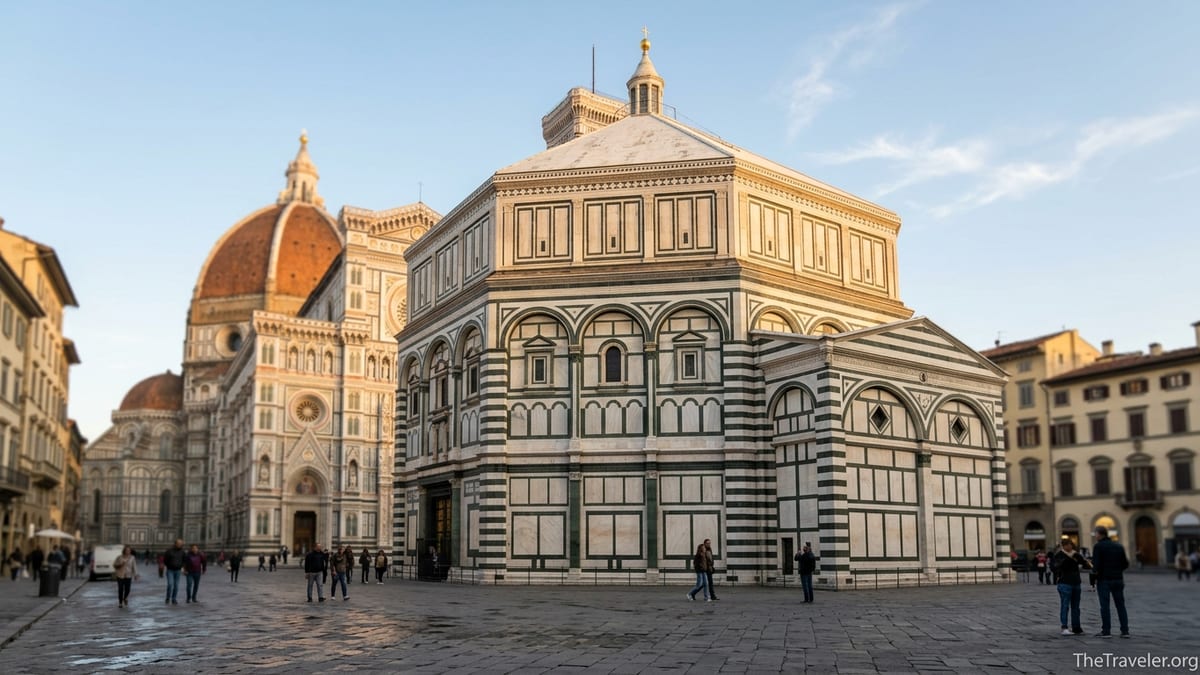
What Is the Baptistery of San Giovanni?
The Baptistery of San Giovanni is a stand-alone octagonal building directly opposite Florence’s cathedral, dedicated to Saint John the Baptist, the city’s patron saint. Today it functions primarily as a historic monument and liturgical space rather than a busy parish church, but for centuries it was where Florentines were baptized and formally welcomed into both the Christian community and the civic life of the city.
Architecturally, the Baptistery is deceptively simple from the outside. It rises in three tiers of white Carrara and green Prato marble, capped by a low pyramidal roof and lantern. Inside, it opens into a surprisingly tall, echoing space crowned by a dome covered in medieval mosaics. Everything in the building, from the geometry of its octagonal plan to the cycle of images overhead, is designed around the sacrament of baptism and the idea of spiritual rebirth.
For modern visitors, the Baptistery is part of the larger cathedral complex that also includes the Duomo, Giotto’s bell tower, the Opera del Duomo Museum, and the crypt under Santa Reparata. One of the most common ways to experience it is with a combined ticket or pass that allows entry to several of these sites over a few days, turning Piazza del Duomo into an extended open-air museum rather than just a place to snap a single photo of Brunelleschi’s dome.
Stepping through the doors, you are entering a building that has served the people of Florence for roughly a millennium, and possibly longer. Its layered history, combined with its relatively compact size, makes it an ideal first stop in understanding the city as a whole.
How Old Is It, Really?
Locals like to tell visitors that the Baptistery is “even older than the Duomo,” and that claim is broadly true. Documents record the building from at least the 11th century, and most scholars date its present form to between the 11th and 12th centuries. Archaeological work beneath the floor has uncovered remains of earlier Roman and late antique structures on the same site, suggesting that Christian worship here may go back much further, even if the visible walls are medieval rather than Roman.
According to research published by the Opera di Santa Maria del Fiore, the institution that manages the cathedral complex, the Baptistery is one of the oldest monumental buildings in Florence and the religious and civic heart of the early city. Excavations have revealed fragments of a Roman domus and later structures, showing that this corner of what is now Piazza del Duomo has been continuously occupied and symbolically important since antiquity. The octagonal plan itself echoes early Christian and late Roman baptisteries elsewhere in Italy.
For travelers, this deep timeline is not just an abstract date range. When you stand in the middle of the marble floor and look up at the mosaics, you are physically in the same space where medieval Florentines gathered for baptisms, where the city’s elite families brought their newborns, and where processions formed on major feast days. Imagine someone being baptized here in the 1200s, while the cathedral we see today had not yet been built and the skyline was still a forest of tower houses instead of a single great dome.
This extraordinary continuity is a key reason the Baptistery is highlighted within Florence’s UNESCO-listed historic center. While the Duomo visually dominates the skyline, the Baptistery anchors the story of the city’s earliest monumental Christian architecture and its transition from late antiquity to the Middle Ages.
Why the Baptistery Matters to Florence’s Identity
The Baptistery is much more than an architectural relic. For many centuries, every Catholic baby in Florence was baptized here, which meant the building stood at the intersection of religious life and civic identity. Being baptized in San Giovanni marked you as Florentine in a way that went beyond citizenship records; it tied your personal story to the city’s sacred heart.
This symbolic role continues today in the annual Feast of San Giovanni on June 24, when Florence celebrates its patron saint with religious services, historical parades, and evening fireworks. The Baptistery is central to these events. Morning Mass here, attended by civic authorities, connects contemporary Florence to the medieval city that first chose John the Baptist as its protector. If you visit in late June, you might find the piazza filled with local families, football club banners intertwined with religious banners, and costumed flag-throwers performing near the Baptistery’s steps.
The building also plays an important role in how Florentines imagine their own history. Medieval chroniclers described it as the city’s “beloved” temple, and later writers pointed to it as proof that Florence had always aspired to artistic greatness. Renaissance architects like Brunelleschi carefully studied its marble cladding, proportions, and interior volume when they looked for inspiration to revive what they saw as the harmony of ancient Roman design. Walking around the exterior today, you can spot how its green and white marble pattern is echoed on the façade of Santa Maria Novella and later in the 19th‑century completion of the Duomo’s own façade.
For travelers looking beyond the surface sights, this makes the Baptistery a key to reading Florence itself. It shows how the city uses its sacred architecture to express political power, civic pride, and continuity over the centuries. You may spend more time under Brunelleschi’s dome, but the Baptistery captures the city’s self-image in a uniquely concentrated form.
Artistic Highlights: From Mosaics to the “Gates of Paradise”
Inside, the most striking feature of the Baptistery is its vast mosaic program, which covers the dome and apse. These mosaics were created in stages between roughly the mid‑13th and early 14th centuries by teams of artists working in the Italo‑Byzantine tradition. When you tilt your head back, your eye is drawn first to the enormous figure of Christ in Majesty occupying three sections of the dome, arms wide, flanked by ranks of angels and saints and a dramatic scene of the Last Judgment.
Below Christ, bands of narrative scenes unfold in gold and jewel-like colors. You can trace the life of John the Baptist, the life of Christ, the stories of Joseph and Mary, and even Genesis scenes with Noah and the Ark. Near the bottom, the Hell scene is particularly vivid, with horned devils and writhing figures. Guides in Florence often point out how these mosaics likely influenced Dante’s imagination when he wrote the Inferno; even today, visitors sometimes compare what they see above them to the punishments described in the poem.
The floor is equally rich if you look down instead of up. Intricate marble inlays form geometric patterns, zodiac motifs, and symbolic imagery related to time and eternity. Standing on these centuries‑old slabs while surrounded by the golden light reflected from the dome creates a rare experience: you are visually immersed in a medieval conception of the cosmos, yet able to view it calmly like a museum piece.
Outside, the Baptistery is famous for its bronze doors, especially the east doors still known as the “Gates of Paradise,” a nickname often attributed to Michelangelo. The original panels by Lorenzo Ghiberti, created in the 15th century and depicting Old Testament scenes in high relief, have been moved indoors to the Opera del Duomo Museum for conservation. What you see on the building today are high-quality replicas, but they still convey the extraordinary detail. Travelers can compare the replicas in situ with the originals in the museum nearby, where spot lighting and close viewing make it easier to appreciate the sculptural depth and gilded surfaces.
Experiencing the Baptistery Today
For visitors planning a trip in 2026, the Baptistery is open daily with morning and afternoon hours. According to the latest timetable from the Opera del Duomo, the building generally opens around 8:30 a.m. and closes in the early evening, with an earlier closing time on the first Sunday of the month. Hours can shift for religious ceremonies and ongoing restoration, so it is wise to check the most recent schedule shortly before your trip or verify at the official ticket office beside the cathedral.
Admission is usually included in multi‑site passes sold for the cathedral complex. At the time of writing, popular options such as the Brunelleschi Pass and Giotto Pass combine entry to the Baptistery with the Duomo museum, bell tower, and sometimes the dome climb. Prices fluctuate, but you can expect to pay roughly the cost of a mid‑range restaurant meal in Florence for one of these bundled tickets, which are valid for several days. Buying online in advance is strongly recommended during busy seasons like Easter week, late spring, and from June through September, when same‑day ticket lines can stretch around the block.
Once inside, you will find the Baptistery relatively small compared to the cathedral, which changes how you experience it. During quieter hours early in the morning, it can feel almost contemplative, with soft light filtering through the high windows and a handful of visitors sitting on the wooden benches, necks craned toward the mosaics. At peak times, it can be crowded, but the compact space means you can still take your time walking the perimeter, examining the marble revetment, and pausing beneath the dome to let your eyes adapt to the shifting reflections on the gold tesserae.
Photography is typically allowed without flash, but tripods and large camera rigs are generally prohibited. If you plan to photograph the ceiling, a wide‑angle lens on a mirrorless or DSLR camera at around 16–24 mm is helpful, though most travelers rely on their smartphones and simply stand near the center of the floor, pointing the camera straight up and using the wide lens mode to capture the full dome in one shot.
Restoration, Conservation, and What You Will See
Like many medieval buildings, the Baptistery has been undergoing phases of restoration and cleaning. In recent years, work has focused on the exterior marble cladding and the interior mosaics. Scaffolding has occasionally been present inside, sometimes partially obstructing views of the ceiling but accompanied by detailed panels that reproduce the mosaic imagery at eye level. Travelers who visited during these campaigns often noted that the interpretive displays helped them understand scenes that would otherwise be hard to see from the floor.
As of mid‑2026, major exterior work has largely been completed, and the building presents a crisp façade in the piazza. Conservation of the mosaics is an ongoing project, but the goal is always to keep as much of the dome visible as possible while ensuring the long‑term stability of the tesserae and underlying structure. Even during active restoration, visitors can typically see the Hell scene and Christ in Majesty, along with several narrative bands, and the floor and lower walls remain fully accessible.
For travelers, this means you may encounter temporary platforms, protective netting, or areas roped off inside the Baptistery. Rather than seeing this as a drawback, it can be an opportunity to witness conservation in action. On some days, you might glimpse conservators at work on the scaffolding, using small tools and microscopes to consolidate loose tesserae. Interpretive signs, usually offered in multiple languages, explain the methods and materials used, providing insight into how such a fragile medieval artwork can survive in a modern, high‑traffic environment.
If viewing the mosaics without obstruction is a priority for you, consider checking recent visitor reports or asking at the Opera del Duomo ticket office whether any portions of the dome are currently covered. Regardless of the stage of restoration, the building’s age, symbolism, and atmosphere remain fully legible.
Tips for Travelers: When and How to Visit
The Baptistery’s central location makes it very easy to fold into a walking itinerary of central Florence. Many visitors see it immediately after touring the Duomo Museum, which displays the original Ghiberti doors and models of the cathedral’s façade and dome. Moving from the museum’s climate‑controlled galleries into the Baptistery itself helps connect the objects behind glass with the space for which they were created.
To avoid crowds, early morning entry within the first hour of opening is often the best strategy, especially from April through October. Tour groups tend to arrive a bit later, and by late morning Piazza del Duomo can be densely packed. In winter, especially in January and early February, foot traffic is lighter, and you may find that you share the building with only a few other visitors. Late afternoon can also be atmospheric, as the angle of the light shifts and the gold mosaics pick up warmer tones.
Budget‑conscious travelers should note that the Baptistery is rarely open for free general admission, but it may host specific religious services or special openings on the Feast of San Giovanni and other liturgical occasions. These are mainly aimed at locals, and access for tourists during ceremonies can be restricted. If you happen to be in Florence on June 24, plan your visit around the civic celebrations and fireworks rather than expecting a standard touring experience inside the building that day.
Because the Baptistery is part of an active religious complex, modest dress is required. While enforcement varies, it is wise to cover shoulders and avoid very short shorts when entering. This is the same standard applied at the cathedral and other churches in the city. Small backpacks are generally permitted, but large luggage is discouraged, and security staff may ask you to keep bags in front of you rather than on your back to prevent accidental knocks against the marble and brass elements.
The Takeaway
For many travelers, Florence is synonymous with the Duomo’s red‑tiled dome, the Uffizi’s masterpieces, and Michelangelo’s David. Yet the Baptistery of San Giovanni, sitting modestly in the same square as the cathedral, is older than most of the city’s headline monuments and in some ways more central to Florence’s sense of itself. It is where generations of Florentines were baptized, where the city celebrates its patron saint, and where medieval artists conjured a shimmering vision of heaven and hell that still captivates visitors.
Understanding what the Baptistery is and why it matters turns a short visit into an encounter with the very beginnings of Florence as a Christian and civic community. The building’s age, its octagonal form, its mosaic dome, and its links to artists such as Ghiberti all make it one of the city’s most important landmarks. Whether you spend twenty minutes or an hour inside, it rewards slow looking and a bit of historical imagination.
On your next trip to Tuscany’s capital, plan time not just to admire Brunelleschi’s dome from the piazza but to step through the doors of San Giovanni, stand on its worn marble floor, and look up. In that moment, surrounded by golden light and centuries of memory, you will understand why this compact structure is one of Florence’s oldest and most enduring treasures.
FAQ
Q1. What exactly is the Baptistery of San Giovanni?
The Baptistery of San Giovanni is an octagonal building in front of Florence’s cathedral, historically used for baptisms and now a major religious and artistic monument.
Q2. How old is the Baptistery compared to the Duomo?
The Baptistery in its current form dates mainly to the 11th and 12th centuries, making it older than the present cathedral, whose construction began in the late 13th century.
Q3. Why is the Baptistery considered one of Florence’s oldest landmarks?
It is among the city’s earliest monumental Christian buildings, built on layers of earlier Roman and late antique structures, and has remained in continuous religious use for centuries.
Q4. What are the main artistic highlights inside the Baptistery?
The chief highlights are the vast medieval mosaic ceiling with scenes from the Bible and the Last Judgment, along with the intricate marble floor and wall revetments.
Q5. Are the famous “Gates of Paradise” doors still on the Baptistery?
No. The original bronze doors by Lorenzo Ghiberti have been moved to the Opera del Duomo Museum for conservation, and high‑quality replicas are installed on the Baptistery.
Q6. How much time should I plan for a visit?
Most visitors spend between 20 and 45 minutes inside, depending on how long they study the mosaics, floor details, and exterior doors.
Q7. Do I need a separate ticket for the Baptistery?
Usually you do not buy a stand‑alone ticket; entry is included in multi‑site passes for the Florence cathedral complex sold by the Opera del Duomo.
Q8. When is the best time of day to visit?
Early morning soon after opening or later in the afternoon tends to be quieter, with softer light on the mosaics and fewer large tour groups.
Q9. Is the Baptistery accessible for travelers with limited mobility?
Access involves only a small threshold, and the interior is on a single level, but very uneven historic flooring can be challenging for some visitors using wheelchairs or walkers.
Q10. Can I attend a religious service in the Baptistery?
Occasional liturgies are held here, especially around the Feast of San Giovanni on June 24, though most regular services for the parish now take place in the cathedral itself.