


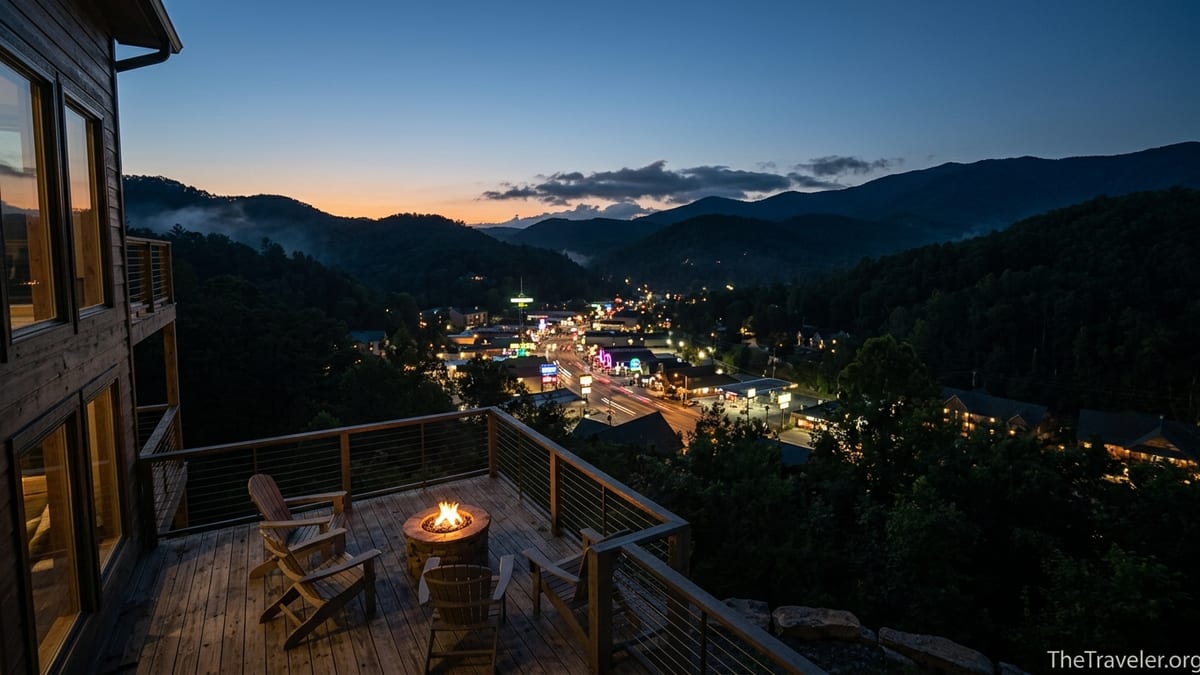
My first glimpse of Gatlinburg was a blur of neon, pancake houses, and airbrushed T-shirts. Wedged in traffic along the Parkway on a Saturday afternoon, I wondered if I had accidentally checked into a theme park instead of a mountain town. Yet by the time the streetlights flickered on and the Smokies turned blue against the sky, Gatlinburg had completely disarmed me. The very place that felt over-the-top touristy by day became one of the most atmospheric small towns I have experienced at night.
Get the latest updates straight to your inbox!
First Impressions on the Parkway: Souvenirs, Crowds and Second Thoughts
Arriving in Gatlinburg in the middle of the day is a lesson in sensory overload. The Parkway, the town’s main artery, is a solid stream of cars inching past Ripley’s attractions, old-time photo studios, and candy shops pulling taffy in the window. Music spills from open doors, lights blink, and there always seems to be someone in a Dollywood T-shirt asking where to find the nearest moonshine tasting. If you are coming straight from Great Smoky Mountains National Park, where the loudest sound is often a woodpecker, the shift can feel almost jarring.
My first hour in town was a slow crawl from the edge of Gatlinburg to a hotel near the aquarium. Parking decks advertised flat daily rates that rivaled big-city prices, and souvenir stores hawked everything from black bear salt shakers to “I got smoked in the Smokies” hoodies. It was easy to write the place off as a strip built solely to separate visitors from their vacation budgets. I debated whether I should have stayed in a quieter spot like Townsend or Wears Valley and just driven in for the day.
But as I checked in and chatted with the front desk clerk, she mentioned something that shifted my perspective. “Give it until after dark,” she said. “Take the aerial tram up before sunset or ride the SkyLift, then come back down once the lights are on. It’s a different town at night.” I decided to follow her advice and plan my afternoon around the evening to see if Gatlinburg’s reputation as pure kitsch was really the whole story.
To kill a couple of hours before sunset, I did what many first-timers do: wandered the Parkway. Even in the tourist crush, there were hints of local character. A man with a fiddle played old Appalachian tunes in a doorway near the Smoky Mountain Brewery. Inside small galleries just off the main drag, I found handmade pottery and woodcarvings that felt worlds away from the mass-produced trinkets out front. Gatlinburg still felt touristy, but I was starting to sense an undercurrent that did not match the caricature.
Riding Above the Noise: Ober Mountain’s Tram and Skyline Views
The turning point came when I boarded the Ober Mountain Aerial Tramway from downtown. Ober’s tram, one of the largest aerial tramways of its kind in the country, glides more than two miles from a station near the Parkway to a mountaintop adventure park and ski area. In late afternoon it was busy, but not overwhelming. As the doors closed and we rose above the rooftops, the honking and chatter below dropped away and the ridges of the Smokies began to dominate the horizon.
In less than twenty minutes, the scene flipped from tacky T-shirt shops to blue ridgelines and cooler air. Up top, I walked past the restaurants and ice cream counters and headed for the overlook. From there, Gatlinburg sprawled below, a pocket of flickering color in a valley ringed by dark, forested mountains. It was the perfect place to watch the shadows stretch across Mount Le Conte and the last light catch the glass of hotel windows before the town’s signs clicked on one by one.
As families queued for the mountain coaster and kids lobbied for one more round of arcade games, I realized that Ober Mountain was where the touristy and the timeless coexisted. You could order a funnel cake and then, a few steps away, stare into the kind of layered, smoky view that inspired the creation of the national park. By the time I rode the tram back down, the Parkway was glowing and the night version of Gatlinburg was waiting.
If you are skeptical of Gatlinburg, an early evening lift ride is one of the best ways to reset your mindset. Whether you choose Ober Mountain’s tram or the chairlift at Gatlinburg SkyPark, getting above town right before sunset lets you appreciate the natural bowl the city sits in. Seeing it from that angle makes the lights feel less like an invasion and more like a cluster of fireflies in the valley.
When the Lights Come On: A Softer Side of the Parkway After Dark
Stepping back onto the Parkway after sunset, I immediately understood what locals meant. The harshness seemed dialed down. Neon reflected in the wet pavement after a brief shower, and the mountains framed the scene in silhouette. The heat had dropped a few degrees, and the worst of the day traffic had thinned to a slow but steady stream of families, couples, and groups of friends drifting from one stop to another.
Shops that felt chaotic in daylight now glowed warmly, their windows filled with jars of honey, handmade soaps, and glass bottles of hot sauce. Candy kitchens had small clusters of people watching caramel apples being dipped, while ice cream counters did brisk business with visitors who had clearly already eaten dinner but could not resist one more treat. Even the ubiquitous mini-golf courses looked more charming under strings of lights than they had in the glare of the afternoon sun.
The soundtrack of Gatlinburg changed too. Instead of the overlapping blare of competing speakers, there were pockets of live music: a duo strumming country covers on a patio, a bluegrass band kicking into “Rocky Top” on an outdoor stage, a solo guitarist tucked into a corner near the aquarium. None of it was particularly polished, but it felt real. Parents swayed with kids on their shoulders, couples lingered over plastic cups of cider or cocktails, and strangers ended up chatting at high-top tables.
Practical details made the night feel more relaxed. Parking garages that felt tense and claustrophobic at midday were easier to navigate, and restaurant waits that had stretched to over an hour earlier had shortened to twenty or thirty minutes, especially after 8 p.m. A number of attractions, from mirror mazes to arcades, stayed open late, but the overall tempo had slowed. The town felt less like a crowded corridor you had to fight through and more like a nighttime promenade where you could stroll and see what caught your attention.
Finding Real Atmosphere at Gatlinburg SkyPark and Anakeesta
For all the action at street level, Gatlinburg’s most memorable nighttime experiences sit above the town. One of the easiest to reach is Gatlinburg SkyPark, accessible via the yellow chairlifts that depart from a station right on the Parkway. The ride itself is simple, but it is the destination that made me a convert. At the top, a broad deck lines the ridge, with firepits, Adirondack chairs, and sweeping views over the valley.
Arriving just after dusk, I joined a small crowd clustered along the railings. The SkyBridge, billed as the longest pedestrian suspension bridge in North America when it opened, stretched out in front of us like a string of fairy lights. Walking it at night felt different than in the daytime; you are less focused on the height and more on the twinkling town below and the dark, protecting wall of the Smokies beyond. On some evenings, SkyPark hosts live music sets, turning the mountaintop into an outdoor lounge with local artists playing folk and Americana as people sip drinks under the stars.
A short walk up the Parkway from the chairlift base is the ticket office for Anakeesta, a mountaintop village and adventure park that has leaned fully into the idea of nighttime magic. After riding the chondola or Ridge Rambler up the mountain, I stepped into a scene that felt purpose-built for evenings: wooden boardwalks edged with lanterns, treetop play areas glowing softly, and views across to Mount Le Conte that deepened from blue to near-black as the night came on.
The standout at Anakeesta after dark is Astra Lumina, an “enchanted night walk” that mixes light, projection, and sound along a wooded trail. It is more art installation than thrill ride. Families shuffle along together, stopping to watch constellations swirl through the trees or light pulse across the path in time with music. Even if you typically avoid anything described as immersive, there is something unexpectedly calming about walking through a forest that has been gently reimagined as a galaxy. When I emerged back into the village square, grabbed a drink from a bar with outdoor seating, and watched kids toast marshmallows at fire tables while a band played classic rock, Gatlinburg’s earlier chaos felt a long way away.
From Shot Glasses to Storytelling: Moonshine Tastings with Local Flavor
Of course, you cannot talk about Gatlinburg at night without mentioning moonshine. Legal distilleries line the Parkway and nearby streets, turning what was once a backroad enterprise into a full-fledged tasting scene. In daylight, the crowds at these places can be intense: shot glasses clinking, tasting guides shouting rehearsed punchlines, lines stretching out the door. At night, especially on weekdays or later in the evening, the vibe softens and the experiences feel more personal.
Ole Smoky Distillery, often called The Holler, sits in an open-air courtyard off the Parkway and has become one of Gatlinburg’s signature stops. In the evening, the stage out front often hosts live Appalachian and country acts, with picnic tables and benches filling up as people settle in with small plastic cups of flavored moonshine. Tasting flights typically cost just a few dollars and run through a rotating lineup that can include everything from classic white lightning to apple pie and blackberry. Even if you are not usually a fan of sweet spirits, the banter from the staff and the mix of locals, bachelorette parties, and multigenerational families make it a memorable slice of local culture.
Just up the road, Ole Smoky’s Barrelhouse location leans more into whiskey and offers a quieter alternative, sometimes with a rooftop patio that looks out over the town. Other distilleries, such as Sugarlands Distilling Company and Tennessee Shine Company, add their own twists, whether through concoctions like jalapeño cornbread flavored spirits or partnerships with Southern brands for dessert-style flavors. Many visitors turn an evening into an informal “shine crawl,” walking from one tasting room to another, sipping responsibly and comparing favorites.
What surprised me most was not the variety of flavors but the stories that came with them. Several tasting guides wove in tales of old-time bootleggers, family recipes, and the region’s complicated relationship with prohibition. They were quick to note that what is sold in these jars is technically corn whiskey, produced according to modern safety and labeling standards, but the cultural lineage is clear. Listening to those stories with the sound of a fiddle drifting in from outside, I felt more connected to the Smokies than I had while staring at shelves of souvenir shot glasses that afternoon.
For travelers who do not drink, or for families with kids in tow, many of these distilleries still offer plenty to enjoy: live music, outdoor seating, nonalcoholic slushies, and space for people-watching. It is entirely possible to soak up the atmosphere with a lemonade in hand rather than a moonshine sample, especially later in the evening when the harsh afternoon light has given way to softer glows and string lights.
Hidden Corners: Backstreets, Creekside Walks and Late-Night Comfort Food
The longer I stayed out, the more Gatlinburg revealed pockets that felt almost like a different town. Slip a block or two off the Parkway, and you find quieter backstreets where wooden inns sit beside small creeks and walkways run along the water. On River Road, which parallels the main drag, traffic noise fades and you can hear the rush of the stream. Several hotels and cabins back onto this corridor, and at night guests sit on balconies or small patios, sipping drinks and listening to the water while the town hums just out of sight.
These side areas are where I found some of my favorite late-night moments. A small breakfast spot on the Parkway turned into a diner-style joint after dark, serving burgers and pancakes to night owls and shift workers. A pizza place tucked into a side alley stayed open long after the last distillery shut its doors, feeding groups of friends who arrived with shopping bags and festival wristbands. Even a simple ice cream cone eaten on a bench overlooking the creek felt different when the only sounds were the water and distant laughter.
Walking further from the bright center, I passed small chapels, cabin-style motels, and the occasional firepit with guests gathered around it. One lodge offered s’mores kits at the front desk, and I watched a family toast marshmallows while peering through the trees at the twinkling lights downtown. The sense of being in a real mountain town with people who live and work there year-round, rather than just a stage set for tourists, came into focus.
Food plays a big part in this late-night charm. A number of local restaurants keep their kitchens open beyond typical small-town hours, particularly on weekends during busy seasons. Places known for breakfast stacks of biscuits and gravy pivot to hearty suppers, while barbecue joints still perfume the air after 9 p.m. The chance to sit over a plate of pulled pork or a slice of pecan pie and watch the last waves of visitors drift home became one of my favorite parts of Gatlinburg’s evenings.
How to Let Gatlinburg Win You Over
By the end of my stay, I realized that my initial resistance to Gatlinburg had less to do with the town itself and more to do with how I tried to experience it. Treat it only as a midday stop between hikes, and it is easy to see nothing but crowds, souvenir overload, and traffic. Give it a full evening, and you start to notice the things that locals quietly cherish: mountain silhouettes behind neon signs, the way live music spills out into the streets, the comfort of knowing you can find a hot meal or a friendly barstool long after dark.
If it is your first visit, build your schedule around that transition from day to night. Spend the afternoon in Great Smoky Mountains National Park, maybe on a drive through Roaring Fork Motor Nature Trail or a hike to a waterfall, then roll into Gatlinburg in the late afternoon. Park once in a central garage or at your lodging, then leave the car behind. Plan to ride up to Ober Mountain or Gatlinburg SkyPark before sunset, watch the lights flicker on from above, and then wander back down for dinner, music, and, if you want, a tasting flight or two.
It also helps to manage expectations. Gatlinburg is not a hidden village; it is a busy gateway town that knows exactly what it is. There will be souvenir stores and photo ops and attractions that are unabashedly kitschy. But there will also be a couple slow dancing to a cover of “Tennessee Whiskey” on a distillery patio, a child wide-eyed at the sight of fireflies floating over a dark hillside, and a line cook stepping outside to catch a quick glimpse of the stars before the next rush. Those are the moments when Gatlinburg stops feeling like a caricature and starts feeling like a place with its own quirky heartbeat.
Above all, give yourself permission to lean into both sides of the experience. Ride the tram and the mountain coaster, then find a quiet bench by the creek. Pose for the cheesy photo if it makes your kids laugh, then slip up to a rooftop spot where you can see the curve of the valley. Gatlinburg is both touristy and tender, both loud and unexpectedly lovely. It took staying out past dark for me to see that, but once I did, the town had me completely.
The Takeaway
Gatlinburg is easy to underestimate. Arriving in daytime traffic, you see only the surface: neon, fudge shops, and a parade of branded sweatshirts. It looks like every stereotype of an overbuilt tourist town. Yet as the sun drops and the mountains fade to shadows, a different version comes into focus. Firepits flicker on ridgelines, distillery courtyards fill with music, and families drift along the Parkway under a canopy of lights, unhurried for the first time all day.
What ultimately won me over was not a single attraction but the way the town feels when it finally relaxes. Gatlinburg at night lets you see the contours of the land that cradle it, hear the echoes of Appalachian music, and taste a bit of local tradition in a plastic cup. It invites you to slow your pace, look up from the souvenir windows, and notice how the glow of the town settles gently into the valley instead of fighting the darkness. If your first instinct is to judge it by the midday crowds, resist that urge. Stay for the evening. Somewhere between the first lift ride at sunset and the last song on a small stage, Gatlinburg just might surprise you too.
FAQ
Q1. Is Gatlinburg worth visiting if I usually avoid touristy towns?
Yes, especially if you plan to experience it at night. While the Parkway can feel crowded and commercial in daylight, evenings reveal quieter corners, mountain views from places like Gatlinburg SkyPark and Ober Mountain, and a relaxed atmosphere with live music, good food, and creekside walks.
Q2. What is the best time of day to see Gatlinburg at its most enjoyable?
Late afternoon into evening is ideal. Arrive before sunset, ride a lift or tram for ridge-top views as the lights come on, then return to the Parkway for dinner, music, and a more laid-back stroll once the daytime crowds thin.
Q3. Are moonshine tastings in Gatlinburg only for serious drinkers?
No. Tastings at places like Ole Smoky, Sugarlands Distilling Company, and Tennessee Shine Company are as much about storytelling and atmosphere as the drinks themselves. Portions are small, there are nonalcoholic options nearby, and many visitors simply listen to the guides, enjoy the music, and sample a flavor or two.
Q4. Can families with children still enjoy Gatlinburg at night?
Yes. Many evening spots are family-friendly, including Anakeesta’s mountaintop village, Astra Lumina’s lighted forest walk, arcades along the Parkway, mini-golf courses, and ice cream or candy shops that stay open late. Parents can enjoy music and views while kids play within sight.
Q5. How can I avoid the worst of Gatlinburg’s traffic and crowds?
Park once and walk, especially if you arrive in the late afternoon. Using a central parking garage or staying at a hotel within walking distance of the Parkway helps. Crowds are typically heaviest midday; by evening, lines shorten at many restaurants and attractions, and the pace slows down.
Q6. Is it safe to walk around Gatlinburg at night?
Generally yes, particularly along the well-lit sections of the Parkway and nearby streets where most visitors gather. As in any busy destination, keep an eye on your belongings, stick to main areas, and use basic common sense, but many families and couples comfortably stroll until late evening.
Q7. Do I need separate tickets for places like Ober Mountain, SkyPark, and Anakeesta?
Yes. Each mountaintop attraction has its own admission, often with options that include both daytime access and evening experiences. It is wise to check current pricing and hours in advance and decide which one or two best fit your schedule and budget rather than trying to do everything in one night.
Q8. What should I wear for an evening out in Gatlinburg?
Casual, comfortable clothing is the norm. Bring layers, since temperatures on mountaintops like Ober Mountain or Anakeesta can be cooler than on the Parkway, even in warmer months. Comfortable walking shoes are important if you plan to stroll the town, explore boardwalks, or cross suspension bridges at night.
Q9. Are there quieter places to stay that are still close to the action?
Yes. Lodging along River Road or slightly uphill from the Parkway often offers a calmer atmosphere within a short walk of downtown. Cabins and small motels tucked off side streets can provide creekside or wooded settings while still giving you easy access to restaurants and attractions after dark.
Q10. How many nights should I plan in Gatlinburg to experience its nightlife and the national park?
Two or three nights is a comfortable amount for most travelers. That gives you time for at least one full evening in town, a mountaintop outing for sunset views, and one or two days exploring Great Smoky Mountains National Park without feeling rushed.