


Walk the Gatlinburg Parkway on a busy afternoon and it can feel more like a theme park midway than a mountain town. Neon signs compete with moonshine tastings, traffic crawls past pancake houses, and sidewalks move at a slow shuffle. Yet within a 10 to 20 minute drive of those same traffic lights, you can step into quiet river coves, artist enclaves, and back roads where the Smokies feel as they were meant to be experienced. Here is how to enjoy Gatlinburg while mostly sidestepping the main Parkway crowds.
Get the latest updates straight to your inbox!
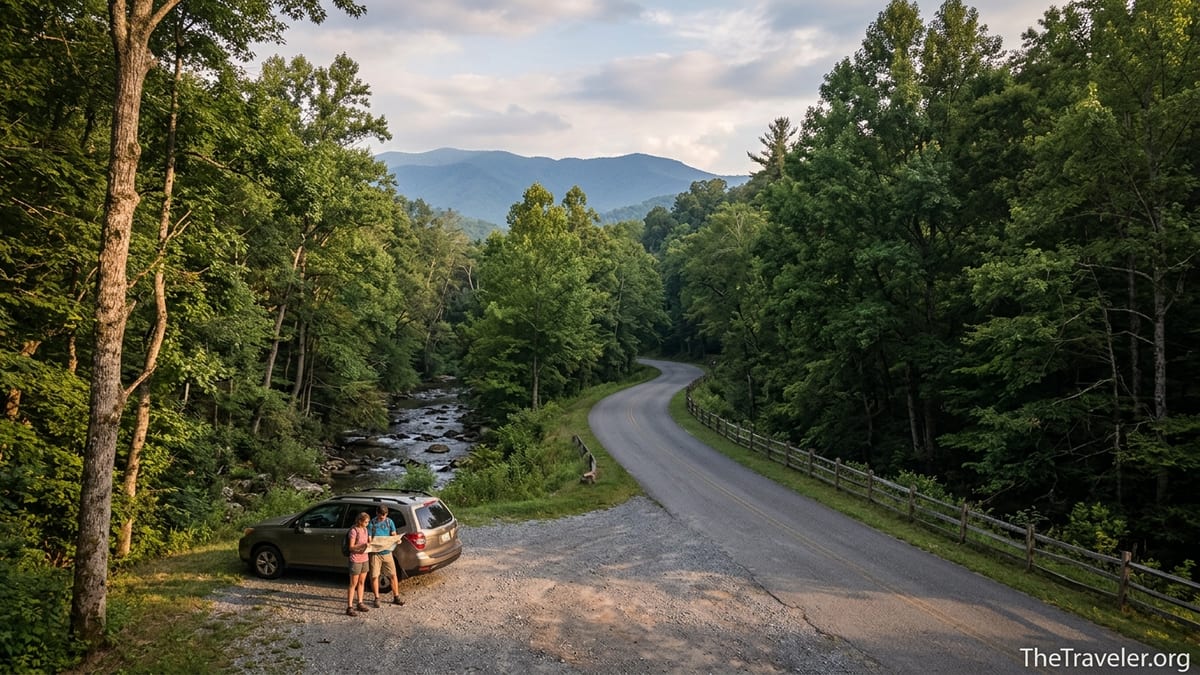
Start With Quieter Gateways Into Great Smoky Mountains National Park
Most first-time visitors enter Great Smoky Mountains National Park through the Sugarlands entrance at the south end of town, which funnels heavy traffic from the Parkway directly into the park. On summer weekends, it is common for cars to back up for more than a mile as visitors jockey for parking at popular trailheads. One of the simplest ways to avoid that bottleneck is to use alternative gateways that sit just a few miles beyond the lights and billboards of downtown.
East of Gatlinburg on US 321, the Greenbrier entrance offers a far quieter way to slip into the park. Roughly 6 miles from town, a signed turnoff leads to a partly paved road that follows the Middle Prong of the Little Pigeon River. The area is known for spring wildflowers, trout streams and historic homesteads, but it rarely feels as congested as Sugarlands or Newfound Gap. Parking lots for Porters Creek Trail and picnic pullouts along the river fill on busy weekends, yet it is still realistic to find a spot late morning, which is rarely the case around places like Laurel Falls.
To the west, the Wears Valley side of the park can be reached by driving out of Gatlinburg toward Pigeon Forge and then cutting across valley roads rather than diving back into Parkway traffic. From there, Metcalf Bottoms and the Little Greenbrier area typically see fewer tour buses and commercial vehicles than popular loops like Cades Cove. You will still encounter other travelers, but the vibe is slower and more local, with families grilling at the riverside picnic tables and children wading in shallow riffles on hot days.
If you prefer to keep your car out of the picture altogether, consider planning around the park-and-ride lots at the edge of downtown rather than circling endlessly for a curbside slot off the Parkway. On peak days it can make sense to leave your vehicle in one of the city lots along East Parkway and use the Gatlinburg trolley to hop between the quieter edges of town and less-trafficked park access points.
Trade Instagram Hotspots for Under-the-Radar Trails
On any given afternoon, parking at the trailheads for Alum Cave, Chimney Tops, or Laurel Falls can resemble a stadium lot before a game. Cars spill down both shoulders of Newfound Gap Road, and hikers thread between bumpers before ever seeing a tree. To find the Smokies you may be picturing in your head, look instead to trails that sit just far enough off the main tourist radar to stay relatively calm.
From the Greenbrier entrance, Porters Creek Trail is a strong alternative to more famous waterfall hikes. The first mile follows a wide gravel road along the creek, lined with spring ephemerals in March and April and shaded by hardwoods in summer. Past a historic cemetery and the stone walls of an old farmstead, the path narrows and climbs gently to a small cascade. The full round-trip is around 4 miles, but you can turn around at any point and still enjoy a sense of deep forest that is hard to find near Gatlinburg’s main entrance.
Also in the Greenbrier area, the Gabes Mountain Trail to Hen Wallow Falls offers a moderate, roughly 4.5 mile round-trip walk that usually sees far fewer hikers than Laurel Falls, even on holiday weekends. The path can be rooty and rocky in places, so sturdy shoes are essential, but the payoff is a tiered waterfall framed by rhododendron and hemlock, rather than a crowded overlook with rails and pavement. Arriving before 9 am is still wise, especially in peak leaf season, but you are more likely to hear birds over voices.
Closer to town, the Gatlinburg Trail starts near the park boundary and follows the West Prong of the Little Pigeon River for around 2 miles one way to Sugarlands Visitor Center. It is one of only a few park trails that allow dogs, and it stays relatively gentle and wide, with old stone walls and the remains of homesteads just off the path. While it does see a mix of locals jogging and visitors out for a stroll, the farther you get from the trailheads, the more the Parkway fades into the background. Planning a late-afternoon walk here, after day-trippers have left for dinner, can be especially peaceful.
Drive the Back Roads and Scenic Loops Outside Peak Hours
Scenic driving is one of the classic Smokies experiences, but it can quickly turn frustrating when you are stuck in a line of cars creeping uphill toward an overlook. The key to enjoying the roads around Gatlinburg without feeling trapped is twofold: choose routes that are slightly removed from the main arteries, and time your drive for early morning or late afternoon when day-visitor traffic is thinnest.
The Roaring Fork Motor Nature Trail is a good example. The one-way, 5.5 mile loop begins just off Historic Nature Trail Road at traffic light number 8 in Gatlinburg, yet it feels worlds apart from the Parkway. The narrow paved road winds through dense forest, passing restored log cabins, rushing streams, and trailheads for several quieter hikes. It is closed in winter and can still be popular in October, but if you start the loop shortly after it opens in the morning, you often share the road mostly with local photographers and a few early risers, not tour buses.
Outside the park, the Gatlinburg Bypass offers a practical crowd-avoidance tool as well as a scenic overlook. Rather than following the Parkway all the way into downtown when approaching from Pigeon Forge or Cherokee, the bypass lets you skirt the most congested blocks and then drop down near the park boundary. A signed overlook along the way delivers a sweeping view of Gatlinburg backed by Mount Le Conte. Visit just after sunrise or in the blue hour after dinner, and you will often find only a handful of other people admiring the lights below.
Those willing to invest an hour behind the wheel can escape the Gatlinburg orbit altogether for part of a day by heading out to Foothills Parkway. This segmented scenic road runs along the spine of the foothills, with long views over the Tennessee Valley on one side and the Smokies on the other. It is not empty, particularly on clear weekends, but the pace is less hectic than the main park roads, and traffic disperses across numerous pull-offs rather than clustering around one or two marquee stops.
Explore the Great Smoky Arts & Crafts Community
For a version of Gatlinburg that revolves around creativity instead of carnival attractions, set aside half a day for the Great Smoky Arts & Crafts Community. Located along an 8 mile loop just east of town, this historic enclave is considered one of the largest independent arts and crafts communities in the United States, with more than 80 working artisans operating galleries, studios, and small shops along a two-lane country road. It was established in the 1930s as local craftspeople banded together to sell handwoven textiles, pottery, woodcarvings, and other work rooted in Appalachian traditions.
Today, visitors can drive the loop independently or use the city trolley route that runs through the community, hopping off at clusters of studios without worrying about the tight curbside parking that plagues the Parkway. Instead of shell games and souvenir megastores, you will find glassblowers shaping vases in front of the furnace, broom makers binding handles by hand, and painters chatting from open studio doors. Prices run the gamut from a few dollars for small, hand-dipped candles to several hundred for original paintings or hand-tooled leatherwork, but browsing is free and most artists welcome questions.
The pace here is notably more relaxed than downtown. Many shops keep traditional business hours and close by early evening, so mornings and afternoons are the time to visit. Consider planning a late breakfast or early lunch at one of the small cafes or pancake houses tucked along the loop, then spending the rest of your time wandering between studios. If you are in town during one of the seasonal craft shows at the Gatlinburg Convention Center, you can often meet many of the same makers displaying their work under one roof, but the loop itself is where you feel the day-to-day rhythm of the community.
For travelers seeking meaningful souvenirs, the Arts & Crafts Community is arguably the best antidote to generic T-shirts on the Parkway. A hand-thrown mug that you watched come off the wheel or a woven table runner made from locally dyed wool carries a sense of place that lasts far beyond vacation. It also spreads your tourism dollars directly among small, often family-run businesses instead of large chains.
Find River Time and Picnic Spots Away From the Noise
Another way to cleanse the palate after an hour or two downtown is to trade neon lights for moving water. The Smokies are threaded with streams and rivers, and several of the quietest places to enjoy them sit just outside the busiest areas of Gatlinburg. Unlike attractions with fixed ticket prices, these spots are typically free aside from any standard park entrance logistics, making them good value for families or travelers on a budget.
Within the Greenbrier section of the park, a riverside picnic area lies at the end of the entrance road. Tables sit under big sycamores and tulip poplars, with steps leading down to boulder-lined pools where children can skip stones or look for salamanders. Arrive with a takeout lunch from a deli east of Gatlinburg and you can often find yourself sharing the area with just a handful of other groups, especially on weekdays. The sounds are almost entirely natural: rushing water, wind in the trees, and the occasional distant laugh.
On the Wears Valley side, Metcalf Bottoms offers another classic Smokies picnic scene without the compacted feeling of downtown Gatlinburg. A broad lawn along the Little River is dotted with charcoal grills and picnic tables. In summer, you will see inflatable tubes drifting downstream and families setting up folding chairs on gravel bars, but the vibe is still more local than commercial. Planning a late lunch or early dinner here can be a way to avoid restaurant waits in town while still enjoying a meal outdoors.
Even within Gatlinburg’s city limits, you can find pockets of calm near water if you know where to look. Short walks along the riverfront promenades that parallel River Road, especially early in the morning before shops open, can provide a respite from the Parkway’s noise. Many cabin developments on the edges of town also back onto small creeks or wooded ravines. Booking lodging that prioritizes a quiet setting, even if it means a 10 or 15 minute drive to the Parkway, can transform your overall experience of the region.
Seek Out Local Flavor Beyond Chain Restaurants and Attractions
The main Parkway is dominated by familiar names: large pancake houses, national fast-food chains, and heavily advertised attractions that could easily sit beside a beach highway or suburban mall. Step just a few blocks off that central spine, however, and Gatlinburg still harbors independent eateries, galleries, and small attractions with more personality and fewer crowds.
Back streets such as Baskins Creek Road, Historic Nature Trail, and sections of River Road feature locally owned cafes, coffee shops, and breakfast spots that primarily draw repeat visitors and residents. Prices are often comparable to or only slightly higher than the big venues on the Parkway, but the atmosphere tends to be calmer. You are more likely to linger over a mug of coffee, chat with your server about current conditions in the park, or get anecdotes about how the town has changed over the years.
Gatlinburg also has a long-running connection to regional arts education. The Arrowmont School of Arts and Crafts, which sits near the Parkway, hosts workshops, exhibitions, and occasional public events that offer a very different take on “something to do in town.” While its multi-day courses are typically aimed at serious hobbyists or professionals, the campus galleries are sometimes open for free or low-cost viewing, showcasing contemporary craft at a standard more often associated with big-city museums than tourist strips.
In the evening, you can bypass the busiest segments of the Parkway by planning dinners either earlier or later than the standard 6 to 7 pm window and prioritizing smaller venues. Ask locals you meet on the trails or in the Arts & Crafts Community where they would take visiting friends for a relaxed meal. Their answers are far more likely to lead you to a tucked-away barbecue joint or diner up a side road than to the neon-lit chains grabbing attention downtown.
The Takeaway
Gatlinburg’s main Parkway will probably always be crowded. It is the price the town pays for sitting at the gateway of America’s most visited national park and packing a surprising amount of entertainment into a narrow valley. Yet that same geography means that you rarely need to drive more than 20 minutes to find a quieter Smokies experience, and sometimes only two or three blocks.
By shifting your focus to alternative park entrances like Greenbrier and Wears Valley, under-the-radar trails such as Porters Creek and Gabes Mountain, scenic loops outside peak hours, and creative enclaves like the Great Smoky Arts & Crafts Community, you can build a Gatlinburg itinerary that feels grounded, calm, and personal. Add in a few riverside picnics, early morning strolls along the Gatlinburg Trail, and dinners at locally favored spots, and the town begins to look less like a caricature of a tourist trap and more like a layered mountain community worth returning to.
FAQ
Q1. When is the best time of day to avoid Gatlinburg Parkway crowds?
Early morning is generally the calmest time on the Parkway, especially before 9 am when most attractions open. Late evening, after 9 or 10 pm outside of peak holidays, can also be noticeably quieter than the late afternoon and dinner rush.
Q2. Which Smokies entrance near Gatlinburg is usually less crowded than Sugarlands?
The Greenbrier entrance, roughly 6 miles east of Gatlinburg along US 321, tends to be less crowded than Sugarlands while still offering picnic areas, river access, and several good hiking options.
Q3. Are there family-friendly trails near Gatlinburg that are not packed with people?
Porters Creek Trail in Greenbrier and the Gatlinburg Trail near the park boundary are both relatively gentle options that are often less crowded than marquee hikes like Laurel Falls, especially on weekdays or early in the morning.
Q4. Do I need a car to explore beyond the Parkway?
A car makes it easier to reach quieter trailheads and the Arts & Crafts Community, but the Gatlinburg trolley can help you get to some areas without driving downtown, and several calmer walks begin near the edge of town.
Q5. What is the Great Smoky Arts & Crafts Community, and how long should I plan there?
The Great Smoky Arts & Crafts Community is an 8 mile loop of studios, galleries, and shops east of Gatlinburg where local artisans sell handmade work. Most visitors find that a half day is enough time to browse comfortably and stop for a meal.
Q6. Are there quieter spots to have a picnic near Gatlinburg?
Yes. The riverside picnic area in Greenbrier and Metcalf Bottoms picnic area on the Wears Valley side both offer tables, grills, and stream access in more relaxed settings than downtown.
Q7. How can I avoid traffic when driving into or out of Gatlinburg?
Using the Gatlinburg Bypass instead of the central Parkway when you are simply passing through can save time and stress. Starting drives early in the day and avoiding peak weekend afternoons also helps.
Q8. Are there less touristy restaurants in Gatlinburg?
Yes. Streets such as Baskins Creek Road, Historic Nature Trail, and sections of River Road host smaller, often locally owned restaurants and cafes that draw more regulars and fewer walk-in crowds from the Parkway.
Q9. Is Roaring Fork Motor Nature Trail very busy?
Roaring Fork can be popular in peak seasons, but driving the loop shortly after it opens in the morning or on non-holiday weekdays usually means lighter traffic and easier parking at pullouts and trailheads.
Q10. Can I still enjoy Gatlinburg if I mostly want peace and quiet?
Yes. By basing yourself in a cabin or lodging outside the immediate Parkway strip, timing activities for early or late in the day, and focusing on quieter park areas, scenic drives, and the Arts & Crafts Community, you can experience a much calmer side of the area.