


Six hours is not much time on a trail that runs for roughly 2,190 miles through 14 states, yet my first half-day on the Appalachian Trail was enough to explain why so many people become almost fanatically devoted to it. I did not shoulder a pack for months or chase a record. I simply stepped onto a short section of the AT, followed the familiar white blazes, and let the rhythm of the path show me why this foot-worn corridor has captured the imagination of everyone from restless college students to retirees searching for a new chapter.
Get the latest updates straight to your inbox!
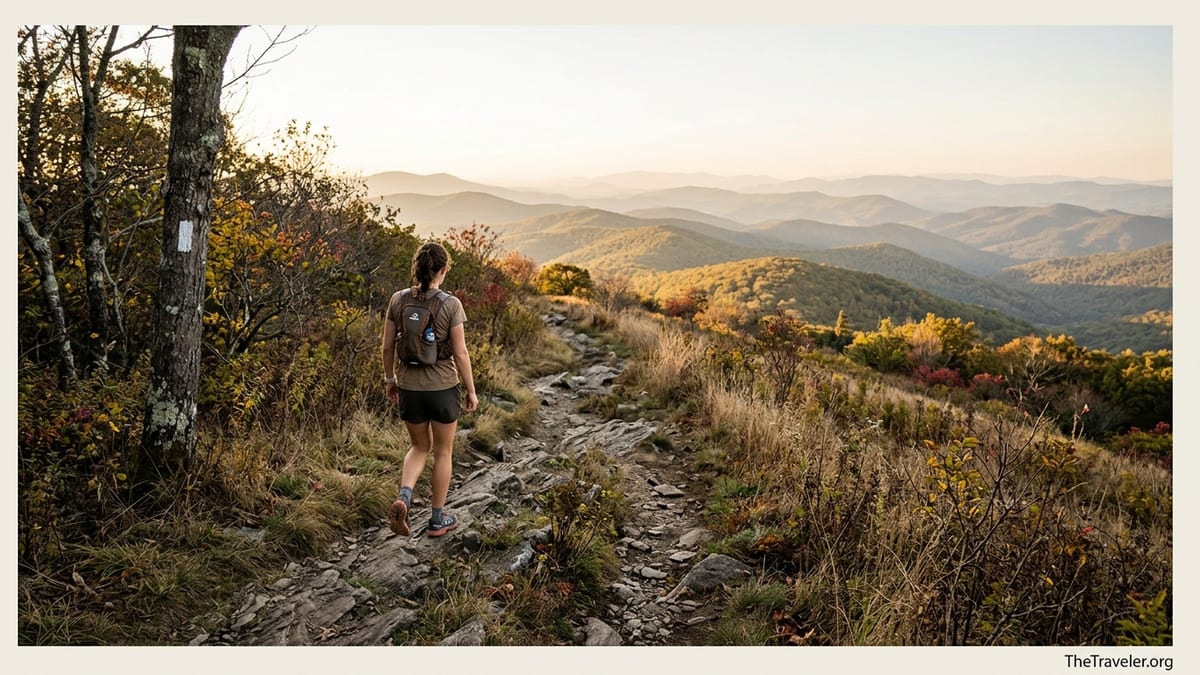
Stepping Onto a Trail With a Century of Stories
I started my six-hour hike on a popular day section in Shenandoah National Park in Virginia, one of the most accessible stretches of the Appalachian Trail. Within minutes, the world narrowed to roots, rocks, the white rectangles painted on trees, and the sound of wind pushing through the oaks. It felt almost ordinary at first, like any other East Coast woodland path. Then the history of where I was started to sink in: this was the same continuous trail that threads from Springer Mountain in Georgia to Katahdin in Maine, the same route that has carried generations of hikers chasing some version of freedom.
The Appalachian Trail Conservancy estimates that roughly 3 to 4 million people step onto some part of the AT each year, yet only a few thousand attempt to walk all of it in a single season. Thru-hiking, the term for covering the entire trail end to end in one continuous journey, can take five to seven months, depending on pace, weather, and luck. In contrast, a six-hour out-and-back might barely cover 8 to 10 miles of its length. Still, the moment you touch that white-blazed tread, you are on the same path as those long-distance hikers. The continuity is part of the magic. Whether you are out for an afternoon or half a year, you are tracing the same line from Georgia toward Maine.
As I climbed away from the trailhead, I thought about the people whose names have become part of AT lore. Early thru-hikers like Earl Shaffer in the 1940s and later figures such as Grandma Gatewood, who famously walked the trail with simple gear and a canvas bag, helped transform what was once a bold idea into a living tradition. More recently, endurance athletes have pushed the limits of what is possible on this path. In 2024, ultrarunner Tara Dower set a southbound speed record on the AT, reminding everyone that this old corridor still inspires new feats. Those achievements give the trail a mythic quality that you can feel even during a short day hike.
Yet the obsession the AT inspires is not only about big records or historic firsts. It is also about countless, ordinary days like the one I was having, strung together into something that feels like a personal story written in footsteps. Every white blaze is a tiny chapter marker, and that narrative can begin with something as simple as six free hours and a curious mind.
The Simple Ritual of Moving Forward
After the first hour, the hike settled into a pattern that felt almost meditative. Look for the next blaze. Step over the next root. Sip water. Repeat. I met a pair of section hikers from North Carolina who were ticking off the AT in long weekend chunks. They had spreadsheets tracking which mile markers they had completed, but in the moment they were as focused as any thru-hiker: one step at a time, keeping a steady pace over the next ridge. That ritual of forward motion, stripped of all the complications of daily life, is one of the reasons people find themselves pulled back to the AT year after year.
Most of us live by clocks and screens. On the trail, time shrinks to very basic questions: When did I last drink? How far to the next shelter? Can I reach that overlook before the clouds roll in? Even in just six hours, I felt how quickly those small calculations replaced the usual background noise in my head. I stopped thinking about email and started thinking about foot placement. On longer hikes, that shift becomes even more pronounced. Thru-hikers often talk about how their world shrinks to the next water source, the next resupply town, the next weather window to cross a high ridge. That reduction of life to a handful of essential decisions can feel like a relief, even a kind of reset.
There is also a physical satisfaction that borders on addictive. The AT is not an easy trail. Even in places where the elevation numbers look modest on paper, the path can be relentlessly rocky and steep. Over my six-hour stretch, my legs burned on climbs and my knees registered every descent. Yet each small summit or viewpoint came with a surge of quiet pride. Multiply that feeling over weeks, and you begin to understand why someone who has walked from Georgia to Virginia might feel compelled to keep going, and why many finishers eventually return to repeat sections or tackle the entire route again.
On a practical level, the AT is unusually suited to feeding this love of continuous motion. The white blazes are frequent and clear. Backcountry shelters, often spaced roughly a day’s hike apart, give you predictable stopping points. Trail towns with outfitters, hostels, and diners cluster at many road crossings. For a long-distance path that feels wild in the woods, the AT offers a steady rhythm of support. Even in six hours, I crossed a paved road, passed a shelter side trail, and glimpsed a side path to a viewpoint crowded with day hikers. The infrastructure quietly encourages you to keep going, one manageable segment at a time.
Community on a Footpath Through Fourteen States
About two hours into my hike, I stepped aside to let a trio of thru-hikers pass. They wore the classic AT uniform: weathered trail runners, shorts streaked with mud, sun-bleached caps, and packs slimmed down by weeks of trial and error. Their conversation drifted back to me on the climb, snippets about a favorite hostel in Damascus, a storm they had ridden out in the Smokies, and how much they were looking forward to a burger in the next town. Within seconds, they were gone, but their energy lingered, proof that this trail is as much a social corridor as it is a wilderness path.
The Appalachian Trail crosses 14 states, from Georgia to Maine, and along the way it passes through or near dozens of small communities that have learned to embrace hikers as a seasonal tide. In places like Hot Springs, North Carolina, Damascus, Virginia, or Hanover, New Hampshire, hikers become part of the local landscape every spring and summer. Outfitters stock fuel canisters and dehydrated meals. Motels offer hiker rates. Churches host donation-based dinners. For many thru-hikers, these towns become as memorable as the summits themselves.
In my short window on trail, I saw a condensed version of that community. Near a road crossing, a local volunteer group had set up what hikers call trail magic: a folding table under a pop-up canopy serving fresh fruit, cookies, and soda to anyone passing by with a backpack and a story. One of the volunteers had completed a northbound thru-hike a decade earlier and now returned every spring to greet the new class. A couple from Pennsylvania who had only planned a three-mile loop hike lingered for nearly an hour, listening to tales of cold nights in the Smokies and hot climbs in southern Virginia. By the time I moved on, the air felt like a crossroads where lives that would never otherwise intersect overlapped for a few minutes.
That sense of belonging, of entering a loose but welcoming tribe, is a powerful part of the AT’s pull. Thru-hikers adopt trail names like "Sunrise" or "Slow Burn," shedding their everyday identities in favor of new ones that grow out of shared experiences. Even day hikers sense it. In those six hours, I found myself trading gear tips with strangers, offering and accepting encouragement on steep sections, and swapping weather updates with a ridge runner. The trail turns solitary walking into a shared narrative, and for many people that community lingers long after the blisters heal.
The Landscape That Keeps Changing Just Enough
From a distance, the Appalachian Trail might sound monotonous: thousands of miles of green tunnel, ridge after ridge of hardwood forest. Up close, however, the variety is part of what keeps people hooked. Over my six-hour stretch, I passed through shady oak and hickory stands, brushed against stretches of mountain laurel, and emerged on a rocky outcrop where the Blue Ridge rolled away in blue-gray layers. The changes were subtle compared with the dramatic shifts you might see on a Western trail, but they were constant enough to make every hour feel distinct.
Extrapolate that over the entire length of the AT, and the diversity is striking. Hikers who start at Springer Mountain in March may begin among leafless trees and cold rain, then watch spring creep north as they move. By the time they reach Virginia, the rhododendrons may be blooming. In New Hampshire’s White Mountains they might encounter lingering patches of snow, and in Maine they could finish amid the first hints of fall color. The AT crosses balds in the southern Appalachians, farmland and river valleys in mid-Atlantic states, and rugged granite ridges in New England. Even on a single-day outing, that constant yet gradual evolution of scenery is part of the trail’s quiet charm.
There is also the way the AT weaves human history into its natural backdrop. My six-hour hike intersected remnants of old stone walls and passed a side trail to a fire tower, reminders that these mountains have served as pastures, woodlots, and lookouts long before they became a playground for backpackers. In other stretches, the trail skirts Civil War battlefields, crosses old logging grades, or passes shelters built by the Civilian Conservation Corps. Walking here, you are never far from the layered story of the eastern United States, and that sense of continuity deepens the connection many hikers feel.
This variety is part of why people return to the AT in different seasons and at different life stages. A teacher might hike a 50-mile section in Shenandoah every summer break. A retiree might tackle the New England states one year and the southern Appalachians the next. Some hikers use the AT as a gateway, returning to favorite stretches again and again until they know the quirks of a particular climb or the way fog settles in a certain gap. The trail becomes less a single route and more a collection of personal landscapes, each loaded with its own memories.
A Manageable Obsession: From Day Hiker to Lifelong Section Walker
As my six hours started to wind down, I met a man in his sixties sitting on a rock with a well-worn map spread across his knees. He had started section hiking the AT fifteen years earlier, squeezing in a week or two at a time around work and family. Now retired, he was down to his final 100 miles in Maine. He was not particularly fast, nor did he talk about setting records. Instead, he described the joy of knowing that every year he would return to add a new piece to his personal map, watching his completed sections slowly stitch together like a quilt.
That approach is part of why the AT inspires such lasting devotion. You do not need to quit your job for half a year to feel part of its story. Many hikers begin with an accessible day hike in places like Shenandoah, Pennsylvania’s Cumberland Valley, or Massachusetts’ Berkshire region. They discover they like the rhythm and decide to come back for an overnight. Then a long weekend. Eventually they might tackle an entire state. Gear evolves, skills improve, and before long they find themselves able to read the terrain, predict how their body will respond to a long climb, and plan resupplies in trail towns with almost casual confidence.
From a practical standpoint, the trail’s design encourages this incremental approach. Road crossings and trailheads appear at regular intervals, especially in more developed states like Virginia, Pennsylvania, and New York. Guidebooks and digital apps break the route into manageable chunks with clear mileage, elevation profiles, and notes on water sources. Hostels along the way offer everything from budget bunks and coin-operated laundry to shuttles back to the trail, making it relatively straightforward for someone with limited vacation time to string together meaningful sections. In that sense, the AT functions as a long-term project that can stretch over years or even decades.
For many people, that long project becomes an organizing force in life. Savings accounts grow around future trips. Vacation requests revolve around peak wildflower seasons or fall colors in a particular state. Friendships form with other hikers who share the same long-term goal of eventually touching every blaze between Georgia and Maine. Even if the actual time spent on trail each year amounts to a few days or weeks, the mental presence of the AT becomes constant. My brief six-hour walk felt like a glimpse into that lifestyle, a sense that I could, if I chose, build years of travel and personal growth around this single, winding footpath.
Cost, Logistics, and the Allure of a Big but Reachable Dream
Another reason the Appalachian Trail captures so many imaginations is that, while it is challenging, it feels reachable. You do not need technical climbing skills or expensive mountaineering gear. Most thru-hikers carry relatively simple setups: a reliable backpack, a lightweight tent or shelter system, a sleeping bag rated for three seasons, and compact cooking gear. Day hikers can start with even less, and many people begin with affordable, entry-level equipment from mainstream outdoor retailers before gradually upgrading as they learn what works for them.
Costs still add up, especially for a full thru-hike. Recent accounts from hikers suggest that a multi-month journey often runs into the thousands of dollars when you add resupplies, hostel stays, the occasional hotel room, transport to and from the trail, and inevitable gear replacements. For many, that price tag is daunting. Yet compared with other long-term travel options, the AT remains relatively accessible. You are not paying nightly resort rates or international airfare every few weeks. Instead, you are trading time and physical effort for a slow, budget-conscious journey across a continent-spanning slice of the eastern United States.
On a shorter scale, a six-hour hike can be remarkably inexpensive. My cost for the day was limited to a park entry fee, fuel to drive to the trailhead, and snacks. I saw others who had traveled farther, booking a cabin for the weekend or staying in nearby small-town motels, turning their day hike into a micro-vacation. The key point is that the barrier to entry is relatively low compared with many other adventures. For the price of a pair of decent trail shoes and a daypack, you can join the same flow of hikers who might be on mile 10 or mile 1,000 of their own journeys.
Logistically, the AT’s infrastructure simplifies what could otherwise be an intimidating undertaking. The route is clearly marked, guide services offer shuttles to trailheads, and online communities share up-to-date information on conditions, closures, and recommended resupply points. Even on my short outing, I benefited from that collective knowledge, choosing a section based on recent reports of good water availability and moderate crowds. For would-be thru-hikers, the same ecosystem of information transforms a vague dream into a detailed plan, often months or years in the making. That transformation from "someday" to "I am leaving in March" is part of what turns casual curiosity into full-blown obsession.
The Takeaway
When I stepped off the Appalachian Trail after six hours, my legs were tired, my shirt was damp with sweat, and my phone showed only a modest handful of miles. By the most obvious measures, it was an ordinary hike. Yet as I drove away, I understood far better why this particular footpath has become a lifelong focus for so many people.
In a single afternoon, the AT offered a sample of nearly everything that keeps hikers coming back: a sense of continuity with a long history of walkers, a simple and absorbing daily rhythm, a welcoming community that stretches from shelters in the woods to diners in small towns, a landscape that changes just enough to stay interesting, and a structure that makes big dreams feel reachable. You do not have to spend months on the trail to feel its pull. Sometimes all it takes is a few hours under the trees, following the white blazes, to realize that you have stumbled onto something larger than a day hike.
For some, that realization leads to a bookmarked guidebook, a new savings goal, or a promise to return next season. For others, it becomes a defining project that shapes years of travel and personal growth. Either way, the Appalachian Trail has a way of turning casual encounters into long-term relationships. My six hours were only a beginning, but they were enough to make one thing clear: it is easy to see how this trail becomes an obsession, and hard not to start planning the next stretch as soon as you leave it behind.
FAQ
Q1. Do I need to be very fit to enjoy a short hike on the Appalachian Trail?
For a six-hour day hike, you should be comfortable walking several miles on uneven, sometimes steep terrain, but you do not need elite fitness. Start with a shorter, well-graded section, carry plenty of water, and turn around earlier if you feel tired. With realistic expectations and basic preparation, many reasonably active people can enjoy a half-day outing.
Q2. How much does it typically cost to thru-hike the entire Appalachian Trail?
Expenses vary widely, but many recent thru-hikers report spending several thousand dollars over the course of five to seven months. That total usually includes food, occasional lodging in trail towns, transport to and from the trail, replacement gear, and small extras like laundry or restaurant meals. Careful budgeting and more nights in tents than in town can keep overall costs lower.
Q3. Can I hike the Appalachian Trail in sections instead of all at once?
Yes. Many people become long-term section hikers, completing the trail over multiple years through a series of weekends and vacations. You might hike one state at a time, or choose 50- to 100-mile segments that fit your schedule. This approach allows you to experience the AT without taking months away from work or family responsibilities.
Q4. What basic gear do I need for a six-hour day hike on the AT?
For a half-day outing, most hikers carry a small daypack with water, snacks or lunch, a light extra layer, rain protection, a simple first-aid kit, and a map or navigation app. Sturdy trail shoes or hiking boots and sun protection are important. Trekking poles are optional but can make steep or rocky sections more comfortable, especially on descents.
Q5. Is it safe to hike the Appalachian Trail alone for just a few hours?
Solo day hiking is common, especially on well-traveled sections near popular parks and trailheads. As with any outdoor activity, safety improves if you tell someone your plans, carry basic navigation tools, watch the weather, and stay within your comfort level. Many hikers find that the steady presence of other walkers and volunteers along the AT adds a sense of reassurance.
Q6. When is the best time of year to plan a short hike on the AT?
Spring and fall are popular in many states, offering cooler temperatures and, depending on location, either wildflowers or colorful foliage. Summer brings longer days but can be hot and humid, especially at lower elevations. Winter hiking is possible in some areas but requires more experience, extra gear, and close attention to weather and trail conditions.
Q7. How crowded should I expect the trail to be?
Crowds vary by location and season. Sections near national parks, scenic overlooks, or trail towns can be busy on fair-weather weekends, while more remote stretches see fewer day hikers. Even on popular segments, you can often find quieter moments between groups, especially if you start early in the morning or choose weekdays.
Q8. Do I need special permits to hike a short section of the Appalachian Trail?
For most day hikes, you do not need a special AT permit, though standard park entry or parking fees may apply in some areas. Certain high-use areas and overnight trips can require permits or reservations, so it is wise to check local regulations for the specific state park, national park, or forest where you plan to visit.
Q9. How can a single short hike help me decide whether I want to thru-hike someday?
A six-hour hike gives you a realistic taste of the trail’s terrain, your comfort level with carrying a pack, and how you respond to extended walking. Pay attention to what you enjoy, what feels challenging, and how you handle navigation, weather, and fatigue. Many aspiring thru-hikers use a few solid day hikes and short overnight trips to decide whether a longer journey feels both appealing and achievable.
Q10. What makes people become so emotionally attached to the Appalachian Trail?
For many, the AT combines physical challenge, simple daily routines, community, and meaningful time in nature into a single experience. Whether they hike for six hours or six months, people often form strong memories tied to particular ridges, shelters, and towns. Over time, those memories turn the trail into more than a line on a map; it becomes a personal touchstone that hikers feel compelled to revisit and share with others.