


I arrived in Newark with the kind of expectations you get from headlines and hurried station transfers: grit, not grace; a place you pass through, not a place you plan a night around. My evening at the New Jersey Performing Arts Center, better known as NJPAC, upended all of that. Between the glow of Prudential Hall, the hum of Military Park, and the easy walk back to Newark Penn Station, I left seeing the city less as a cautionary tale and more as a cultural capital hiding in plain sight.
Get the latest updates straight to your inbox!
Arriving in Newark: From Transit Hub to Night Out
Like many visitors, my night in Newark began under the fluorescent lights of New York Penn Station. A straightforward NJ Transit ride carried me ten miles across the Hudson to Newark Penn, a trip that usually runs in the 20 to 30 minute range depending on the line and time of day. Stepping onto the Newark platform, the mood was immediately different from Manhattan’s crush: busy but not frantic, commuters mixing with couples dressed up for a show, and the occasional family debating where to grab dinner before curtain.
From Newark Penn, NJPAC is close enough that you have options. You can hop the Newark Light Rail for a one-stop ride to NJPAC/Center Street station, whose platforms practically spill out toward the arts center’s plaza. Or, if you prefer to stretch your legs, it is about a ten to fifteen minute walk along Raymond Boulevard or through downtown streets that are far more active in the evening than their reputation suggests. I chose to walk, joining a loose stream of theatergoers whose dress shoes and heels telegraphed we were all headed to the same place.
What surprised me most in those first minutes was how purposeful the foot traffic felt. You pass office towers that now house law firms, tech companies, and universities, storefronts with coffee shops still lit, and apartments that signal how much downtown Newark has shifted toward a true 24-hour neighborhood. The evening felt less like heading into a forgotten district and more like arriving in a city that is finally being seen on its own terms.
First Impressions of NJPAC and the Neighborhood Around It
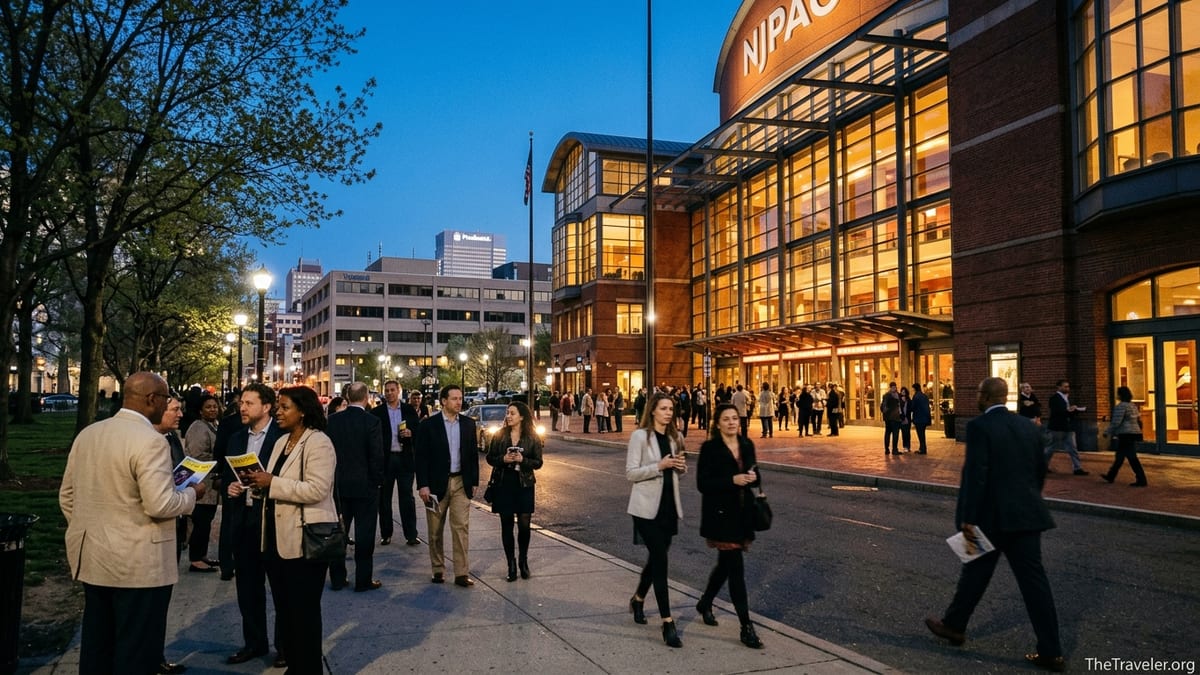
NJPAC itself emerges gradually as you move north from Newark Penn. The closer you get, the more the skyline opens and you see the performing arts center’s brick and glass facades framing a generous public plaza. Completed in the late 1990s and expanded over the years, it ranks among the largest performing arts centers in the United States, and it feels that way on approach. Even before you step inside, banners announce upcoming jazz residencies, touring Broadway productions, comedy specials, and community festivals.
Across the street, Military Park stretches like a green welcome mat. Once a tired patch of lawn, it has been reimagined as a six-acre gathering place with walking paths, public art and seasonal programming. On the night I visited, the park was dotted with people finishing early dinners at outdoor tables and kids lingering at the playground while parents checked the time before their show. A decade ago, this area might have emptied out after office hours. Now you see office workers, students from nearby Rutgers–Newark, and concertgoers weaving through the same shared space.
Inside NJPAC, the sense of scale is matched by warmth. Security staff greet you at the door and guide you toward will call, coat check, and the lobby bars without the brusque impatience common at big-city venues. Wide staircases and glass walls offer glimpses of the downtown skyline, Prudential Center’s glow, and the park’s tree canopy. Even before you enter the main hall, you can see why the center is treated as a civic living room as much as a performance venue.
Dining Before the Show: Military Park and Beyond
One of the practical questions any traveler asks before a show is where to eat. Around NJPAC, you find more variety than you might expect in a compact radius. Military Park itself hosts dining options like The Yard, a restaurant that leans into elevated comfort food inspired by the African diaspora. Think plates like jerk chicken with coconut rice, shrimp and grits, or a towering fried chicken sandwich, paired with cocktails that feel more Brooklyn than suburban chain. It is the kind of place where you can sit at the bar, grab something substantial for under twenty-five dollars, and still make an eight o’clock curtain.
Inside the arts center, NJPAC operates its own dining outlets that open ahead of major performances, including a sleek bistro-style space and tier-level cafés that serve small plates, sandwiches, and wine. For symphony nights, the Tier 3 Café above Prudential Hall opens a couple of hours before the concert, catering to patrons who want to avoid the weather and stay close to their seats. On my night, the line for charcuterie plates and glasses of New Jersey craft beer moved briskly, the chatter bouncing off the glass and steel.
If you have time to wander a bit farther, Newark’s Ironbound district lies just across the tracks from Newark Penn Station. A short rideshare or about a twenty-minute walk brings you to a dense grid of Portuguese, Spanish, and Brazilian restaurants where you can share a pitcher of sangria and a platter of grilled seafood for roughly what you would pay for two cocktails in midtown Manhattan. For travelers basing themselves in Manhattan or Jersey City, building Ironbound dinner and an NJPAC performance into a single night can make Newark feel like a destination rather than a detour.
Inside Prudential Hall: Acoustics, Crowd and Atmosphere
The heart of NJPAC is Prudential Hall, a 2,700-seat theater renowned among musicians for its acoustics. The room manages a balance that many large halls miss: intimate enough that you can see the performers’ expressions from the balcony, yet grand enough to give a symphony orchestra or full choir room to breathe. Warm wood paneling curves around the stage, and the tiered seating rises steeply enough that even so-called “cheap seats” feel close to the action.
My visit happened to coincide with a major touring artist’s appearance, the kind of show that might easily sell out in Manhattan. What struck me was the crowd’s range: longtime Newark residents in their Sunday best, students in sneakers and hoodies, couples who had clearly come in from the suburbs, and groups of friends who looked like they might have coordinated their outfits all week. Conversations floated between talk about neighborhood changes, kids’ school performances on the same stage, and plans to come back for a jazz festival later in the year.
The performance itself felt elevated by the context. Knowing that this same stage regularly hosts the New Jersey Symphony, international dance companies, and community arts showcases gives each event a sense of continuity. Applause between numbers was enthusiastic but respectful, the sort of audience that knows when to wait for a musical phrase to land. When the house lights came up at intermission, it was easy to imagine how attending performances here on a regular basis could quietly recalibrate your sense of what Newark is and who it is for.
Seeing Newark Differently: Safety, Streets and Small Moments
For all the artistry inside the hall, it was the walk back toward Newark Penn Station that most clearly challenged my assumptions. I left the theater along with hundreds of other patrons spilling into the plaza. Staff members were stationed near exits to answer questions about directions or rideshares. The path toward Raymond Boulevard was well lit, with a visible presence of security and Newark police near key intersections. Parents with strollers, older couples and solo visitors all moved at an unhurried pace that felt more like leaving Lincoln Center than navigating a city some still speak of only in the past tense.
Along the way, snippets of conversation floated through the air: a woman explaining to her friend how NJPAC’s campus is expanding into new housing and retail developments, a teenager talking about performing there in a school choir, an older man reminiscing about when Military Park was somewhere you hurried past rather than into. Those small, overheard stories stitched together an image of a Newark that is actively rewriting its own narrative.
None of this is to gloss over real challenges. Like many American cities, Newark continues to wrestle with uneven development and the lingering impact of disinvestment. But in the blocks surrounding NJPAC, you see concrete efforts to make the streets feel welcoming at night: pedestrian-friendly lighting, active storefronts that keep eyes on the street, and clear wayfinding signs pointing back to Newark Penn, Broad Street Station and key landmarks. For a traveler unsure whether an evening show here is “safe,” the lived experience feels far calmer and more ordinary than the stereotype suggests.
Practical Tips for Planning Your Own NJPAC Night
If you are coming from New York City, the simplest route is usually NJ Transit from New York Penn Station to Newark Penn, then either walking or taking the Newark Light Rail one stop to NJPAC/Center Street. Buying your rail tickets through the NJ Transit app can save you time in kiosk lines, especially on busy weekend evenings. Weeknight shows often align well with peak commuter schedules, which means more frequent trains but also more crowds, so plan to arrive a bit early.
For those already staying in New Jersey, driving is a viable option. NJPAC offers access to nearby parking garages, and on performance nights attendants and signage help direct traffic. Prices vary by event but are typically in line with or slightly lower than what you would pay to park near major Manhattan venues. Just keep in mind that exiting can take time after a sold-out show, so consider grabbing a drink or dessert nearby while the garages clear out.
Inside the center, arriving at least thirty to forty-five minutes before curtain allows you to pass through security, orient yourself, and explore some of the public art installations and lobby overlooks. Many patrons treat the entire experience as a night out rather than a simple in-and-out performance, mingling in the lobby at intermission rather than rushing straight back to their seats. Casual attire is perfectly acceptable for most events, though you will see everything from jeans to evening gowns depending on the night.
Beyond the Stage: NJPAC’s Role in Newark’s Revival
Standing outside after the show, it is hard not to see NJPAC as more than a single venue. Over the past two decades, it has helped anchor a broader wave of investment in downtown Newark. The surrounding blocks have welcomed new residential towers, hotels, and restaurants, while the arts center itself has pursued plans to transform what were once surface parking lots into a mixed-use arts and residential district. That kind of campus development signals a long-term commitment to embedding culture in the everyday life of the city, not just in special events.
NJPAC’s reach extends into education as well. Throughout the year, the center hosts school matinees, after-school programs, and community workshops that bring thousands of local students into the building. For many, their first live orchestra or dance performance happens not in Manhattan but right here, a short bus ride from their neighborhoods. When those same kids later return with their families for marquee events, they do so with a sense of ownership that changes the typical visitor narrative of who cultural institutions are built for.
For travelers, that broader mission matters because it shapes the atmosphere you encounter. The audience does not feel like a detached collection of tourists and suburbanites but a cross-section of Newark and northern New Jersey. Hearing people swap recommendations about neighborhood bakeries, debate the merits of different local coffee shops, or talk about a cousin’s art class at the center underscores that you are stepping into a living ecosystem, not a cultural outpost dropped onto a blank map.
The Takeaway
I left NJPAC that night with the echo of applause still ringing, but it was the image of Newark’s streets that replayed in my mind on the train back to New York. The well-lit walk between station and theater, the vibrancy of Military Park, the diversity of the audience and the ease of the whole experience all chipped away at a mental picture built from outdated narratives and secondhand caution. Where I had expected to simply “get through” Newark on my way to culture elsewhere, I found the culture here compelling enough to justify the trip on its own.
If you have ever changed trains in Newark and wondered whether there was a reason to linger, an evening at the New Jersey Performing Arts Center provides a clear answer. Plan a meal in Military Park or the Ironbound, give yourself time to walk rather than rush, and let the experience of moving through downtown reshape your assumptions. You may find, as I did, that once you see Newark through the lens of a night at NJPAC, it is no longer a place to pass by, but one to plan around.
FAQ
Q1. How do I get to NJPAC from New York City without a car?
Taking NJ Transit from New York Penn Station to Newark Penn, then walking about ten to fifteen minutes or riding the Newark Light Rail one stop to NJPAC/Center Street, is usually the simplest option.
Q2. Is it safe to walk between Newark Penn Station and NJPAC at night?
Many visitors and local patrons routinely walk this route before and after shows. The area is well lit, generally busy around performance times, and supported by visible security and police presence, though you should use the same awareness you would in any city.
Q3. Where can I eat near NJPAC before a performance?
Dining options include restaurants in Military Park such as The Yard, on-site venues inside NJPAC, and a wide range of Portuguese and Brazilian spots in the nearby Ironbound district.
Q4. Do I need to dress up for a show at NJPAC?
Dress codes are relaxed for most events. You will see everything from jeans and sneakers to suits and dresses, so smart casual is a comfortable middle ground.
Q5. How early should I arrive before a performance?
Arriving thirty to forty-five minutes before curtain gives you time for security, finding your seat, grabbing a drink or snack, and exploring the lobby without feeling rushed.
Q6. Is parking available if I decide to drive?
Yes, NJPAC is served by nearby parking garages that typically offer event parking on performance nights, with attendants and signage helping guide drivers in and out.
Q7. Can I combine an NJPAC show with sightseeing in Newark?
Absolutely. You can visit nearby attractions such as Military Park, the Newark Museum of Art, or the Ironbound neighborhood during the day and then attend an evening performance.
Q8. Are there family-friendly performances at NJPAC?
NJPAC regularly hosts family-oriented programming, including children’s theater, holiday shows and school-time matinees, making it suitable for kids as well as adults.
Q9. How much do tickets typically cost for events at NJPAC?
Ticket prices vary widely depending on the artist and event, ranging from relatively affordable balcony seats to premium orchestra seating comparable to major venues in New York.
Q10. Is NJPAC accessible for visitors with mobility challenges?
The center offers accessible seating, elevators, and step-free routes, and staff are generally quick to assist with directions or seating needs for visitors using wheelchairs or with limited mobility.