


Few cultural projects have transformed a city and a state as profoundly as the New Jersey Performing Arts Center in Newark. Opened in 1997 on the banks of the Passaic River, NJPAC has evolved from an ambitious performing arts complex into a year-round civic living room for New Jersey, drawing hundreds of thousands of visitors annually, nurturing local talent, and anchoring a dramatic downtown revival. For travelers, culture seekers, and anyone curious about Newark’s resurgence, understanding why NJPAC became a true cultural landmark is key to understanding modern New Jersey itself.
Get the latest updates straight to your inbox!
A Vision That Helped Recast Newark’s Image
When the New Jersey Performing Arts Center opened its doors in 1997, Newark was still struggling with the legacy of deindustrialization and the 1967 civil unrest. Many New Jersey residents knew the city mostly through headlines about crime and decline, and few considered it a destination for a night out. NJPAC was conceived as a bold counter-narrative: a world-class performing arts complex that would invite residents from every corner of the state to experience Newark differently, as a place of creativity, history, and shared civic life.
The state invested roughly $180 million to build NJPAC in Newark’s downtown, right by Military Park and the Passaic River. The decision to locate such a significant institution here, rather than in the suburbs, signaled a commitment to urban revitalization. Within a few years of opening, surveys commissioned by civic groups suggested that a large majority of New Jerseyans reported a more positive impression of Newark after attending events at NJPAC, and Newark residents themselves expressed greater pride in their city. Those shifts in perception are hard to quantify precisely, but they show up concretely in full theater lobbies, crowded restaurants on show nights, and the proliferation of new residential towers now rising within a short walk of the arts center.
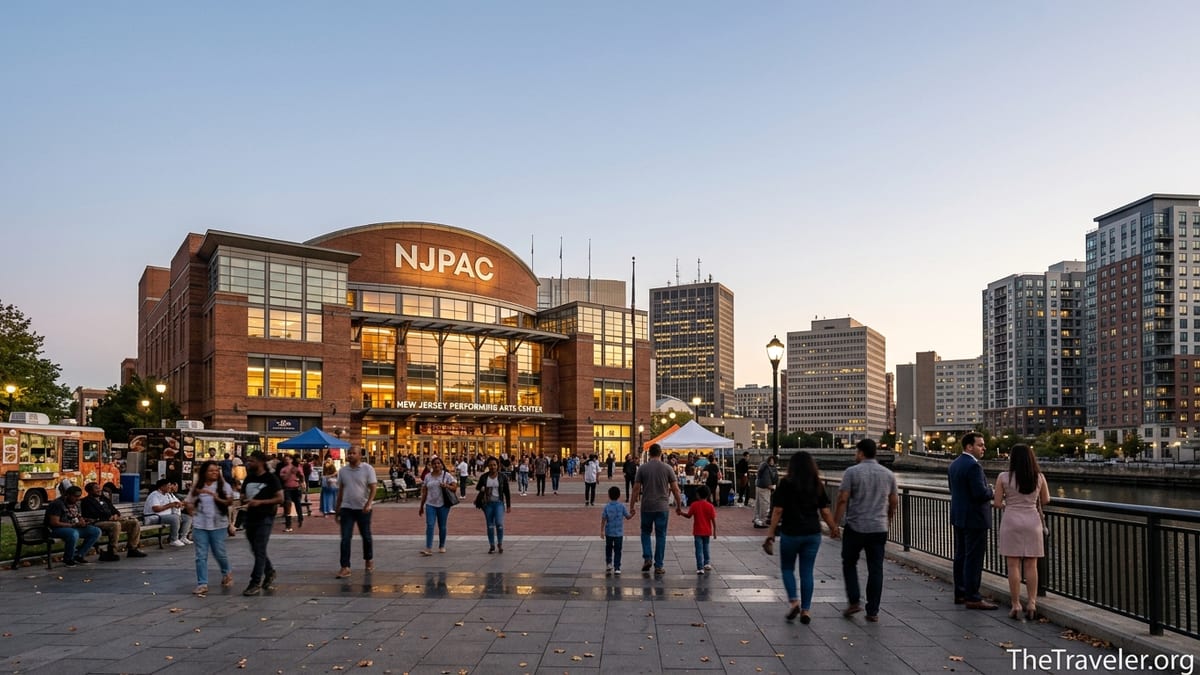
Today, when visitors step out of Newark Penn Station and follow the short walk past Military Park toward NJPAC, they encounter a downtown that feels fundamentally different from the late 20th-century image of the city. Office workers share sidewalks with families heading to a matinee, couples dressed for a symphony concert, and students on their way to an arts workshop. The center’s glowing facade at night has become part of the city’s visual identity, often the backdrop in tourism photos, news features, and travel coverage that frame Newark not just as an airport hub, but as a regional cultural capital.
For travelers, NJPAC offers a practical gateway into this new Newark. It is reachable in under 20 minutes by train from Manhattan, with direct paths from Hoboken, Jersey City, and many New Jersey suburbs. That convenience means a visitor can plan an evening that combines a pre-show dinner nearby with a performance at NJPAC and still be home before midnight, making Newark a realistic and appealing alternative to more expensive Manhattan venues.
Architecture, Setting, and the Sense of Place
NJPAC’s physical presence is a major reason it has become such a recognizable landmark. Designed by Skidmore, Owings & Merrill with theater specialists, the complex uses warm brick, glass, and generous public plazas that tie the building to Newark’s historic streetscape while still feeling contemporary. The main Prudential Hall, with seating for roughly 2,750 patrons, is known for its excellent acoustics and clear sightlines, which have helped attract major touring productions and renowned orchestras.
Outside, Theater Square Plaza gives NJPAC a civic front yard. On summer evenings, visitors find food trucks parked along the plaza, kids splashing in the fountain, and free outdoor concerts that pull in office workers, neighborhood residents, and out-of-town guests. Someone arriving for a headline comedian or a New Jersey Symphony concert will often stumble upon a free community performance in the plaza beforehand, turning what might have been a simple night at the theater into an open-air festival.
Its location along Center Street and close to the riverfront also places NJPAC within a walkable cultural district that includes the Newark Museum of Art, the New Jersey Historical Society, and the historic Newark Public Library. Travelers can easily spend an afternoon viewing galleries at the museum, walk ten minutes down Washington Street or through Military Park, then settle into an evening at NJPAC without ever needing a car. That clustering of institutions reinforces the sense that this is Newark’s cultural heart.
As the campus grows, the physical landmark quality is only intensifying. Current redevelopment plans call for new residential buildings, additional arts education facilities, and a film and television production studio complex to rise on and around NJPAC’s 12-acre site. For a visitor returning in the next few years, the center is likely to appear not just as a standalone hall but as the anchor of an entire arts and entertainment neighborhood, with more street-level cafes, small shops, and public spaces spilling out from its front doors.
A Home Stage for New Jersey’s Premier Ensembles
Part of NJPAC’s cultural weight comes from the institutions that call it home. The most prominent is the New Jersey Symphony, the state’s flagship orchestra and a resident company at NJPAC. Regular subscription concerts in Prudential Hall bring world-class soloists and ambitious programs to Newark, from Mahler symphonies to film-with-orchestra events that pair live performance with screenings of popular movies. For many New Jersey residents, their first live orchestral experience happens here on a school field trip or a family outing, and the grandeur of the hall paired with the intimacy of the sound leaves a lasting impression.
Beyond the symphony, NJPAC has hosted a wide spectrum of resident or regularly returning partners in dance, jazz, and theater. Co-presented series with the Institute of Jazz Studies at Rutgers University in Newark have made the center a serious jazz destination, while touring companies bring Broadway shows, ballet, and international ensembles that might otherwise only appear in New York. Visitors who check the seasonal calendar will often find, in a single month, a major orchestra, a top-tier jazz vocalist, a stand-up comedy star, a contemporary dance company, and a family-friendly show like a children’s TV character tour sharing the same stages.
These regular partnerships give NJPAC a rhythm that locals can rely on. A Newark family might buy a small subscription package to the symphony, attend a free jazz jam session in the lobby, and then return for a big-name R&B concert, all within the same season. Travelers, meanwhile, can time their visit to coincide with a specific festival or series, such as a weekend of Latin music or a multi-day dance celebration. Because NJPAC works closely with these partner organizations, the programming reflects New Jersey’s diversity rather than a narrow slice of the arts world.
The effect is that NJPAC operates as the state’s shared living room for high-profile performances. While other venues across New Jersey, such as bergenPAC in Englewood or the State Theatre in New Brunswick, have strong reputations and loyal audiences, NJPAC’s breadth of programming and its role as a home base for major New Jersey ensembles give it a unique statewide resonance.
Education and Social Impact at the Core
From the beginning, NJPAC was designed not only as a place to watch performances but as a place to learn, participate, and build community. Its arts education department launched even before the theaters were completed and has since grown into one of the most extensive arts education operations in the state. Thousands of students each year attend school-time performances, enroll in weekend and summer classes, and meet working artists on the NJPAC campus or in their own classrooms through teaching-artist residencies.
Programs range from jazz and classical music instruction to acting, musical theater, hip hop arts and culture, and technical theater training. A teenager from Newark might join the Wells Fargo Jazz for Teens program or the Brick City Jazz Orchestra, gaining access to mentors, rehearsal spaces, and performance opportunities that would be difficult to find otherwise. A student from elsewhere in New Jersey might take a train into Newark on Saturdays for acting classes hosted in NJPAC’s education facilities, learning stagecraft in the same building where Broadway tours are loading in.
In recent years, NJPAC has folded these efforts into an even wider Social Impact portfolio that includes community engagement and arts-and-well-being initiatives. The center organizes free performances in every ward of Newark, offers theater classes for returning citizens, leads free poetry workshops for teens, and brings performances into hospitals to reach patients and staff who cannot easily travel to the campus. NJPAC raises many millions of dollars annually to underwrite this work, allowing most of these offerings to be free or heavily subsidized for participants.
A major physical expansion now underway underscores how central these programs have become. The planned Cooperman Family Arts Education and Community Center, a roughly 58,000-square-foot facility scheduled to open around 2027, will consolidate arts education, community engagement, and social-impact programming under one roof adjacent to the main complex. For visitors, this means an even livelier campus: on any given day, travelers might see lines of school buses dropping off students for workshops, adults attending community conversations about public policy, and families participating in wellness programs that use music and movement as tools for health.
Driving Newark’s Downtown Revival
NJPAC’s influence extends well beyond its stages and classrooms and into the bricks and mortar of downtown Newark. When the arts center opened, downtown office vacancy rates were high, and large swaths of land near the Passaic River were surface parking lots. Over time, the presence of a major, reliable crowd generator drew restaurants, small businesses, and developers who saw an opportunity to serve an audience that arrives year-round for performances, education programs, and festivals.
Economic impact studies in the years after NJPAC’s opening showed that downtown office occupancy improved significantly as new tenants were attracted to a revitalizing urban core with high-profile amenities. Since then, waves of new residential construction have followed. Mid-rise and high-rise apartment towers have risen within a few blocks of the arts center, appealing to young professionals, families, and students who want walkable access to Penn Station, the Prudential Center arena, and NJPAC’s cultural offerings. For a traveler stepping off the train today, cranes and recently completed buildings around the arts center are a visible reminder that this district is still actively evolving.
Looking ahead, NJPAC is at the heart of a multi-hundred-million-dollar redevelopment plan for its 12-acre campus, including mixed-income housing, retail, streetscape improvements, and an expanded arts hub. One component involves collaboration with a major entertainment company to open a large film and television production studio nearby, which could bring hundreds of permanent jobs and frequent on-location shoots to the neighborhood. For visitors in coming years, it may become common to see production trucks parked near NJPAC or to learn that a favorite streaming series was filmed just steps from the theater plaza.
The transformations are not without debate. Historic preservation advocates have raised concerns about the potential demolition of older structures, including landmarked buildings, to make way for new construction, prompting ongoing conversations about how best to balance development with respect for Newark’s layered history. Yet even critics often acknowledge that NJPAC’s presence has brought foot traffic, investment, and a sense of possibility to a downtown that struggled for decades. The question for the future is how to shape that growth so that it benefits long-time residents as well as new arrivals.
For travelers, this means that an evening at NJPAC is also an opportunity to witness urban change in real time. A pre-show stroll might thread past construction sites for future housing, historic churches, small local restaurants, and sleek new towers, all clustered around a performing arts complex that helped spark this reinvention.
A Mirror of New Jersey’s Diversity
New Jersey is one of the most diverse states in the country, and NJPAC’s programming reflects that reality. The center regularly presents performances that speak directly to the many communities that call the state home, from Afro-Latin music festivals to South Asian dance showcases, from gospel concerts to contemporary theater that addresses immigration, identity, and social justice. Rather than positioning itself as a rarefied institution for a narrow audience, NJPAC has consciously cultivated a sense that everyone in New Jersey belongs in its halls.
On a typical weekend, visitors might find a salsa legend performing in Prudential Hall, a Broadway star leading a masterclass with local students, a Nigerian pop artist playing to a packed house in a smaller theater, and a free hip hop dance battle in the lobby. Community partners from Newark’s neighborhoods and statewide cultural organizations co-produce many of these events, ensuring that the center’s calendar is not simply imported from outside but grounded in local networks and tastes.
This approach matters for travelers as well. A visitor from out of state who checks the calendar for a random weekend is likely to encounter something that feels distinctly New Jerseyan rather than generic touring fare. That might be a hometown comedian building a following, an emerging Newark-based band, or a panel with local activists and artists discussing the city’s future. Attending one of these events offers travelers a snapshot of New Jersey’s social and cultural conversations, not just its entertainment offerings.
Importantly, NJPAC has worked to keep access broad through pricing strategies that mix premium seats with more affordable options, frequent free events, and subsidized tickets for students and community groups. While top-tier shows can command prices comparable to New York venues, many performances in the smaller theaters, education showcases, and outdoor festivals are free or low-cost, lowering the barrier for first-time visitors who may be curious but cautious about their budget.
Planning a Visit: What Travelers Actually Experience
For travelers, part of NJPAC’s landmark status lies in how straightforward it is to integrate into an itinerary. The center is a short walk or quick light-rail ride from Newark Penn Station, which is served by Amtrak, NJ Transit, and PATH trains. This means someone staying in Manhattan or Jersey City can easily plan a round-trip evening visit: arrive in Newark by late afternoon, walk through Military Park or the historic Ironbound neighborhood for an early dinner, then head to NJPAC for a show.
On performance nights, the area immediately around NJPAC hums with activity. Visitors use nearby garages or lots, but many also arrive on foot from downtown hotels or new apartment complexes. Inside the lobby, the atmosphere is welcoming rather than stuffy: families with children share elevator rides with symphony regulars, college students line up for rush tickets, and older Newark residents greet staff and ushers by name. Concession stands offer snacks and drinks, and during festivals or special events, pop-up food vendors and merchandise tables may fill the public spaces.
Seasonal highlights give travelers especially memorable entry points. Summer often brings free outdoor concerts and movie nights on the plaza, drawing crowds who spread picnic blankets on the stone benches. Around the holidays, family-oriented programming, from orchestral holiday concerts to touring stage productions, encourages multi-generational outings. Special series dedicated to jazz, world music, or dance allow visitors to plan a weekend around several related performances, pairing cultural exploration with local dining and sightseeing.
Because NJPAC sits within walking distance of other Newark attractions, it can anchor a full day of exploration. A visitor might spend the morning at the Newark Museum of Art, stop at a local cafe for lunch, join an afternoon walking tour of the city’s historic architecture or public art, and then attend an evening performance at NJPAC. For travelers used to associating New Jersey primarily with shore towns or suburban malls, this urban cultural itinerary offers a very different vision of the state.
The Takeaway
The New Jersey Performing Arts Center became a cultural landmark not simply because of its size or the prestige of the artists who appear there, but because it fundamentally changed how New Jersey sees itself and how the world sees Newark. It anchored a struggling downtown, offered a major stage to the state’s leading ensembles, opened its doors to young people and communities who had rarely felt welcome in large arts institutions, and reflected the diversity of one of America’s most varied states.
For travelers, NJPAC is more than a place to catch a show. It is a lens onto Newark’s past and future, a gathering place where local residents and visitors share the same rows, and a gateway to a broader cultural district that continues to evolve. As the campus expands with new education facilities, housing, and film studios, its role as both a symbol and driver of change will only grow.
Whether you are planning a quick evening excursion from New York, mapping a multi-day New Jersey itinerary, or simply curious about how arts investments can reshape a city, standing in Theater Square Plaza as the lights come up on Prudential Hall offers a compelling answer. NJPAC is not just New Jersey’s performing arts center. It is one of the clearest expressions of the state’s resilience, creativity, and ambition.
FAQ
Q1. Where is the New Jersey Performing Arts Center located?
NJPAC is in downtown Newark, New Jersey, near Military Park and the Passaic River, within walking distance of Newark Penn Station and several major hotels.
Q2. How do I get to NJPAC by public transportation?
Most visitors arrive via Newark Penn Station, served by Amtrak, NJ Transit, and PATH trains. From there, it is roughly a 10 to 15 minute walk or a short light-rail ride to the arts center.
Q3. What types of performances does NJPAC present?
NJPAC presents a wide range of events, including classical concerts by the New Jersey Symphony, jazz, dance, comedy, Broadway tours, family shows, and community festivals.
Q4. Is NJPAC suitable for families with children?
Yes. The center offers family-friendly performances, school-time shows, youth arts classes, and seasonal events that welcome children, teens, and multi-generational groups.
Q5. Are there affordable ticket options at NJPAC?
Ticket prices vary by event, but many shows include lower-priced seats, and NJPAC frequently offers free outdoor performances, subsidized student tickets, and discounted community programs.
Q6. What else can I do near NJPAC before or after a show?
Within a short walk you can visit the Newark Museum of Art, explore Military Park, dine at local restaurants, or stroll through nearby neighborhoods like the Ironbound.
Q7. Does NJPAC offer tours or access behind the scenes?
NJPAC occasionally offers tours or behind-the-scenes access through its education and community programs. Availability varies, so visitors should check current offerings when planning a visit.
Q8. How is NJPAC involved in Newark’s community beyond performances?
The center runs extensive arts education, social-impact, and wellness initiatives, including free performances across Newark, workshops in schools, and programs for returning citizens and hospital patients.
Q9. Is NJPAC accessible for visitors with disabilities?
Yes. NJPAC provides accessible seating, elevators, restrooms, and services such as assistive listening devices for many events, along with staff trained to assist guests with mobility or other needs.
Q10. Why is NJPAC considered a cultural landmark for New Jersey?
It is widely viewed as a landmark because it combines world-class performances, deep community engagement, and a central role in Newark’s downtown revival, making it a symbol of the state’s cultural identity.