


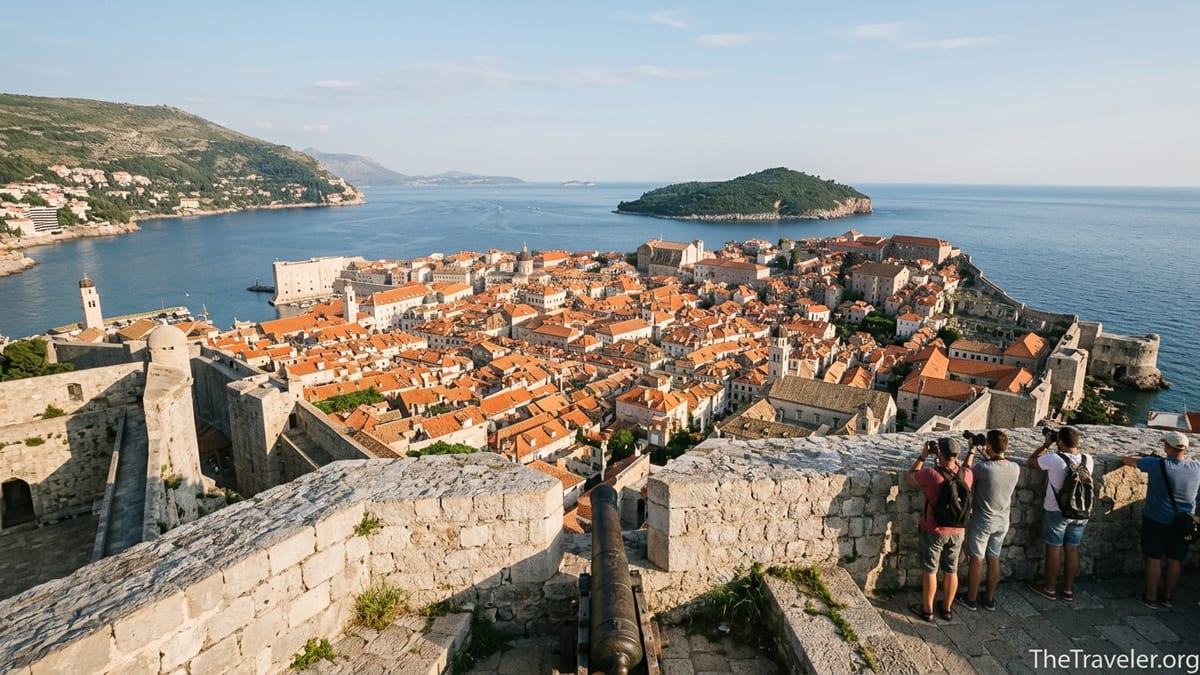
There is a moment in Dubrovnik when the city stops being a postcard and becomes a living, layered coast. For me, it happened on the upper terrace of Fort Lovrijenac, 37 meters above the Adriatic, where a single view gathered stone walls, terracotta roofs, open sea and green islands into one frame. It changed how I understood not only Dubrovnik, but the entire Dalmatian coast that unspools north and south from these cliffs.
Get the latest updates straight to your inbox!
Climbing Toward a Different Perspective
Fort Lovrijenac rises on a rocky spur just west of Dubrovnik’s medieval walls, separated from the Old Town by a narrow inlet and a horseshoe of water known as Kolorina Bay. From Pile Gate, the main western entrance to the Old Town, you follow a short path past kayak rentals and small tour stands, then begin up the fort’s stone staircase. Guides like to quote the fort’s nickname, the Gibraltar of Dubrovnik, as you climb, but it is the height that you feel most keenly. By the time you reach the top, you have ascended roughly 200 steps, trading the press of crowds at sea level for the dry scent of pine and stone above the water.
Most visitors come armed with a City Walls ticket or Dubrovnik Pass, which in 2026 typically costs in the region of 35 to 40 euros for a day ticket and includes entry to Fort Lovrijenac. That bundled access matters in a city where prices can surprise even well-prepared travelers. Choosing the combined option instead of a stand-alone fort ticket means you are more likely to make the climb, to follow those steps away from the Stradun’s cafes and up into a different Dubrovnik. The walk is short, but it becomes a quiet threshold between the commercial Old Town and the wider coast beyond its gates.
The first terraces inside the fort are modest spaces: thick stone walls, low arches, cannons angled toward the sea. Many visitors pause here for photos and then turn back. It is the upper terrace, reached by one more stone ramp, that delivers the view that changes everything. Up here the tourist chatter falls away for a moment, replaced by the sound of water working the rocks below and the faint clink of glasses drifting across from Old Town balconies.
The View That Holds a Thousand Years
From the upper terrace, Dubrovnik’s Old Town appears as a complete miniature city, squeezed onto a promontory of rock and wrapped in walls that were thickened and raised over centuries of sieges and sea threats. Looking down, you see the full circuit of the fortifications, almost two kilometers of stone, curving around the red roofs and bell towers. Tourists walking the walls become a single moving line, tracing the outline of a city that once controlled key trade routes between East and West. Seen from street level, those walls can feel decorative. From Fort Lovrijenac, their defensive logic suddenly makes sense.
Turn your head slightly and the Adriatic fills your vision. On a clear day, the water here is an improbable palette of blues: turquoise around the shallows below Kolorina Bay, cobalt where the sea floor drops away, and a deep ink along the horizon. Kayak groups push out from the small pebble beach below, often paying around 35 to 45 euros for a half-day tour that circles Lokrum Island. From above, their bright boats look almost fragile against the scale of the open sea. It is from this vantage point that the phrase Pearl of the Adriatic ceases to be travel brochure language and becomes a simple description of geography and vulnerability.
Beyond the city walls lies Lokrum, a low, forested island just 600 meters offshore. From the fort, its outline is unmistakable: a long green shape, thick with Aleppo pines and cypresses, sheltering tiny coves and rock platforms where locals swim. Regular boats shuttle travelers between the Old Port and Lokrum for a modest fee, often under 10 euros for a return ticket in high season. Watching those boats track back and forth, you see how closely bound Dubrovnik is to the small islands off its coast, and how the Adriatic is less a barrier than an everyday street.
History Etched Into Stone and Sea
It is easy to stand on Fort Lovrijenac and think only of television. Tour guides now routinely point out that the fortress appeared as the Red Keep exterior in Game of Thrones, and fans arrive with scene stills on their phones. Yet the walls underfoot predate any screen by almost a millennium. The people of Dubrovnik first built a fort here in the 11th century to keep Venice from doing the same. They understood that whoever controlled this rock controlled both the sea approach to the harbor and the land approach through Pile Gate.
From the upper terrace, the old Venetian threat and later Ottoman pressure become more than footnotes in a guidebook. You can see how cannons once pointed toward open water, covering ships approaching from the south, while others faced inland to counter any land attack. The famous Latin inscription above one entrance, roughly translated as Freedom is not to be sold for all the gold in the world, feels less like patriotic decoration and more like a straightforward statement of defense policy when you see the sheer drop beneath the fort’s walls.
That long history is layered with more recent scars. Turn toward Mount Srd, the low mountain behind the city, and you can pick out the cable car station and the outlines of Fort Imperial at the summit, now home to a small museum about the siege of Dubrovnik in the early 1990s. Many travelers combine a visit to Fort Lovrijenac with a cable car ride, paying around 30 euros for a round trip to see the city from above. From Lovrijenac, though, you are reminded that this coastline was not always a place of beach towels and cruise ships. In living memory, artillery shells fell on these same walls and roofs.
That duality of beauty and vulnerability is what begins to shift your understanding of the broader Adriatic coast. When you later travel north to Split or Zadar, or south toward Montenegro’s Bay of Kotor, you will recognize the same combination of mountain backdrops, fortified peninsulas, and sea routes that once carried both trade and war. The view from Lovrijenac is a lesson in how this coast was shaped as much by who needed to defend it as by who wanted to admire it.
Seeing the Coast as a Living Everyday Space
From Fort Lovrijenac, the everyday life of Dubrovnik plays out in miniature. Below, in Kolorina Bay, local children jump from rocks into water that glows green in the late afternoon light. Small fishing boats nose out past rental kayaks, the older hulls sitting lower and matte among the bright plastic of tourist craft. On the rocks opposite you can often spot a few students or off-duty workers from the Old Town sprawled on towels, using the same sea as the travelers who paid for organized tours.
This is where the Adriatic stopped being an abstract body of water for me and became a shared room. From the fort you can follow the line of the coast north toward Lapad and Babin Kuk, where modern hotels line the peninsula and beaches like Copacabana and Coral Beach attract day guests with 10 euro sunbed rentals and cocktails at sunset. To the south, your eye runs past the lighthouses guarding the city’s approaches and out toward the islands of the Elafiti archipelago, where small ferries carry day-trippers to car-free Kolocep, Lopud and Sipan.
Recognizing these routes from above makes later journeys along the coast feel almost intimate. When you stand on the pebble beach of Lopud’s Sunj Bay, paying a few euros for a coffee in a beach bar, you can mentally trace the line back to the fort where you first saw this pattern of city, island and sea. The same happens if you board a Jadrolinija ferry from Dubrovnik’s Gruz port, heading north toward the islands of Korcula or Hvar. The ferries become moving bridges between places that all share the same basic arrangement of stone, mountain and water you first understood high above Kolorina Bay.
Even everyday logistics begin to feel different. Sitting on a local bus in Split, squeezed among suitcase wheels and grocery bags, you remember how the terracotta roofs of Dubrovnik clustered so tightly between walls and sea. Cities along this coast are pressed into narrow strips of habitability, and the view from Lovrijenac shows you why. There is the mountain, there is the sea, and the space between them is what people have been negotiating for centuries.
Planning Your Own Moment on the Terrace
Translating that transformative view into your own travels does not require luxury. It does require timing. In high season, cruise ships can disgorge thousands of visitors into Dubrovnik in a single morning. Many of those guests walk the city walls in the late morning or early afternoon, when stone and sun combine into a white glare. If you visit Fort Lovrijenac then, the terraces can feel crowded and the heat punishing. Aim instead for early morning, when the fort opens, or for the last hour before closing when shadows lengthen over the Old Town and the light softens on the sea.
In practical terms, the easiest way to include Fort Lovrijenac is to buy a City Walls ticket or Dubrovnik Pass from the official kiosks near Pile Gate or the Old Port. Both options generally include one entry to Fort Lovrijenac within a set time window, often 24 to 72 hours from first use. Travelers focused on value often choose the Dubrovnik Pass, which, for around 40 to 60 euros depending on validity length, combines the walls and fort with local bus rides and entry to several museums. That means you can climb Lovrijenac one evening, walk the walls the next morning, and still have time to visit the Franciscan Monastery’s cloister or a small city museum without additional tickets.
Wear shoes with decent grip and bring water. The steps to the fort are uneven in places, and Dubrovnik’s summer temperatures routinely climb into the high twenties and low thirties Celsius. There is usually a small refreshment stand just outside Pile Gate where a bottle of water can cost several euros, more than at supermarkets in newer parts of the city. If you are watching your budget, it is worth buying supplies in advance in the Gruz neighborhood or near Lapad, where convenience stores price drinks closer to what locals pay.
Photography enthusiasts should consider bringing a mid-range zoom lens. From the upper terrace of Fort Lovrijenac, a focal length around 35 to 70 millimeters on a full-frame camera captures both the sweep of the city walls and tighter details like laundry strung across a single lane or the reflection of sunlight on a single dome. Even a modern smartphone has enough dynamic range to handle the contrast between bright sea and shaded streets, especially in the softer light of late afternoon.
Beyond the Fort: Following the Adriatic North and South
Once you have seen Dubrovnik from Fort Lovrijenac, it becomes hard not to compare every other coastal view to that first encounter. Travel north to Split and climb the bell tower of the Cathedral of Saint Domnius in Diocletian’s Palace. From the top, you see the Riva promenade, the ferry port and the green hump of Marjan Hill, the city’s pine-covered escape. The outline echoes Dubrovnik’s: old stone core, working harbor, green headland, open sea. The Adriatic, it turns out, repeats a pattern along much of its Croatian shore.
Farther north, Zadar’s sea organ and sun salutation installation sit on a peninsula once guarded by Venetian fortifications. From the top of the city’s bastions or from the bell tower of Saint Anastasia, you can look out over low islands like Ugljan and Pasman, seeing again the relationship between mainland and offshore that you first understood in Dubrovnik. When you step onto a local ferry in Zadar, paying a few euros to cross the channel to Ugljan for an afternoon swim, you are repeating the same everyday crossing that boatmen have made here for generations.
South of Dubrovnik, the road curves toward the Montenegrin border and then into the deep inlet of the Bay of Kotor. Here, too, you can climb to a fortification, the ruins of Saint John’s Fortress above Kotor Old Town, and look down on a familiar arrangement: stone walls, red roofs, cruise ships anchored where trading galleys once moored, and a ring of mountains closing around a stretch of water. The Adriatic’s coastal cities begin to look like variations on a theme written in stone and sea.
Returning to Dubrovnik after visiting these other places, the view from Fort Lovrijenac feels even more instructive. It is both specific and representative. Specific, because nowhere else offers quite the same combination of isolated fort, complete walled city and close offshore island. Representative, because it distills the elements that define so much of the eastern Adriatic: limited flat land, defensive architecture, maritime trade, and communities that have always looked outward across the water as much as inward to the continent.
The Takeaway
Travel often promises transformation, but the moments that genuinely shift your perspective tend to be quiet and specific. Standing on the upper terrace of Fort Lovrijenac, looking down at Dubrovnik’s stitched-together roofscape and out at the layered blues of the Adriatic, you gain more than a spectacular photograph. You begin to understand how geography, history and everyday life braid together along this coast.
That single view invites you to read the Adriatic differently. The ferries departing Gruz are no longer just transport but continuations of old trade routes. The stone alleys of Korcula, Hvar and Kotor become part of a shared architectural language shaped by the same need to defend narrow strips of habitable land. The prices you pay for a city walls ticket or a boat ride stop feeling like isolated expenses and become a modern contribution to the maintenance of structures that have stood watch over this sea for centuries.
When you leave Dubrovnik, whether by bus hugging the cliff road north, by catamaran skipping between islands, or by plane lifting above the ragged coastline, the memory that lingers is likely to be that first, wide frame from Fort Lovrijenac. It is a reminder that the most powerful travel experiences are often less about ticking off landmarks and more about finding a vantage point that helps you see an entire region anew.
FAQ
Q1. Where exactly is Fort Lovrijenac in Dubrovnik?
Fort Lovrijenac sits on a rocky headland just west of Dubrovnik’s Old Town walls, near Pile Gate and overlooking Kolorina Bay and the open Adriatic.
Q2. How much does it cost to visit Fort Lovrijenac?
Most travelers visit Fort Lovrijenac using a combined City Walls ticket or Dubrovnik Pass, typically around 35 to 40 euros for a day ticket as of 2026.
Q3. Do I need a separate ticket if I already paid to walk the city walls?
No. The standard Dubrovnik City Walls ticket generally includes a single entry to Fort Lovrijenac within a defined validity period, usually 24 to 72 hours.
Q4. When is the best time of day to enjoy the view from Fort Lovrijenac?
Early morning and the last hour before closing are ideal, with softer light, fewer crowds, and more comfortable temperatures than midday in summer.
Q5. How challenging is the climb up to Fort Lovrijenac?
The approach involves roughly 200 stone steps. It is short but steep, so moderate fitness, comfortable shoes and water are recommended, especially in hot weather.
Q6. Can I combine Fort Lovrijenac with other nearby sights in one visit?
Yes. Many visitors pair the fort with a walk on the city walls, a swim or kayak trip from Kolorina Bay, or a sunset cable car ride to Mount Srd.
Q7. Is Fort Lovrijenac suitable for travelers interested in Game of Thrones locations?
Yes. The fort appeared as the exterior of the Red Keep in the series and is a key stop on themed walking tours that explore Dubrovnik’s filming sites.
Q8. Are there facilities such as cafes or restrooms at Fort Lovrijenac?
Facilities inside the fort are limited. Cafes, small shops and public restrooms are available around Pile Gate and just inside the Old Town nearby.
Q9. Can I visit Fort Lovrijenac with children?
Children can visit, but supervision is essential. The terraces are secure yet elevated, the steps can be tiring, and sun protection and water are important in summer.
Q10. How does the view from Fort Lovrijenac compare to the view from Mount Srd?
Mount Srd offers a high, wide panorama of the whole region, while Fort Lovrijenac provides a closer, more intimate perspective of the Old Town, walls and immediate coast.