


Perched on a 37 meter cliff outside Dubrovnik’s western walls, Fort Lovrijenac looks like an indestructible stone ship guarding the Adriatic. Step inside, though, and it becomes something more intimate: a compact world of courtyards, gun positions and sea views that tell the story of how Dubrovnik survived as an independent city-state. Today it is a key stop for history lovers and Game of Thrones fans alike, but its real importance lies in the role it played in defending and defining Dubrovnik for centuries.
Get the latest updates straight to your inbox!
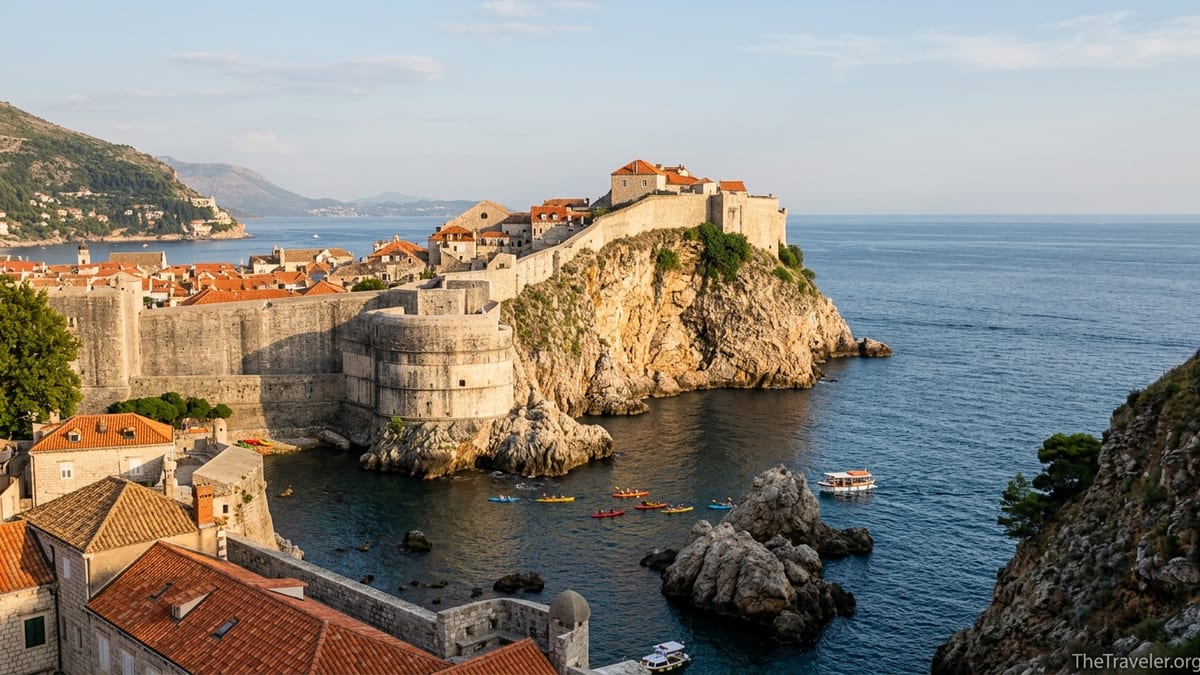
Where Fort Lovrijenac Sits in Dubrovnik’s Story
Fort Lovrijenac, often called St Lawrence Fortress, stands outside the main circuit of Dubrovnik’s walls on a steep rocky promontory that dominates the city’s western approach. That location is not accidental. For a small republic that relied on trade and diplomacy rather than brute force, controlling the natural harbor and sea routes into the city was vital. From the upper terraces of the fort, you can see how it commands the entrance to the old port, the channel between the rock and the city walls, and the open sea beyond.
Local tradition says that Dubrovnik’s citizens rushed to build Lovrijenac in the 11th century specifically to stop the rival Venetian Republic from constructing its own stronghold on the same rock. Whether or not the timeline is exact, the story captures an essential truth. Dubrovnik, then known as the Republic of Ragusa, could not afford to let a foreign power plant cannons directly above its harbor. The very existence of Fort Lovrijenac is a declaration of political independence, carved into stone.
By the late Middle Ages and into the early modern period, the fort was one of the most important points in the city’s defensive system. Its angled outer walls, some reportedly up to several meters thick facing the sea, were designed to absorb cannon fire. Inside, however, the structure is more compact and vertical, with three levels arranged around a central courtyard. Walking from the entrance up to the gun terraces gives a physical sense of how tightly space was used in a city where every square meter of rock mattered.
Even today, when you arrive by the short but steep path that climbs from Pile Gate and West Pier, you feel the separation. The crowds and cafe tables of the Old Town fall away behind you. Ahead, Lovrijenac stands alone against the sky, a reminder that Dubrovnik’s survival was never guaranteed but carefully defended.
Inside the Walls: What You Actually See in the Fortress
Most visitors first encounter Fort Lovrijenac as a photogenic silhouette from Dubrovnik’s city walls or from the kayaks that paddle below. The real experience begins once you step through the stone gate. Just above the entrance is an inscription in Latin, “Non bene pro toto libertas venditur auro,” usually translated as “Freedom is not sold for all the gold in the world.” For centuries this motto summarized the city’s political philosophy. Seeing it in its original context, carved where soldiers would pass under it every day, makes Dubrovnik’s talk of liberty feel much less abstract.
Immediately inside, the fort opens into a small, roughly rectangular courtyard. It feels almost like a miniature town square in stone, with staircases leading up to higher levels, a cistern that once stored rainwater, and narrow passages branching toward the sea-facing ramparts. Guides often pause here to explain how the garrison lived: soldiers sleeping in cramped rooms along the inner walls, gunpowder stored in carefully ventilated magazines, officers keeping watch from the upper terraces. If you visit in the late afternoon, when the rock has warmed in the sun and the cicadas are buzzing, it is easy to imagine the same sounds echoing several hundred years ago.
From the courtyard, stairways lead to the artillery platforms that made Lovrijenac so strategically valuable. The most atmospheric spot is the sea-facing battery, where you can still see the embrasures that once housed cannon muzzles. Many visitors stop to photograph the modern replica cannons and the framed views of Lokrum Island and the open Adriatic. On windy days, the sound of waves striking the base of the cliff rises up through the gun ports, a reminder of just how exposed this outpost was in bad weather.
Climb to the upper terrace and the fort’s defensive purpose becomes even clearer. Here you have a commanding view over Pile Bay, the curved line of Dubrovnik’s main walls, and the terracotta roofs of the Old Town. Guides like to point out that in an emergency, the Republic’s leaders were prepared to sacrifice the fort rather than allow it to fall into enemy hands. According to local lore, the walls facing the city are noticeably thinner than those facing the sea so that Lovrijenac’s guns could be turned on it from the mainland if its garrison ever rebelled. Whether or not that was ever tested, the idea captures the delicate balance of trust and control that shaped Ragusan politics.
A Fortress Built for Cannons and Diplomacy
Unlike many medieval castles built around high towers and narrow arrow slits, Fort Lovrijenac evolved as artillery changed warfare. By the time it reached its current form, it was clearly designed with cannons in mind. The low, thick outer walls facing the sea are angled to deflect incoming fire, while the interior is arranged to support heavy guns and store powder safely. As you walk the corridors, you can spot extra-thick pillars and small openings intended for ventilation and smoke dispersal.
Yet Dubrovnik’s strength was never purely military. The Republic survived between far larger powers by paying attention to shifting alliances and by investing in diplomacy as carefully as in stone. Fort Lovrijenac is part of that story too. The very sight of a heavily armed fortress looming above the harbor sent a message to any foreign fleet considering a show of force. Venetian and Ottoman envoys arriving by sea could not miss the fort, and its motto about liberty would have been one of the first inscriptions they saw.
On guided tours, you will often hear how Lovrijenac played a role during various conflicts, from medieval rivalries with Venice to the turbulence of the Napoleonic era. While large scale sieges were rare compared with other European cities, the threat was constant enough to justify maintaining a permanent garrison and artillery here. The fort also saw action and damage during the fighting in the early 1990s, when Dubrovnik itself was shelled. Some visitors who remember seeing those events on the news in their youth find that standing on these walls connects the city’s long military history with much more recent events.
Today, the fort’s defensive function is symbolic rather than practical, but the architecture remains. When you walk along the sea-facing ramparts and look down at the kayakers and tour boats below, it helps to picture the same line of sight with tall-masted merchant ships or a hostile fleet on the horizon. That mental overlay is what makes Lovrijenac more than just a picturesque viewpoint.
From Cannons to Culture: Hamlet and the Summer Festival
In the second half of the 20th century, Fort Lovrijenac gained a new role that had nothing to do with war. It became one of the most dramatic open-air stages in Europe, best known for performances of Shakespeare’s Hamlet during the Dubrovnik Summer Festival. For many locals, these productions are now as much a part of the fort’s identity as its cannons.
Arrive on a summer evening when a performance is scheduled and the atmosphere feels completely different from a daytime visit. Stage lights and sound equipment line the courtyard, and technicians move between stone staircases that once echoed with marching boots. When the play begins, the thick outer walls and dark sea beyond create a natural backdrop. International reviewers over the years have often highlighted how the real fortress setting brings extra weight to lines about power, betrayal and mortality.
For travelers, this cultural layer offers a specific, real-world option: if your visit to Dubrovnik falls in July or August, you can sometimes buy a ticket to see a performance inside Lovrijenac instead of simply touring the fort. Prices vary by production and year, but recent seasons have seen tickets for major plays at roughly the same level as a mid-range restaurant dinner in the Old Town. Compared with the cost of a boat trip or a day tour to nearby islands, it is a competitive way to experience local culture inside a historic setting.
Even if you do not attend a performance, small details hint at this second life. You might see anchor points for lighting rigs in the courtyard, or notice how the walls provide natural acoustics when a guide raises their voice. This blending of heritage and contemporary use is typical of Dubrovnik, where many historic palaces host concerts and exhibitions during the summer season.
Game of Thrones and a New Wave of Visitors
In the last decade, Fort Lovrijenac has become globally recognizable as the stand-in for the Red Keep in HBO’s Game of Thrones. Many scenes involving King Joffrey, the Lannister court and the battlements of King’s Landing were filmed here, particularly in the early seasons. If you remember Joffrey’s name-day tournament or courtly confrontations overlooking the sea, you will recognize the stone staircases and courtyards the moment you step inside.
This screen fame has brought a different kind of visitor. On a typical morning in high season, you might share the courtyard with several Game of Thrones walking tours, each guide holding a laminated still from the series to show the exact framing. Some companies base their entire route around filming locations, combining Lovrijenac with the nearby Pile Harbour, the Jesuit Staircase and stretches of the city walls. Prices for these tours in 2026 often cluster in the range that many travelers would normally reserve for a half-day excursion, and they sell especially well on days when cruise ships are in port.
For Dubrovnik, this surge matters because it has redefined how many people first hear about the city. A traveler who discovered Lovrijenac as “the Red Keep” might arrive with no prior knowledge of the Ragusan Republic, then leave having learned about the motto over the gate, the Venetian rivalry and the city’s trading past. Guides frequently use scenes from the series as an entry point to talk about real events, turning pop culture into a bridge toward history rather than a distraction from it.
The challenge is managing this attention without overwhelming the site. Local authorities and tour operators have gradually adjusted group size limits and timing to reduce congestion in the narrow stairways, especially at the main viewpoints. When planning your own visit, it is worth checking when cruise ships are scheduled to dock and aiming for early morning or late afternoon to experience both the Game of Thrones resonance and the quieter historical atmosphere.
How to Visit Fort Lovrijenac Today
Practicalities matter as much as history when you are standing at the base of the cliff with the sun already high. The climb to Fort Lovrijenac is short but steep, involving a series of stone steps that can feel intense in midsummer. Sensible footwear and a bottle of water are more useful here than a second camera lens. Shade is limited once you leave the trees near the base, so a hat or light scarf helps during July and August visits.
Access rules can change from season to season, but in recent years entry to Fort Lovrijenac has typically been included with the main Dubrovnik City Walls ticket, which is valid for several days and priced firmly in the “major attraction” bracket for the region. This combined ticket offers good value if you plan to walk the full circuit of the walls and then visit the fort either on the same day or within the validity window. There is usually a smaller standalone ticket as well, aimed at travelers who only want to see the fort or who have already walked the walls on a previous trip. Children, students and local residents often benefit from discounts, so it is worth asking at the ticket office if you are traveling with family or carrying a student card.
The most common approach is from Pile Gate, walking down to the small cove and then following the signed path uphill. This route takes you past filming locations used as King’s Landing’s harbor and offers several chances to pause for photos of kayaks, swimmers and the fort looming above. Independent travelers often combine Lovrijenac with a swim at the nearby pebble beach or with a short sea-kayaking trip that circles the base of the cliff. Seeing the fort first from the water and later from the inside gives a fuller sense of its scale.
Inside, there are no cafes or shops, only occasional pop-up stands during special events, so it is best to eat and drink beforehand in the Old Town. Basic amenities are minimal, which preserves the historic atmosphere but means you should not expect the kind of visitor center you might find at a large castle elsewhere in Europe. Plan around an hour for a relaxed visit, longer if you like to linger over photos or are joining a themed guided tour.
Why Fort Lovrijenac Still Matters to Dubrovnik
Viewed from a distance, Fort Lovrijenac is one more picturesque silhouette in a city full of them. Once you step inside and understand its role, it becomes something closer to a key. It helps unlock why Dubrovnik looks the way it does, and why it survived as a small but independent maritime republic for so long. Without a strong, well-positioned outpost on this rock, the harbor would have been far harder to defend, and foreign powers would have had much more leverage in negotiations.
The Latin motto above the gate captures this link between stone and identity. “Freedom is not sold for all the gold in the world” was not just an idealized phrase. It reflected hard choices about paying tribute to powerful neighbors, investing heavily in fortifications instead of palaces, and training citizens to serve as both merchants and defenders. When you see school groups passing under the inscription today, or hear a guide explain it to a tour that just stepped off a cruise ship, you are watching the city continue to teach its story through this building.
Lovrijenac also matters because it shows how Dubrovnik uses its heritage in the present. The same courtyard that once stored gunpowder now hosts Shakespeare and summer concerts. The same terraces that faced down hostile fleets now accommodate photo shoots, Game of Thrones location tours and wedding portraits. This layered usage keeps the fort alive in the city’s daily imagination instead of freezing it as a museum piece.
Finally, the fort is a reminder that Dubrovnik is more than a scenic backdrop. Many visitors arrive on short visits, see the walls and the sea, and leave with the impression of a beautifully preserved stage set. Standing inside Lovrijenac, reading the motto and feeling the wind push in from the Adriatic, it becomes harder to forget that real people once depended on these stones. For a city that now lives largely from tourism, that sense of continuity is important.
The Takeaway
Walking into Fort Lovrijenac is one of the most efficient ways to understand Dubrovnik. In less than an hour, you move from the tight streets of the Old Town to a lonely rock that once guarded the republic’s freedom, stand in the courtyard where soldiers drilled and actors now perform, and look out over a harbor that has welcomed both merchant fleets and film crews. The climb is short, the views are wide, and the stories are larger than the footprint of the building itself.
For history enthusiasts, the fort provides concrete evidence of how a small city-state protected itself among larger powers. For culture lovers, it offers a setting where Shakespeare, local festivals and modern tourism converge. For fans of Game of Thrones, it turns familiar scenes into a three dimensional reality. Put simply, Fort Lovrijenac connects the dots between Dubrovnik’s past, present and global image in a way few other sites can.
If your time in the city is limited, prioritizing a visit here alongside the main city walls is a practical decision rather than an indulgence. You get the iconic photographs, but you also leave with a clearer sense of why this particular rock, crowned by stone and Latin script, has mattered so much to Dubrovnik’s story. In a place where every viewpoint feels like a postcard, Fort Lovrijenac is where the picture gains depth.
FAQ
Q1. Where exactly is Fort Lovrijenac located in relation to Dubrovnik’s Old Town?
Fort Lovrijenac stands on a rocky cliff just outside the western walls of Dubrovnik’s Old Town, above Pile Bay and opposite the main city fortifications.
Q2. How long should I plan to spend inside Fort Lovrijenac?
Most visitors find that 45 to 60 minutes is enough time to climb through the levels, enjoy the views, take photos and read the main information panels.
Q3. Is Fort Lovrijenac included in the Dubrovnik City Walls ticket?
In recent years Fort Lovrijenac has generally been included with the main City Walls ticket, but it is wise to confirm current details at the official ticket office.
Q4. How difficult is the climb up to the fortress?
The climb is short but fairly steep, with a series of stone steps. Most reasonably fit visitors manage it easily, but good footwear and water are recommended in summer.
Q5. What makes Fort Lovrijenac historically important for Dubrovnik?
Its position controlling the harbor and western approaches allowed Dubrovnik to defend crucial sea routes and deter powerful neighbors, helping preserve the city’s independence.
Q6. Can I visit Fort Lovrijenac independently, or do I need a guided tour?
You can visit independently with a standard ticket, walking through at your own pace, or join a guided tour that adds detailed historical or Game of Thrones context.
Q7. What Game of Thrones scenes were filmed at Fort Lovrijenac?
Several key King’s Landing scenes were filmed here, including Joffrey’s name-day celebration and various courtyard and battlement moments around the Red Keep.
Q8. Are there facilities like cafes or restrooms inside the fortress?
Facilities are limited. You may find basic amenities during events, but in general it is best to eat, drink and use restrooms in the Old Town before your visit.
Q9. When is the best time of day to visit Fort Lovrijenac?
Early morning and late afternoon are ideal, providing softer light for photos, slightly cooler temperatures in summer and fewer large tour groups on the stairs.
Q10. Does Fort Lovrijenac host events or performances during the year?
Yes, especially in summer, when the fortress often becomes a stage for plays and concerts, including acclaimed productions during the Dubrovnik Summer Festival.