


I almost skipped Fort Lovrijenac. Standing at Dubrovnik’s Pile Gate on a sweltering July afternoon, I stared up at the stone fortress perched on its cliff and seriously considered saving my legs. I had already walked the city walls, my water bottle was empty, and the staircase to the fort looked like a punishment. But curiosity won, and twenty minutes later I was standing on the ramparts of one of the most spectacular viewpoints on the Adriatic. Skipping it would have been the single worst decision of my time in Dubrovnik.
Get the latest updates straight to your inbox!
First Impressions: The Fort I Nearly Talked Myself Out Of
From ground level near Pile Gate, Fort Lovrijenac can look like an optional extra. Many visitors arrive in Dubrovnik focused on the famous city walls and Old Town streets and assume the detached fortress across the cove is just a photo backdrop. I did the same. Google Maps showed it was only a few minutes away, but the reality on a hot afternoon is a steep climb of close to 200 stairs that puts off more than a few tired travelers.
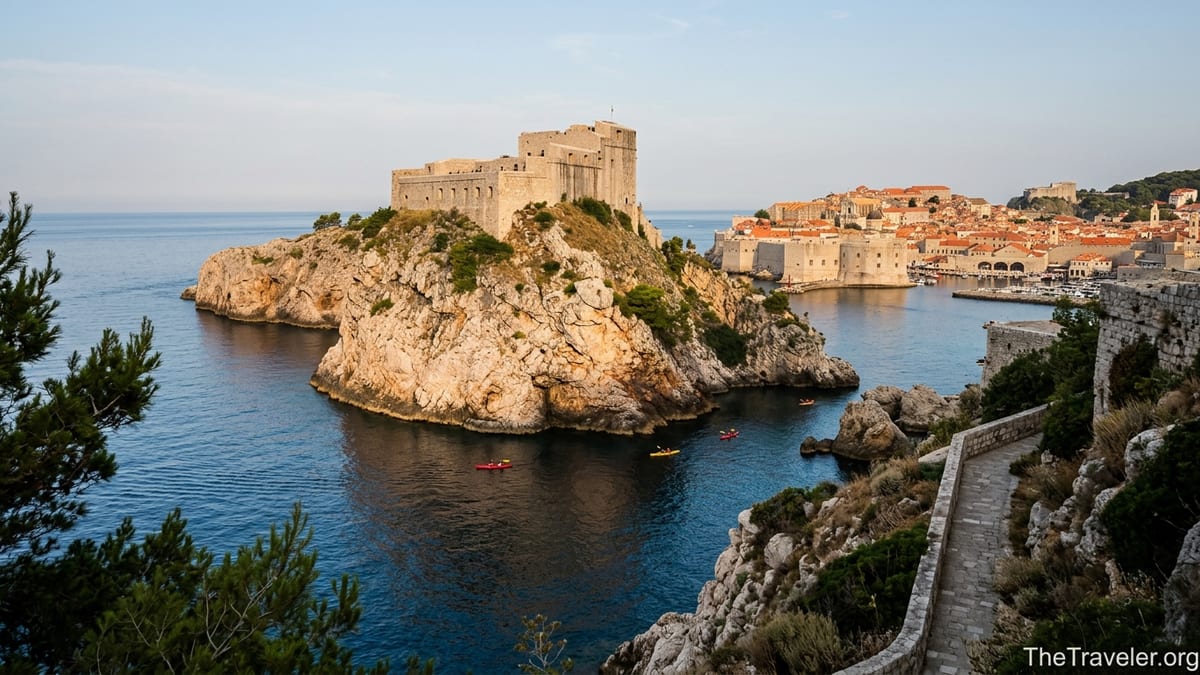
What changed my mind was a glimpse of the fort from the small shingle beach in Pile Bay, the cove locals call Kolorina. From there, Lovrijenac rises almost vertically from a 37 meter rock above the sea, its walls catching the late-afternoon light while kayaks slide below the cliffs. It suddenly stopped being a vague “extra fortress” and became a destination in its own right, as dramatic as anything I had seen from the city walls.
As I started up the steps from Pile, pausing on the small terrace halfway to catch my breath, I realized something else: almost everyone around me was speaking English, German, or Spanish, but the stream of people was a trickle compared with the crowds shuffling along the main walls. For a site within a five-minute walk of Dubrovnik’s busiest gate, that is rare, and it already felt like I had stumbled onto a side of the city that most day trippers never fully see.
By the time I reached the entrance, the harbor and terracotta roofs of the Old Town were framed below me like an aerial photograph. Any thoughts of skipping Lovrijenac vanished. This was not a side quest. It was the vantage point that makes sense of Dubrovnik’s geography, history, and even its pop culture fame.
Practicalities: Tickets, Opening Hours, and What to Expect
One of the most common misconceptions is that Fort Lovrijenac requires a separate, expensive ticket. In reality, entry to the fortress is commonly bundled with the main Dubrovnik City Walls ticket. As of 2026, the standard walls ticket costs in the region of 35 to 40 euros per adult, purchased at the official ticket booths by Pile Gate or Ploče Gate. That ticket typically includes a visit to Fort Lovrijenac within a defined window, often 24 to 48 hours. Policies can change, so it is worth confirming at the booth, but for most visitors the fort is effectively included in the price they have already paid.
If you are planning several sights, another option is the Dubrovnik Pass, which many travelers use to access the walls along with museums and public transport. The pass can offer better value if you are in the city for more than a day and want to step into places such as the Rector’s Palace, the Maritime Museum, or use local buses out to Lapad. Fort Lovrijenac is one of the attractions that pass holders frequently mention as a highlight, despite the minimal extra time it requires.
Opening hours vary by season, but in the peak summer months the fort generally opens in the morning and closes in the early evening, with shorter hours in winter. In practical terms, that means aiming for early morning (shortly after opening) or late afternoon if you want gentler light and fewer crowds. Midday in July or August can be brutally hot on the exposed stone, with little shade once you are inside. There are no cafés or kiosks within the fortress, and no toilets, so arrive with water and plan on heading back into the Old Town or to a nearby café afterward.
The climb itself is part of the experience. From the street near Pile Gate, a stone staircase zigzags up through pine trees toward the entrance. The steps are uneven in places but solid, and most reasonably fit visitors can handle the ascent in under ten minutes with a couple of pauses. Families with small children often carry younger kids for parts of the climb, and you will see plenty of people in sandals and casual sneakers making their way up. If you have mobility issues, the number of steps can be a real consideration, so it is worth evaluating this honestly rather than underestimating the effort.
History on a Cliff: Why Lovrijenac Matters
It is easy to see Fort Lovrijenac purely as a viewpoint, but its story is tied to Dubrovnik’s survival. Built on a rocky promontory just outside the western walls, the fortress guarded what was historically the most vulnerable side of the city, facing Venice and the open Adriatic. Local guides love to repeat the anecdote that the Republic of Ragusa hurried to build the fort in the 11th century after learning that Venice planned its own fortress on the same rock. Whether or not every detail is accurate, the rivalry with Venice and the urgency to fortify this spot are well documented in local histories.
Walking through the main gate, you pass an inscription over the entrance that sums up the spirit of the old city: “Non bene pro toto libertas venditur auro.” In rough translation, it reads, “Freedom is not to be sold for all the gold in the world.” For centuries, Lovrijenac was not only a defensive structure but a symbol of Dubrovnik’s independence. Looking back toward the walled Old Town, it is not difficult to imagine watchmen scanning the horizon for galleys while merchants and diplomats negotiated in the streets below.
Inside, the fort is a compact maze of courtyards, staircases, and cannon positions. You can see the thickness of the walls, particularly on the seaward side, where stone blocks were designed to absorb artillery fire. The interior has been adapted over time; in the 20th century, some rooms were repurposed, and today the main courtyard doubles as a performance space. During the annual Dubrovnik Summer Festival, Shakespeare plays such as Hamlet and Macbeth are staged here, with spectators sitting on temporary stands and the city and sea providing an open-air backdrop.
For travelers used to heavily curated heritage sites, Lovrijenac feels refreshingly raw. There are a few basic information panels, but there is also plenty of open space where you are free to explore at your own pace. Nobody hurries you on from the viewpoints, and it is entirely possible to find a quiet corner even on a busy day, especially on the lower terraces that most visitors bypass in their rush to the top.
The Views: Dubrovnik’s Best Natural Panorama
The main reason Fort Lovrijenac is unmissable is simple: the views. From the upper terrace, Dubrovnik’s UNESCO-listed Old Town unfolds in a full 180 degrees. You can trace the line of the city walls, pick out landmarks such as Minčeta Tower and St John Fortress, and look straight across the narrow channel to the stone arches of Pile Gate. The terracotta rooftops form a dense patchwork, interrupted by the domes of churches and the long rectangle of the Stradun, the city’s marble main street.
What makes this perspective unique is that it places Dubrovnik against its context. From the walls, you mostly look outward, with the sea as your backdrop. From Lovrijenac, you see both the city and the sea at once, framed by green islands and the deeper blue of the open Adriatic. When a cruise ship is anchored offshore and kayakers are circling beneath the cliffs, the scene feels almost impossibly layered: medieval fortifications, everyday city life, and 21st century tourism in a single sweep of the eye.
Photographers gravitate to a few classic angles. One is from the battlements facing directly toward the Old Town, where a short ledge lets you place the fort’s own stone in the foreground and the harbor in the background. Another is from a lower platform looking down into Pile Bay, where traditional wooden boats and modern kayaks assemble in the same sheltered water. In the golden hour shortly before sunset, the walls glow a warm amber, and even smartphone cameras deliver images that would not look out of place in a travel magazine.
The best part is that you have room to enjoy it. On my visit, there were no crowds pressed shoulder to shoulder, as happens on the narrowest parts of the main city walls. Couples sat quietly on cannon platforms, a small tour group listened to a guide explain how the fort doubled as the Red Keep in a certain television series, and a local teenager in a Luka Modrić jersey scrolled through his phone in the corner, oblivious to the billion-dollar view behind him.
Game of Thrones and Beyond: Pop Culture Pilgrimage
It is impossible to talk about Fort Lovrijenac today without mentioning its on-screen alter ego. From the second season of HBO’s Game of Thrones onward, the fortress became the principal stand-in for the Red Keep in King’s Landing. Scenes such as King Joffrey’s name day tournament, Tyrion’s tense conversations with Cersei, and various courtyard confrontations were filmed here, often with minimal digital alteration. For fans of the series, stepping into the main courtyard can feel uncannily like walking into the show.
Several local operators now run dedicated Game of Thrones walking tours that include Lovrijenac as a key stop, sometimes with still images from the series to match against the real arches and walls. Prices for these themed tours typically fall somewhere between 25 and 45 euros per person, depending on group size and whether the city walls ticket is included. For travelers who are not especially interested in the series, it is still worth knowing that groups tend to cluster around a guide for 10 or 15 minutes and then move on, leaving large sections of the fort quiet.
What might surprise visitors is how much the fortress has been used beyond Game of Thrones. Historical dramas such as Knightfall have shot scenes on these same ramparts, taking advantage of the authentic stonework and the absence of modern intrusions such as high-rise buildings. Dubrovnik’s film office actively promotes the city as a production location, and Fort Lovrijenac is one of the first places directors consider when they need a believable medieval stronghold by the sea.
Even if you have never seen an episode of a fantasy series, the pop culture connections can add a layer of fun. On my visit, I overheard a family from the United States trying to recreate a scene shot-for-shot based on a screenshot saved on their phone, complete with mock-serious dialogue delivered by a teenage son who clearly wished he were somewhere else. A group of older travelers from Germany walked through at the same time and, judging by their puzzled expressions, had no idea why a stone courtyard had suddenly become a stage.
Planning Your Visit: Timing, Crowds, and Simple Hacks
The difference between a rushed, exhausting visit and a memorable one often comes down to timing. A smart approach is to pair the fort with the city walls in a way that reduces backtracking and heat exposure. One common strategy is to walk the walls in the cooler morning hours, break for lunch in the Old Town, and then tackle Lovrijenac in the late afternoon when the light is softer on the stone. Another is to reverse the sequence on a day when cruise ships are in port: visit the fort just after it opens, before organized groups arrive from the ships, and then start the walls once the initial surge of crowds has moved on.
Checking cruise schedules online before your visit can give you a sense of whether three or four large vessels are due in on a particular day. On those busiest days, the Old Town’s narrow streets and walls can feel congested between mid-morning and mid-afternoon. Fort Lovrijenac, fortunately, tends to absorb visitors more gently. Even on days when multiple tours are scheduled, the number of people inside rarely feels overwhelming, and there is enough space for independent travelers to find quiet spots to sit or take photos.
Footwear and water make a bigger difference here than at some other attractions. Flip-flops can handle the stone floors, but the climb up and down is more comfortable in basic trainers or walking sandals with a bit of grip. There are no taps or fountains in the fortress itself, so a one liter bottle of water is a simple insurance policy against the heat, especially when temperatures in July and August regularly climb above 30 degrees Celsius. Many visitors stop at a small supermarket or kiosk just outside Pile Gate before heading up.
If you are staying outside the Old Town, local buses that stop near Pile Gate make access easy. Lines that run to Lapad, Babin Kuk, and the main port often pass within a short walk of the gate, and bus tickets are included with certain versions of the Dubrovnik Pass. From the bus stop, it is a two or three minute walk downhill to the start of the stairs and then the climb up to the fort, so you can realistically fit a visit into even a half day in the city.
Nearby Moments: What Not to Miss Around the Fort
One of the arguments I gave myself for skipping Fort Lovrijenac was that it looked “too far out of the way.” In reality, visiting the fortress opens up one of Dubrovnik’s most atmospheric little corners, all within a few hundred meters. After descending from the fort, you can step down to Pile Bay, the sheltered cove used in multiple Game of Thrones harbor scenes and, long before that, by local fishermen. Today, it is a launch point for kayak tours that circle the city walls and the nearby island of Lokrum, often lasting two to three hours and including a swim stop in a hidden cave beach.
Even if you are not joining a tour, lingering in the bay offers a different perspective on the fort you just visited. From the pebbly shore, Lovrijenac’s walls rise almost vertically beside the lower Bokar Fortress on the opposite side of the channel. Swimmers float in the clear water beneath the cliffs, and in the quieter shoulder months of May and October, locals sometimes gather here in the late afternoon for a dip after work.
Just above the bay, a short path leads along the outer side of Bokar Fortress to a viewpoint often used by wedding photographers and postcard vendors. It is one of those spots where everything about Dubrovnik’s appeal is compressed into a single frame: the old harbor walls, the detached fort on its rock, the open sea, and the low hum of life from the Old Town just out of sight. Many visitors who never climb Lovrijenac still make it here, but combining the lower viewpoint with the heights of the fort gives you a sense of how meticulously the republic defended every angle.
When your legs begin to protest, cafés near Pile Gate offer an easy reward. Prices here are understandably higher than in neighborhoods farther from the Old Town, but an espresso or a cold Karlovačko beer on a shaded terrace is a pleasant way to decompress and scroll through the photos you just took. If you prefer a quieter atmosphere, walking ten minutes away from the gate toward the residential streets of Boninovo or Lapad can drop both the noise level and the menu prices noticeably.
The Takeaway
Standing on the highest terrace of Fort Lovrijenac, with a soft wind coming off the sea and the red roofs of Dubrovnik spread below, it is hard to imagine that I nearly missed it. In the moment, the excuses had felt reasonable: tired legs, hot stone, a belief that I had already seen the essentials from the city walls. What I would have missed was not just another viewpoint but a place that ties together the city’s history, geography, and even its current role in global pop culture.
Lovrijenac offers the most complete single view of Dubrovnik you can get without boarding a boat or climbing a mountain trail. It gives context to the city walls you have just walked, shows you how the republic defended itself for centuries, and lets you step into settings you may have glimpsed on screens around the world. The climb is short, the ticket is often already in your pocket, and the reward is disproportionately large for the effort involved.
If you find yourself hesitating at the foot of the stairs as I did, treat that moment as a small test. Refill your water bottle, tighten your shoelaces, and go. In a city where so much can feel carefully staged for tourism, Fort Lovrijenac retains a rough-edged authenticity. Skipping it would not just be a minor oversight. It would mean leaving Dubrovnik without ever seeing its most revealing angle.
FAQ
Q1. Is Fort Lovrijenac included in the Dubrovnik City Walls ticket?
In most seasons, entry to Fort Lovrijenac is included with the standard Dubrovnik City Walls ticket within a set time window, typically 24 to 48 hours, but you should always confirm current conditions at the official ticket booth.
Q2. How difficult is the climb up to Fort Lovrijenac?
The climb involves roughly a few hundred stone steps from near Pile Gate and Pile Bay. It is short but quite steep, so most reasonably fit visitors manage it in under ten minutes, while those with mobility issues may find it challenging.
Q3. How long should I plan for a visit to Fort Lovrijenac?
Most travelers spend about 30 to 60 minutes inside the fort, which allows time to explore the courtyards, climb to the upper terrace, take photos of the Old Town, and pause at a few viewpoints.
Q4. What are the best times of day to visit Fort Lovrijenac?
Early morning and late afternoon are usually the most pleasant, offering softer light for photography, fewer crowds than midday, and slightly cooler temperatures on the exposed stone.
Q5. Are there facilities such as toilets, shops, or cafés inside Fort Lovrijenac?
No, there are no toilets, shops, or cafés within the fortress itself, so you should use facilities and buy water in or around the Old Town before you make the climb.
Q6. Can I visit Fort Lovrijenac without being interested in Game of Thrones?
Yes. While many visitors come because of the series, the main reasons to visit are the panoramic views, the history of Dubrovnik’s defenses, and the overall atmosphere of the cliff-top fortress.
Q7. Is Fort Lovrijenac suitable for children and older travelers?
Children and many older travelers visit regularly, but the suitability depends on individual fitness and mobility, as the access involves a sustained staircase with no elevator and limited resting spots.
Q8. Do I need to book a guided tour to see Fort Lovrijenac?
No. You can visit independently with a standard ticket, though guided walking tours, including Game of Thrones themed routes, can add context about the history and filming locations if you prefer commentary.
Q9. Can I combine a visit to Fort Lovrijenac with other nearby attractions?
Yes. It pairs naturally with a walk on the Dubrovnik city walls and a short visit to Pile Bay below, and many travelers also join sea-kayaking tours that depart from the same small cove.
Q10. What should I wear and bring when visiting Fort Lovrijenac?
Comfortable walking shoes or sandals with some grip, a hat, sunscreen, and at least a small bottle of water are recommended, especially in the summer months when the sun and stone surfaces can be very hot.