


Airport security used to be treated as an unavoidable tax on business travel. Perk’s new partnership with CLEAR suggests that for many companies, those minutes in line are now seen as a solvable business problem. By giving Perk customers preferred pricing on CLEAR+, CLEAR Concierge and TSA PreCheck, the travel and spend management platform is betting that faster access through crowded U.S. airports is no longer a perk but part of how modern businesses protect productivity.
Why airport fast-track services are booming
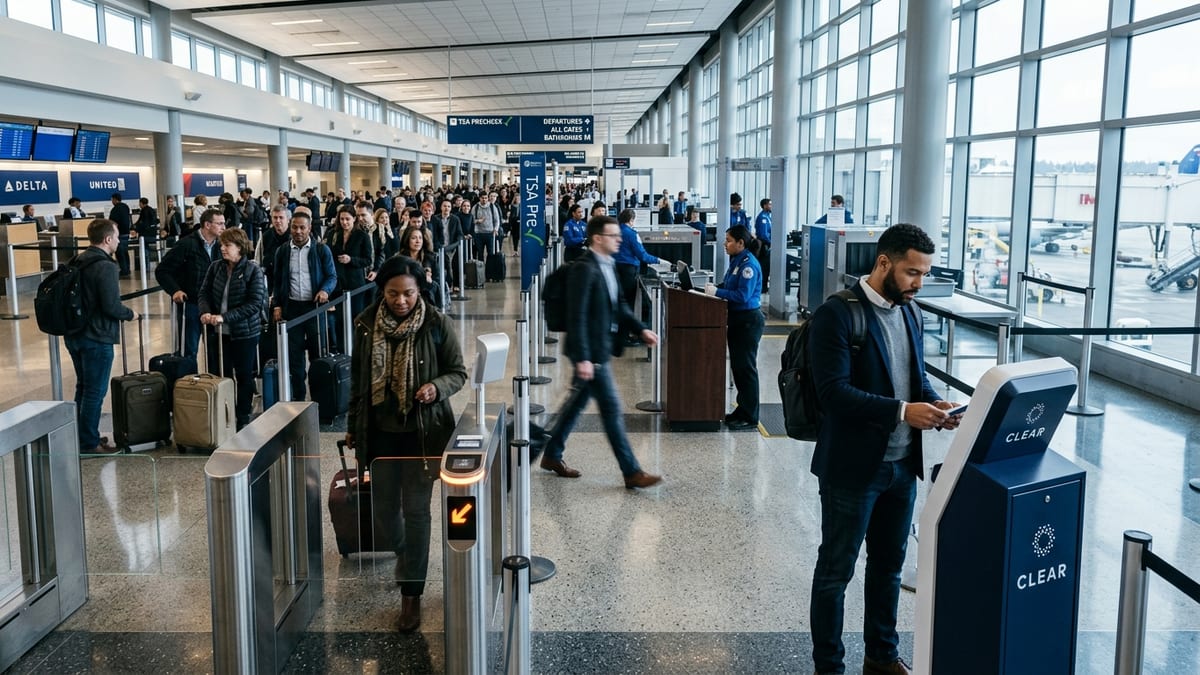
Across the United States, airport traffic has climbed back above pre‑pandemic levels, and in many hubs it has set new records. Travelers flying through airports such as Las Vegas, Houston or Atlanta in 2024 and early 2025 have routinely encountered snaking security lines that stretch deep into check‑in halls, particularly during Monday mornings and late‑afternoon bank departures. For frequent business travelers who may pass through the same airport dozens of times a year, that congestion is no longer an occasional nuisance but a recurring operational drag.
Security wait times have also become far less predictable. At some major airports, travelers report breezing through in ten minutes one week, then facing 45‑minute queues at the same time on the same route the next. This unpredictability forces business travelers to build in large buffers, which often translates to an extra hour or more at the airport that may or may not be needed. When multiplied across an entire sales team or consulting practice, that buffer time quickly becomes a noticeable cost.
These conditions help explain the rising popularity of fast‑track services such as CLEAR+, TSA PreCheck and various airline priority security lanes. Rather than simply hoping to hit a quiet time of day, travelers are increasingly willing to pay, or ask their employers to pay, for a more reliable and consistently faster experience. Even smaller airports have begun adding biometric lanes and identity‑verification technology to reduce bottlenecks, signaling that this is not only a big‑city problem.
At the same time, many travelers have grown more comfortable with digital identity tools in their daily lives, from smartphone facial recognition to app‑based ID checks. That shift lowers the psychological barrier to enrolling in services that use biometrics to speed up airport checkpoints. In this context, a partnership that bundles preferred pricing on multiple fast‑track options is arriving at a moment when both congestion and technology adoption are peaking.
What Perk’s partnership with CLEAR actually includes
Perk, formerly known as TravelPerk, positions itself as an AI‑native travel and spend management platform focused on automating the admin side of corporate travel. Its new partnership with CLEAR is described as an industry first because it makes Perk the first travel and spend platform to offer preferred partner pricing on three separate offerings: CLEAR+, CLEAR Concierge and TSA PreCheck. The intent is to give companies one place where they can both manage trip bookings and extend tangible time‑saving benefits to the travelers executing those trips.
For Perk customers, the practical starting point is CLEAR+ membership. CLEAR+ is CLEAR’s subscription service that lets members verify their identity using biometrics at dedicated CLEAR lanes in participating airports, then proceed directly to the screening area. The partnership means Perk’s corporate clients can offer their employees access to this network at a lower negotiated rate than the standard public price, and in some cases can integrate enrollment into their travel policy or onboarding workflows.
The collaboration also encompasses TSA PreCheck, which is the U.S. government’s trusted traveler program that speeds up the physical security screening process. CLEAR is now one of TSA’s official enrollment providers, which allows travelers to start or complete their TSA PreCheck application through CLEAR’s channels, including in some airport locations. For Perk users, the promise is a more streamlined path to combining CLEAR+ for identity verification with TSA PreCheck for faster checkpoint screening, arranged and subsidized by their employer rather than handled ad hoc by each traveler.
A more premium layer comes through CLEAR Concierge. This service offers a VIP‑style experience where a dedicated concierge meets travelers at the curb, helps with baggage and check‑in, escorts them through security using CLEAR’s lanes and then guides them to their gate or lounge. Under the Perk partnership, companies focused on senior executives, high‑value client travel or mission‑critical trips can use preferred pricing on CLEAR Concierge to create a door‑to‑gate experience that feels closer to a private terminal than a standard commercial departure, without building their own ground operations team.
How CLEAR fits into the airport journey
Understanding how this partnership changes the airport experience requires a clear view of where CLEAR actually sits in the security process. CLEAR+ focuses on the identity verification step. Instead of standing in the general TSA line, presenting a physical ID and boarding pass to an officer, CLEAR+ members use a dedicated lane where a CLEAR pod or eGate scans their boarding pass and confirms their identity with biometrics such as facial recognition. Once verified, they are directed to the front of the appropriate security lane.
By contrast, TSA PreCheck is about how you are screened, not how you are identified. Travelers who are approved for TSA PreCheck, typically for a five‑year membership period after a background check and interview, can use designated TSA PreCheck security lanes. In those lanes, most travelers can usually leave on shoes, belts and light jackets, and keep laptops and small liquids in their bags. This reduces the friction and time associated with the screening itself but does not eliminate the need to wait in line to reach the screening area.
When a traveler holds both CLEAR+ and TSA PreCheck, the two services complement each other. A typical journey might look like this: arriving at a large hub such as Denver or Atlanta during a busy morning bank, the traveler heads directly to the CLEAR+ lane, scans their boarding pass and confirms their identity at an eGate in seconds, then follows a CLEAR ambassador who guides them to the front of the TSA PreCheck lane. They then proceed through the easier screening process associated with PreCheck. In ideal conditions, the id‑check step might shrink to under a minute, while screening time also shortens, turning a potential 40‑minute queue into a sub‑10‑minute process.
CLEAR Concierge extends that journey further back toward the curb. Instead of juggling luggage, a mobile boarding pass and a phone full of work emails, a traveler is met outside the terminal by a concierge. That person helps with checking bags, navigates any airline counter interactions and then walks with the traveler through the CLEAR lanes and security, often finishing the handover at a lounge or gate. For a chief executive landing in an unfamiliar city for a packed day of meetings, this can remove not only time but also mental overhead from the travel day.
How CLEAR differs from TSA PreCheck
It is easy to conflate CLEAR and TSA PreCheck because both are framed around getting through security faster. In practice they solve different problems. CLEAR+ is a privately run service centered on biometric identity verification and line access, while TSA PreCheck is a government‑operated trusted traveler program that affects how your body and bags are screened at the checkpoint.
With CLEAR+, the core benefit is that you can bypass the standard ID‑check queue. At participating airports, you enter a marked CLEAR+ lane, scan your boarding pass and confirm your identity via face or fingerprint at a CLEAR kiosk or eGate. Instead of waiting your turn in the main line, you are then directed toward the front of whatever physical screening lane you are eligible to use, which might be the general lane or, if you have it, the TSA PreCheck lane.
TSA PreCheck on its own does not remove the need for an ID check or guarantee minimal wait times, especially at peak hours. What it does do is reduce the complexity of the screening process and, in many airports, provide a separate set of lanes that are typically shorter than the general queue. For a traveler who flies a few times a year, TSA PreCheck alone often represents a cost‑effective baseline improvement, particularly given that its fee covers a multi‑year membership term.
For heavy business travelers, the combination of CLEAR+ and TSA PreCheck is where the most dramatic time savings often appear. By pairing a faster, technology‑driven identity check with an expedited screening lane, the traveler gains more predictable door‑to‑gate timing across a range of airports. The Perk and CLEAR partnership essentially tries to make this combination more accessible at scale by letting companies buy into both sides of the equation through a single travel management platform and preferred partner rates.
Why business travelers care about saving time at airports
In Perk’s own annual travel disruption report, a large majority of surveyed business travelers said they experienced disruptions in the previous year, and a notable share believed those disruptions caused them to miss out on new business opportunities. Long, unpredictable security queues are one of the more visible contributors to that disruption, especially when they lead to missed connections, rushed arrivals or the need to book earlier, less convenient flights just to build in enough margin for security.
For a frequent traveler who flies twice a month, an extra 40 minutes per trip spent in security lines works out to roughly 16 hours a year lost purely to queueing. For road warriors flying weekly on busy routes such as New York to Los Angeles or Chicago to Dallas, the time cost can easily double or triple. Those hours are not simply personal inconvenience. They represent meetings that have to be rescheduled, calls that are cut short and preparation time for key client conversations that disappears into the maze of stanchions and scanners.
There is also a psychological dimension. Many executives report that the most stressful part of a trip is the window between arriving at the airport curb and clearing security. Concerns about traffic, ride‑hail delays or unexpectedly long queues add a layer of anxiety that can linger into the rest of the day. When travelers know they can usually move through the airport in a consistent, shortened timeframe by using services like CLEAR+ and TSA PreCheck, they are more likely to arrive at the gate in a focused, ready‑to‑work state rather than feeling rushed and depleted.
That helps explain why more companies now treat premium airport access as a legitimate business expense rather than a luxury. Just as it became normal for employers to pay for noise‑cancelling headphones or productivity apps, many now see value in investing in services that reclaim otherwise wasted airport time and reduce stress for their highest‑traveling employees.
The rise of premium airport experiences
What Perk and CLEAR are tapping into is a broader shift toward premiumized airport experiences that used to be reserved for celebrities or ultra‑high‑net‑worth travelers. Concierge offerings that provide curb‑to‑gate assistance, priority lines, lounge access and even tarmac transfers have proliferated in recent years. Some are run by airports themselves, others by airlines and a growing number by third‑party specialists that partner with corporations and travel agencies.
CLEAR Concierge is one example of this trend in a mainstream U.S. context. Rather than building a private terminal, it strives to deliver many of the same benefits inside the standard terminal environment. At a busy hub like New York LaGuardia on a stormy Thursday evening, that might take the form of a concierge who meets a traveling executive at the drop‑off zone, escorts them to an airline’s priority check‑in counter, navigates the CLEAR+ lane and then deposits them at a quiet lounge where they can catch up on email before boarding.
Other markets show similar patterns. In Europe and the Middle East, airport‑operated meet‑and‑assist services have become a standard upsell for premium cabin travelers, and private immigration channels have emerged at certain hubs. In the United States, airlines have leaned on services like priority check‑in lines, branded fast‑track lanes and enhanced lounge portfolios to differentiate their products. CLEAR’s expansion into arenas and stadiums indicates that friction‑reduction at entry points is becoming a recognizable premium feature well beyond aviation.
For business travelers, these services are shifting expectations. Once someone has experienced a smooth curb‑to‑gate escort on a complex trip, the contrast with a crowded, confusing, every‑traveler‑for‑themselves experience can be stark. As that contrast becomes more familiar, pressure grows on employers and travel managers to consider when and for whom premium airport experiences make sense, particularly for strategically important or time‑sensitive trips.
What travelers should realistically expect
Despite the marketing language around “breeze through security,” it is important to maintain realistic expectations about what services like CLEAR+ and TSA PreCheck can and cannot do. They reduce the time you spend in line and lower the friction of the screening process, but they do not guarantee a fixed door‑to‑gate duration. Staff shortages, equipment issues or extraordinary surges of travelers can still result in bottlenecks, and sometimes the dedicated lanes can attract so many users that they slow down relative to expectations.
Coverage is another factor. While CLEAR+ is present in dozens of major U.S. airports and is steadily expanding, it is not yet universal. Some mid‑sized or regional airports lack CLEAR lanes entirely, and even at airports that do have them, the lanes may be available only in certain terminals or at specific checkpoints. TSA PreCheck is more widely available but can still be closed during very early or late operating hours, forcing travelers into regular lanes regardless of membership.
Costs vary by program and by how a traveler accesses them. CLEAR+ is typically priced as an annual subscription, with optional add‑ons for family members, while TSA PreCheck charges a multi‑year enrollment fee. Corporate preferred pricing through platforms like Perk can meaningfully reduce those figures, particularly for organizations enrolling large cohorts of frequent travelers. Even then, travel managers need to weigh the cost against actual travel patterns, focusing on employees who regularly pass through congested hubs or who travel on tight, high‑stakes schedules.
Experiences also differ by airport layout and time of day. At a relatively quiet airport on a Tuesday afternoon, a traveler with no memberships may clear security just as quickly as someone using multiple fast‑track services. At a crowded coastal hub before a major holiday, the value of combining CLEAR+, TSA PreCheck and, perhaps, concierge support can be much more pronounced. The Perk and CLEAR partnership gives companies new tools, but it does not eliminate the need for thoughtful deployment.
The Takeaway
The partnership between Perk and CLEAR is about more than a discounted membership offer. It reflects a larger realignment in how companies view travel time, treating airports as a domain where technology and premium services can directly protect productivity and reduce friction. By bundling CLEAR+, CLEAR Concierge and TSA PreCheck access into the fabric of a travel and spend management platform, Perk is helping normalize the idea that moving through the airport quickly is a business outcome worth planning for.
For business travelers, the most important question is not whether a particular press release sounds impressive but whether their own day‑to‑day experience changes. In the best cases, this kind of partnership means fewer anxious glances at the clock in a slowly moving line, more calm minutes to prepare for a meeting at the gate and a smoother overall journey between home and client. It does not remove every uncertainty, and it will not be necessary for every traveler, but it adds meaningful options at a time when U.S. airport congestion is unlikely to fade.
Looking ahead, airport access services are likely to become even more integrated with corporate travel strategies. As biometric identity systems mature and concierge‑style offerings spread, travelers can expect a more tiered landscape where basic access remains as it is today while a growing slice of business trips benefit from orchestrated, fast‑track journeys. The Perk and CLEAR collaboration is one sign that the race to reclaim airport time has moved from the fringes of travel hacking into the mainstream of business travel planning.
FAQ
Q1. Does CLEAR replace TSA PreCheck for faster security?
CLEAR does not replace TSA PreCheck. CLEAR+ is designed to speed up the identity verification step by letting you use biometrics in a dedicated lane instead of waiting in the regular ID‑check queue. TSA PreCheck focuses on how your bags and body are screened, usually allowing you to leave on shoes and light jackets and keep electronics in your bag. For the fastest experience, many frequent travelers use both together, with CLEAR+ getting them to the front of the line and TSA PreCheck making the screening itself quicker and easier.
Q2. Which U.S. airports support CLEAR+ and how do I check?
CLEAR+ is available in dozens of major U.S. airports, including large hubs like Atlanta, Denver, Los Angeles, New York, Dallas and others, as well as a growing number of mid‑sized fields. However, it is not yet present in every airport, and in some locations it operates only in specific terminals or checkpoints. Travelers should always check current airport coverage on CLEAR’s official channels before relying on it for a tight connection or early‑morning departure, particularly when flying from secondary or regional airports.
Q3. Can international travelers use CLEAR and TSA PreCheck?
CLEAR+ membership is available to eligible travelers from multiple countries who meet CLEAR’s enrollment requirements and can provide the necessary identification at sign‑up. TSA PreCheck is run by the U.S. Transportation Security Administration and is primarily aimed at U.S. citizens and lawful permanent residents, with a limited set of foreign partner programs. International business travelers who frequently fly to, from or within the United States sometimes pair CLEAR+ with other trusted traveler schemes such as Global Entry, which speeds up re‑entry into the country while TSA PreCheck and CLEAR+ address outbound security at participating airports.
Q4. How does CLEAR Concierge work in practice on a busy travel day?
CLEAR Concierge is a premium service that extends CLEAR’s role beyond the checkpoint. On a typical trip, a traveler books the service in advance through CLEAR, often with costs supported by their employer for senior staff or high‑priority journeys. On the day of travel, a concierge meets them at the curb, helps with baggage and check‑in, then escorts them through CLEAR+ lanes and security before guiding them to a lounge or gate. For example, a chief financial officer flying from Boston to San Francisco for a one‑day board meeting could use CLEAR Concierge to minimize time spent navigating a crowded terminal and maximize time spent preparing for the session.
Q5. How do Perk customers actually access preferred pricing on CLEAR services?
Perk’s partnership with CLEAR is structured so that companies using Perk can unlock preferred partner pricing for CLEAR+, CLEAR Concierge and TSA PreCheck enrollment through their travel and spend platform. In practice, that might mean that eligible employees see CLEAR offers inside the corporate booking tool or receive enrollment invitations tied to their corporate email accounts. Finance and travel managers can then decide which traveler groups should receive which benefits, align costs with budgets and track uptake and usage as part of their broader travel program analytics.
Q6. Is CLEAR+ worth it if I already have TSA PreCheck through my employer?
For some travelers, TSA PreCheck alone will be sufficient, especially if they typically fly at off‑peak times or through less congested airports. CLEAR+ tends to add the most value for frequent travelers who depart from busy hubs during rush periods, such as Monday mornings or Thursday evenings, when the ID‑check line itself can stretch for 30 minutes or more. In those scenarios, combining CLEAR+ with TSA PreCheck often provides a noticeably smoother experience, and corporate preferred pricing through Perk can make the incremental cost easier to justify.
Q7. Do CLEAR and TSA PreCheck guarantee I will never miss a flight?
No airport fast‑track service can offer a guarantee against missed flights. Severe weather, security incidents, staffing shortages and airline operational issues can all cause delays that are outside the control of CLEAR, TSA or your travel management platform. What CLEAR+ and TSA PreCheck can do is significantly reduce one important variable, the time it typically takes to move from the terminal entrance to the secure side. That reduction makes it easier to plan realistic arrival times and gives travelers more margin when other parts of the journey start to slip.
Q8. How does privacy work with CLEAR’s biometric identity system?
CLEAR positions itself as a secure identity company and emphasizes that members remain in control of their information, with biometric data used to verify identity rather than to track travel patterns for resale. The company states that it does not sell biometric or sensitive personal data, and its systems are subject to both internal controls and external oversight. That said, any biometric service requires a level of trust in the provider, so companies and individual travelers should understand enrollment terms and weigh the privacy trade‑offs against the time saved at the airport.
Q9. Will fast‑track services still help if my home airport is relatively small?
At smaller airports, security wait times can fluctuate sharply depending on staffing and traffic, sometimes moving from near‑zero to unexpectedly long queues after a single delayed departure dump of passengers. CLEAR+ and TSA PreCheck can still provide benefits in those environments, particularly on peak days or when only a limited number of lanes are open. However, the absolute time savings may be smaller than at a major hub, so travel managers might prioritize these services for travelers who frequently connect through large, congested airports even if their home base is relatively quiet.
Q10. How should companies decide which employees receive CLEAR and concierge benefits?
Many organizations start by looking at travel frequency and trip criticality. Employees who fly at least monthly through busy airports, or who regularly undertake trips where a missed meeting would carry a high revenue or reputational cost, are often the first candidates for CLEAR+ and concierge services funded by the company. Using a platform like Perk, travel managers can analyze booking data, identify traveler segments with the highest disruption exposure and then roll out benefits gradually, measuring whether on‑time arrival rates and traveler satisfaction scores improve as fast‑track access expands.