


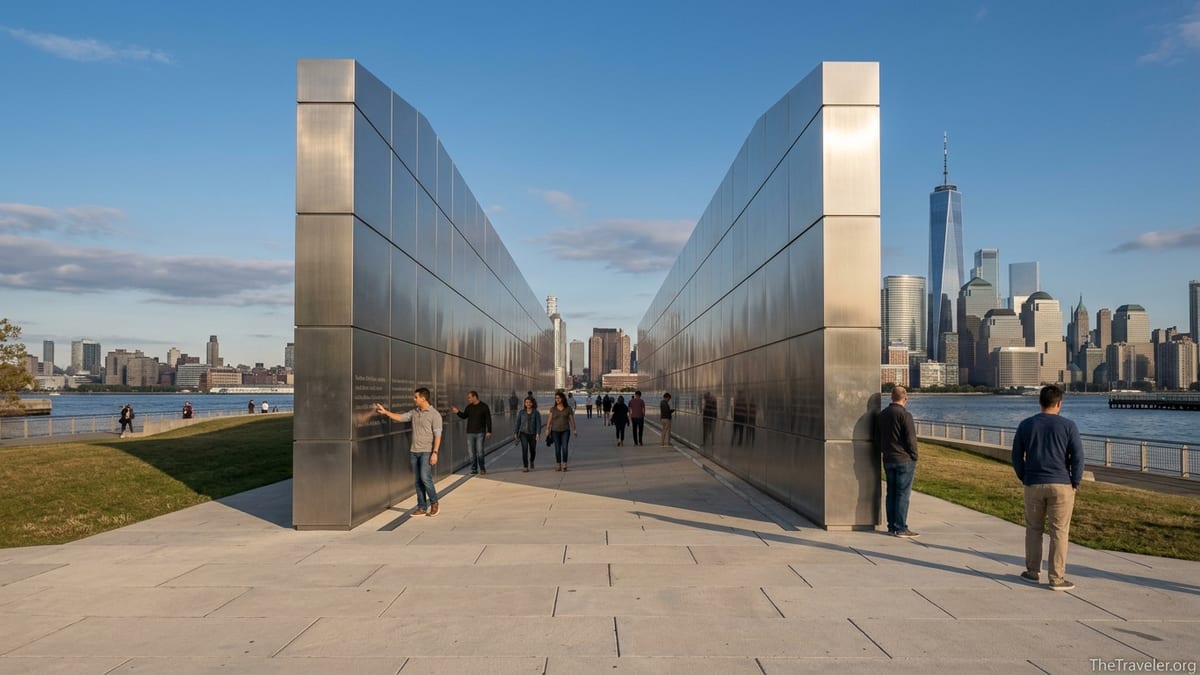
Stand in the stone plaza at Liberty State Park in Jersey City and the noise of New York Harbor falls away. Ahead, two stainless steel walls stretch toward the Hudson River like a corridor of light, perfectly framing the gap in the Lower Manhattan skyline where the Twin Towers once stood. This is Empty Sky, New Jersey’s official 9/11 memorial, and its design manages to tell a powerful story without saying much at all.
Get the latest updates straight to your inbox!
A Memorial Written in Space and Light
Empty Sky is easy to describe in physical terms: two parallel walls, each about 210 feet long and 30 feet high, set 12 feet apart. They rise from an earthen mound on the edge of Liberty State Park, directly aligned with the former footprints of the Twin Towers across the Hudson River. From the moment you step into the corridor, however, the project stops feeling like an object and starts feeling like an experience. The space itself becomes the language.
The designers, architects Jessica Jamroz and the late Frederic Schwartz, resisted the urge to overload visitors with words or iconography. There are no large interpretive panels describing the events of September 11, 2001. Instead, the memorial relies on perspective, reflection, and the New York skyline to communicate loss. As you walk between the walls, your eye is drawn forward to the place where the Twin Towers once rose, now an absence that is as eloquent as any statue or inscription.
On a clear afternoon, sunlight bounces off the brushed stainless steel, turning the corridor into a muted mirror of sky and water. On overcast days, the walls dull to a somber gray, echoing the mood of the weather. In the early evening, as office lights begin to blink on in Lower Manhattan and ferries trace lines of white foam across the river, the memorial quietly shifts again. Each visit reads differently, yet the structure says the same simple thing: look here, to what is no longer there.
This is not a memorial you simply look at from the outside. The power of Empty Sky lies in the act of moving through it. Travelers walking from the Liberty State Park parking area or light rail station often approach casually, chatting or checking their phones. By the time they reach the midpoint of the corridor, the tone usually changes. Conversations drop, footsteps slow, and people instinctively turn toward the skyline. The design has done its work without a single spoken word.
Names at Eye Level: Making Loss Personal
While the form of Empty Sky speaks in broad strokes about absence and the changed skyline, its inscriptions bring the story down to the human scale. The memorial honors 749 New Jersey residents who died in the attacks at the World Trade Center, the Pentagon, and in Shanksville, Pennsylvania. Their names are etched into the stainless steel panels at eye level, running along both interior walls of the corridor so visitors encounter them at arm’s reach rather than overhead or underfoot.
For travelers, this detail can be unexpectedly powerful. Many first-time visitors arrive from Manhattan by ferry, perhaps after a morning at the Statue of Liberty and Ellis Island. The trip across the water, often under open sky, feels almost festive. Then they turn onto the short path toward Empty Sky and find themselves inches away from rows of names, each cut cleanly into metal that reflects their own face. It is common to see people trace the letters with their fingers, or pause when they recognize a familiar surname that could easily belong to a neighbor or colleague.
The decision to list the names without elaborate biographical details keeps the focus on presence rather than narrative. There are no job titles, no references to where each person worked, and no explanation of how they died. Instead, the uniform lettering underscores that each life carried equal weight. Families sometimes visit carrying small bouquets from local florists in Jersey City or nearby Bayonne, tucking flowers into the narrow ledge at the base of the wall or laying them gently on the plaza stones. The otherwise spare surface of the memorial briefly fills with color, a reminder that each line of text represents someone once vividly alive.
If you visit on or near September 11, you may encounter relatives and friends attending the state’s annual ceremony at the memorial. Folding chairs are set up along the plaza, and the names are read aloud against the backdrop of the skyline. For the rest of the year, Empty Sky remains largely unprogrammed. It simply waits, allowing individual encounters between visitor and name to unfold quietly and on personal terms.
Aligned With an Absence: How the Skyline Becomes the Story
What makes Empty Sky unusual among 9/11 memorials is the way it enlists the city itself as part of the storytelling. The walls are positioned so that if you stand at the western entrance, looking east down the corridor, your line of sight runs straight to the void where the Twin Towers once rose. That vanished vertical pair is now replaced by a horizontal gesture on the New Jersey side of the river, mirroring their original width and spacing in plan.
For travelers familiar with Lower Manhattan’s current landmarks, the effect is easy to grasp. One World Trade Center’s glass spire rises off to the right of the corridor’s central axis, while the memorial frames the open air where its predecessors stood. In photos taken from the western end of Empty Sky, the walls function like a camera viewfinder: the city is still there, bustling and bright, but something essential is missing from the frame. Even visitors too young to remember 2001 find themselves instinctively trying to picture what used to fill that gap.
The alignment is deliberate but understated. There are no arrows on the ground or plaques explaining where to stand. Instead, the memorial relies on the natural curiosity of visitors walking toward the water. Couples out for an evening stroll, runners finishing a loop through Liberty State Park, and families who have just returned from the Statue of Liberty ferries all tend to drift to the centerline of the corridor, where the view “clicks” into place. The moment is quiet, but it lingers.
This partnership between built form and urban panorama means the memorial is never entirely complete or static. As Lower Manhattan continues to evolve, with new towers rising at the World Trade Center site and along the waterfront, Empty Sky keeps framing that change. Travelers who return years later often comment on how the same corridor now contains a different skyline, yet the absence it points to remains freshly legible.
Silence as a Design Material
Many public memorials rely on dense text, figurative sculptures, or multimedia displays to explain what happened and how visitors should feel. Empty Sky takes the opposite approach. Beyond the names and a small inscription marking it as New Jersey’s 9/11 memorial, it offers almost no verbal guidance. Instead, it uses silence, scale, and sensory cues as primary materials.
The approach along the low grassy berm is intentionally unremarkable. There are no grand staircases or triumphal arches. You simply walk up a gentle incline from the park’s paved paths or from the nearby parking lot, pass a stand of trees, and suddenly encounter the mirrored walls cresting over the hill. The simplicity of the approach makes the transition into the corridor feel more pronounced. Sound from the adjacent bikeway and picnic areas falls away, replaced by the rhythm of footsteps on concrete and the occasional echo of a voice.
For travelers, this quiet can be as striking as the architecture. Many people approach with cameras in hand, intent on capturing the skyline view. After a few steps between the walls, they lower the lens and just look. Parents shepherding children from the Liberty Science Center or the historic Central Railroad of New Jersey Terminal often soften their tone, answering questions in hushed voices. School groups from across New Jersey and neighboring states visit during the academic year; even middle-schoolers, who normally buzz with chatter, tend to quiet down without being asked.
The design does not avoid beauty, but it uses it carefully. Reflections ripple softly across the steel, catching clouds, gulls, and passing ferries. In winter, snow collects along the base of the walls, brightening the corridor; in summer, the metal warms under the sun, and the breeze off the river brings salt and diesel on the air. None of this is scripted, yet all of it contributes to an atmosphere that invites contemplation. The story the memorial tells is layered into these everyday details rather than spelled out in text.
A Place in the Life of Liberty State Park
Liberty State Park is one of the region’s most practical and heavily used green spaces, a reality that shapes how travelers encounter Empty Sky. On any given weekend, joggers loop along the waterfront, families spread picnic blankets near the playgrounds, and visitors line up at the ferry terminal for trips to the Statue of Liberty and Ellis Island. Food trucks park near the main lots when weather allows, selling everything from empanadas to ice cream. The memorial occupies a quieter northern section of the park, but it remains woven into this everyday activity.
For many road trippers or day-trippers from elsewhere in New Jersey and Pennsylvania, a visit to Empty Sky fits naturally into a broader Liberty State Park itinerary. Travelers might start with a morning boat tour to Liberty Island, then return in the afternoon to stroll along the Hudson River walkway. From there, it is a short walk past the marina and historic rail terminal to the memorial. Parking near the waterfront is typically fee-based during busy seasons, with rates that are modest by metro New York standards, and there is usually enough turnover for visitors willing to circle the lots for a few minutes.
Public transit users often arrive via the Hudson-Bergen Light Rail to Liberty State Park station, then walk or bike the roughly 15 to 20 minutes across the park. Rental bikes and scooters are not always guaranteed on-site, so many travelers bring their own or use bike-share options from Jersey City and pedal along the dedicated paths. Approaching Empty Sky this way, with the skyline gradually opening up in front of you, can heighten the sense of arrival.
Because the memorial is open-air and part of a state park, there is no admission fee and no ticketing system. Visitors can wander in at sunrise, when joggers have the place almost to themselves, or arrive shortly before sunset, when photographers cluster along the plaza capturing the sky turning gold behind the Manhattan towers. This accessibility ensures that Empty Sky functions not only as a ceremonial space on anniversaries, but as a daily site of reflection for commuters, local residents, and travelers passing through.
Visiting Tips: When the Design Speaks Loudest
While Empty Sky is open year-round during general park hours, certain times of day can deepen the experience of its design. Early morning visits, particularly on clear spring and autumn days, tend to be quiet and cool. The low angle of the sun strikes the eastern ends of the walls and picks up the faint textures of the brushed steel, while the riverfront paths remain largely empty. Travelers who arrive for first ferries to the Statue of Liberty sometimes detour here first, lingering for ten minutes before joining the day’s sightseeing.
Late afternoon and early evening create a different kind of drama. As sun sets behind New Jersey, the memorial walls slip into shadow while the Manhattan skyline across the river glows in warm light. Office windows reflect pink and orange hues, and boats returning to slip at the Liberty Landing Marina cut through the water in front of the corridor’s opening. On clear evenings, photographers carrying mid-range DSLR or mirrorless cameras often set up just outside the western end of the memorial, using 24–70 mm lenses to frame the entire corridor and skyline in a single shot.
Weather also shapes the narrative. On foggy or rainy days, the city may all but disappear, leaving the walls to reflect only shifting shades of gray. Travelers who come prepared with umbrellas and waterproof jackets find themselves in a nearly monochrome world where the etched names stand out more starkly. Snowfall, when it occurs, muffles sound across the entire park and makes the corridor feel even more isolated from the ferry horns and highway traffic in the distance.
Whatever time you choose, it is worth planning for a short pause before and after your walk through the corridor. Many visitors sit on the low walls of the earthen berm or stand along the edge of the plaza, looking back at where they just walked. Parents with school-age children often use these moments to talk about what the kids learned earlier at the National September 11 Memorial in Manhattan, connecting the two experiences. The design of Empty Sky, so economical on words, leaves room for these personal conversations.
Reading the Memorial’s Subtle Imperfections
More than two decades after the attacks, Empty Sky carries not just the weight of memory but also the realities of weather, maintenance, and public use. Frequent temperature swings along the Hudson, combined with the salt air, have begun to leave their mark on the exposed concrete and steel. Local news outlets have reported concerns from families and designers about sections of weathered material and out-of-service electronic kiosks that once helped visitors locate specific names.
For travelers, these subtle signs of aging can read in different ways. Some visitors see in the small stains and scuffs a reminder that memory is a living, imperfect process, constantly exposed to the elements of daily life. Others find that such wear underscores the need for continued stewardship and investment, particularly when compared to the meticulously maintained memorials at Ground Zero across the river. What is clear on the ground is that people still come: joggers slow to walk through the corridor, office workers on lunch breaks stand quietly by the names, and families bring children to learn a chapter of recent history.
Occasionally, Empty Sky also surfaces in community debates about how Liberty State Park should balance commemoration with recreation and development. Advocates emphasize the importance of preserving unobstructed views of the skyline and ensuring that any new amenities respect the memorial’s sightlines and atmosphere. Travelers may witness these tensions in small ways, such as temporary fences for construction or signage directing visitors along alternative paths. Even these practical adjustments become part of the evolving story that Empty Sky quietly frames.
In this sense, the memorial is both a finished work of design and an ongoing civic conversation. Its core message, delivered through axis, space, and reflection, remains clear. Yet the environment around it shifts with policy decisions, park improvements, and changing public attention. Visitors encountering Empty Sky today are seeing not only an elegant piece of architecture, but also a barometer of how one state continues to live with and interpret the events of September 11.
The Takeaway
Empty Sky does not try to compete with the scale or complexity of the memorials at Ground Zero. It speaks more softly, using two walls, a corridor of air, and a carefully chosen vantage point to translate an unimaginable event into a walkable, human experience. For travelers, it offers a chance to step back from the density of Lower Manhattan and see the story of 9/11 written across an entire skyline.
In an era when public spaces are often crowded with signage, interactive displays, and constant commentary, Empty Sky’s restraint feels almost radical. It trusts visitors to bring their own questions and emotions, providing only a frame, a view, and the names of those lost. Whether you come as part of a day exploring Liberty State Park or make a deliberate journey across the river to see it, the memorial rewards unhurried attention.
Walk through the corridor once, turn, and walk it again. Notice how your eye moves, how the reflections shift, how your own silhouette briefly shares space with the etched names. The design is doing its work, telling a story that spans a state, a river, and a city, without ever needing to raise its voice.
FAQ
Q1. Where is the Empty Sky Memorial located?
Empty Sky stands inside Liberty State Park in Jersey City, New Jersey, near the Hudson River waterfront with a direct view across to Lower Manhattan.
Q2. How much does it cost to visit the Empty Sky Memorial?
There is no admission fee to visit Empty Sky. It is part of a public state park, so you only need to budget for parking or transit to reach the site.
Q3. What is the best time of day to visit for photography?
Late afternoon into sunset often provides the most striking light, with the memorial in soft shadow and the Manhattan skyline glowing in warm colors behind it.
Q4. How long should travelers plan to spend at the memorial?
Most visitors spend 20 to 40 minutes walking through the corridor, reading names, and taking in the view, though some stay longer to sit and reflect.
Q5. Is the memorial suitable for children and school visits?
Yes. Many families and school groups visit. The simple design and visible skyline help adults explain the events of 9/11 in age-appropriate ways.
Q6. Can I combine a visit to Empty Sky with a Statue of Liberty trip?
Absolutely. The memorial is a short walk from the Liberty State Park ferry terminal, so many travelers visit before or after Statue of Liberty and Ellis Island tours.
Q7. Are there specific rules visitors should follow at the memorial?
Empty Sky is a place of remembrance, so quiet behavior, respectful photography, and not climbing on the walls or touching names aggressively are all expected.
Q8. Is the Empty Sky Memorial accessible to visitors with mobility challenges?
The approach paths and corridor are gently sloped and paved, making the memorial accessible for wheelchairs, mobility aids, and strollers in most conditions.
Q9. Do I need a guide to understand the memorial’s design?
No guide is required. The memorial is intentionally minimal; simply walking through the corridor and looking toward the skyline reveals its core meaning.
Q10. Is it appropriate to take photos or selfies at the memorial?
Photography is allowed, and many visitors take photos, but it is best to do so quietly, avoid blocking others, and remain mindful that this is a place of mourning.