


I thought I knew the story of September 11. I had watched the documentaries, read the headlines every anniversary, stood silently during moments of remembrance. But it was not until I walked through the Empty Sky Memorial in New Jersey’s Liberty State Park, facing the gap where the Twin Towers once stood, that the loss of 9/11 stopped being history and began to feel achingly personal.
Get the latest updates straight to your inbox!
Arriving at Liberty State Park: A Quiet Approach to Ground Zero
The journey to Empty Sky begins quietly. Liberty State Park stretches out along the Hudson River in Jersey City, a wide sweep of lawns, jogging paths, and families pushing strollers past views of Lower Manhattan and the Statue of Liberty. On a clear day you see glass towers glittering on the far shore, Staten Island ferries cutting white wakes through the water, and the delicate outline of One World Trade Center catching the light. It looks like any thriving city skyline until you notice what is not there.
Most visitors come by car, pulling into the large parking areas that fan out from the historic Central Railroad of New Jersey Terminal. On a weekend, you may pay a modest day rate at the meters and follow the paved path toward the waterfront. The memorial does not dominate the park at first. You pass playgrounds, picnickers with coolers, cyclists ringing their bells, and couples lining up for the ferry rides out to Ellis Island and Liberty Island. Then, as the crowds thin and the river comes closer, two long, silver walls appear ahead, cutting a sharp line into the sky.
For travelers used to the bustle of Lower Manhattan’s National September 11 Memorial & Museum, the approach here feels different. There are no ticket booths, no timed entries, no security checkpoints. Empty Sky is part of the everyday fabric of the park. Joggers drift in and out, a wedding party might pose on the grass nearby, and yet there is a distinct hush as you step off the main path and face the memorial itself. The scale of what you are about to walk into does not fully register until you stand directly in front of it.
First Sight of Empty Sky: Two Walls and a Void
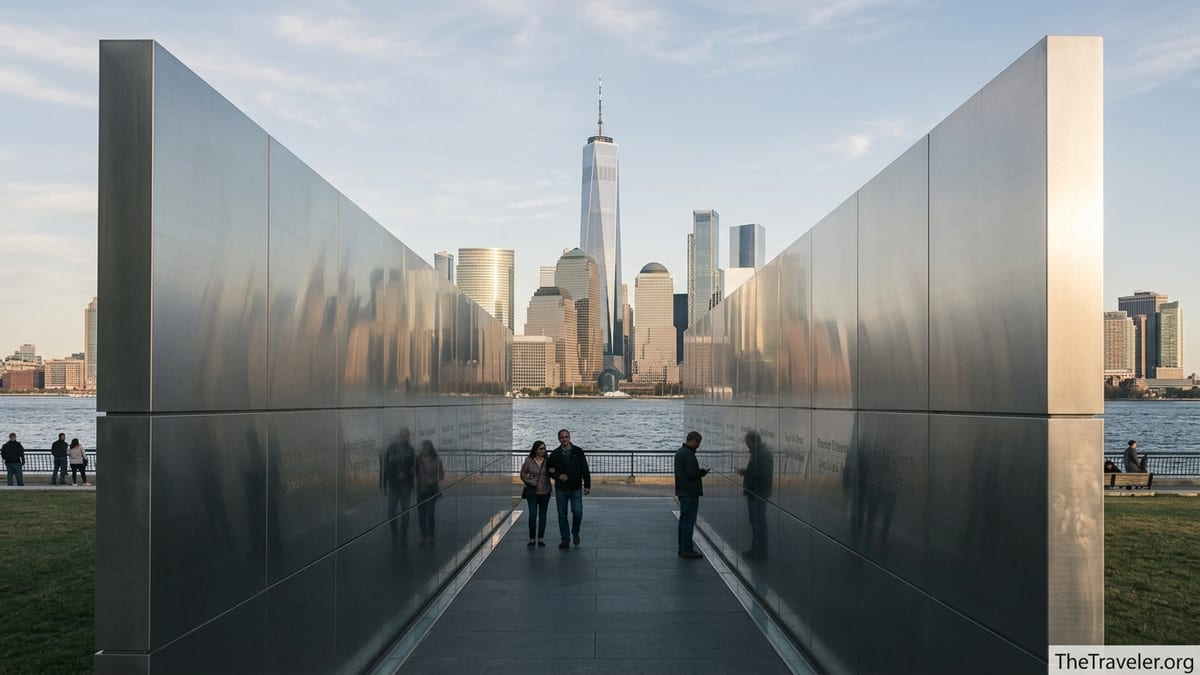
Empty Sky is New Jersey’s official 9/11 memorial, dedicated to the hundreds of residents of the state who were killed in the attacks. It consists of two parallel stainless steel walls that rise about 30 feet and stretch the length of a fallen Twin Tower, creating a corridor that points your gaze directly across the Hudson River to the former site of the World Trade Center. Where the towers once stood, there is now a carefully framed gap in the Manhattan skyline, a literal empty sky that gives the memorial its name.
From a distance, the structure can seem almost abstract, like a minimalist sculpture planted in the grass. Up close, the brushed metal panels catch everything around them. Morning runners appear and disappear in the reflections. The river shimmers in distorted bands of light. Passing clouds streak themselves across the steel. You see yourself too, smaller than you expect, surrounded by names cut into the surface. The design is deceptively simple: two walls, one corridor, one view. Yet the geometry pulls you forward, inviting you to step into the space between past and present.
Standing at the threshold, the sounds of the park fade. The chatter of kids on bikes and the distant hum of car traffic soften against the flat planes of metal. In their place you hear wind moving through the corridor and the muffled slap of footsteps on the concrete. At busy times, you might share the space with families carrying flowers, people in business clothes on their lunch break, or visitors from abroad quietly tracing letters in the steel. Even when it is crowded, the memorial carves out a narrow pocket of stillness.
Reading the Names: Strangers Who Stop Feeling Like Strangers
Names are what shift Empty Sky from impressive architecture to something far more intimate. At eye level along both walls, the brushed steel gives way to darker panels etched with the names of New Jersey’s victims of 9/11. There is no hierarchy in their arrangement. Executives appear beside receptionists, firefighters beside financial analysts, passengers beside waitstaff. You do not see job titles or ages. You see first names and last names, sometimes a middle initial, sometimes a familiar nickname in quotation marks that hints at an entire life behind it.
What surprised me most was how quickly strangers on a wall began to feel like people I might have known. A row of Italian surnames reads like a Little Italy block transplanted into metal. Irish names recall corner bars and firehouses across the Hudson. You notice a cluster of Spanish and Portuguese names and can almost hear the languages that once filled Newark living rooms and Jersey City kitchens. Some visitors arrive with printouts or phone screenshots, searching deliberately for a particular father, sister, neighbor, or colleague. Others wander, reading names until one stops them cold because it echoes a friend back home or an uncle they lost for entirely different reasons.
The act of reading here is physical. The letters are cut deeply enough that you can slide your fingers into the grooves. People lean in to take paper rubbings, pressing souvenir brochures or plain white printer sheets against the metal and shading the names into being with pencil or crayon. Children ask quietly why there are so many. Parents fumble for explanations, pointing across the river. More than any statistic or documentary, standing shoulder to shoulder with these names, palms resting on cold steel, makes the scale of the loss tangible.
Turning Toward Manhattan: The Moment It Becomes Personal
Walk halfway down the corridor and turn your body toward the opening. The perspective lines of the walls rush together ahead of you, like standing on train tracks that converge at a single point in the distance. That vanishing point is Lower Manhattan. One World Trade Center rises in the center, sharp and glassy. Around it cluster newer towers and older brick buildings. But in the slice of sky framed by the memorial, you cannot help but imagine the absent shapes of the Twin Towers. Your eyes fill in their outline without meaning to.
This is the moment the abstraction of “Ground Zero” disappears. The view makes clear that on the morning of September 11, 2001, many people in New Jersey watched events unfold almost in real time from this shoreline. Commuters standing on the very promenade outside the memorial would have seen the smoke, then the fire, then the unimaginable collapse. Empty Sky fixes you in that line of sight. Even if you were thousands of miles away that day, or not yet born, you briefly inhabit the vantage point of those who stood here and could do nothing but watch.
For travelers from abroad, this can be a sobering revelation. Many have only known New York City in its post-9/11 form, defined by Broadway shows, trendy Brooklyn neighborhoods, and social media images of the new World Trade Center. At Liberty State Park, with no crowds rushing you along, you have time to imagine a different skyline and a different morning. The loss stops belonging only to news archives in New York or Washington and becomes something that affected specific families in Hoboken, Bayonne, Montclair, and countless other towns whose commuters filled those towers daily.
Small Human Rituals: How Visitors Grieve in Public
Despite its stark geometry, the Empty Sky Memorial is filled with small human gestures. On any given day you might find bouquets wedged gently into the base of the walls, photographs in plastic sleeves taped near a name, or tiny stones carefully balanced along the panels in the Jewish tradition of honoring the dead. In late afternoon, when the sun dips low over New Jersey, these offerings cast long shadows that cross the path like quiet footnotes to the official design.
Anniversary dates bring fuller rituals. On or around September 11, local families and state officials gather here for ceremonies that often include reading the names out loud, moments of silence timed to the impact and collapse of the towers, and the distant glow of the Tribute in Light rising from Lower Manhattan. Travelers who visit on those dates sometimes stumble into the events by accident, dressed for a casual waterfront stroll and suddenly surrounded by people carrying framed portraits and tissues. If you happen to be there, it is worth stopping, even at the edge of the crowd, to witness how communities continue to remember decades later.
On an ordinary weekday, however, the memorial functions as a shared but deeply personal space. Office workers from nearby Jersey City towers may walk over at lunchtime, coffee in hand, and spend five quiet minutes in the corridor before returning to their desks. A tourist in shorts and camera gear might stand frozen at the far end, lens forgotten, simply looking across the water. Parents murmur brief explanations to curious children, then allow the silence to stretch. Everyone seems to find their own small ritual, whether it is reading every name on one panel or standing in the center and closing their eyes.
Planning Your Own Visit: Practical Tips for Travelers
Because Empty Sky sits inside Liberty State Park rather than in a dense commercial district, a visit requires a bit of planning. Many people staying in Manhattan reach it by taking public transit to Jersey City and then a short ride share or walk, depending on the station. Others drive from elsewhere in New Jersey, using the park’s sizable surface lots that typically charge for daytime parking during peak seasons. On warm weekends, arrive earlier in the day to avoid competition for spaces with ferry passengers headed to the Statue of Liberty and Ellis Island.
The memorial is open during normal park hours, which generally cover daylight from early morning to evening. There are no admission fees, no timed tickets, and no guided tours required. This makes Empty Sky an accessible stop to fold into a broader day exploring the region. Families often combine time at the memorial with a picnic on the lawns, letting kids run off steam at the playgrounds before or after a quieter visit. Photographers may want to time their arrival for late afternoon or golden hour, when the stainless steel walls catch warm light and the Manhattan skyline glows orange and pink.
Weather shapes the experience more than you might expect. On crystal clear days, the view to Lower Manhattan is sharp and almost unreal in its clarity, making the “empty sky” effect especially striking. On foggy or rainy days, the towers of downtown dissolve into mist and the memorial feels more introspective, the reflections on the metal shifting into muted gray bands. Bring a light jacket in shoulder seasons; winds off the Hudson can feel cooler at the waterfront than temperatures inland suggest. Comfortable walking shoes are essential, as you may find yourself wandering the promenade long after you planned to leave.
Connecting Empty Sky to Other 9/11 Sites
For many travelers, Empty Sky is part of a broader journey through 9/11 memorial spaces around New York and New Jersey. Some begin at the National September 11 Memorial & Museum in Lower Manhattan, where the enormous reflecting pools sit in the exact footprints of the Twin Towers and exhibits dive deep into the chronology of the attacks. Later, crossing the Hudson to Liberty State Park offers a different angle: instead of standing on the site itself, you are positioned in the line of sight of those who watched from afar, with the river acting as both barrier and bridge between experiences.
Within New Jersey, a string of other memorials line the Hudson River waterfront, each with its own character. In nearby Weehawken, a waterfront memorial incorporates steel trident fragments from the original World Trade Center. Further south in Bayonne, a towering sculpture known as “To the Struggle Against World Terrorism” rises at the end of a former military pier, its vertical form pierced by a teardrop-shaped void. Smaller town memorials dot suburban plazas, firehouse lawns, and local parks, often featuring plaques with a handful of names, bronze statues of firefighters, or simple granite stones bearing the date.
Visiting several of these sites in one trip can be emotionally demanding but also illuminating. You begin to see how a single event radiated outward into countless local stories. Empty Sky, with its corridor of names and carefully framed skyline, ties these threads together. It is grand enough to feel like a state memorial yet still intimate enough that you can stand inches from each engraved name, hearing your own footsteps echo off the steel.
The Takeaway
Standing inside the Empty Sky corridor, you realize how easily history can harden into abstraction. Dates become shorthand, and phrases like “never forget” risk sliding into routine. Yet the physicality of this place pushes back. The cold of the stainless steel under your fingertips, the wind funneled through the narrow passage, the relentless presence of the Manhattan skyline beyond the opening: all of it insists that the lives remembered here belonged to ordinary people who woke up expecting an ordinary day.
For travelers accustomed to checking off attractions on a list, Empty Sky offers something different. It is not about views alone, though the panorama of New York Harbor is spectacular. It is about pausing long enough for someone else’s story to brush against your own. Even if you have no direct connection to anyone named on the walls, you may find yourself imagining who they were, what trains they took, which coffee carts they favored, how many times they had stood on this very shoreline. In that imagining, the loss of 9/11 stops being distant and becomes, for a brief and humbling moment, deeply personal.
FAQ
Q1. What is the Empty Sky Memorial?
Empty Sky is New Jersey’s official September 11 memorial, located in Liberty State Park in Jersey City. It consists of two long stainless steel walls engraved with the names of the state’s victims and aligned to face the former World Trade Center site across the Hudson River.
Q2. Where exactly is Empty Sky and how do I get there?
The memorial stands on the waterfront inside Liberty State Park in Jersey City. Visitors typically reach it by driving and parking in the park’s lots or by using public transit to Jersey City and then taking a short ride share or walk to the park entrance.
Q3. Is there an admission fee or ticket required?
No. Empty Sky is part of Liberty State Park and is free to visit. There are no tickets, security checkpoints, or set tour times, though you may need to pay for parking during the day.
Q4. How long should I plan to spend at the memorial?
Most visitors spend between 20 minutes and an hour at Empty Sky. Allow extra time to walk the surrounding promenade, take in the views of Manhattan and the Statue of Liberty, and reflect quietly if the memorial moves you.
Q5. When is the best time of day to visit?
Late afternoon and early evening often provide the most atmospheric experience, with warm light reflecting off the stainless steel walls and the Manhattan skyline glowing in the distance. Morning visits tend to be quieter and less crowded.
Q6. Can I visit Empty Sky and the Statue of Liberty in the same day?
Yes. Ferries to the Statue of Liberty and Ellis Island depart from nearby within Liberty State Park, making it easy to combine a stop at Empty Sky with a visit to those landmarks if you plan your timing carefully.
Q7. Is photography allowed at the memorial?
Photography is allowed and common, but visitors are encouraged to be respectful. Many people are there to remember loved ones, so avoid loud conversations, staged photo shoots directly in front of names, or blocking others’ access to the walls.
Q8. Are there specific remembrance events held at Empty Sky?
On or around September 11 each year, New Jersey officials, families of victims, and community members gather for ceremonies that typically include reading names, moments of silence, and other tributes. Details vary by year, so check local listings if you hope to attend.
Q9. Is the memorial accessible for visitors with mobility challenges?
Yes. The approach to Empty Sky is via paved paths, and the corridor between the walls is level, making it accessible for wheelchairs, strollers, and visitors with limited mobility. Nearby park facilities also include accessible restrooms during operating hours.
Q10. How does Empty Sky differ from the 9/11 Memorial in Lower Manhattan?
The memorial in Lower Manhattan sits on the original World Trade Center site and includes large reflecting pools and a museum, often with significant crowds and security. Empty Sky, across the river in New Jersey, offers a quieter, more contemplative experience that frames the skyline and focuses on New Jersey’s victims, allowing the loss of 9/11 to be felt from a more personal, local perspective.