


I thought I knew Florence’s Duomo before I ever set foot inside the Opera del Duomo Museum. Like many visitors, I had a mental postcard: Brunelleschi’s red-brick dome rising over terracotta roofs, crowds circling the cathedral, and a quick photo stop at the Baptistery doors. But one unhurried morning in the Museo dell’Opera del Duomo quietly rewired that image. Instead of a single monument, the cathedral complex became a centuries-long project shaped by rival artists, engineering experiments, floods, and even today’s ticketing decisions. If you are planning to visit Florence’s Duomo, the museum is not a side dish. It is the key that changes how everything else tastes.
Get the latest updates straight to your inbox!
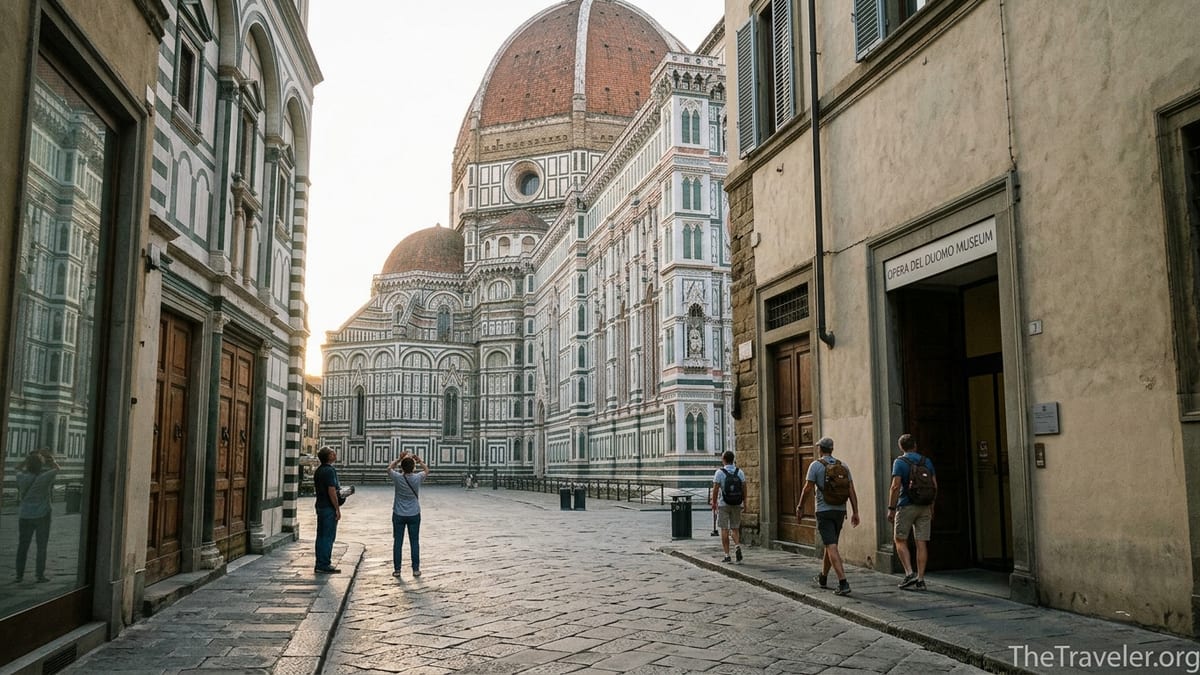
From Postcard Monument to Worksite in Progress
The Opera del Duomo Museum sits directly behind the cathedral, on Via della Canonica, in the very building where the “Opera” or cathedral works office once managed the construction of Santa Maria del Fiore. Walking through its doors feels less like entering a gallery and more like stepping into the backstage area of a theater you thought you knew from the audience. According to the museum’s own description, it preserves original artworks from over seven centuries tied to the cathedral, Baptistery, and bell tower, gathered from facades, altars, and niches that are now seen only in reproduction outside.
This context matters when you step back out into Piazza del Duomo. Most first-timers queue for a selfie with the Baptistery’s gleaming reliefs or the cathedral’s marble front without realizing that much of what they admire is modern replacement. The museum carefully explains why vulnerable masterpieces, especially bronze reliefs and marble saints, have been moved inside to climate-controlled rooms. It was not simply to charge a ticket, but to save works that were corroding in the open air and threatened by pollution and floods like the devastating Arno flood of 1966.
Seeing the Duomo after the museum visit, you start to notice which sculptures are copies and which niches now stand empty. You understand that Brunelleschi’s dome is only one episode in a long story that begins with medieval masons and continues with modern conservators, curators, and even ticket managers trying to balance access and preservation.
The Hall of the Old Facade: A Lost Cathedral Rebuilt Indoors
The museum’s showstopper is the vast Hall of the Old Facade, a light-filled space where the demolished 14th-century front of the cathedral has been reconstructed at full scale. Architects rebuilt this lost facade using surviving fragments, archival drawings, and dozens of original sculptures by Arnolfo di Cambio and his workshop, many dating to the early 1300s. On the opposite side, the hall displays the original bronze Baptistery doors, turning the room into a kind of indoor piazza that compresses centuries of change into one glance.
Standing here, Florence’s cathedral stops being a fixed image and becomes a palimpsest. The marble faces of prophets and saints that once looked down over medieval processions now stand almost at eye level. You can lean close and see shallow chisel marks, weather-pitted surfaces, and even early attempts at perspective carving. Where outside, on the current 19th-century facade, figures read as decorative texture, in the museum they reappear as individual artworks with biographies and authorship.
The impact is practical as well as emotional. Later, when you are back in the square, you can pick out what belongs to that older facade and what is a 19th-century Neo-Gothic invention. Travelers often talk about how Rome teaches you to read layers of history in a single wall. This hall does something similar for Florence in one clean, comprehensible space.
Seeing the Real “Gates of Paradise” Up Close
Nowhere is the gap between outside spectacle and inside reality starker than with the Baptistery doors. Tour groups bunch around the east entrance of the Baptistery to photograph what they think are Lorenzo Ghiberti’s 15th-century “Gates of Paradise,” the nickname Michelangelo supposedly gave to these exquisitely detailed bronze panels. In fact, those outdoor doors are modern replicas. The fragile, restored originals were removed to protect them from weather and pollution and now live inside the Opera del Duomo Museum in controlled conditions.
In the museum, the doors are displayed almost at ground level, behind glass, with gentle, even lighting. Instead of craning your neck from across a busy square, you can stand a meter away and follow the narrative threads: Abraham poised to sacrifice Isaac, Joseph sold into slavery, crowds carved so delicately that individual curls and garments feel almost like wax modeling. You see how Ghiberti experimented with depth, pushing some figures forward in high relief and sinking others into shallow space to suggest distance, a sculptural counterpart to what painters were doing with linear perspective.
This changes the Baptistery outside into something like an architectural mount for a masterpiece you know in detail. When you later glance at the copies in the piazza, you are no longer just snapping a pretty door. You are remembering the thousands of work hours invested in minute repoussé work and gilding, and the decades-long competitions and commissions that helped launch the Florentine Renaissance.
Michelangelo’s Restless Pietà and Donatello’s Radical Saints
For many visitors, the surprise emotional core of the museum is not the spectacle of the facade hall but a quiet room where Michelangelo’s so-called “Florence Pietà,” also known as the Bandini Pietà or Deposition, is displayed. He began this work around 1550, originally intending it, scholars believe, for his own tomb. The aging artist carved a knot of figures: Christ supported by Nicodemus (whose face may be a self-portrait), Mary Magdalene, and the Virgin. Frustrated with the marble, he reportedly struck and partially broke the sculpture; it was later repaired and finished by another sculptor. Today it stands in the museum, scarred but powerful.
Seeing this Pietà partway through a day of Renaissance sightseeing shifts your perspective on Michelangelo. Here is not the confident hero of the Sistine ceiling or the giant David, but an older man wrestling with stone and mortality. The museum’s interpretation notes emphasize that this work was once meant to stand inside the Duomo, which casts the cathedral not only as a civic icon but as a deeply personal spiritual space for one of its greatest artists. When you eventually enter the cathedral nave, you may remember that it once nearly housed a work carved for its maker’s own burial.
Elsewhere in the museum, Donatello appears not as a name you recite in an art-history list, but as a genuinely unsettling sculptor. His wooden Mary Magdalene, often dating to the 1450s, is all gaunt cheeks, tangled hair, and eroded paint, a far cry from the smooth, idealized saints on souvenir postcards. Nearby reliefs and cantorias (singing galleries) connect his career to the cathedral’s musical life. By the time you see other Donatellos around Florence, from the Bargello to Orsanmichele, you will likely read them less as isolated masterpieces and more as parts of a wider conversation centered on this complex.
How the New Pass System Reorders a Visit
The museum today is woven into a ticketing structure that shapes how you experience the entire cathedral complex. As of mid 2026, the Opera di Santa Maria del Fiore sells timed “passes” rather than individual tickets for each monument. Options such as the Brunelleschi Pass, Giotto Pass, and Ghiberti Pass bundle combinations of the Dome climb, Giotto’s bell tower, Baptistery, crypt of Santa Reparata, cathedral floor access, and the Opera del Duomo Museum itself, generally valid over three consecutive days.
Prices vary slightly over time, but for planning purposes you can expect a comprehensive pass that includes the dome climb to run somewhere in the range of a substantial museum ticket in a major European city per adult, while a pass without climbs is typically somewhat cheaper. These passes must be purchased with a specific date, and climbs require a fixed time slot that can sell out days or weeks ahead in peak months. The museum and Baptistery, however, usually do not require an advance time slot, which makes them flexible anchors around a pre-booked climb.
For many travelers, this structure nudges the museum from optional add-on to built-in stop. If you buy, for example, a non-climb pass that includes the museum, Baptistery, and crypt, it makes sense to give each its due rather than rushing through the complex in a single afternoon. A practical approach is to dedicate one morning entirely to the museum and Baptistery, then visit the cathedral interior and crypt the next day, perhaps before or after a bell tower or dome climb depending on your pass.
This slower rhythm is precisely what allows the museum to reframe the rest. Travelers who start here report that when they later stand in the long security queue snaking toward the cathedral entrance, they spend less time wondering if the wait is “worth it” and more time noticing details they learned about in the museum: the switch from the old to the new facade, the placement of specific reliefs, the way the dome’s brickwork interlocks at crazy angles overhead.
Designing a Museum-First Duomo Day
Choosing when to visit the Opera del Duomo Museum can change the tone of your time in the square. Opening hours can vary slightly by season, but in recent years the museum has generally opened in the later morning and closed in the early evening, with the important exception that it is closed on the first Tuesday of every month. Always double-check times just before your trip, especially if you are visiting around holidays. Planning around this closure is essential if you have a short stay.
An effective itinerary is to reserve an early climb for the dome or Giotto’s bell tower on one day, then schedule the museum for late morning the same day. Begin with a quick espresso at a bar just off the main square to avoid tourist markups, then enter the museum when it still feels calm. Many visitors report that arriving around opening time means walking into nearly silent galleries, particularly outside the peak summer season. Spending 90 to 120 minutes inside gives you enough time to absorb the main halls without museum fatigue.
After the museum, stepping into the Baptistery is like walking into a three-dimensional footnote. You will recognize subjects from the doors in the narrative mosaics overhead and see how the building’s octagonal plan relates to the cathedral’s orientation. Break for lunch at a trattoria a few streets away rather than in the tight ring of piazza cafes, where prices tend to spike. In the afternoon, return for your reserved climb or the crypt of Santa Reparata, now equipped with a mental map of how those spaces evolved.
This chain of experiences, starting with the museum, transforms the Duomo from an isolated “must-see” into a narrative thread you follow across 24 or 48 hours. Small choices, such as buying your pass only from the official channels, protecting a museum morning from over-scheduling, and treating the complex as a set of related spaces rather than a series of lines to beat, all build on what you learned inside those quiet galleries.
Practical Details: Tickets, Crowds, and Expectations
In practical terms, visiting the Opera del Duomo Museum is easier than many of Florence’s blockbuster sights. While Brunelleschi’s dome and the bell tower routinely sell out or involve substantial queues, the museum remains comparatively uncrowded, especially early in the day or in the late afternoon. Even during busy months, you are more likely to find room to linger in front of Ghiberti’s doors here than to carve out personal space in the cathedral nave.
Because there is currently no widely available museum-only ticket sold at the official level, you will almost certainly access it via one of the passes. Factor that into your budget as part of the overall cathedral experience, not as a separate museum fee. Third-party vendors sometimes bundle Duomo passes into “skip-the-line” packages at a markup; in practice, all legitimate passes issued through authorized channels allow you to bypass the ticket office but not routine security lines. Buying straight from official sources, either online in advance or at the authorized ticket office near the cathedral, is usually the simplest and most transparent option.
Plan for moderate climate control inside the museum. It is comfortably cool in summer, making it an excellent refuge during midday heat when queues in the sun around the cathedral can feel punishing. Bags are inspected but generally allowed inside if reasonably sized; professional tripods and bulky equipment may be restricted, and flash photography is typically discouraged or banned to protect sensitive works. Dress codes are more relaxed than in the cathedral itself, though conservative attire is still wise if you plan to head into the church or Baptistery afterward.
Setting expectations also matters. If you arrive expecting another Uffizi, you may be surprised by how tightly the collection focuses on a single religious complex. There are no sweeping landscapes or mythological nudes here, but instead pulpits, choir lofts, crucifixes, and liturgical objects. The payoff is depth rather than breadth. By the time you have studied a few reliefs and models closely, you may feel that you know this one corner of Florence more intimately than if you had raced through three different museums in a single day.
The Takeaway
Visiting the Opera del Duomo Museum before or alongside Florence’s cathedral complex changes the hierarchy of your trip. The Duomo stops being a monument you conquer by climbing to the top of the dome and becomes a long collaborative project between architects, sculptors, patrons, and restorers. Ghiberti’s “Gates of Paradise” shift from background for a selfie to a set of narratives you have traced panel by panel. Michelangelo and Donatello re-emerge not as isolated geniuses but as working artists grappling with specific commissions for a specific sacred space.
In an age of checklist travel, this shift is more than aesthetic. It encourages you to spend time where most people do not: in the museum’s quiet halls; in front of a weathered prophet from the old facade; tracing the faint toolmarks on a marble relief. Later, when you join the crowds on the piazza or on the dome’s narrow stairs, you may find that your experience feels strangely more personal, not less. Florence’s cathedral complex will still be one of the busiest places you visit in Italy, but after the Opera del Duomo Museum, it will also be one of the most intelligible.
If your schedule in Florence is tight, it may be tempting to skip the museum in favor of a dome climb or a rushed cathedral interior visit. Yet travelers who have made room for it often say it was the moment when the Duomo stopped being anonymous stone and started to feel like a story they could tell. For a place this iconic, that is perhaps the most unexpected change of all.
FAQ
Q1. Do I need a separate ticket for the Opera del Duomo Museum?
The museum is accessed through the same multi-site passes used for the cathedral complex, rather than a widely available standalone ticket. Expect to choose among several pass types that bundle the museum with other sites like the Baptistery, crypt, dome, or bell tower.
Q2. How much time should I plan for the museum?
Most visitors are well served by 90 minutes to two hours. If you enjoy reading detailed labels or sketching, you could easily spend longer, but an unhurried visit focusing on the facade hall, Baptistery doors, and Michelangelo’s Pietà fits comfortably into a morning.
Q3. Is it better to visit the museum before or after the cathedral and dome?
Visiting the museum first usually makes the rest of the complex more meaningful. You will recognize sculptures and decorative schemes later in the cathedral, Baptistery, and on the dome, and you will better understand what is original and what is a later copy or reconstruction.
Q4. Are the Baptistery doors outside the originals?
No. The outdoor doors on the Baptistery are high-quality replicas. The restored originals, including the famous “Gates of Paradise,” are displayed inside the Opera del Duomo Museum in controlled conditions where you can see their details up close.
Q5. Is the museum suitable for children or non-art lovers?
Yes, with the right pace. The reconstructed facade hall feels like walking into a giant stage set and tends to impress even those who are not usually museum enthusiasts. Parents can focus on a few highlights rather than trying to cover every room.
Q6. When is the museum closed?
Opening hours can vary by season, but a key point is that the Opera del Duomo Museum is generally closed on the first Tuesday of each month for maintenance. Always confirm current hours shortly before your visit, especially around holidays.
Q7. Is the museum accessible for visitors with limited mobility?
The museum’s modern renovation included elevators and ramps, and it is significantly more accessible than the dome or bell tower climbs. Visitors who use wheelchairs or avoid stairs typically find this one of the easiest parts of the cathedral complex to explore.
Q8. Can I take photos inside the museum?
Non-flash photography for personal use is generally allowed, though rules can change and specific works may have restrictions. Tripods, flashes, and professional lighting equipment are usually prohibited to protect the artworks and avoid disturbing other visitors.
Q9. Does the museum have audio guides or tours in English?
Audio guides and guided tours in multiple languages, including English, are often available for an additional fee. Tour operators in Florence also run small-group or private visits that include the museum as part of a broader Duomo itinerary.
Q10. Is it worth visiting the museum if I am already seeing the Uffizi and Accademia?
Yes. The Opera del Duomo Museum has a very specific focus: artworks made for the cathedral complex itself. Rather than repeating what you see in larger galleries, it gives you the missing context that ties the Duomo, Baptistery, and bell tower together into a single, understandable story.