


In a city overflowing with world class museums, the Opera del Duomo Museum in Florence quietly does something unusual. Instead of presenting Renaissance masterpieces in isolation, it gathers the original sculptures, reliefs and tools created for the Cathedral complex and puts them back into dialogue with the Duomo, the Baptistery and Giotto’s bell tower just outside its doors. For many travelers it ends up being the missing piece that makes the whole Piazza del Duomo finally make sense.
Get the latest updates straight to your inbox!
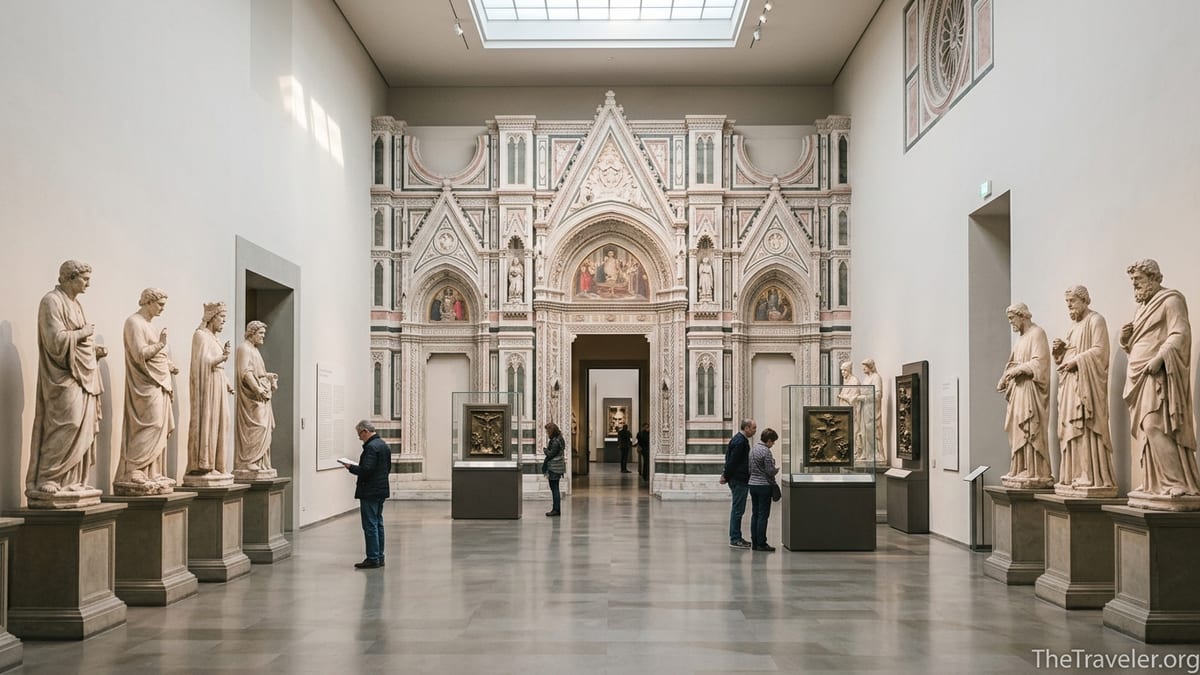
The Museum That Explains the Duomo Itself
Most visitors first encounter Florence’s Duomo as a façade: the colored marble, the queue for the dome climb, the crush of people in Piazza del Duomo. The Opera del Duomo Museum, located just behind the cathedral, is where that façade becomes a story. It is run by the Opera di Santa Maria del Fiore, the same institution that has overseen the cathedral and its works since the Middle Ages, and its entire collection is drawn from the buildings you see in the square outside.
Unlike the Uffizi, which spans centuries of European painting, or the Accademia, focused on Michelangelo and a handful of Florentine masters, this museum has a sharply defined mission: to explain how the Duomo complex was built, decorated and experienced over seven centuries. The panels, scale models and archival materials are not side notes; they are central to the visit. Travelers who arrive with only a vague idea of Brunelleschi’s dome or the Baptistery doors often leave feeling they understand how the whole ensemble fits together.
In practical terms, this makes the museum an ideal first or last stop on a Duomo day. Many travelers visit in the morning, using a combined Duomo ticket that covers the dome, bell tower, Baptistery, crypt and the museum, typically valid for several days. Others come later, after their dome climb or Baptistery visit, to see the originals of what they have just admired in situ. Either way, the museum turns what can feel like a checklist of monuments into a coherent narrative.
Home to Masterpieces You Only See Copies Of Outside
One of the most striking differences between the Opera del Duomo Museum and other Florentine museums is the way it handles originals versus copies. Because the Duomo complex is exposed to weather and pollution, many sculptures and reliefs have been removed from the exterior over the past century and replaced with replicas. The museum is where the originals now live, in a carefully controlled climate that keeps marble and bronze from deteriorating.
The clearest example is the enormous reconstruction of the cathedral’s medieval façade in the museum’s main hall. For centuries, that façade was thought lost, until 19th century demolitions and archival research allowed historians to reimagine its appearance. Inside the museum, the façade has been rebuilt at full scale, lined with the original sculptures by artists such as Arnolfo di Cambio that once watched over the square. When visitors stand in the hall and then step back outside into Piazza del Duomo, they can suddenly visualize how dramatically the cathedral’s face has changed over time.
The same is true of Lorenzo Ghiberti’s Baptistery doors. Outside, you will likely see crowds clustering around the so called Gates of Paradise on the Baptistery’s eastern side. These, however, are modern copies. The museum displays the meticulously restored bronze originals, their gilding brought back to something close to the luminous sheen 15th century Florentines would have known. Standing a meter away from the panel showing the story of Isaac, travelers can examine details that are almost impossible to appreciate from ground level in the piazza.
Other star works have also migrated from the open air or from dim corners of the cathedral interior. Donatello’s haunting wooden Penitent Magdalene and his dramatic bronze reliefs for the bell tower are now among the museum’s highlights, displayed with controlled lighting that picks up the grain of the wood and the depth of the bronze casting. In contrast, at the Bargello Museum Donatello’s David and other sculptures appear in a broader survey of Renaissance sculpture; at the Opera del Duomo Museum, his work is always tied back to a particular chapel, bell tower niche or liturgical use.
Brunelleschi’s Dome, From Idea to Engineering Feat
Florence’s most recognizable silhouette is Brunelleschi’s dome. At most museums you see it only in paintings or skyline views; at the Opera del Duomo Museum you come face to face with the very models, tools and technical drawings that allowed the dome to rise above the city in the 15th century. This is one of the museum’s most distinctive contributions, and it sets it apart from art focused collections like the Uffizi or Pitti Palace.
Travelers often remark on the full scale wooden models and brick samples that show how Brunelleschi experimented with a double shell structure and herringbone brick pattern to span the cathedral without traditional wooden centering. In one room you can stand beside a surviving wooden model, roughly human height, that Brunelleschi presented to the cathedral wardens to explain his radical proposal. Nearby, original hoisting devices and iron chains demonstrate the sheer mechanical ingenuity required to lift tons of stone and brick nearly 100 meters into the air.
For visitors who have just climbed the dome, these displays provide a satisfying “behind the scenes” look. The sloping inner corridors that felt so claustrophobic during the ascent suddenly make sense when you see cross section diagrams and scale cutaways in the museum. In this way the Opera del Duomo Museum functions as a kind of on site interpretation center for one of the most important feats of Renaissance engineering, a perspective you will not find in more traditional painting galleries elsewhere in Florence.
Families and travelers without a deep background in art history often find these engineering exhibits more approachable than long sequences of altarpieces. Instead of abstract theory, they are confronted with very tangible questions: how do you lift a stone block, how do you keep a dome from collapsing, how does an architect convince skeptical patrons to back a risky plan. It is a side of the Renaissance that many visitors do not encounter at larger, more crowded museums.
A Quieter, More Manageable Alternative to Florence’s Big Hitters
Florence’s blockbuster museums are extraordinary, but they can also be exhausting. The Uffizi routinely books out days in advance in high season, with timed entry and security queues that can stretch along the Arno. The Accademia, home of Michelangelo’s David, often requires timed reservations and still feels packed at peak hours. By contrast, the Opera del Duomo Museum, while popular, generally offers a calmer experience with more breathable galleries and shorter waits, especially outside the very busiest summer weeks.
The combined ticket for the Duomo complex, which includes the museum, is typically priced in the range of a mid tier museum visit in Florence, and is valid for multiple days, so you are not forced to cram all the Duomo sites into a single afternoon. Visitors can, for example, climb the dome on one morning, visit the Baptistery and crypt another, and keep the museum for a quieter late afternoon when feet are tired and the thought of crossing the river to the Pitti or hiking up to San Miniato feels like too much.
Inside, wide ramps and elevators in key areas make the museum more accessible than some older institutions housed in medieval palaces with steep, uneven staircases. Travelers who have struggled with the long corridors and smaller elevators of the Uffizi or Pitti Palace often comment on how straightforward navigation feels here. The galleries are laid out as a chronological and thematic path, and clear signage in Italian and English helps orient you at each stage.
Because the museum is focused on a single monumental complex, the visit time is also more flexible. While you could easily spend half a day here if you pore over every panel, many travelers find that 90 minutes to two hours gives them a satisfying overview. That makes it far easier to fit into a short Florence stay than, for instance, the Uffizi, where a properly paced visit can easily fill a morning and early afternoon.
Context, Not Just Masterpieces: How the Museum Tells Florence’s Story
Another element that distinguishes the Opera del Duomo Museum is its insistence on context. The displays constantly link art objects to real historical events and religious practices. A relief is not simply labeled “marble, 15th century” but is explained as part of a cancelled façade program, a sculptural contest between rival workshops or a liturgical furnishing that guided how worshipers moved through the space.
For example, the rooms devoted to the medieval and early Renaissance decoration of the Baptistery show how the bronze doors were part of a broader civic project to assert Florence’s wealth and piety. Visitors see preparatory drawings, wax models and small bronze test castings that reveal the competitive tender process in which artists like Ghiberti and Brunelleschi participated. These displays connect directly to the civic politics of the time, when guilds financed the doors and used them to proclaim their importance in a city based on trade.
Later galleries trace how the cathedral interior changed as Florence’s role in Italy evolved. When the city briefly served as capital of a newly unified Italy in the 19th century, a new façade was finally completed after centuries of debate. The museum presents period photographs, plaster models and political cartoons that show how controversial these choices were. Unlike the more generalized narrative of “Medici Florence” that you might encounter at the Pitti Palace, here the focus stays tightly on how one sacred complex adapted to shifting historical needs.
This emphasis on context makes the museum especially rewarding for travelers who want to go beyond “art for art’s sake.” Teachers bringing students, families traveling with teenagers and independent travelers who like to understand the bigger story behind what they see often find that the Opera del Duomo Museum gives them language and reference points that enrich the rest of their time in Florence. After a visit here, even a simple walk around the cathedral exterior becomes a kind of open air classroom.
Comparing the Opera del Duomo Museum to Other Florence Museums
Because Florence has an unusually dense museum landscape, it helps to think concretely about how the Opera del Duomo Museum compares to other famous institutions. The Uffizi is fundamentally a painting gallery, focused on masterpieces by Botticelli, Leonardo, Raphael and Titian. Its rooms can feel overwhelming to travelers who are not already deeply invested in Renaissance painting. The Accademia is compact but even more single minded, with most visitors there for one reason: Michelangelo’s David, flanked by unfinished slaves.
The Bargello, housed in a former government palace, offers an extraordinary survey of Renaissance sculpture, including Donatello’s David, works by Verrocchio and Michelangelo’s early pieces. However, its collection is drawn from many churches and palaces and is presented as an art historical sequence. The Pitti Palace across the river is about dynastic opulence as much as art. Visitors spend as much time gawking at stucco ceilings, silk wall coverings and royal apartments as they do at the paintings themselves.
In this company, the Opera del Duomo Museum fills a different niche. It is not about presenting “the best of everything” but about going deep into one architectural complex. The same names appear on the labels Ghiberti, Donatello, Michelangelo, Brunelleschi but always in relation to a specific chapel, door or façade. For a traveler with only two or three museum slots in a short Florence stay, one smart strategy is to pair the Uffizi with either the Opera del Duomo Museum or the Bargello, rather than trying to see both the Accademia and Pitti on a rushed schedule.
In terms of atmosphere, many visitors report that the Opera del Duomo Museum feels less pressured than the Uffizi. There are no long bottlenecks at a single painting, few tour groups blocking a whole room for extended lectures, and more space to step back from a work and see it properly. Photography rules are clearly posted but generally more relaxed than in smaller church museums, which can make it easier to bring home reference shots of details that caught your eye.
Planning a Visit: Tickets, Timing and Practical Tips
Most travelers encounter the Opera del Duomo Museum as part of a combined ticket for the Duomo complex. Current passes tend to bundle the cathedral’s dome climb, Giotto’s bell tower, the Baptistery, the crypt of Santa Reparata and the museum into a ticket valid for several days from first use. Prices change periodically, but they are broadly comparable to other major Florence museum admissions, with discounts often available for children and students. Because dome climb slots can sell out in high season, it is wise to buy the pass online in advance for popular months like May through September and during major holidays.
The museum itself typically opens in the morning and runs into the early evening, although exact hours vary slightly by season and special closure. As a rule of thumb, last entry is usually set about 45 minutes before closing time, giving visitors time for at least a quick circuit. Compared with the cathedral, which has services and liturgical events that can close it without much notice, the museum tends to keep more stable hours, making it a reliable anchor for planning your day even when schedules at other sites shift.
In terms of timing, late afternoon often proves ideal. Many day trippers have left by then, and those who reserved early dome climbs or bell tower entries are usually resting or at dinner. Arriving around 4 pm allows plenty of time for a visit even in shorter winter opening hours, and it positions you to exit around golden hour, when the marble of the Duomo and Baptistery glows warmly in the slanting light. On very hot summer days, the museum’s air conditioned galleries can also offer welcome relief after time in the open piazza.
Because the museum has several levels and expansive halls, comfortable footwear is recommended, though the walking is far less demanding than a dome or bell tower climb. Audio guides and printed materials are typically available at the entrance, and labels include English, which helps those who might struggle in more traditional Italian only church museums. Combining the museum visit with a coffee or gelato on a quieter side street just east of the cathedral can also give you a mental break from the constant crowds in the square.
The Takeaway
For travelers deciding how to allocate limited time in Florence, the Opera del Duomo Museum often flies under the radar compared with marquee names like the Uffizi or Accademia. Yet it offers something these bigger institutions do not: an intimate, carefully curated insight into how Florence’s most famous landmark was imagined, engineered and decorated over seven centuries. It is where the familiar postcard view of the Duomo turns into a layered story of competition, devotion and civic pride.
By housing the original Baptistery doors, façade sculptures and key works by Donatello, Ghiberti and Michelangelo in conditions that allow close, unhurried viewing, the museum bridges the gap between the crowded piazza and the scholarly monograph. Its focus on Brunelleschi’s dome as both artistic and engineering marvel reveals a side of the Renaissance that appeals as much to design and architecture enthusiasts as to art lovers.
Set against Florence’s wider museum scene, the Opera del Duomo Museum stands out for its clarity of purpose, manageable scale and direct connection to the buildings that dominate the city’s skyline. Whether you visit before or after climbing the dome, it is the place where scattered impressions from the square outside come together. For many visitors, it quietly becomes one of the most memorable museum experiences in Florence.
FAQ
Q1. How much time should I plan for the Opera del Duomo Museum?
Most visitors find that 90 minutes to two hours is enough for a rewarding visit, though enthusiasts of architecture or sculpture could easily stay longer, especially in the main hall with the reconstructed façade and the galleries on Brunelleschi’s dome.
Q2. Is the Opera del Duomo Museum suitable for children and teens?
Yes. The life sized models, visible tools and clear explanations of how the dome was built often appeal to children and teenagers more than long rows of paintings. Families can turn the visit into a puzzle about how people in the 1400s managed such a huge engineering challenge.
Q3. Should I visit the museum before or after climbing the dome?
Both orders work, but many travelers enjoy visiting the museum after the dome climb. Seeing the models and tools makes sense of the narrow passageways and double shell structure they have just walked through, turning a physical experience into a story they can visualize.
Q4. Do I need a separate ticket for the museum?
The museum is usually included in combined passes sold for the Duomo complex, which also cover the dome, bell tower, Baptistery and crypt over several days. It is rarely sold as a completely standalone ticket, so most visitors access it with one of these multi site passes.
Q5. How does the Opera del Duomo Museum compare to the Uffizi for a short visit?
The Uffizi is larger, busier and focused on painting, while the Opera del Duomo Museum is more compact, quieter and centered on sculpture, architecture and the Duomo’s history. Travelers with limited time often find the Opera del Duomo Museum easier to absorb in a single visit.
Q6. Are the Baptistery doors I see outside the originals?
No. The bronze doors on the Baptistery in the piazza are high quality copies. The fully restored originals, including the famous Gates of Paradise, are displayed inside the Opera del Duomo Museum, where you can stand close enough to examine individual figures and details.
Q7. Is the museum accessible for visitors with limited mobility?
The museum layout includes elevators and ramps that make the major galleries reachable for visitors with limited mobility, and the walking demands are far lighter than those of the dome or bell tower climbs. It is generally considered one of the more accessible major sites in the Duomo complex.
Q8. Can I see works by famous artists like Donatello and Michelangelo here?
Yes. The museum houses important works by Donatello, including the Penitent Magdalene, and a late Michelangelo Pietà that he initially intended for his own tomb, along with sculptures and reliefs by Ghiberti and other key Renaissance artists tied to the cathedral.
Q9. What is the best time of day to visit to avoid crowds?
Late afternoon is often a good choice, when day trip groups have thinned out and those with early dome or bell tower reservations have moved on. Weekdays outside peak summer and major holidays also tend to be quieter than Saturdays and Sundays.
Q10. Is the Opera del Duomo Museum worth visiting if I am not an art expert?
Yes. The museum is designed to be understandable without specialist knowledge, emphasizing stories, engineering solutions and the human effort behind the Duomo rather than only stylistic analysis. Many visitors who feel overwhelmed in large galleries find it one of the most approachable museums in Florence.