


The Opera del Duomo Museum in Florence is one of Italy’s most rewarding art experiences, yet many visitors walk right past it on their way to the cathedral dome. Tucked just behind Santa Maria del Fiore, this museum holds the original sculptures, doors and masterpieces that once decorated the Duomo complex, presented in calm, modern galleries. If you are planning a trip to Florence in 2026, understanding how tickets work, when to go, and what you will actually see inside will help you make the most of this remarkable collection.
Get the latest updates straight to your inbox!
What Exactly Is the Opera del Duomo Museum?
The Opera del Duomo Museum, or Museo dell’Opera del Duomo, is the museum of the works of Florence’s cathedral complex. Rather than being another general art museum, it is focused almost entirely on objects created for the Duomo, the Baptistery of San Giovanni and Giotto’s bell tower. Many of the sculptures and reliefs that once stood outside in the Piazza del Duomo are now preserved here, protected from weather and pollution, and replaced on the buildings by high-quality replicas.
The museum sits just behind the cathedral, with its main entrance on a quiet side street a short walk from the Baptistery. Inside, more than 6,000 square meters of exhibition space are spread across three floors and over two dozen rooms. The layout is modern and airy, with wide ramps, spacious galleries and carefully controlled lighting that lets you see details you would miss on the façade high above the square.
For visitors trying to decide whether to spend precious Florence time here, it helps to think of the museum as the “backstage” of the Duomo. The marble figures you admire on the cathedral’s exterior, the famous Baptistery doors and many key works by artists such as Donatello, Ghiberti and Michelangelo are here in their original form. After seeing the museum, stepping back outside into Piazza del Duomo feels different, because you now know the stories behind the architecture and decoration.
The collection is dense with masterpieces but rarely feels overwhelming, partly because it focuses on a single ensemble of monuments. Even travelers who feel “museum fatigue” at the Uffizi often find the Opera del Duomo manageable and surprisingly engaging, especially if they have already seen the Duomo from the outside or climbed the dome.
Tickets, Passes and How the System Works in 2026
One of the most important things to understand before visiting is that you cannot usually buy a ticket just for the Opera del Duomo Museum. As of mid‑2026, entry is included in combination passes for the whole cathedral complex. The main official options are commonly referred to as the Brunelleschi Pass, Giotto Pass and Ghiberti Pass. All of them include the museum and the Baptistery, but differ in whether they include a climb of Brunelleschi’s dome or Giotto’s bell tower.
The Brunelleschi Pass is the most comprehensive and typically the most in-demand, because it includes the dome climb along with the museum, Baptistery, bell tower and the archaeological site of Santa Reparata under the cathedral. The Giotto Pass usually includes the bell tower climb but not the dome, plus the other monuments. The Ghiberti Pass is the more economical option focused on the museum, Baptistery and Santa Reparata, ideal if you are not interested in climbing but still want the core art and history experience.
Prices can change seasonally and are occasionally adjusted, but recent examples in 2026 place adult passes roughly in the range of a few dozen euros, with discounts for children and some concessions. Ticket validity is generally three consecutive days from the date you choose, with the crucial detail that you must book a specific time slot for your main climb (dome or bell tower) on the first day of use. That means if you reserve a Giotto Pass with a bell tower slot at 12:30 on 4 April, you can visit the museum and Baptistery earlier that same morning, but you cannot use the ticket on 3 April.
In busy months such as May, June and September, Brunelleschi Pass dome climb slots can sell out well in advance, while entry to the museum itself is almost never sold out. Many travelers in recent seasons have reported arriving in Florence to find the most popular passes fully booked for their dates. To avoid disappointment, it is wise to buy your chosen pass directly from the official ticketing system as soon as your travel dates are fixed, rather than waiting until you are already in the city.
Opening Hours, Closures and Best Times to Visit
The Opera del Duomo Museum generally keeps long daytime opening hours throughout the year, typically from morning until early evening. Recent schedules show opening around 8:30 or 9:00 and closing around 19:00, with last entry earlier than closing time. Exact times vary slightly by season and on special religious or civic occasions, so it is essential to check the latest hours on the official Florence Duomo information channels when finalizing your plan.
One important recurring closure catches many travelers by surprise: every first Tuesday of the month the museum is closed for maintenance. If you happen to be in Florence on that day and you have purchased a pass mainly for the museum, you may need to rearrange your schedule so you can use another day within your ticket validity. Around major holidays such as Christmas, Easter and some Italian national holidays, hours can also change, sometimes with earlier closing or exceptional closures of parts of the complex.
In terms of crowd patterns, the museum is far calmer than the free-entry cathedral and the dome climb. Even at the height of summer, long lines at the museum entrance are rare. The quietest times are usually the first hour after opening and the last hour before closing. A practical strategy many visitors use is to climb the dome or bell tower in the morning, have lunch nearby, then spend the hotter early afternoon inside the air‑conditioned museum when Florence’s streets are busiest.
If your schedule is tight, you can comfortably see the major highlights in about 60 to 90 minutes, though art enthusiasts often linger two or three hours. Those traveling with children or companions who tire quickly can break the complex into two blocks: one day focused on the climb and cathedral interior, and another day reserved just for the museum and Baptistery, all within the three‑day pass window.
Highlights You Should Not Miss Inside the Museum
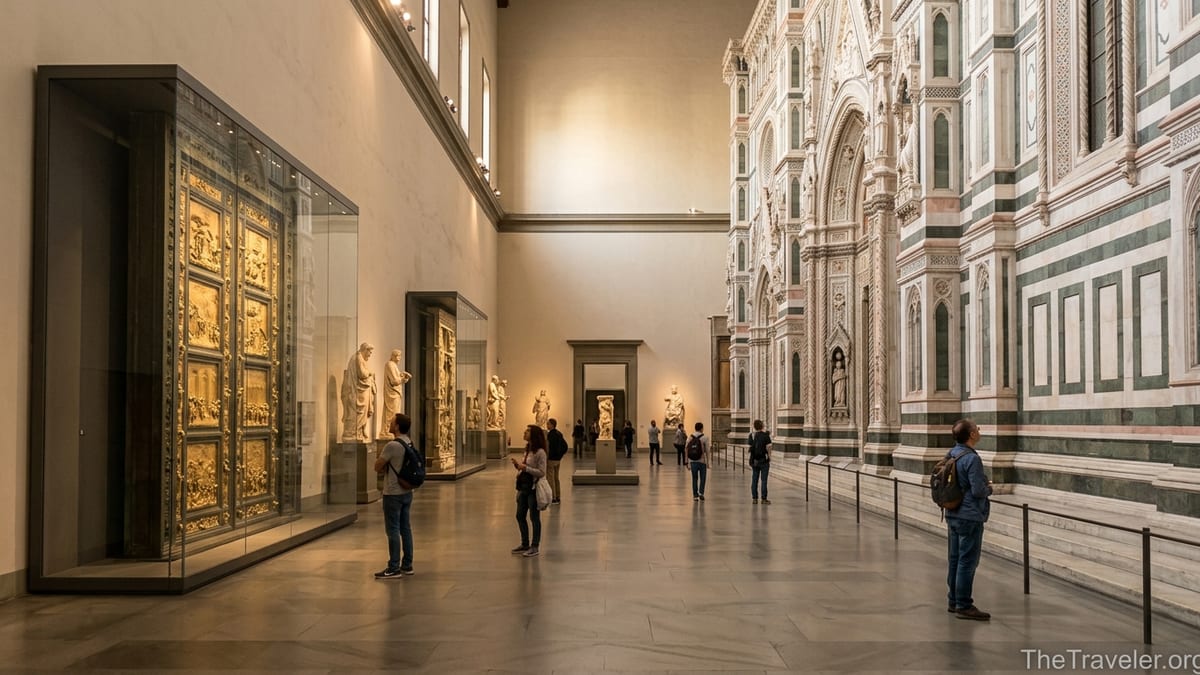
The centerpiece of the museum is a monumental gallery that recreates, at full scale, the original medieval façade of the cathedral designed by Arnolfo di Cambio. When you step into this long hall, you see a wall-sized architectural reconstruction lined with dozens of original sculptures and reliefs, while opposite it stands the restored north and east doors of the Baptistery. This single room is often cited by visitors as the most powerful space, because it condenses the entire history of the Duomo’s exterior decoration into one sweeping view.
The Baptistery doors are another essential highlight. The so‑called “Gates of Paradise,” the gilded east doors designed by Lorenzo Ghiberti, are housed here in their original panels, displayed at eye level. Nearby are Ghiberti’s earlier north doors. Visitors who first saw the replica doors outside are often startled by the fine detail and glowing surfaces visible only at close range in the museum. If you are traveling with teenagers or anyone interested in craft and technique, lingering here to examine a single panel can be more engaging than racing through the whole collection.
Two works by Donatello are especially worth seeking out. His wooden Mary Magdalene, often called the Penitent Magdalene, presents a gaunt, deeply human figure unlike the idealized saints many travelers expect from Renaissance art. In another gallery, his dramatic bronze relief of the Feast of Herod, with its inventive use of perspective, contrasts with more classical works nearby and offers a vivid illustration of how Florentine sculpture was evolving in the early 1400s.
The museum also preserves a late Michelangelo sculpture known as the Florence Pietà or Bandini Pietà, which he worked on in his old age. It was originally intended for his own tomb. Though unfinished and partially damaged, the group’s raw surface and twisted figures fascinate many visitors, especially those who have seen his more polished works in the Accademia. Standing close to this piece in the quiet of the Opera del Duomo Museum gives a different, more intimate sense of the artist than the crowded viewing conditions at his famous David.
Planning Your Visit: Routes, Timing and Practical Tips
Because your Duomo pass is valid for several days, one of the most effective ways to enjoy the museum is to place it after, not before, your climb or first encounter with the cathedral. For example, you might reserve a morning Brunelleschi dome slot on your first full day in Florence, wander the nave of the cathedral afterward, then return on your second day to spend a slow afternoon in the museum connecting everything you saw in situ to the original works.
A common real-world itinerary used by many travelers is to book a mid‑morning dome or bell tower slot, arrive 20 to 30 minutes early to clear security and queues, then reward themselves with a relaxed lunch around Piazza della Repubblica or on a side street off Via dei Calzaiuoli. After lunch, when temperatures and crowds outside peak, they walk the few minutes back to the Opera del Duomo Museum and spend 90 minutes exploring in the relative calm. This schedule avoids both the crush of the midday dome queues and the hottest hours spent outdoors.
If you are traveling in high season or on popular weekends, assume that entry security checks and general congestion around Piazza del Duomo will slow you down. It is wise to keep a buffer of at least 20 minutes between the time you intend to arrive at the complex and any booked slot for a climb. Because the museum itself does not typically require a fixed entry time, you can use it flexibly: if a sudden rain shower blows over the square, duck into the museum first, then climb later in your three‑day window if your pass allows.
Audio guides and printed floor plans are sometimes available at or near the entrance, and some travelers choose to use a general Florence guidebook app that includes the museum. Even without extras, the bilingual labels in Italian and English are clear enough for most independent visitors. Those particularly interested in medieval and Renaissance sculpture may benefit from a specialist tour, but many casual travelers find that free resources and a bit of pre‑trip reading are enough to appreciate the main works.
Accessibility, Families and Practical Logistics
Compared with climbing the dome or bell tower, the Opera del Duomo Museum is one of the more accessible parts of the Duomo complex. Its modern renovation introduced elevators, ramps and wide circulation spaces. Travelers using wheelchairs or with limited mobility report that they can see the principal galleries without tackling stairs, though some upper or lower sections may still require assistance. Benches and seats are scattered through many rooms, which is welcome for older visitors.
Luggage rules for the Duomo complex can affect your museum visit. Oversized bags, large backpacks and suitcases are not allowed inside the monuments and must be left at the official cloakroom located at Piazza del Duomo, a short distance from the museum entrance. This cloakroom is run by the same organization that manages the cathedral complex, and in some cases a luggage deposit service is bundled with certain pass types or on‑site options when regular passes are sold out. To avoid walking back and forth, it is best to check bag size limits in advance and, if you are arriving directly from the train station, to drop larger items at your hotel or a luggage storage service before coming to the Duomo area.
For families, the museum can be more comfortable than the more hectic monuments outside. There are restrooms inside, climate control in summer heat, and far fewer stairs. Children often respond well to the large-scale sculptures, the reconstructed façade hall and the gleaming Baptistery doors. Some parents bring a small sketchbook to keep children engaged by drawing their favorite statues. Because tickets are already covered by your pass, you can step out for a snack and come back later the same day if needed, as long as you stay within the overall validity period.
Photography without flash is generally tolerated for personal use, though tripods and professional setups are usually not permitted. As always in Italy, guidelines can change and staff instructions take precedence, so it is wise to check signage at the entrance on the day of your visit. Food and drink are not allowed in the galleries, so plan to eat in nearby cafes before or after your visit rather than bringing snacks inside.
How the Museum Connects With the Rest of the Duomo Complex
One of the best reasons to make time for the Opera del Duomo Museum is the way it deepens your understanding of the buildings you see in the square. After standing under the cathedral façade, then walking through the museum’s reconstruction room and seeing the original sculptures at close range, you can step outside again and look up with new eyes. The prophets, saints and decorative foliage that once looked like a distant pattern become individualized works, each with a story, artist and original position on the church.
The link with the Baptistery is just as strong. Most passes that include the museum also include entry to the Baptistery, where you admire the ornate mosaic ceiling and the replica doors in context. Then, in the museum, you view the original doors in controlled light at arm’s length. Travelers often comment that this sequence turns what might have been just “another pretty building” on a busy Florence checklist into a coherent narrative about the city’s religious and civic identity from the Middle Ages through the Renaissance.
Even the dome and bell tower climbs are enriched by a museum visit. In one gallery, scale models and drawings explain how Filippo Brunelleschi engineered the dome without modern scaffolding. In another, you see sculptural programs created for Giotto’s bell tower. After absorbing this material, climbing those structures is not only a physical challenge or a quest for the best view over the Arno, but also a more informed appreciation of the ingenuity involved.
If you are short on time in Florence, it can be tempting to skip the museum and focus just on the climb or the square. Yet many travelers who have visited in recent years report that the Opera del Duomo Museum ended up being one of the unexpected highlights of their trip, precisely because it is less crowded and more contemplative than the headline attractions. Thinking of the Duomo complex as a complete experience, with the museum as its interpretive heart, can help you allocate your hours wisely.
The Takeaway
Visiting the Opera del Duomo Museum is one of the most effective ways to unlock the meaning and artistry of Florence’s cathedral complex. Rather than functioning as an optional add‑on, it holds the original works that define the Duomo’s visual identity, from the Baptistery doors to major sculptures by Donatello and Michelangelo. Because entry is included with the main Duomo passes, planning your visit is more about timing than extra cost.
Before you go, check the current opening hours and remember that the museum closes on the first Tuesday of each month. Choose the pass that matches your interest in climbing and book any required time slots as early as you can, especially in peak months when the most popular options routinely sell out. On the day, aim to pair an early climb or cathedral visit with a slower, cooler afternoon in the museum.
With a bit of forethought, the Opera del Duomo Museum can turn a quick photo stop in front of the Duomo into a deeper encounter with Florence’s history. You will leave not only with better pictures, but with a clearer sense of how generations of Florentines shaped one of Europe’s great religious and civic spaces.
FAQ
Q1. Do I need a separate ticket for the Opera del Duomo Museum?
In most cases you do not buy a standalone museum ticket. Entry is included in the main Duomo passes, such as the Brunelleschi, Giotto or Ghiberti options, which also cover other monuments in the complex.
Q2. How long should I plan for a visit to the museum?
Most visitors are satisfied with 60 to 90 minutes, which allows time for the reconstructed façade hall, the Baptistery doors and a few key sculptures. Serious art lovers may prefer two to three hours.
Q3. Is the Opera del Duomo Museum suitable for visitors with limited mobility?
Yes, the museum is one of the more accessible parts of the Duomo complex. It has elevators, ramps and wide galleries, and many important rooms can be reached without stairs, though some assistance may still be helpful in certain areas.
Q4. When is the museum closed?
The museum is normally open daily, but it closes on the first Tuesday of each month for maintenance and may have special hours or closures around major holidays. It is wise to confirm the exact schedule shortly before your visit.
Q5. Can I visit the museum without climbing the dome or bell tower?
Yes. If you are not interested in climbing, you can choose a pass type that focuses on the museum, Baptistery and archaeological areas. These options avoid the stairs while still giving you the core artistic and historical experience.
Q6. Are there long lines to enter the Opera del Duomo Museum?
The museum is usually much less crowded than the cathedral or the dome climb. Outside of peak holiday moments, entry lines tend to be short or nonexistent, especially early in the morning or late in the afternoon.
Q7. Is photography allowed inside the museum?
Photography for personal use without flash is generally allowed in most galleries, though tripods and professional equipment are typically prohibited. Always check posted signs and follow staff instructions, as rules can change.
Q8. What are the must-see works inside the museum?
Do not miss the full-scale reconstructed façade hall, the original gilded Baptistery doors, Donatello’s Penitent Magdalene and the Florence Pietà attributed to Michelangelo. Together they give a powerful overview of the Duomo’s artistic history.
Q9. Is the museum a good choice with children?
Yes, especially compared with the more crowded monuments. Children often enjoy the large sculptures and dramatic spaces, and the museum’s calmer atmosphere, seating and restrooms make it easier for families to take breaks.
Q10. Should I visit the museum before or after seeing the cathedral and Baptistery?
Both orders work, but many travelers find it most rewarding to see the cathedral and Baptistery first, then visit the museum later the same day or the next. That way the original works inside the museum connect directly to what you have already seen outside.