


The cheapest flight on the screen is rarely the cheapest trip once baggage fees are added. On many budget airlines, and increasingly on major carriers, a cabin bag or checked suitcase can cost more than the seat itself if you buy it at the wrong time. Understanding how to compare baggage fees before you click “book” is now as important as checking flight times or connections.
Get the latest updates straight to your inbox!
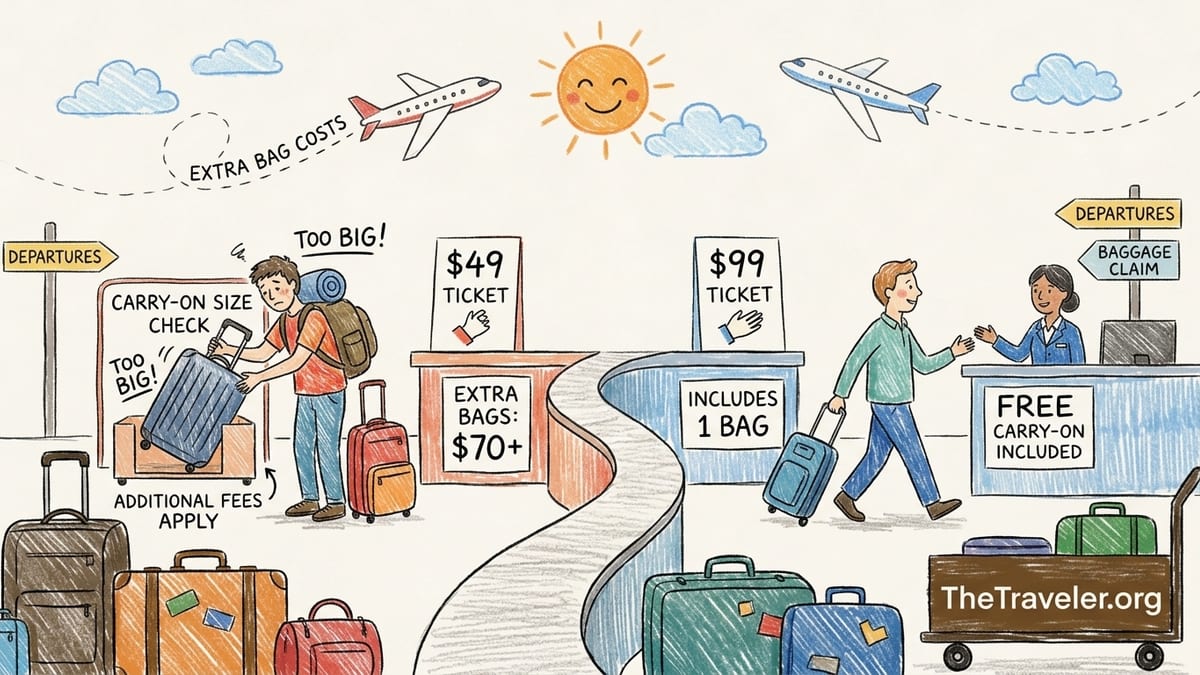
Why baggage fees now matter as much as the ticket price
Across Europe and the United States, airlines derive a significant share of revenue from ancillary charges such as baggage, seat selection and change fees. On carriers like Frontier in the U.S., government and industry data indicate the airline collected more than 30 dollars per passenger in baggage and change fees in 2024, a material part of its income. The pattern is similar at low cost European airlines where base fares are kept very low and baggage is priced separately.
This matters because two tickets that look identical on a search screen can cost very different amounts once bags are included. A 49 dollar fare on an ultra low cost carrier from Denver to Las Vegas can jump above 100 dollars each way after adding a carry on and one checked bag at later stages in the booking process. Meanwhile, a 99 dollar fare on a legacy carrier with a free carry on and discounted first checked bag might end up cheaper for the same trip.
The shift is not confined to budget airlines. Major U.S. carriers have steadily raised domestic checked bag fees, with reports in 2026 of first checked bags on certain United domestic routes costing around 45 dollars each way if you are not in a premium cabin or loyalty tier. On many routes within North America, United’s basic economy fares only include a personal item under the seat, with carry on bags either prohibited or charged as checked baggage at the airport depending on the itinerary.
As a traveler, that means you can no longer compare flights by base fare alone. To avoid surprises at the airport, you need to know exactly what size and weight of bag is included in your fare, what you plan to bring, and how much it will cost if you pay for bags at different stages before departure.
Decoding cabin bags, personal items and checked luggage
Most airlines now separate your baggage into three main categories: a small personal item, a larger cabin bag for the overhead compartment, and checked luggage for the hold. The rules and prices differ sharply between budget airlines and traditional carriers, even on similar routes.
European low cost carriers such as Ryanair and Wizz Air usually include only a small personal item in their lowest fares. Ryanair, for example, allows all passengers a small bag of about 40 by 30 by 20 centimeters that must fit under the seat in front. To bring a wheeled cabin suitcase of up to 10 kilograms into the overhead bin, you need to buy a product such as “Priority and 2 Cabin Bags,” which includes the small item plus a 10 kilogram cabin bag with typical dimensions around 55 by 40 by 20 centimeters, or pay separately for a 10 kilogram checked bag.
U.S. ultra low cost carriers like Spirit and Frontier use a similar structure but with different dimensions and labels. Both allow one free personal item, such as a small backpack or laptop bag that fits under the seat. A larger carry on backpack or small roller case is chargeable and must meet each airline’s maximum size, often close to 22 by 14 by 10 inches. Checked bags are charged separately and sized using linear dimensions and weight caps, commonly up to 62 linear inches and 40 or 50 pounds before overweight fees apply.
Legacy North American and European airlines often include a standard cabin bag in the main economy fare, but basic economy or hand baggage only fares are an exception. United, for example, sells domestic basic economy tickets where only a personal item is permitted for free; many itineraries do not include a complimentary overhead bin bag. On some transatlantic basic economy routes between the United States and Europe, recent policy documents indicate that a full size carry on is permitted without extra charge, but checked bags remain a separate fee unless you are in a higher fare class or have elite status.
How to research real baggage prices before booking
The starting point for any comparison is the airline’s official baggage calculator or fee table. United provides an online tool that requires your route and ticket purchase date because the first checked bag price can vary by region and by when you bought the ticket. Recent examples show first checked bags on many domestic routes costing in the mid 40 dollar range each way, while flights to Europe or Asia may include one free checked bag even in economy.
Frontier and Spirit both maintain bag price checkers where you enter your origin, destination and travel dates. These tools typically return a matrix showing what you will pay for a carry on or first checked bag at booking, after booking but before online check in, during online check in, and at the airport gate. On Spirit, travelers report first checked bags as low as about 30 to 40 dollars each way when purchased during initial booking, rising to 60 dollars or more if added later, and can exceed 70 dollars if you wait until the gate.
European budget airlines lay out baggage fees in several sections of their websites. Ryanair’s help center and travel extras pages explain the different products: a 10 kilogram cabin bag option, a 20 kilogram checked bag, and the “Priority and 2 Cabin Bags” bundle. Prices are often shown as ranges that depend on route and travel date, and the airline notes that fees are higher during peak periods such as Christmas and summer or when purchased at the airport desk rather than online.
Because fees change frequently and can depend on fine details such as when you purchased your ticket, you should treat third party blog tables as examples rather than guarantees. Use them to understand rough ranges, then confirm your actual price by running your specific route and date through the airline’s own calculator or through the “add bags” step of the booking path before you finalize payment.
Budget airlines: when a cheap fare is not really cheap
Consider a real world comparison on a short haul route such as London to Barcelona in spring. A Ryanair fare might appear at 25 euros each way including only a small under seat bag. If you are traveling for a weekend with a 10 kilogram wheeled carry on, you may add Priority and 2 Cabin Bags for a fee that often runs in the 20 to 40 euro range each way on such routes. If you also need a 20 kilogram checked suitcase, that can add another 20 to 35 euros each way depending on season and purchase timing, so your 25 euro seat can easily become 70 to 90 euros with bags.
On a U.S. domestic leisure route such as Orlando to Las Vegas, you might see a Spirit Airlines fare advertised at around 39 dollars one way on off peak dates. The airline will then quote bag prices that depend on your route and when you pay. Travelers on similar itineraries have reported checked bag or carry on prices around 40 to 50 dollars each way at booking, rising to roughly 60 to 70 dollars closer to departure. If you need both a carry on and a checked bag, your 39 dollar fare can climb above 130 dollars for the one way journey once baggage is included.
Frontier uses a comparable structure. For example, a Denver to Phoenix ticket might sell for under 50 dollars, but checked baggage fees documented by travel analysts range from under 50 dollars to well over 100 dollars each way depending on whether you buy your allowance at booking or at the airport, with additional surcharges for overweight bags. Passengers on online forums describe situations where round trip checked bag costs approached 300 dollars per person when added late for multiple bags, more than the base fare itself.
The lesson is clear: when you compare a budget airline low fare to a more expensive ticket on a carrier that includes a cabin bag and perhaps a checked bag, you must add your realistic baggage costs on both sides. Often, a major carrier priced 30 or 40 dollars higher each way will be cheaper overall once you count a carry on and one checked bag, especially if you risk airport bag fees on the ultra low cost option.
Legacy carriers: basic economy versus standard economy
On full service airlines, the key comparison is not just between airlines but between fare types. In North America, United, American and Delta all sell basic economy fares that restrict changes and boarding priority and often reduce baggage allowances compared with standard economy. On United’s domestic basic economy, you are allowed one personal item only, such as a small backpack that fits entirely under the seat, and bringing a larger cabin bag can result in paying to check it at the lobby or gate according to the airline’s checked bag fee schedule.
By contrast, main cabin or standard economy on the same airline and route usually includes one cabin bag in the overhead bin plus the personal item, and the first checked bag price is often the same regardless of whether you bought basic or standard economy. On many international long haul routes, including transatlantic flights to Europe, recent United documentation shows at least one checked bag included even in basic economy, though there are nuances when partner airlines are involved.
To see the impact in practice, imagine a New York to Los Angeles round trip on a United domestic flight. A basic economy ticket might price at 179 dollars, while a standard economy ticket could be 219 dollars. If you need a full size carry on and a personal item only, the 40 dollar difference can be worth paying to avoid the risk of a carry on being treated as checked baggage. If you plan to check one suitcase, and United’s current calculator shows a 45 dollar first checked bag fee each way for your travel dates, you will pay that 90 dollars in either fare but still enjoy the carry on allowance and flexibility of standard economy.
On many transatlantic routes, a basic economy fare from Chicago to London may include a cabin bag and one 23 kilogram checked bag already in the fare. In that case, upselling yourself into a higher fare class for baggage reasons alone makes less sense unless you need a second checked bag. The crucial step is to use the airline’s calculator for your specific route, fare type and purchase date rather than assuming all basic economy products work the same way on every route.
Comparing total trip price: worked examples
To compare flights accurately, you need to build a simple total trip calculation. Start with the base fare, then add the cost of the bags you truly intend to bring, at the price you will realistically pay if you buy them during booking rather than at the airport.
Take a weekend trip from Chicago to Orlando for a family of two adults and two children. Option one is an ultra low cost carrier such as Frontier, advertising a 59 dollar one way fare on your dates. Each person will bring one personal item and share two checked bags at about 50 pounds each. If Frontier’s bag price checker quotes roughly 55 dollars per checked bag each way at booking on that route, the family will pay around 110 dollars in bag fees each way. The flights cost about 472 dollars round trip in base fares plus 440 dollars in checked bag fees, a total near 912 dollars.
Option two is a legacy carrier such as United, pricing main cabin fares at 119 dollars one way on the same dates. United’s calculator may show first checked bags at about 45 dollars each way for non elite economy passengers on that domestic route. If the family checks one bag per adult and has the children share their parents’ allowances, they will have two checked bags at 45 dollars each way, or 180 dollars total. The base fares are 952 dollars plus 180 dollars in checked bag fees, a total near 1,132 dollars.
On these assumptions, the ultra low cost carrier is still cheaper by about 220 dollars, but the gap is far smaller than the headline fare suggests, and the family will give up benefits such as free cabin bags, loyalty miles and easier changes. If the family also wants one wheeled cabin bag per person, and the budget airline charges, for example, about 50 dollars round trip per carry on at booking, that adds another 200 dollars, bringing the total very close to the legacy carrier. For some travelers, the extra comfort and flexibility of the higher fare becomes worth the minimal price difference once baggage is included.
In Europe, consider a solo traveler flying from Milan to Berlin with one 20 kilogram checked bag. Wizz Air might advertise a 29 euro base fare, but the airline’s baggage tables could quote a 20 kilogram checked bag at, for example, around 35 to 45 euros each way depending on season and how early you purchase. The total then lands in the 64 to 74 euro range. A traditional carrier such as Lufthansa or ITA Airways selling a hand baggage only ticket for 89 euros that includes a full size cabin bag but no checked luggage would still be more expensive if you must check a bag; however, a bundled fare that includes one 23 kilogram case for about 109 euros could end up only modestly higher than the budget option once you factor in schedule convenience and airport choice.
Strategies to minimize or avoid baggage fees
Once you understand how airlines structure fees, you can make deliberate choices to keep costs down. The biggest single lever is timing. On Spirit and Frontier, public examples and traveler reports show that buying checked or cabin bags during initial booking can save 20 dollars or more per bag each way compared with adding the same bag at the airport. Ryanair states clearly that bags purchased via call centers or airport desks are more expensive than those added online in advance, especially during peak travel periods.
Another powerful tactic is learning to travel with only a personal item, particularly on budget airlines that allow generous under seat dimensions. Many frequent Frontier travelers describe fitting four or five days of clothing into small under seat suitcases sold specifically to meet the airline’s size box, eliminating carry on charges entirely. Similar strategies work on European low cost carriers where small backpacks or compact duffels can slide under the seat while still holding enough for a weekend city break.
Co branded credit cards and frequent flyer status can also offset baggage fees on legacy airlines. On United, for example, holders of certain airline credit cards and elite status members often receive a free first checked bag on domestic and some international routes for themselves and sometimes one companion on the same reservation. If you fly a particular airline several times a year with checked luggage, the value of waived bag fees can outweigh a card’s annual fee even before counting other travel benefits.
Finally, weigh and measure your bags before leaving home. Overweight and oversize penalties can be steep: Frontier’s current policy shows a triple digit fee for bags weighing more than 50 pounds on many tickets, and similar surcharges exist on other carriers once your suitcase exceeds the standard 23 or 32 kilogram limits. Using a small luggage scale and choosing slightly smaller cases can save far more than they cost.
Staying ahead of rapid rule changes
Baggage policies and fees change frequently, and the direction of travel so far has been upward. Regulatory documents released in 2024 and 2025 in the United States and Europe highlight the growth of ancillary revenue and the difficulty consumers face in comparing total trip prices. In response, regulators have pressed airlines and online travel agencies to present baggage costs more transparently at the time of shopping, but implementation varies and can lag behind real time adjustments by airlines.
Because of this, any specific price you see in a media article or traveler forum should be treated as a snapshot. A Spirit checked bag that cost 30 dollars each way when a guide was written might now cost 40 or 50 dollars on the same route and date pattern. United’s first checked bag fee to a particular region could change for tickets purchased after a certain date, meaning two passengers on the same flight may pay different amounts if they bought their tickets in different months.
The only reliable approach is to recheck baggage details for every trip. Before you book, open the airline’s baggage calculator or fee page in one browser tab while you shop for flights in another. For each candidate itinerary, note the cost of your planned baggage mix at booking and at the airport, and make your decision with those numbers in front of you. If you book through an online travel agency, still verify on the airline website, as that is where you will ultimately pay for bags and where last minute changes are most accurately reflected.
For complex itineraries involving codeshares or partner airlines, read the fine print. A basic economy ticket marketed by a U.S. carrier but operated by a European partner may follow either airline’s baggage rules depending on the most significant carrier on the itinerary. When in doubt, call the airline before purchase and ask them to confirm which baggage policy applies to your specific combination of flights.
Conclusion: build baggage into your idea of a cheap flight
Cheap flights still exist, but a cheap base fare is no longer the same as a cheap trip. The rise of baggage fees on both budget and legacy airlines means that your total cost depends heavily on what you pack and when you choose to pay for it. On routes served by ultra low cost carriers, adding one or two bags per person can quickly erase the entire saving compared with a full service airline that offers more generous allowances.
By breaking fares into their components, decoding personal item, cabin bag and checked luggage rules, and running your real bags through each airline’s online calculators, you can compare options in a meaningful way. Worked examples show that once baggage is included, a seemingly more expensive ticket often narrows the gap or even becomes cheaper, particularly when you value cabin bags, flexible changes or frequent flyer benefits.
Above all, treat baggage as part of your flight decision, not an afterthought. Plan what you will bring before you shop, check current policies on the airline websites, and buy any necessary allowances during booking rather than at the airport. With a little preparation, you can keep control of your costs, avoid surprise fees at the gate, and ensure that your next “cheap” flight really is good value from departure to arrival.