


Few places capture Barcelona’s imagination quite like La Pedrera, Gaudí’s undulating stone apartment block on Passeig de Gràcia. Officially called Casa Milà, this UNESCO-listed icon offers some of the best rooftop views in the city along with interiors that reveal how avant-garde early 20th-century Barcelona really was. With several ticket types, changing light throughout the day, and a mix of indoor and outdoor spaces, a little planning goes a long way toward an unforgettable visit.
Get the latest updates straight to your inbox!
Getting Oriented: Where La Pedrera Fits Into Your Barcelona Day
La Pedrera sits at number 92 Passeig de Gràcia, in the Eixample district, one of Barcelona’s central, well-connected neighborhoods. You are in easy walking distance of other Gaudí landmarks such as Casa Batlló and a 15 to 20 minute metro ride from the Sagrada Família, which makes La Pedrera easy to combine with other major sights in a single day. The building itself is eight stories high, wrapping around two interior courtyards and crowned by a rooftop terrace that feels like a sculptural garden in the sky.
From a logistics perspective, it is hard to beat the transport connections. The nearest metro stop is Diagonal, served by lines L3 and L5, with exits that bring you within a short walk of La Pedrera’s entrance. Many visitors staying near Plaça de Catalunya or in the Gothic Quarter simply walk up Passeig de Gràcia, treating the avenue’s modernist façades and high-end shop windows as a prelude to Gaudí’s stone waves above. Taxis and ride-hailing services can also drop you at the curb directly in front of the building.
A typical first-time visitor spends 1.5 to 2 hours inside, more if you linger on the rooftop or browse the exhibitions in the attic. If you plan to visit both La Pedrera and Casa Batlló the same day, spacing them with a relaxed lunch in Eixample is a comfortable rhythm. For example, you might take a 10:30 a.m. La Pedrera entry, have a menu del día at a nearby brasserie on Rambla de Catalunya, and then walk ten minutes down the avenue for a mid-afternoon Casa Batlló slot.
Because La Pedrera is a fully functioning cultural site rather than a static museum, timings for special experiences such as sunrise or night visits can vary by season. It is worth checking current schedules when you plan your day to decide whether an early-morning, daytime, or evening rooftop suits you best.
Choosing the Right Ticket for Rooftops and Interiors
La Pedrera offers several ticket types, each shaping the way you experience the rooftop views and interior highlights. The standard daytime visit, often called “The Essential La Pedrera,” includes general admission, a self-guided videoguide in multiple languages, and access to the courtyards, the Espai Gaudí exhibition in the attic, a recreated early 20th-century apartment, and the rooftop. As of early 2026, published prices start around 25 euros for this option, with discounts for children, students, and older visitors.
If you are focused on the rooftop at its most atmospheric, the “La Pedrera Night Experience” is designed around that goal. This is a guided evening visit that typically starts after regular closing time, in small groups, with explanations in English, Catalan, or Spanish. The highlight is the rooftop itself, where projected light and sound sequences play across the chimneys and ventilation towers, followed by a drink, often cava, served with city lights twinkling around you. Ticket prices for the night experience start around the high 30 euro range, reflecting the guided format and added elements.
For travelers who want quieter spaces and softer light, the “La Pedrera Sunrise” visit offers early-morning entry before the building opens to the general public. This guided tour in languages such as Spanish, English, Chinese, Japanese, and Korean lets you see the courtyards and rooftop with fewer people in your photos and a calm, almost contemplative mood. Prices are typically similar to the night experience, in the upper 30 euro range. There are also premium guided visits, combined tickets with other cultural sites in Barcelona, and open-date tickets that give flexibility for travelers with fluid schedules.
In practice, first-time visitors who mainly want to see the architecture from the inside and enjoy the views do very well with the Essential daytime ticket. If you are particularly interested in photography, a double approach works nicely: a daytime Essential visit to fully explore the attic and apartment, and a separate Night Experience on another evening just for the theatrical rooftop atmosphere. When buying tickets online, look for official channels and be cautious of resellers that add booking fees without additional value.
Timing Your Visit for the Best Rooftop Views
The rooftop of La Pedrera is one of Barcelona’s most memorable vantage points, but the experience changes dramatically depending on when you go. During mid-morning on a clear day, sunlight glances off the cream-colored stone and broken-ceramic mosaic, creating strong shadows around the helmet-like chimneys. This is excellent for crisp contrast in photos, especially if you are using a phone or a compact mirrorless camera with a wide-angle lens set around 24 millimeters.
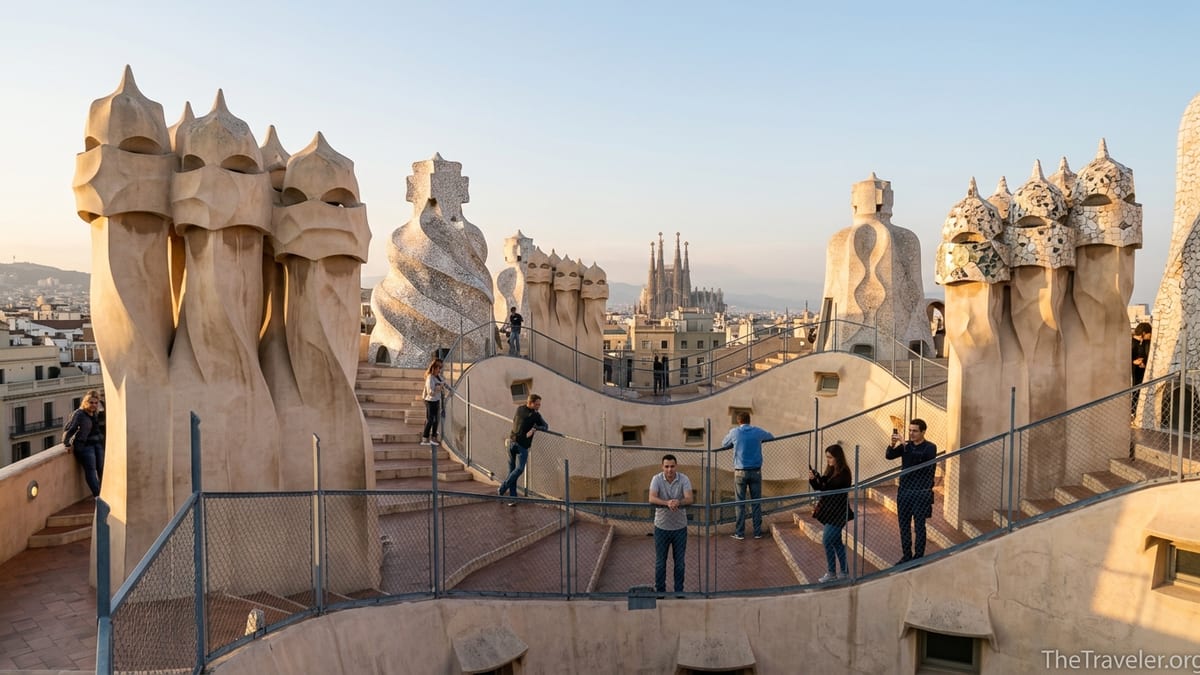
By late afternoon and into golden hour, the mood softens. The western light paints the façades of Eixample in warm tones, and you can often see as far as Tibidabo hill on one side and the Mediterranean glinting on the horizon on the other. Standing near the taller “warrior” chimneys, you can frame photos that capture both the sculpture and the skyline. Travelers who schedule a 5 p.m. to 6 p.m. entry in spring or autumn often find that they reach the rooftop just as the sun is dropping, without the intensity of midday heat.
Evening visits, whether part of the Night Experience or the last standard entries of the day in summer, reveal a different layer of the city. Streetlights come on along Passeig de Gràcia, headlights trace soft lines of movement below, and the illuminated spires of the Sagrada Família glow in the distance. During the Night Experience, rooftop projections add surreal color washes to the chimneys, which can be magical in person, though it requires a steady hand or higher ISO settings if you are shooting in low light.
Weather matters too. In the event of rain, the rooftop may close temporarily for safety, and strong winds can make it less pleasant to linger. On very bright summer days, a brimmed hat and sunglasses are almost essential, as there is little shade. If you are sensitive to heat, consider an early-morning Sunrise visit or a night-time tour during July and August. In winter, bring a windproof layer; the exposure that makes the rooftop views so sweeping also means breezes can feel sharp once you step up from the sheltered attic.
What Not to Miss Indoors: Courtyards, Attic and the Period Apartment
While most people come chasing the rooftop, La Pedrera’s interiors reveal just how radical Gaudí’s ideas were for everyday living. The visit typically starts in one of the two courtyards, where you can look up and see the oval of sky framed by irregular, painted walls and a ring of balconies. The walls, decorated with murals that suggest foliage and organic forms, feel almost theatrical. Standing in the center and tilting your camera upward makes for a classic shot that captures the building’s verticality.
From there, you ascend to the Espai Gaudí in the attic, a series of catenary brick arches that resemble the ribcage of some red-brick creature. This space houses models, drawings, and interactive displays that explain Gaudí’s design language across multiple works, from Park Güell to the Sagrada Família. A particularly useful exhibit for visitors is the scale model that shows the rooftop landscape in miniature, helping you orient yourself before you step outside. The narrow brick arches photograph well, but the light can be low, so many travelers find that resting their phone on a railing or using a museum-approved monopod helps avoid blur without flash.
One floor below, the recreated early 20th-century apartment is both a time capsule and a lesson in Gaudí’s approach to comfort. Rooms are arranged as they would have been for a bourgeois Barcelona family: a formal salon overlooking Passeig de Gràcia, bedrooms with embroidered linens, a tiled bathroom with curved fixtures, and a working kitchen stocked with period utensils and cast-iron stoves. Details such as custom door handles that fit the curve of the hand and built-in cabinetry show how seriously Gaudí took ergonomics long before the term was common.
As you move through these spaces, take a moment to pay attention to elements that are easy to overlook in the rush toward the rooftop. The wooden doors along the stairwells, the ironwork on the balconies seen from the inside, and even the shapes of the window openings are all part of Gaudí’s effort to blur the line between structure and sculpture. Photography is generally allowed for personal use, but tripods and professional lighting are restricted, so plan on hand-held shots and be considerate of other visitors moving through the narrow corridors.
Making the Most of the Rooftop: Views, Angles and Safety
Once you emerge onto La Pedrera’s rooftop, you are in what feels like an open-air sculpture park. The chimneys, ventilation towers, and stairwell outlets are clad in broken ceramic, stone, and marble, emerging like helmeted warriors or abstract sentinels. A gentle, uneven path winds between them, rising and falling with the building’s organic forms. This is where most visitors spend the largest chunk of their time, both for the views and for the chance to wander among some of Gaudí’s most iconic silhouettes.
For city views, look for openings in the parapet that frame specific landmarks. Facing inland, you can often spot the spires of the Sagrada Família rising above the Eixample grid. Turning toward the sea, you may catch the profile of Montjuïc hill and, on clear days, a slice of the Mediterranean. The neighboring blocks of Eixample, with their chamfered corners and consistent building height, create a geometric carpet beneath the rooftop’s curves, a contrast that is particularly striking in late-afternoon light.
Photography on the rooftop rewards patience and movement. Circling a single chimney can reveal multiple compositions, from tight close-ups of mosaic textures to wide views that place the figures against the skyline. Many travelers use a smartphone with the built-in wide lens, walking closer to the elements rather than zooming in, to keep images sharp. If you are using a DSLR or mirrorless camera, a zoom lens in the 24 to 70 millimeter range lets you switch from sweeping scenes to details of the ceramic shards without changing lenses in the breeze.
Safety and rules are important here. The rooftop includes steps, sloping sections, and uneven surfaces, which can be slippery if they are damp. Handrails are present on steeper areas, and staff members are positioned along the route to manage one-way flows and advise visitors. The site does not allow access with bulky professional photographic gear, and in wet weather the rooftop may close temporarily, with staff redirecting visitors to indoor spaces until it reopens. Wearing closed, comfortable shoes rather than flip-flops or high heels makes the walk more secure and will help you enjoy lingering at viewpoints instead of watching your footing every second.
Accessibility, Families and Practical On-Site Tips
La Pedrera works steadily to be accessible, but its historic structure brings limitations you should understand before you go. Elevators connect street level to the main visit areas, and visitors with disabilities typically receive priority access. However, the rooftop has constant changes in level and narrow sections, so only part of it is accessible to manual wheelchairs, and mobility scooter use may be restricted. If you rely on a wider wheelchair, contacting the site in advance to discuss specific dimensions and assistance options is sensible.
Families often find La Pedrera surprisingly child-friendly, especially if they frame the visit as exploring a “stone dragon” or “warrior castle.” The attic exhibition includes models and visual displays that can hold older children’s attention, while younger ones often enjoy running their hands along the wave-like walls in the courtyards. For safety, strollers may be limited in certain sections, especially on the rooftop and in narrow stairways, so a baby carrier can be more practical for infants and toddlers. Toilets and baby-changing facilities are available in the visit circuit, which makes it easier to plan around nap times.
On a practical level, it is strongly recommended to buy timed-entry tickets in advance, especially in peak months between April and October and around public holidays. Queues at the entrance can be significant for last-minute buyers. Inside, videoguides are available in a wide range of languages, including English, Chinese, Japanese, Korean, and major European languages, and provide short, clear explanations keyed to numbered stops throughout the visit. If you travel light, remember that large backpacks may need to be checked or carried in front in busy areas to avoid brushing other visitors or exhibits.
Dress is generally informal. There is no strict dress code for standard visits, but as a cultural institution, La Pedrera reserves the right to refuse access to visitors wearing clothing or symbols that might be considered offensive or disruptive. A light layer is useful even in warmer months, as temperature-controlled interiors can feel cool after time on the sunlit rooftop. In summer, a compact folding fan or refillable water bottle can make the difference between a rushed visit and a comfortable wander through the spaces.
Combining La Pedrera With Nearby Gaudí Highlights
La Pedrera rarely exists in isolation on a Barcelona itinerary. Most visitors combine it with other Gaudí works or Eixample landmarks to make a full morning or afternoon of it. The most obvious pairing is Casa Batlló, around a ten-minute walk down Passeig de Gràcia, visible from the sidewalk as a colorful, dragon-backed façade. Some travelers choose La Pedrera in the morning and Casa Batlló in the afternoon to avoid architectural fatigue and to experience two very different interpretations of modernisme in one day.
If your time is limited, you can create a compact Gaudí corridor: start at the Sagrada Família early, then take the metro or a short taxi ride to La Pedrera for a late-morning or midday visit, followed by a stroll down Passeig de Gràcia for exterior views of Casa Batlló and other modernist buildings in the so-called “Block of Discord.” Cafés on nearby Rambla de Catalunya or in the grid of Eixample streets east of Passeig de Gràcia make convenient stops for lunch or an afternoon coffee.
Travelers with more days in the city can use La Pedrera as a thematic anchor for exploring the Eixample district. From its entrance, you can walk fifteen minutes to the intersection of Avinguda Diagonal and Passeig de Sant Joan, then continue toward lesser-known modernist apartments, or loop back via small plazas and side streets lined with local boutiques and bars. Evening visitors to the Night Experience often book dinner at a nearby restaurant on Carrer de Provença or Enric Granados, turning the rooftop visit into the centerpiece of a leisurely night out.
While each Gaudí site sells its own tickets, pay attention to combined passes that link La Pedrera with other attractions, such as the Sant Pau Art Nouveau Site or a concert hall. These combinations can sometimes save money compared with buying individual entries, especially if you plan to see multiple modernist landmarks across two or three days. Just be sure to compare inclusions, particularly whether rooftop access and guided tours are part of the package, before you purchase.
The Takeaway
Experiencing La Pedrera at its best means thinking in layers: the rooftop for sweeping views and sculptural drama, the attic for understanding Gaudí’s ideas, and the apartment and courtyards for a glimpse of how radical this building was for the people who once lived here. When you match those layers with the right ticket type, a well-chosen time of day, and realistic expectations about crowds and accessibility, the result is a visit that feels both inspiring and surprisingly personal.
Whether you stand beneath the brick arches of the Espai Gaudí tracing structural diagrams with your eyes, or lean against the rooftop parapet watching sunset light catch on the Sagrada Família in the distance, La Pedrera rewards unhurried attention. Plan ahead, arrive with curiosity, and give yourself space to wander. The building’s curves, textures, and shifting perspectives reveal new details with every step, turning what might have been a quick photo stop into one of your most enduring memories of Barcelona.
FAQ
Q1. Do I need to buy La Pedrera tickets in advance, or can I walk up?
It is technically possible to buy tickets on-site, but in busier months you may face long lines or find popular time slots sold out. Booking a timed-entry ticket in advance is the safest way to secure your preferred visit window, especially for the Night Experience or Sunrise tours, which have more limited capacity.
Q2. Which La Pedrera ticket is best if I mainly care about rooftop views?
If your priority is simply to reach the rooftop and enjoy the city panorama, the Essential daytime ticket is usually enough and includes rooftop access. If you want a more atmospheric visit, with projections and a drink, the Night Experience places the rooftop at the center of the tour and is worth considering, especially in summer when evenings are warm.
Q3. How much time should I plan for a La Pedrera visit?
Most travelers are comfortable with 1.5 to 2 hours. That allows time to see the courtyards, explore the attic exhibition, walk through the period apartment, and linger on the rooftop for photos. If you tend to read every panel or are an architecture enthusiast, allow closer to two and a half hours.
Q4. What is the best time of day to visit for photos?
For balanced light and fewer harsh shadows, late afternoon and golden hour are excellent, especially if you want warm tones on the stone and city skyline in your rooftop shots. Early morning offers softer light and smaller crowds, while night visits provide dramatic contrast and city lights but require more care with camera settings in low light.
Q5. Is La Pedrera suitable for visitors with limited mobility?
Much of the building, including the courtyards, attic exhibition, and apartment, is accessible by elevator and adapted routes. However, the rooftop has uneven surfaces and steps, so only certain sections may be accessible, and some visitors using wheelchairs or with balance issues may prefer to enjoy the views from safer vantage points inside. It is wise to contact the site in advance for tailored advice.
Q6. Can I visit La Pedrera with young children?
Yes, many families enjoy visiting La Pedrera. Children often respond to the imaginative forms of the chimneys and courtyards. Parents should keep a close eye on kids on the rooftop due to steps and railings, and may find a baby carrier easier than a stroller in narrow or stepped areas. Short breaks in the courtyards or café can help keep younger visitors engaged.
Q7. Are there any clothing or behavior rules I should know about?
There is no strict dress code for ordinary visits, but as with other cultural sites, clothing that could be considered offensive or inciteful may lead to denied entry. Visitors are expected to behave respectfully, avoid touching delicate elements, and follow staff instructions, particularly on the rooftop and in crowded areas.
Q8. Is photography allowed inside La Pedrera?
Photography for personal use is generally permitted throughout the visit, including on the rooftop, but the use of tripods, flashes, or professional equipment is restricted. Commercial shoots and large gear typically require prior authorization. When taking pictures, be mindful not to block pathways or disturb other visitors.
Q9. What is the easiest way to get to La Pedrera using public transport?
The closest metro stop is Diagonal on lines L3 and L5, a short walk from La Pedrera’s entrance on Passeig de Gràcia. Many visitors staying near Plaça de Catalunya also choose to walk up Passeig de Gràcia, using the avenue itself as part of their sightseeing and stopping at shops or cafés along the way.
Q10. Can I combine La Pedrera with other Gaudí sites in one day?
Yes, it is very common to visit La Pedrera on the same day as Casa Batlló or the Sagrada Família. A popular route is an early Sagrada Família visit, followed by a late-morning or early-afternoon slot at La Pedrera, and a relaxed walk down Passeig de Gràcia for exterior views of Casa Batlló. Combined tickets with other cultural sites can sometimes offer savings if they match your interests.