


For many first-time visitors, Barcelona begins on La Rambla. The city has grander avenues and quirkier neighborhoods, yet this slightly chaotic tree-lined promenade between Plaça de Catalunya and the waterfront still exerts a magnetic pull. Renovations, changing shops and shifting local attitudes have altered its look in recent years, but La Rambla remains the street where new arrivals come to feel that they have finally, undeniably, arrived in Barcelona.
Get the latest updates straight to your inbox!
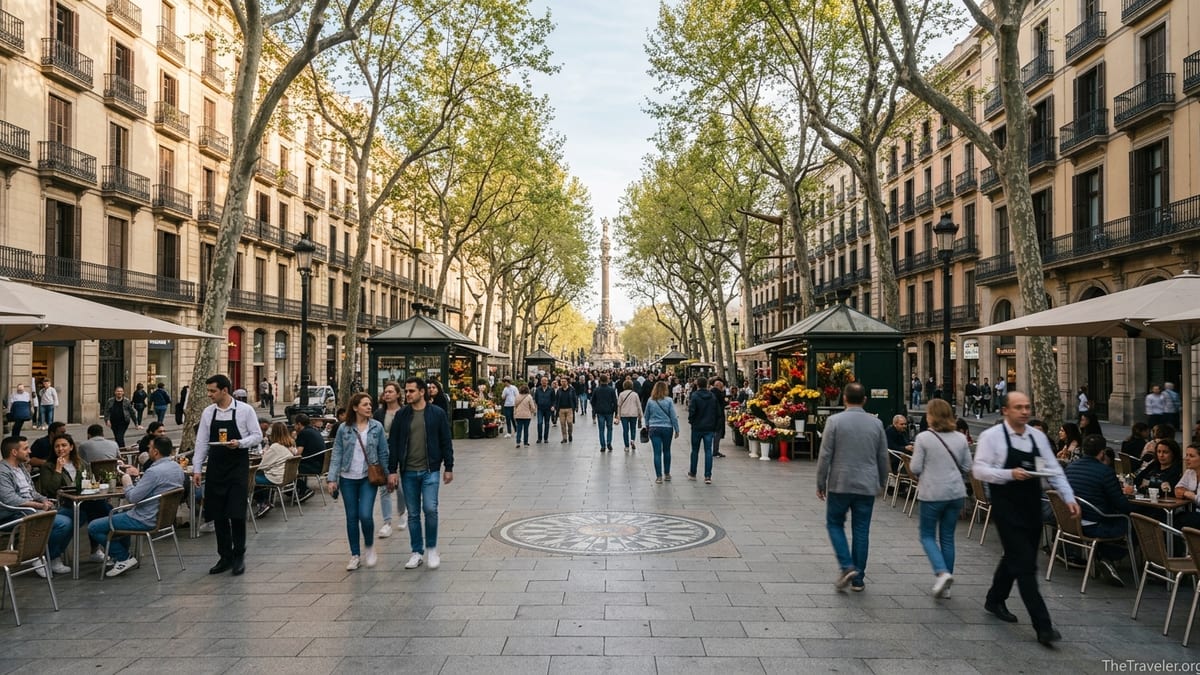
A Straight Line Into the Heart of the City
La Rambla is often the first place travelers find themselves simply because of where it sits. The 1.2-kilometer boulevard runs downhill from central Plaça de Catalunya to the Columbus Monument by the old port, connecting the Eixample grid with the medieval waterfront. Most airport buses and metro lines converge around Plaça de Catalunya, so after dropping bags at a hotel or rental, many people naturally drift toward the wide tree canopy they can see at the square’s southern edge.
For a first-time visitor trying to get oriented, La Rambla works like a giant compass needle. Walk south and you reach the sea. Turn left into the Barri Gòtic and you are suddenly in a tangle of stone alleys, Roman walls and Gothic spires. Turn right into El Raval and you hit contemporary art centers, street murals and a rougher, more lived-in side of the city. Spend an hour strolling and you will have a basic mental map of central Barcelona before you ever open a guidebook.
Urban planners have been reshaping La Rambla in recent years to tilt it back toward people rather than traffic. Sections that once felt like busy roadways have been narrowed for cars and expanded for pedestrians, and in 2026 the city confirmed new rules for the outdoor terraces that line the promenade. The number of tables is being capped and standardized so that more space is returned to walkers while café culture is preserved. For first-time visitors arriving this year, the effect is subtle but real: it is easier to move, pause and simply watch the city flow around you.
This straightforward layout also makes La Rambla a practical meeting point. Friends arriving on different trains or flights often agree to meet “by the Canaletes fountain” near the top of the street or “under Columbus” at the bottom. Tour companies use central spots along La Rambla as departure points for bike tours, Gaudí walks and food excursions, which means a traveler can arrive with nothing booked and, within half an hour, be signed up for a same-day experience with clear instructions on where to return.
Living History on a Single Promenade
Part of La Rambla’s enduring appeal lies in the way its history is literally built into the pavement. The very word “rambla” comes from an old word for a seasonal streambed, and for centuries this was a drainage channel outside the city walls. As Barcelona grew, it was filled in and turned into a fashionable promenade. Even today, you can sense that original spine of the old city in the way the boulevard divides the Gothic Quarter from El Raval, with churches, convents and palaces layered along both sides.
First-time visitors quickly encounter some of Barcelona’s best-known institutions without ever leaving the street. The Gran Teatre del Liceu, Barcelona’s opera house, stands roughly halfway down on the eastern side. From the pavement you can peer into its foyer and ticket office, and many travelers pick up last-minute tickets for performances or a daytime guided tour. A bit further down, closer to the waterfront, the Centre d’Art Santa Mònica occupies a former convent and now hosts free contemporary art exhibitions that make for an easy cultural stop between coffees.
Even the ground has become part of La Rambla’s iconography. Near the entrance to the Liceu metro station you will likely see people stopping to photograph the circular pavement mosaic by Joan Miró, installed in the 1970s. Guides often point it out on walking tours as a playful way of saying: you are officially in Barcelona now. A few steps away, the Font de Canaletes, a cast-iron fountain at the top of La Rambla, is famous as the spot where FC Barcelona fans gather to celebrate major victories. A first-time visitor who happens to be in town on a big match night can find themselves swept into a very local celebration simply by being in the right place.
Over the last decade some older businesses have moved or closed, and facades keep changing, but the boulevard’s role in local life endures. Bookstalls still sell maps and glossy art books, newspaper kiosks stock Catalan and international titles, and flower stalls brighten the central walkway. On Sant Jordi, Barcelona’s beloved day of books and roses in April, stands traditionally filled La Rambla from end to end. Street works have temporarily shifted part of the celebration to nearby avenues, but the image of couples browsing books and buying roses along this promenade remains one of the city’s most evocative scenes.
Markets, Food and the Easy First Taste of Barcelona
La Rambla also stays high on first-time itineraries because it delivers a condensed introduction to Barcelona’s food culture with almost no planning required. Midway down the promenade, a large modernist metal arch marks the entrance to Mercat de Sant Josep, better known as La Boqueria. For many travelers this is their first real contact with a Catalan market. Inside, beneath an iron and glass roof, are rows of produce, seafood, cured meats and tapas bars, along with stalls clearly aimed at tourists selling fruit cups and colorful sweets.
Prices here are usually higher than in neighborhood markets, and regulars often prefer quieter options elsewhere in the city. Still, La Boqueria functions as a user-friendly introduction for someone who has just landed. A visitor can perch at a counter bar for a plate of grilled baby squid, order a slice of tortilla and a small beer for around the cost of a casual lunch at home, and observe how local office workers order a quick menú del dia before returning to work. The market typically opens from morning until mid-afternoon Monday to Saturday and closes on Sundays, so planning a daytime visit early in your trip helps avoid disappointment.
Around the market, side streets branching off La Rambla are lined with tapas bars, bakeries and ice cream shops that help ease jet-lagged travelers into local schedules. A couple arriving on a Friday afternoon, for example, might stroll down from Plaça de Catalunya, explore La Boqueria around 5 p.m., then duck into a nearby bar for patatas bravas, croquetas and a glass of vermut before heading back to their hotel. Without realizing it, they will have experienced an early-evening tapeo, Barcelona’s casual bar-hopping food ritual.
At night, the dining offer shifts again. Restaurants along the main stretch of La Rambla tend to prominently display paella and fixed-price tourist menus. Quality and value vary widely, and locals often recommend walking a block or two into side streets toward Plaça Reial, the Gothic Quarter or El Raval for more characterful options. For a first-time visitor, the convenience of seeing menus in multiple languages, knowing approximate prices in advance and being able to eat outdoors right on the promenade can still be appealing, especially on the first night when energy is low and the main goal is simply to be somewhere that feels alive.
Street Theater, Human Statues and the Nighttime Glow
First-time visitors often say that their strongest memory of La Rambla is not a specific building but a feeling: the noise of conversations in several languages at once, buskers switching from guitar to opera, the smell of roasting chestnuts in cooler months and the soft yellow glow of terrace lights in the evening. Even after regulations have reduced the number of street vendors and tightened rules on licensed performers, La Rambla remains a stage set for low-key street theater.
The human statues that line parts of the promenade, especially in the section around the Liceu, have become a familiar feature. Dressed as living versions of Gaudí’s fantastical chimneys, sea captains, dragons or silver-painted “invisible men,” they freeze until a coin drops in their tin, then suddenly spring into an exaggerated pose for photos. For some locals these are a symbol of tourist excess, but for many first-time visitors they are simply part of the surprise of the street, a reminder that they are somewhere different from home.
Night amplifies the boulevard’s atmosphere. Streetlights reflect off wet paving stones after a brief Mediterranean shower, and the trees form a canopy over the central walkway that makes the middle of the street feel like a long outdoor room. Couples stroll arm in arm, families push strollers in the early evening, and later on, groups of friends drift from one bar or club to the next. Police presence has increased in recent years to address pickpocketing and petty scams, and it is common to see patrols moving along the central section, especially on weekends.
For a solo traveler or jet-lagged couple, La Rambla can feel like a reassuring place to walk after dark because there are always people around and the route is simple. A guest staying near Plaça de Catalunya might wander down at 10 p.m., grab an ice cream or a takeaway slice of coca de recapte from a bakery, and continue to the port before looping back through the Gothic Quarter. Even if they later discover more atmospheric corners of the city, that first nighttime stroll along La Rambla often anchors their sense of Barcelona after the sun goes down.
Culture on the Doorstep: From Flamenco to Bookshops
Although flamenco is more deeply rooted in Andalusia, for many international visitors the art form is synonymous with Spain as a whole. La Rambla offers one of the most accessible introductions through tablaos, small venues where live flamenco shows are performed. Around the middle of the street, for example, a long-running tablao presents nightly performances in an intimate, low-ceilinged room decorated with tiles and wooden beams. Typical tickets combine a 60 to 90 minute show with a drink or buffet-style dinner, with prices that often start around the cost of a mid-range restaurant meal and rise for front-row seats and full menus.
Nearby, just off La Rambla in Plaça Reial, another historic tablao offers shorter, more affordable shows of around 40 minutes. Some travelers choose this option as a first taste of flamenco, then decide later in their trip whether they want to dedicate an entire evening and a larger budget to a more elaborate performance. The convenience is hard to beat: a visitor can finish an afternoon of sightseeing on La Rambla, have a casual tapas dinner in the square’s arcades and then step directly into a late show without worrying about taxis or metro transfers afterward.
La Rambla’s cultural offer extends beyond flamenco. The boulevard hosts regular street bookstalls, particularly around major events, and national chains have long kept flagship branches here. In 2025, for example, one major multimedia retailer moved its central Barcelona store to a prominent building on La Rambla, reaffirming the street’s role as a commercial and cultural anchor. For first-time visitors this simply translates into convenience: a reliable place to pick up a Spanish-language novel, a Catalan cookbook, a European phone charger or an SD card for their camera without leaving the pedestrian core.
Art is never far away either. In addition to the Miró mosaic underfoot and occasional temporary installations, La Rambla connects directly to side streets leading to the Museu Picasso, the Barcelona Museum of Contemporary Art and smaller independent galleries. A traveler staying only two or three nights can spend a morning exploring La Rambla and its immediate surroundings and still cover a surprising number of museums, performances and bookstores without ever using public transport.
Tourist Traps, Safety and How to Enjoy La Rambla Wisely
Part of La Rambla’s fame comes from its flaws as much as its charms, and first-time visitors increasingly arrive informed about both. It is common to hear the street described as a “tourist trap,” and there is some truth to the criticism. Souvenir shops along the central stretch sell mass-produced flamenco dresses, plastic Gaudí lizards and football jerseys at prices that can be higher than in less central neighborhoods. Restaurant touts compete for attention with glossy photos of paella, and quality varies from acceptable to forgettable.
That does not mean first-time visitors should avoid La Rambla. It simply means approaching it with the awareness you would bring to any famous city center street. As a rough rule, stepping one or two blocks away from the main promenade usually brings prices down and quality up, whether you are buying a coffee, a T-shirt or a sit-down dinner. For example, instead of ordering a cocktail at one of the most prominent terraces near the top of the street, you might walk into the Gothic Quarter toward Plaça del Pi and find a bar where a glass of cava costs noticeably less and the crowd includes as many locals as tourists.
Safety is another recurring concern. Pickpocketing around La Rambla and its metro stations has been an issue for years, especially during peak months and at night around bar zones. Local authorities have responded with increased police patrols, cameras and awareness campaigns. For visitors, practical steps make the biggest difference: carry bags zipped and in front of you, avoid keeping phones and wallets in back pockets, be cautious around groups that crowd suddenly or stage distractions and remain skeptical of overly friendly strangers offering unsolicited help.
Examples of small scams have become familiar: a “found” gold ring pressed into your hand followed by a demand for money, a clipboard petition that distracts while an accomplice targets your bag, or an inflated bill for drinks you did not clearly order. Simply walking away from pressure and checking prices before ordering goes a long way. Many visitors pass several pleasant evenings on and around La Rambla with no problems at all, and for most, any negative experience is limited to an overpriced coffee rather than serious trouble.
The Takeaway
La Rambla has changed significantly in recent years, and the city continues to reshape it through renovations, terrace rules and cultural programming. Some long-time residents now prefer quieter streets, and seasoned travelers may spend more of their time in neighborhoods like Gràcia, Poblenou or Poble-sec. Yet for someone arriving in Barcelona for the first time, La Rambla remains a natural starting point. It is where jet-lagged newcomers first sense the scale of the city, where they taste their initial forkful of local seafood at a market bar, where they hear their first strains of live Spanish guitar and where they realize that the medieval alleys and the Mediterranean sea are only a short stroll apart.
Walking La Rambla will not give you a complete picture of Barcelona, but it will quickly supply a framework into which the rest of your trip can fit. It offers a straight line through history, food, nightlife and performance in a single, manageable promenade. Approach it with awareness, curiosity and realistic expectations, and it can still provide that indelible feeling of arrival that has made it one of Europe’s most famous streets for generations.
FAQ
Q1. Is La Rambla safe for first-time visitors, especially at night?
La Rambla is usually busy and generally safe, but pickpocketing and minor scams are common. Keep bags zipped and in front of you, avoid flashing valuables and stay alert in crowds, particularly around metro entrances and late-night bar areas.
Q2. What is the best time of day to walk La Rambla?
Late morning and early evening are ideal. In the morning, markets and shops are open but the street feels less crowded. Early evening offers lively terraces and street performers without the densest late-night crowds.
Q3. Are restaurants on La Rambla worth trying or should I avoid them?
Quality varies. Many places cater mainly to tourists and can be overpriced, but some are perfectly acceptable for a simple meal. As a rule, walking a block or two off the main street into the Gothic Quarter, El Raval or Plaça Reial usually leads to better value and more character.
Q4. When is La Boqueria market open, and is it open on Sundays?
La Boqueria generally opens Monday to Saturday from morning until mid-afternoon and closes on Sundays and public holidays. Hours can vary slightly by stall, so visiting before lunch is the safest bet for a full experience.
Q5. How much should I expect to pay for a meal or drink on La Rambla?
Prices are higher than in residential areas. A basic coffee on a terrace may cost more than in a neighborhood café, and set tourist menus for paella often run at mid-range restaurant prices. Checking menus before sitting down and comparing with nearby side-street options helps avoid surprises.
Q6. Is La Rambla accessible for travelers with limited mobility?
Yes, the central promenade is mostly flat and paved, and recent works aim to improve pedestrian space. However, some sections can be very crowded, and side streets may have uneven cobblestones. Allow extra time and try to visit outside peak midday hours.
Q7. Can I visit major sights in Barcelona just by starting from La Rambla?
La Rambla is a strong base for exploring central sights. From the promenade you can easily reach the Gothic Quarter, El Raval, the old port, several museums and metro lines that connect to landmarks like the Sagrada Família and Park Güell.
Q8. Are there authentic flamenco shows near La Rambla or are they all tourist-focused?
Tablaos around La Rambla do cater to visitors, but many feature professional dancers and live musicians and are respected within the flamenco community. Shorter, cheaper shows in nearby squares can be a good first taste, while longer dinner shows offer a fuller experience at higher prices.
Q9. How long does it take to walk the full length of La Rambla?
Walking the 1.2-kilometer stretch from Plaça de Catalunya to the Columbus Monument takes about 15 to 20 minutes without stops. Most visitors take at least an hour or two to allow for photos, a drink, market browsing and detours into side streets.
Q10. Is La Rambla still worth visiting if I only have one day in Barcelona?
If you have just one day, La Rambla is an efficient way to experience a cross-section of the city: central squares, markets, historic lanes and the waterfront. A focused stroll combined with a visit to a nearby landmark or museum gives a compact but memorable introduction to Barcelona.