


Most visitors arrive at La Pedrera with one goal in mind: to stand among Gaudí’s surreal warrior chimneys on the rooftop and photograph the Barcelona skyline. Yet the building that locals still call Casa Milà is far more than a scenic terrace. Behind its undulating stone façade lies a living cultural center and one of the best places in Barcelona to understand how Gaudí thought, how the city’s bourgeoisie lived in 1912, and how the house is still used today. If you rush straight to the roof, you miss the most revealing parts of La Pedrera.
Get the latest updates straight to your inbox!
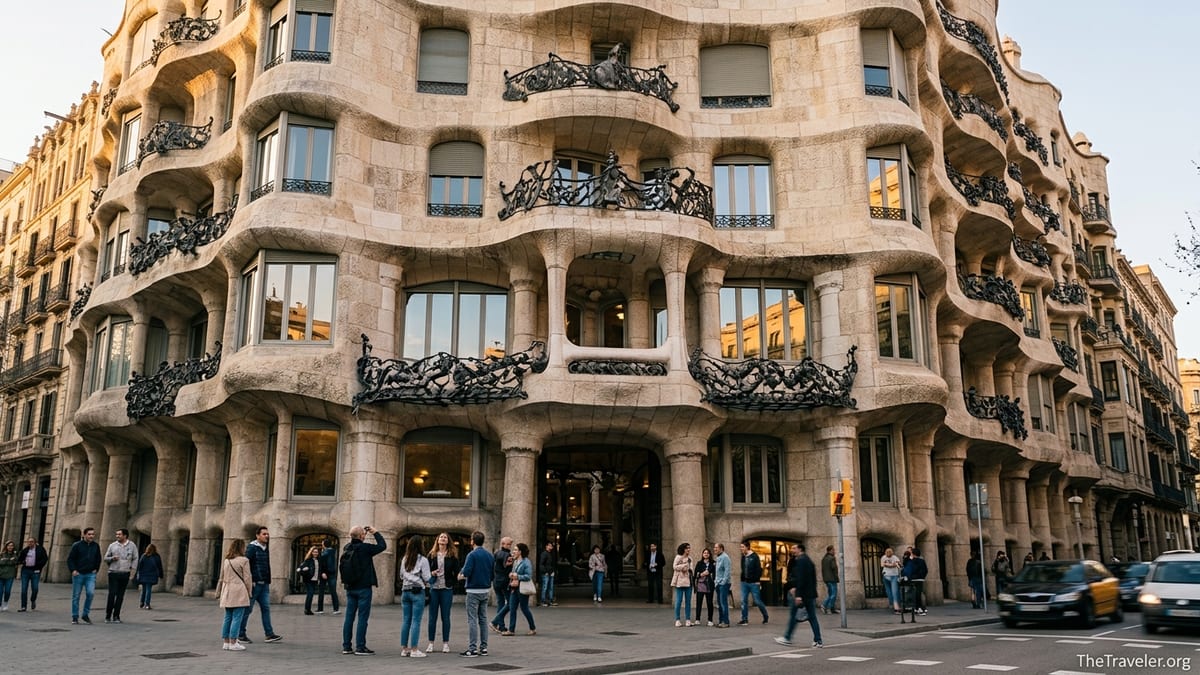
The Courtyards: La Pedrera’s Beating Heart
Many visitors move quickly through La Pedrera’s two courtyards because they see them as a passage rather than a destination. In reality, these open voids are where you first understand that Casa Milà is not a crazy sculpture but a functioning apartment building designed around light and air. If you pause on the ground floor and look up, you will notice that every balcony curves in a different way, and the walls are painted in soft pastels and floral motifs that feel closer to a garden than an urban block.
The main Passeig de Gràcia courtyard is where residents once arrived by carriage, driving straight into the building and up to interior ramps. Today, you can still see the wide entrances and the original wrought-iron gates, a reminder that this was designed as a practical luxury residence, not a museum. In the quieter Provença courtyard at the back, the noise of the avenue fades and you can hear the echo of voices from the upper floors. Visiting mid-morning on a weekday, when large tour groups are already upstairs, often means you can stand almost alone and listen to the building breathe.
Light shifts dramatically here throughout the day. On bright summer afternoons, the courtyards become vertical light wells, their upper floors almost blindingly white while the ground level stays cool and shaded. In winter, the more oblique sun reveals the texture of the stucco and the brushstrokes in the painted walls. If you are visiting with children, this is an easy place to point out how Gaudí used color and curvature to soften a stone giant, and how these interior voids keep the apartments naturally ventilated in the pre-air-conditioning era.
For photographers, the courtyards can be as rewarding as the rooftop. Wide-angle shots from the ground floor looking straight up capture a swirling ring of balconies and sky, while closer details of railings and painted ceilings show La Pedrera as a lived-in space rather than a postcard silhouette. Spend ten minutes here before taking the elevator higher and you arrive on the roof already understanding the logic underneath it.
The Espai Gaudí Attic: Where His Ideas Come to Life
Just below the rooftop sits the Espai Gaudí, an attic that many visitors drift through quickly on the way up. That is a mistake. This long, vaulted space, constructed from more than 270 catenary brick arches, is one of the most radical interiors in the building and the key to decoding Gaudí’s work. Walking through feels a bit like stepping inside the ribcage of a giant animal, yet every curve is perfectly calculated to support the weight of the stone above without the need for heavy, straight beams.
Inside the Espai Gaudí, models and displays explain how Gaudí experimented with gravity to design his buildings. One of the most fascinating exhibits is a hanging chain model, similar to the system he used for the Sagrada Família. Small weights pull the chains into natural catenary curves, and mirrors below flip the image so you see an upside-down “building.” It is a simple, almost homemade invention, but it reveals that La Pedrera’s strange shapes are not fantasy. They are the direct result of geometric logic tested with very basic tools.
The attic is also the only place where you see all of Gaudí’s major projects laid out together. Scale models and drawings of Park Güell, Casa Batlló, the Sagrada Família, and even lesser-known works show recurring ideas, from parabolic arches to organic ventilation chimneys. If you are deciding which Gaudí house to visit during a short stay, this compact interpretation center can be more useful than any guidebook because it places Casa Milà within the wider story of his life.
In practice, this is a comfortable, climate-controlled space that offers a break from summer heat or winter wind on the rooftop. Benches along the route allow you to sit and study individual models. Visiting later in the evening, especially in the last time slots, often means thinner crowds so you can linger in front of specific displays. Many travelers who give the attic time come away saying it was the most unexpectedly interesting part of the building.
The Pedrera Apartment: A Time Capsule of 1912 Barcelona
Another space that many rooftop-focused visitors skim is the recreated Pedrera Apartment, set up as an early twentieth-century bourgeois home. It is easy to underestimate this floor because furnished period rooms sound like a generic museum feature. In practice, walking through the apartment gives a vivid, almost cinematic understanding of who Casa Milà was built for and how radical its design was compared with traditional Barcelona flats.
Room by room, you see how the curved exterior of the building shapes daily life. The salon bends gently around the courtyard, the dining room opens onto a balcony with swirling ironwork, and even the nursery is subtly distorted by the absence of straight lines. Original or period-correct furniture, patterned tiled floors, and delicate light fixtures evoke a world of pianolas, formal visiting hours, and live-in staff. The kitchen, with its early gas stove, icebox, and copper pans, usually fascinates visitors used to minimalist contemporary design because it looks like something between a film set and a relative’s house frozen in time.
Pay attention to small details: the layout separates formal reception rooms from private family spaces and servant areas, a silent map of class and gender roles in 1912 Barcelona. The maid’s room is modest and located near the kitchen, while the grand salon faces the street with the best light and views. Standing at the apartment windows and looking down to Passeig de Gràcia, you see not only the modern luxury boutiques below but also imagine horse-drawn carriages pulling up with guests in long evening gloves.
From a practical traveler’s perspective, the apartment often feels less crowded than the rooftop and provides excellent photo opportunities without harsh midday sun. Couples and solo travelers can take their time in each room, and families often find that children engage with the storytelling here more than with long panels of text. If you are visiting several Gaudí sites, this is where you best understand how his architecture changed everyday domestic life, not just church vaults and facades.
Temporary Exhibitions: A Living Cultural Center, Not Just a Monument
One of the biggest surprises for first-time visitors is that La Pedrera is also a serious cultural venue. The main floor of the former Milà family residence periodically transforms into an exhibition hall run by the Fundació Catalunya La Pedrera, with two major shows a year. These are not minor side activities but curated exhibitions that could easily stand alone as ticketed attractions elsewhere in the city.
Recent programming has included a major show on the Nabis movement, developed with the Musée d’Orsay, and a large exhibition devoted to stone sculpture that brought works by artists such as Barbara Hepworth, Henry Moore, Louise Bourgeois, Eduardo Chillida, and Jorge Oteiza into dialogue with the building’s own stone structure. When you walk through a room where a polished Hepworth sculpture frames a view of La Pedrera’s undulating façade, Gaudí’s architecture starts to feel like part of a larger conversation about material, form, and light rather than an isolated marvel.
For travelers who enjoy art museums but have limited days in Barcelona, catching one of these exhibitions can be extremely efficient. You effectively combine a Gaudí visit with a high-level temporary show in a single stop. Exhibition rooms retain much of the original layout and decorative detail of the Milà family’s floor, so even when you are focused on paintings or sculptures, you are still reading the architecture. Labels and explanatory texts are typically available in multiple languages, and the atmosphere tends to be calmer than the rooftop or main staircase.
Checking the current exhibition schedule before you buy tickets can help you decide whether to allocate extra time here. If a major show aligns with your interests, consider visiting La Pedrera on a day when you plan fewer other museum stops. Building and exhibition together can easily occupy two to three hours without feeling rushed, which is more time than most visitors currently plan for the site.
Night Experiences, Concerts, and Activities Many Visitors Overlook
Most travelers see La Pedrera during the day, often in the late morning when tour groups are thickest. Yet some of the most memorable experiences happen after dark. The La Pedrera Night Experience is a special ticketed visit that combines a guided tour of key spaces with a rooftop video mapping show. Visitor numbers are capped compared with daytime capacity, and the atmosphere is very different: courtyards in soft light, an almost theatrical play of shadows in the attic, and the chimneys glowing against the night sky.
Prices vary slightly by season, but as of 2026 adult tickets are typically around the high thirties in euros, with discounts for teenagers and free entry for young children. For many travelers, this feels comparable to a nice dinner out in Barcelona. The experience includes a glass of cava on the rooftop at the end of the show, which softens the price difference from a standard daytime visit. Importantly, the guided format means you are not just wandering: a live guide explains Gaudí’s ideas as you move from courtyards to attic to terrace, which many visitors find more engaging than reading panels.
Beyond the night tour, La Pedrera hosts seasonal cultural activities that even some locals miss. Summer jazz concerts on the rooftop, for example, combine sunset light, live music, and one of the best views over the Eixample grid. Family workshops introduce children to architecture through games and model building, while occasional lectures and heritage events use Casa Milà as a stage to discuss broader topics such as sustainability or the future of cultural tourism. These are real community programs, not just tourist entertainment, and they illustrate how the building functions today as a foundation dedicated to culture and social projects.
If your schedule allows, consider aligning your visit with one of these events. An evening concert on the roof after a late-afternoon walk up Passeig de Gràcia gives you a completely different relationship with the building than a quick midday photo stop. Tickets for special activities often sell out in advance, especially in high season, so once you have your travel dates, it is worth checking the events calendar and booking early if something appeals.
Practical Ways to Experience More Than the Rooftop
Knowing that La Pedrera has so much beyond the rooftop is one thing. Experiencing it without feeling rushed is another. Most visitors currently allocate about 60 to 90 minutes for a daytime visit, which often results in crowded rooftop photos and only a quick look at the attic and apartment. To really absorb the building, plan for closer to two hours, especially if there is a temporary exhibition that interests you.
Timing matters. Early morning entry slots often mean softer light in the courtyards and a calmer rooftop before the day heats up. Late afternoon visits can be beautiful as the sun sinks along Passeig de Gràcia and long shadows curve around the chimneys, but these slots sometimes coincide with peak crowd levels. If you are sensitive to crowds, shoulder seasons such as late autumn and early spring, or weekdays outside school holidays, can make the experience feel far more intimate.
Think about combining ticket types to see different sides of the house. For example, you might do a standard daytime visit focused on the attic, apartment, and a current exhibition, then return another evening for the Night Experience. While this is an investment, it still compares reasonably with the combined cost of several separate attractions, and it turns Casa Milà into a thread that runs through your days in Barcelona rather than a single tick-box stop.
Finally, bring curiosity about how the building functions today. Remember that Casa Milà still houses private apartments and the headquarters of a contemporary foundation. When you notice closed doors on upper floors or offices inside parts of the complex, you are seeing the building as living heritage rather than a frozen relic. That awareness transforms staircases, courtyards, and even the gift shop into parts of a building that has adapted to more than a century of changing city life.
The Takeaway
La Pedrera is often marketed through a single image: a visitor framed against sculptural chimneys and blue sky. The rooftop is spectacular, and no one should skip it. Yet the real depth of Casa Milà lies in the spaces most people hurry through on their way up and down. The courtyards reveal how light and air shaped the building, the attic shows the experimental mind of Gaudí at work, and the recreated apartment opens a window into the daily life of Barcelona’s early twentieth-century elite.
Temporary exhibitions, night visits, concerts, and educational programs prove that La Pedrera is not just a historic monument but a living cultural engine. When you give these elements time, you come away with more than a set of striking photos. You leave with a sense of how a radical private residence built between 1906 and 1912 became a UNESCO World Heritage site, a foundation headquarters, and one of the city’s most active cultural hubs.
For travelers who plan carefully, the difference is dramatic. Instead of “we saw the roof,” La Pedrera becomes one of those rare places where you understand a city’s past, present, and future in a single visit. Next time you approach the undulating stone façade on Passeig de Gràcia, resist the urge to rush upstairs. Linger in the courtyards, slow down in the attic, explore the exhibitions, and consider staying after dark. The rooftop will still be there, but what you discover along the way is what most visitors miss.
FAQ
Q1. How long should I plan for a visit to La Pedrera if I want to see more than the rooftop?
Most travelers who want to explore the courtyards, Espai Gaudí attic, Pedrera Apartment, and any temporary exhibition comfortably should allow about two hours. If you also attend a night experience or concert, plan an additional 90 minutes for that separate visit.
Q2. Is the La Pedrera Night Experience worth the higher ticket price?
For many visitors, yes. The Night Experience includes a guided tour, smaller groups than typical daytime crowds, a rooftop video mapping show, and a glass of cava. If you value atmosphere, storytelling, and photography under night lighting, it can feel like good value compared with a standard visit.
Q3. Can I visit the temporary exhibitions without doing the full La Pedrera tour?
Ticket formats vary, but in most cases the main exhibitions are integrated into the overall visitor route. In practice, this means that when you come for a major show, you will also see key parts of the building such as the courtyards and circulation spaces, even if your main focus is the art.
Q4. What is the best time of day to avoid crowds on the rooftop?
Early morning slots often have the calmest conditions, especially outside main holiday periods. The very last daytime entry can also be quieter, though this depends on the season. Regardless of time, weekdays generally feel less crowded than weekends, and shoulder months outside peak summer are more relaxed.
Q5. Is La Pedrera suitable for children, or is it mainly for architecture fans?
La Pedrera can work very well for families. The rooftop chimneys feel like a fantasy landscape, the chain models and arches in the attic are visually engaging, and the recreated apartment rooms are more like a film set than a traditional museum. Family-friendly workshops and activities are also offered at certain times of year.
Q6. How does La Pedrera compare with Casa Batlló if I only have time for one Gaudí house?
Casa Batlló offers a highly immersive, color-saturated experience, while La Pedrera provides a deeper look at structure, daily life, and Gaudí’s working methods, especially through the attic interpretation center and the apartment. If you are especially interested in understanding how his architecture functions, La Pedrera often gives more context.
Q7. Are parts of La Pedrera still used as private residences?
Yes. Although major areas are open to the public, some upper floors remain private apartments and other spaces house the offices of the Fundació Catalunya La Pedrera. This mix of uses is part of what makes Casa Milà a living building rather than a purely museumified site.
Q8. Do I need a guided tour to appreciate the attic and apartment, or is the self-guided route enough?
The self-guided route, with its models, displays, and room settings, is enough for many visitors, especially if you read the interpretive panels. However, joining a guided visit, particularly in the evening, can add rich anecdotes about the Milà family, Gaudí’s experiments, and how the building has changed over time.
Q9. Can I combine a visit to La Pedrera with other Gaudí sites in one day?
Yes. Many travelers pair La Pedrera with nearby Casa Batlló on Passeig de Gràcia or with an afternoon or evening visit to the Sagrada Família. If you plan to see several Gaudí sites in one day, consider starting with La Pedrera, as its attic interpretation center helps you understand design ideas you will notice again elsewhere.
Q10. Is La Pedrera accessible for visitors with reduced mobility?
Core visitor areas, including the courtyards, exhibition floors, and much of the attic, are accessible by elevator and adapted routes. Certain sections of the rooftop have uneven surfaces and steps, but staff can advise on the best paths and alternatives. If accessibility is a concern, it is wise to mention specific needs at the ticket office or when booking.