


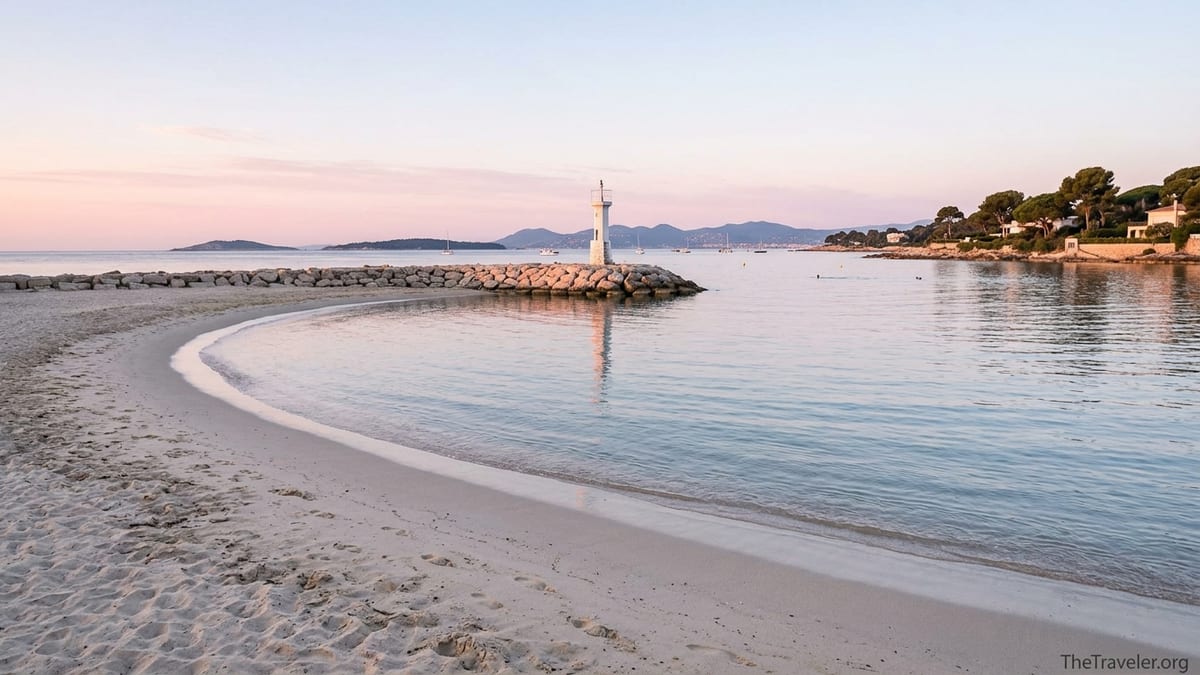
On busy summer days along the Côte d’Azur, Plage des Ondes can feel like a secret that slipped out. This small, sandy cove on Cap d’Antibes, framed by a stone jetty and views across the bay to the Lérins Islands, is beloved by locals precisely because it is calmer and less developed than the big urban beaches in Antibes and Juan les Pins. Yet timing your visit makes a dramatic difference. With a bit of planning around seasons, tides, and local habits, you can enjoy remarkably calm water and a surprisingly peaceful patch of sand in one of the Riviera’s most beautiful corners.
Get the latest updates straight to your inbox!
Understanding Plage des Ondes and Its Setting
Plage des Ondes sits on the western side of Cap d’Antibes, between Antibes and Juan les Pins. Sheltered by the headland and protected by a low stone jetty, the bay often feels like a natural swimming pool when the conditions are right. The beach itself is compact, with fine, pale sand, a shallow entry, and clear, turquoise water that gently deepens. On a quiet morning, you can clearly see the sandy bottom and patches of seagrass beneath the surface.
Unlike the larger town beaches such as La Gravette in Antibes or Plage de la Salis near the old town, Plage des Ondes has no big beachfront restaurants or rows of sun loungers. Facilities are minimal, which helps keep the atmosphere relaxed and mostly local. Parking is limited to a few perpendicular side streets, so visitors who arrive late on busy days can find it difficult to stop, another reason the beach tends to be calmer when compared with more accessible spots.
Because of its position in a semi-sheltered bay, Plage des Ondes is less exposed to waves than more open stretches of coast. On days when the mistral is blowing strongly from the northwest and roughening the sea near Nice, this cove can still offer comparatively smooth water. That said, it is not immune to wind and swell, especially when southerly winds pick up, so choosing the right season and time of day is critical if your priority is calm conditions and fewer people.
From central Antibes, many visitors reach Plage des Ondes by car or on foot via the coastal road around Cap d’Antibes. Others prefer to stay in Juan les Pins and stroll or cycle along the seafront before cutting inland toward the Cap. The modest effort required to reach the cove is rewarded when you arrive early on a clear morning and find only a handful of swimmers in the water.
Season by Season: When the Beach Is Quietest
The classic high season on the French Riviera runs roughly from late June through August, when school holidays, long daylight hours, and festival calendars bring heavy crowds to almost every stretch of sand. At Plage des Ondes, this period can still feel busy by local standards, particularly in the afternoons, but it is rarely as packed as flagship beaches such as Pampelonne near Saint-Tropez. If you are fixed to traveling in July or August, you will need to rely more on time-of-day strategies to find calm water and relative quiet.
For most visitors who prioritize both tranquility and comfortable swimming temperatures, the most rewarding months are late May, June, September, and early October. In late May and early June, holiday traffic is just beginning to build, and many local families are still tied to school schedules. You might share the beach with early-season visitors from northern Europe and local retirees, but crowds are generally light on weekdays. Water temperatures are warming, typically climbing from the mid-teens Celsius in April to the high teens or around 20 degrees in late May, making short swims refreshing but manageable with a light rash vest for those sensitive to cooler water.
September is often considered the Riviera’s sweet spot. Peak tourism has eased, yet the sea retains the warmth accumulated through July and August, often hovering around the low twenties Celsius. On a calm mid-September morning, Plage des Ondes can feel almost private, with a few regulars swimming laps along the jetty and perhaps a paddleboarder crossing the bay. Even on sunny weekends, the atmosphere is still more subdued than in midsummer, and families with school-age children tend to arrive only for the afternoon.
By early October, many beach clubs elsewhere on the coast have packed up for the season, but Plage des Ondes remains accessible as a public strand. The air can be pleasantly mild, and on sunny days the water is still swimmable for many people, especially around midday. The trade-off is less predictable weather and the possibility of autumn storms, but when conditions line up, you may experience the calmest water and thinnest crowds of the entire year.
Weather, Water Temperatures, and Sea Conditions
Antibes enjoys a classic Mediterranean climate: mild, relatively wet winters and dry, sunny summers. For swimmers who want calm water, the most important factors are not only air temperature but also sea temperature, wind direction, and recent weather. Winter months from December to February bring cooler water, averaging in the low teens Celsius. While hardy locals sometimes swim year-round, most visitors find this too chilly without a wetsuit. On the plus side, if you do not mind staying dry, the beach and surrounding coastal path are almost empty, turning Plage des Ondes into a peaceful place for seaside walks and photography.
From April onward, the sea gradually warms. Many visitors start to swim comfortably around late May or June when water temperatures approach or pass 18 to 20 degrees Celsius, depending on recent sunshine and currents. By July and August, the sea is typically at its warmest. On these summer days, the water at Plage des Ondes can feel almost bath-like by European standards, especially late in the afternoon after hours of sun on the shallow sand. This warmth, combined with light morning winds, often delivers the glassy-smooth surface that makes the cove so appealing for gentle laps and floating.
Wind is the key variable that can disrupt an otherwise perfect beach day. Northerly and northwesterly winds that dry the air over Provence can sometimes leave the west-facing side of Cap d’Antibes relatively protected, with only small ripples inside the cove. Southerly or easterly winds, however, may push more chop into the bay, increasing wave height and stirring sediment from the sandy bottom. When planning a visit, it is helpful to check a marine forecast or local weather app the evening before to look for days with light winds and stable conditions, especially if traveling with young children or nervous swimmers.
In practical terms, this means that a mid-June weekday with a calm forecast can produce a near-ideal scene at Plage des Ondes: morning air around 22 degrees, water approaching 20 degrees, and barely a ripple on the surface. In contrast, a windy afternoon in late August might bring more pronounced waves and floating seaweed, combined with hotter air and more people. Using weather and sea temperature information to guide your choice of day within a trip window often matters more than the precise calendar date.
Daily Rhythms: Best Time of Day for Calm and Quiet
Even during busy months, Plage des Ondes follows a distinct daily rhythm that you can use to your advantage. Early morning, roughly from sunrise until around 9 or 10 am, is consistently the calmest window for both water and crowds. Locals arrive for quick dips before work, often parking for 30 minutes, swimming a set route along the jetty, and leaving. Photographers and paddleboarders also favor this period for the low, soft light and cooler air. If you reach the beach between 7 and 8 am in July or August, you may find only a few towels on the sand and almost no noise beyond the lap of the water.
Late morning through mid-afternoon is when the beach fills up, particularly in school holidays and on weekends. Families with young children begin to arrive from 10 am onwards, often bringing umbrellas, coolers, and inflatable toys. The shallows in front of the jetty can become crowded with waders and beginner swimmers, and noise levels rise accordingly. At this time of day, small boats and stand-up paddleboards sometimes cross the bay, adding to the sense of activity, even though motorized traffic is relatively low compared with larger harbors.
By late afternoon, especially after 4 or 5 pm, crowds slowly thin as families head home for dinner and the sun begins to drop. On hot midsummer days, this late-afternoon window can be especially pleasant: the water remains warm from the day’s heating, but the intensity of the sun eases and the overall atmosphere becomes calmer. The sea surface often smooths out again if wind decreases with the evening. In shoulder season months like May, June, and September, this is a prime time for unhurried swims and reading on the sand.
If your schedule allows, plan your main swim for the first part of the morning, then use late afternoon for a second, more relaxed visit. Travelers staying in Antibes or Juan les Pins sometimes pair an early dip at Plage des Ondes with a leisurely breakfast in town, returning to the beach after 4 pm once the heat and noise have peaked. This simple timing strategy can transform your experience even in weeks when the Côte d’Azur is at its busiest.
Weekdays vs Weekends and Local Holiday Patterns
Crowd levels at Plage des Ondes are not only tied to the season but also to the day of the week and the French school calendar. On ordinary weekdays in June or September, a typical scene might be a handful of locals, a few couples, and occasional solo travelers resting between coastal hikes. Towels are spaced widely on the sand, and it is easy to find a quiet corner near the water’s edge. In contrast, weekends, public holidays, and the peak of August bring a clear jump in visitor numbers.
French school summer holidays usually run from early July through the first days of September. During this period, local families have more flexibility to visit the beach, and relatives from other parts of France often come to stay. Saturdays and Sundays are the busiest, especially between 11 am and 4 pm, when multi-generation groups gather, children play in the shallows, and conversations drift across the sand. If you prefer a quiet atmosphere, it is worth shifting your main beach outings to Monday through Thursday whenever possible.
There are also more subtle patterns. In late June, for example, secondary school exams can keep older teenagers occupied, softening crowds on some midweek mornings. In early September, once classes resume, weekday mornings revert to a mostly adult audience, with a few toddlers and caregivers. This period is highly attractive for visitors seeking calm: the sea is still warm from summer, but the energy of the beach is noticeably more relaxed. Travelers who can book flights in early or mid-September rather than peak August often comment that the same cove feels like an entirely different destination.
Public holidays, such as mid-August religious celebrations, can also influence beach use. On these days, some businesses close or operate shortened hours, and city residents flock to the coast. If your visit coincides with a major holiday, plan ahead by arriving at Plage des Ondes very early, or alternatively, using the morning to explore Antibes’ old town and targeting a quieter weekday for your beach time.
Practical Tips for Timing Your Visit and Beating the Crowds
Because Plage des Ondes is small and parking is limited, timing your arrival is just as important as picking the right month. If you are driving, aim to reach the nearby streets before 9 am, especially from late June through early September. At that time, it is usually still possible to find a free curbside space within a short walk of the sand. Later in the morning, drivers often circle for extended periods or settle for spots farther up the Cap, turning what should be an easy visit into a minor logistical challenge.
Travelers staying in central Antibes or Juan les Pins who do not want to deal with parking can consider taking a local bus part of the way and then walking, or using a bicycle or electric scooter. Several rental shops in both towns offer daily or half-day bike rentals, and cycling the coastal road around Cap d’Antibes in early morning or late afternoon is a scenic experience in itself. Lock up near public racks or secure railings and walk the final stretch to the beach. This approach not only sidesteps parking but also lets you adjust easily if Plage des Ondes feels busier than expected; you can continue along the coast to another, quieter cove.
Pack with the daily rhythm in mind. If you plan to stay through midday, bring a compact sun umbrella or a light pop-up shade, as natural shade on the beach is limited and the stone jetty provides only small pockets of relief. A thin neoprene top can extend your comfortable swimming season into May or October when the water can still feel cool, while water shoes are generally optional thanks to the soft sandy bottom. For a peaceful experience, many visitors pack a simple picnic rather than relying on cafes, since there are no big establishments directly on the sand. You can pick up fresh bread, fruit, and pastries early in Antibes or Juan les Pins and avoid leaving at peak hours to search for lunch.
Finally, pay attention to local etiquette and regulations. Lifeguard coverage may be limited or seasonal, and the beach does not have the same level of organized supervision as larger urban stretches. Swim within your limits, avoid blocking the narrow access paths with chairs or large gear, and keep noise low in the early morning and evening when many visitors come specifically for quiet reflection or exercise. These small choices contribute to the overall calm that makes Plage des Ondes so appealing.
Alternative Spots When Conditions Are Not Ideal
Even with careful planning, you may encounter a day when wind, swell, or crowds make Plage des Ondes less inviting. Fortunately, Cap d’Antibes and the nearby coastline offer several alternatives that can complement your visit. On days when westerly or northwesterly winds ruffle the surface at Plage des Ondes, you might find more sheltered water on the opposite side of the Cap, at beaches such as Plage de la Garoupe or smaller coves accessed via the coastal path. These spots can benefit from different exposure to wind and waves, providing smoother conditions when one side is choppy.
Closer to Antibes’ old town, Plage de la Gravette sits in a nearly enclosed harbor-like setting, with stone walls that significantly limit swell. While it usually attracts more people than Plage des Ondes, especially families with young children, its enclosed shape can make the water surprisingly calm on days when more open beaches are rough. Likewise, Plage de la Salis, just beyond the old town, offers a long, gradually sloping sandy shoreline and tends to be popular with both locals and visitors. Arriving there early, around 8 am, can deliver a similarly peaceful swim with views back to the fort and the Alps.
If the sea itself is unsettled but you still want to enjoy the coastline, consider walking the famous coastal path around Cap d’Antibes. Portions of the trail start not far from Plage des Ondes and wind past rocky inlets, villas, and viewpoints over the Bay of Cannes. On days with large swell, waves crash spectacularly on the outer rocks, creating dramatic photo opportunities while you remain safely on the marked path. You can then return another day when the wind drops to swim at Plage des Ondes under calmer conditions.
For travelers visiting in the coldest months, when swimming is less appealing, these alternative activities become the main draw. A winter walk around Cap d’Antibes, followed by coffee in Antibes’ old town and a quiet stop at Plage des Ondes to watch the changing light, offers a different but equally memorable experience of the beach, even without entering the water.
The Takeaway
Plage des Ondes rewards those who think carefully about timing. For the calmest water and fewest crowds, aim for late May, June, September, or early October, and focus your visits on weekday mornings or late afternoons. Within high season, early starts and flexible plans can still reveal a quieter side to this beloved local beach, especially if you arrive before 9 am or linger after 5 pm when daytime visitors drift away.
Combining weather checks, awareness of local holiday patterns, and a bit of logistical planning around parking or transport will significantly improve your chances of enjoying tranquil swims and peaceful time on the sand. When the conditions line up, Plage des Ondes offers exactly what many travelers hope to find on the Riviera: clear, gently lapping water, a simple strip of sand, and enough space to breathe, float, and watch the light move across the bay.
FAQ
Q1: What month is best for calm water and fewer crowds at Plage des Ondes?
September is often ideal because the sea is still warm from summer, but school holidays have ended, so weekday mornings and late afternoons are typically quiet and the water is calm when winds are light.
Q2: Is July or August ever a good time to visit for a peaceful swim?
Yes, but you need to go very early. Arriving between 7 and 8 am in July or August usually lets you enjoy relatively calm water and far fewer people before families and day-trippers arrive.
Q3: How early should I arrive to find parking near Plage des Ondes in summer?
If you are driving in late June, July, or August, try to arrive before 9 am on weekdays and even earlier on weekends. After mid-morning, the limited street parking near the beach often fills up.
Q4: When is the water warm enough to swim comfortably without a wetsuit?
Many visitors start swimming comfortably from late May or June, when the sea often reaches around the high teens to about 20 degrees Celsius, and continue through September when it remains relatively warm.
Q5: Are weekdays really less crowded than weekends?
Generally yes. From late May through September, Monday to Thursday tends to be noticeably quieter than Friday to Sunday, especially outside French school holidays, making it easier to find space on the sand and in the water.
Q6: What is the best time of day for families with young children?
Late morning, around 10 am to noon, offers warm air and plenty of light, but it is also when the beach becomes busier. For a calmer family experience, consider arriving by 9 am so children can play in the shallow water before the main crowds appear.
Q7: Can wind conditions ruin a planned beach day at Plage des Ondes?
Strong winds can create choppier water and bring in seaweed, even in this sheltered cove. Checking a local weather forecast the day before and favoring days with lighter winds will help you find calmer conditions.
Q8: Is it worth visiting Plage des Ondes outside the main swimming season?
Yes. From late autumn through early spring, the beach is very quiet and becomes a lovely spot for seaside walks, picnics, and photography, even if the water is too cold for most swimmers.
Q9: What should I bring to make the most of a quiet visit?
Pack a light umbrella or shade, water, snacks or a simple picnic, a towel, and any swimming gear you prefer. Since facilities are minimal and natural shade is limited, being self-sufficient helps preserve a peaceful, unhurried experience.
Q10: Are there good alternatives nearby if Plage des Ondes is too crowded?
Yes. Plage de la Gravette near Antibes’ old town and Plage de la Salis slightly farther east are popular options, while beaches on the opposite side of Cap d’Antibes, such as Plage de la Garoupe, can sometimes offer calmer or quieter conditions depending on wind and time of day.