


Hong Kong International Airport (HKG) on Lantau Island is one of Asia’s best-connected hubs, but the number of transport options can feel overwhelming when you are trying to catch a flight. In 2026, you can reach the airport quickly and reliably by train, airport bus, regular bus, taxi, private transfer, and even ferry if you are coming from Macau or the Chinese mainland. This guide walks through each option in plain language, using current example routes and approximate fares so you can choose the best way to get to your flight.
Get the latest updates straight to your inbox!
Understanding Where Hong Kong International Airport Sits
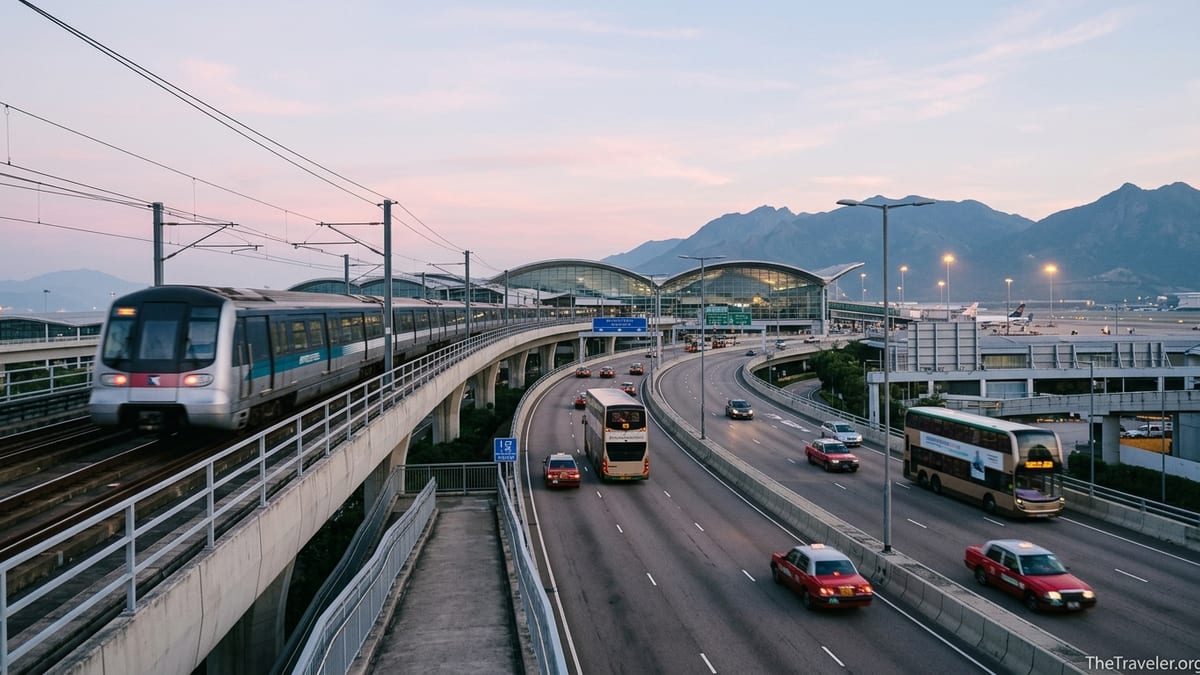
Hong Kong International Airport is built on reclaimed land off the north shore of Lantau Island, about 35 kilometers from Central. Unlike some cities where the airport sits just outside downtown, HKG is connected to the urban core by a long bridge and expressway system, as well as a dedicated railway line. That separation means journey times and costs vary a lot depending on whether you travel by train, bus or road.
Most ground transport to the airport converges at the Ground Transportation Centre next to the terminal buildings, while the Airport Express station is integrated directly into the arrivals and departures halls. If you are staying in common visitor areas such as Central, Sheung Wan, Wan Chai, Causeway Bay, Tsim Sha Tsui or Mong Kok, you will usually be choosing between the Airport Express train, a Citybus “A” airport bus, or a red taxi. Travelers coming from Lantau, Disneyland, Tung Chung, or the New Territories often combine local MTR or bus lines with a short taxi ride.
Because traffic conditions on the Lantau Link and in the Harbour Crossings can change quickly at peak hours or during bad weather, it is wise to build a buffer into your schedule. For example, a taxi from Central to the airport might take 30 minutes late at night but 45 minutes or more in the evening rush. The Airport Express train, on the other hand, runs on its own tracks and takes around 24 minutes from Hong Kong Station to the terminal, regardless of road traffic.
When planning your trip to the airport, it helps to think in terms of your starting district, luggage, budget, and appetite for transfers. A solo traveler with a carry-on in Sheung Wan might prioritize speed and choose the train. A family of four staying on Nathan Road in Tsim Sha Tsui may prefer a direct bus or shared taxi, which can be more economical than four separate train tickets.
Taking the Airport Express Train to Hong Kong Airport
The Airport Express is the flagship way to reach Hong Kong International Airport by rail. The line runs from Hong Kong Station in Central through Kowloon and Tsing Yi to the Airport and AsiaWorld-Expo. Trains run roughly every ten minutes from early morning to after midnight, and the non-stop journey from Hong Kong Station to the airport is around 24 minutes, while Kowloon to the airport takes about 21 minutes.
As of 2026, an adult single journey ticket from Hong Kong Station to the airport typically costs a little over HK$110, with slightly lower fares when you pay with an Octopus stored-value card and for shorter hops from Tsing Yi. Promotional discounts and period offers are common, so a traveler leaving from Central might realistically pay in the range of HK$100 to HK$120. Children and certain concession card holders usually enjoy around half-price travel, and there have been recent promotions that give free rides for young children and discounts for seniors, so it is worth checking current offers at MTR service counters when you arrive.
To use the Airport Express from the city, you first reach Hong Kong, Kowloon or Tsing Yi stations on the regular MTR or by taxi. For example, a visitor staying near Temple Street in Jordan could take the Tsuen Wan Line one stop south to Tsim Sha Tsui, walk the underground passage to East Tsim Sha Tsui, ride the Tuen Ma Line one stop to Austin, then follow signs to Kowloon Station and board the Airport Express. Travelers with heavier luggage often do the same trip by red taxi straight to Kowloon Station’s drop-off area, then roll their bags into the station. From many hotels in Central and Sheung Wan, it is a ten-minute taxi ride to Hong Kong Station’s Airport Express concourse.
One of the main advantages of the Airport Express is the set of extra services tailored to air passengers. In-town check-in facilities at Hong Kong Station and, for some airlines, Kowloon Station let you drop your bags and collect boarding passes several hours before your flight. Some airlines, such as Cathay Pacific and China Airlines group carriers, regularly participate in this service. Once checked in, you can ride to the airport with only hand luggage. Free porter services, Wi-Fi on trains, and occasional free same-day return rides between the city and airport add to the value, particularly for business travelers who prize reliability over absolute cost.
Using Public Buses and Airport Buses
Airport buses are the most budget-friendly way to reach Hong Kong International Airport and are a solid choice if you are not in a rush and your hotel is near a major bus stop. Several companies operate airport routes, but visitors most commonly use the Citybus “A” and “NA” routes, which run between the airport and key urban districts, stopping at major roads and hotels along the way. From Kowloon and Hong Kong Island, fares usually fall somewhere between HK$30 and HK$50, depending on distance, which is significantly cheaper than the Airport Express.
As a concrete example, the popular A21 route links the airport with Nathan Road in Kowloon, passing through Mong Kok, Yau Ma Tei and Tsim Sha Tsui. Travelers staying near Jordan MTR Station can walk a few minutes to the nearest A21 stop, tap their Octopus card on boarding, and pay roughly the mid-30s in Hong Kong dollars. The journey to the airport typically takes 45 to 70 minutes, depending on traffic. On Hong Kong Island, routes like A11 connect the airport with Sheung Wan, Central, Admiralty, Wan Chai and Causeway Bay. A traveler staying near Times Square in Causeway Bay can catch the A11 on Hennessy Road and ride all the way to the airport without changing, for a similar fare.
All airport buses stop at the Ground Transportation Centre, a short walk from the terminal doors via covered walkways and moving sidewalks. Buses are equipped with luggage racks and mostly air-conditioned double-deckers. You can pay with exact cash in Hong Kong dollars or with an Octopus card; paying cash usually requires no change, so it is practical to pick up an Octopus when you first arrive in Hong Kong, then reuse it for the return trip to the airport. Digital signage and announcements in Chinese and English clearly indicate the next stop, but it is still wise to note the name of the stop closest to your hotel, such as “Mody Road, Tsim Sha Tsui” or “Luard Road, Wan Chai,” to avoid missing it on the way back.
Night owls and early-morning flyers benefit from the “NA” overnight routes, which provide 24-hour coverage to key districts. For example, when the Airport Express has stopped for the night, an NA11 bus still connects the airport with major stops on Hong Kong Island. Journey times can be shorter late at night due to lighter traffic, though roadworks and lane closures sometimes slow things down. For most travelers, allowing 90 minutes for a bus journey from dense urban areas during the day provides a comfortable buffer.
Taking a Taxi or Private Car to Hong Kong Airport
Taxis in Hong Kong are tightly regulated and metered, making them a convenient way to reach the airport, especially if you are carrying large luggage, traveling with young children or older relatives, or leaving from a location far from rail links. Three taxi colors serve different regions: red urban taxis cover most of Hong Kong Island and Kowloon, green taxis focus on the New Territories, and blue taxis mainly serve Lantau Island, including the areas near the airport and Tung Chung. From Central or Tsim Sha Tsui, you will almost always be using a red taxi to reach the airport.
In 2026, a typical daytime fare from Central to Hong Kong International Airport in a red taxi often ends up between roughly HK$350 and HK$450 including tolls and luggage surcharges, though the exact amount depends on the tunnel used, route and traffic. Journeys from Tsim Sha Tsui are usually a little cheaper than from Wan Chai or Causeway Bay, because the taxi has slightly less distance to cover before reaching the expressway system. If you are leaving from a hotel near the Star Ferry in Tsim Sha Tsui, it is normal to see the driver choose the Western Harbour Crossing and then continue along expressways to the Lantau Link. Tunnel tolls are added to the metered fare and can amount to several tens of dollars.
For short rides on Lantau Island itself, such as from hotels in Tung Chung to the airport, blue taxis are used. A family finishing a stay near Citygate Outlets in Tung Chung, for example, may pay around HK$60 to HK$100 for a quick blue taxi ride to the terminal, an attractive option when carrying shopping bags and suitcases. Luggage in the boot attracts a small per-item surcharge, and payment is usually in cash, although more taxis now accept contactless payments or local mobile wallets. It is good practice to have enough cash in small notes, especially when leaving from less busy districts.
Pre-booked private car transfers and ride-hailing services such as app-based taxis also serve Hong Kong International Airport. Hotels catering to business travelers in Central and Admiralty, such as large international chains, often arrange private sedans or vans with flat rates that can fall in the HK$600 to HK$900 range for up to three or four passengers, depending on vehicle size and inclusions. These services are comfortable and eliminate the need to handle luggage on public transport, but they cost more than a standard metered taxi. When booking online, pay attention to whether the quoted price includes tolls, waiting time, and meet-and-greet service in the arrivals hall.
Regional Ferries and SkyPier Services
Although ferries are not used to get from downtown Hong Kong to the airport, they are very important for travelers coming from neighboring cities around the Pearl River Delta, such as Macau, Zhuhai, Zhongshan, Shenzhen and parts of Guangzhou. High-speed ferries operate between these ports and the SkyPier terminal area at Hong Kong International Airport. These services are intended mainly for transit passengers who remain within the airport’s secure zone rather than entering Hong Kong proper.
In practice, a traveler flying into Hong Kong and heading onward to Macau might check in at their origin airport all the way to Macau’s ferry terminal, then, on arrival at HKG, follow signs for “Ferries to Mainland/Macau” without passing through Hong Kong immigration. At the SkyPier check-in counters, staff verify boarding passes and direct passengers to the appropriate high-speed ferry. The journey to Macau or nearby ports typically takes around an hour, turning what would otherwise be a multi-step bus and land border crossing into a single seamless connection.
The reverse is also possible. A business traveler finishing meetings in Guangzhou or Zhongshan can board a high-speed ferry to SkyPier, where airline desks accept checked luggage and issue boarding passes for many international flights. After clearing security, passengers use an internal people mover system to reach the main departure concourses. While schedules and routes have evolved over the last few years, and some services have been temporarily suspended or reconfigured, regional ferries remain a valuable option for those traveling between the airport and cities across the Greater Bay Area.
It is important to note that these ferry services are designed primarily for international transfer passengers and generally cannot be used if you have already entered Hong Kong through regular immigration channels. Travelers starting their journey in Central or Tsim Sha Tsui should not plan to take a public ferry to the airport; the practical options are land transport by train, bus or taxi instead. Anyone considering a SkyPier ferry should verify current schedules and conditions with their airline or ferry operator and allow generous connection times, as both weather and cross-border procedures can affect operations.
Choosing the Right Option for Your Trip
With so many ways to reach Hong Kong International Airport, the best choice depends on your priorities. If you value speed and predictability above all else, the Airport Express is hard to beat. A business traveler staying in Central with just a carry-on bag can walk or take a short taxi ride to Hong Kong Station, check in bags at the in-town counter if their airline supports it, then board the train and be at the airport in around half an hour door to door. Even if the fare is higher than the bus, the saved time and reduced stress can justify the cost.
Budget-conscious travelers staying along major road corridors often gravitate toward the airport buses. A solo backpacker in a hostel near Mong Kok MTR Station, for instance, might walk a couple of blocks to catch the A21 bus to the airport, pay a fare in the mid-30s with an Octopus card, and spend just under an hour on the road while watching the cityscape pass by from the upper deck. For that traveler, the cost savings compared with the Airport Express plus MTR transfer can pay for a meal or attraction ticket in the city.
Families and small groups frequently find that metered taxis or pre-booked cars strike the right balance between comfort and value, especially when shared among three or four people. Consider a group of four staying in a serviced apartment in Wan Chai, each with a suitcase. They could drag their luggage through the MTR and Airport Express interchanges, or they could take a red taxi directly from their building to the terminal for perhaps HK$400 including tolls. Divided four ways, that is comparable to or even cheaper than four individual Airport Express tickets, and it removes the worry of maneuvering on crowded platforms or escalators.
Age and mobility also matter. Visitors traveling with elderly relatives or very young children often appreciate the reduced walking that taxis and private transfers offer. Some taxi ranks at major stations and the airport itself are supervised by staff who help allocate passengers and can provide printed estimates of typical fares to major districts. For anyone with mobility challenges, notifying the airline in advance can unlock wheelchair assistance all the way from check-in to the taxi or train platform, easing the transfer regardless of which transport mode you choose.
Practical Tips: Tickets, Timing and Luggage
A few practical habits can make your journey to Hong Kong International Airport smoother, whichever mode you select. First, allow more time than you think you need, especially during weekday evening peaks, weekend afternoons, or in heavy rain and typhoon seasons when traffic may slow suddenly. As a rule of thumb, plan to leave Central or Tsim Sha Tsui for the airport at least three hours before a long-haul international departure, and even earlier if you are using road transport during rush hour or traveling from farther-flung New Territories districts.
Second, consider buying an Octopus card early in your stay. This contactless stored-value card is accepted on the MTR, buses, trams, many taxis and convenience stores. A visitor who purchases an Octopus at the airport on arrival can use it throughout their trip for almost all public transport, then tap on the Airport Express, Citybus routes or local buses on the way back. Not only does this simplify payments, it often makes transfers smoother. Rather than queuing at a machine for every ticket, you simply tap and go, which is particularly helpful when boarding busy airport buses or taking connecting MTR lines to Hong Kong or Kowloon stations.
For luggage, think about how comfortable you are with stairs, escalators and lifts. The Airport Express stations and airport buses are designed with travelers in mind, featuring wide walkways and luggage racks, but some older MTR exits and pedestrian tunnels involve relatively long walks and occasional staircases. If you are carrying multiple large bags, the combination of a short taxi ride to an Airport Express station plus the train usually feels easier than a purely bus-and-MTR route. In contrast, a single medium suitcase and backpack are manageable on most buses and trains.
Finally, keep an eye on notifications from your airline and local news, especially during typhoon season. While the Airport Express and airport buses have good records for operating in adverse weather, extreme conditions can temporarily disrupt all modes of transport. In those situations, leaving for the airport even earlier, or staying at an airport hotel the night before, can be a sensible precaution. Many travelers flying early morning long-haul flights choose to stay at hotels in Tung Chung or near the airport to minimize travel risks on the day of departure.
The Takeaway
Reaching Hong Kong International Airport is straightforward once you match the transport mode to your situation. The Airport Express train is the fastest and most predictable option from Central and Kowloon, especially for business travelers and those with light luggage. Airport buses offer excellent value and wide coverage, particularly along Nathan Road in Kowloon and Hennessy Road on Hong Kong Island. Taxis and private cars shine when comfort, door-to-door convenience and group travel are more important than absolute price.
Regional ferries via SkyPier extend the airport’s reach to Macau and cities across the Pearl River Delta, providing convenient connections for international transit passengers. Whichever option you choose, building in a generous time buffer, using an Octopus card for easy payment, and being realistic about your luggage and mobility will make your journey to the airport smoother and far less stressful. With a little planning, getting to Hong Kong International Airport becomes just another enjoyable part of your trip rather than a last-minute scramble.
FAQ
Q1. What is the fastest way to get to Hong Kong International Airport from Central?
The Airport Express train from Hong Kong Station is usually the fastest option, taking around 24 minutes to reach the airport once you are on board.
Q2. How early should I leave for the airport from downtown Hong Kong?
Leaving at least three hours before an international flight is sensible from Central or Tsim Sha Tsui, and even earlier during peak traffic or bad weather.
Q3. Is the Airport Express worth the higher fare compared with buses?
For many travelers it is, because it offers a fixed journey time, comfortable seating, and fewer transfers. Budget travelers may still prefer the cheaper airport buses.
Q4. Can I take a regular city bus to the airport instead of a special airport route?
Yes, some regular bus routes serve the airport area, but most visitors find the dedicated airport “A” and “NA” routes easier due to luggage space and simpler stops.
Q5. How much does a taxi from Tsim Sha Tsui or Central to the airport usually cost?
In normal daytime conditions, a red taxi fare from these areas often falls in the approximate range of HK$350 to HK$450 including tunnel tolls and luggage surcharges.
Q6. Are there 24-hour transport options to Hong Kong International Airport?
Yes, overnight airport bus routes and taxis operate around the clock. The Airport Express runs from early morning to shortly after midnight but not all night.
Q7. Can I use ride-hailing apps to get to the airport?
Yes, several ride-hailing and app-based taxi services can take you to the airport, usually at prices similar to or slightly higher than standard metered taxis depending on demand.
Q8. How do I get to the airport from Disneyland or Tung Chung?
From Hong Kong Disneyland or Tung Chung town, you can take a short blue taxi ride or a local bus to the airport, with journey times typically under 20 minutes.
Q9. Can I go straight from Macau or mainland China to Hong Kong International Airport by ferry?
Yes, high-speed ferries connect ports such as Macau and some mainland cities to the airport’s SkyPier, mainly for international transit passengers who remain in the secure area.
Q10. Is it safe and easy to travel to the airport with large luggage on buses and trains?
Yes, both the Airport Express and airport buses are designed with luggage racks and wide aisles. However, if you have very bulky bags, a taxi or private car may be more comfortable.