


More news on this day
More than 100 firefighters have been deployed to tackle a major blaze along a railway embankment in east London, where dry vegetation and proximity to homes and rail lines have turned a fast-moving fire into a significant transport and neighbourhood incident.
Get the latest news straight to your inbox!
Fire breaks out near Walthamstow homes and rail lines
Reports indicate that the fire began on Sunday near Vallentin Road and Shernhall Street in Walthamstow, a residential area of east London bordered by busy rail routes. Publicly available information describes flames spreading through back gardens, sheds and trees before taking hold along a nearby railway embankment.
Images and video shared by local media and social platforms show thick smoke rising behind terraced housing and over the tracks, with the glow of the fire visible from surrounding streets. Witnesses described fast-moving flames racing through parched shrubs and fence lines close to people’s homes.
London Fire Brigade statements cited in published coverage say around 20 fire engines and approximately 120 to 125 firefighters have been committed to the incident. Crews are understood to be working from multiple access points to surround the seat of the blaze and prevent it spreading further along the embankment or into adjoining properties.
Early assessments suggest that the fire involved a mix of domestic outbuildings, garden structures and lineside vegetation, a combination that can burn intensely when conditions are hot and dry. At this stage, publicly available reports do not indicate a confirmed cause.
Residents evacuated as firefighters create safety cordon
People living closest to the fire have been moved out of their homes as a precaution while crews continue to work in back gardens and along the rail corridor. Local coverage notes that residents on streets immediately adjacent to the affected stretch of embankment were asked to leave while firefighters established a safety cordon and positioned hose lines.
Those remaining in nearby properties have been advised in public messages to keep windows and doors closed to limit smoke entering their homes. For some streets, the fire has come within a short distance of rear walls and fences, raising concerns about flying embers and radiant heat.
Emergency access has required partial road closures around the Walthamstow Village area, with fire appliances, support vehicles and hose reels occupying narrow streets. This has caused localised disruption for drivers and bus services, while pedestrians have been diverted around cordoned sections.
There have been no immediate reports in the public domain of serious injuries linked to the incident. However, crews are expected to remain on scene for some time to damp down hotspots and carry out checks on affected outbuildings and garden structures.
Rail services severely disrupted across east London
The location of the blaze on and beside a railway embankment has had a pronounced impact on travel through east London. Published reports reference significant disruption around Walthamstow and Stratford, where key commuter routes converge and multiple operators share tracks and junctions.
Public information from rail operators indicates that trains through the area have been suspended or diverted while the line is inspected for heat and smoke damage. Signalling and telecoms equipment installed along the tracks is particularly vulnerable when fires reach the embankment, and early statements suggest that some infrastructure may have been affected.
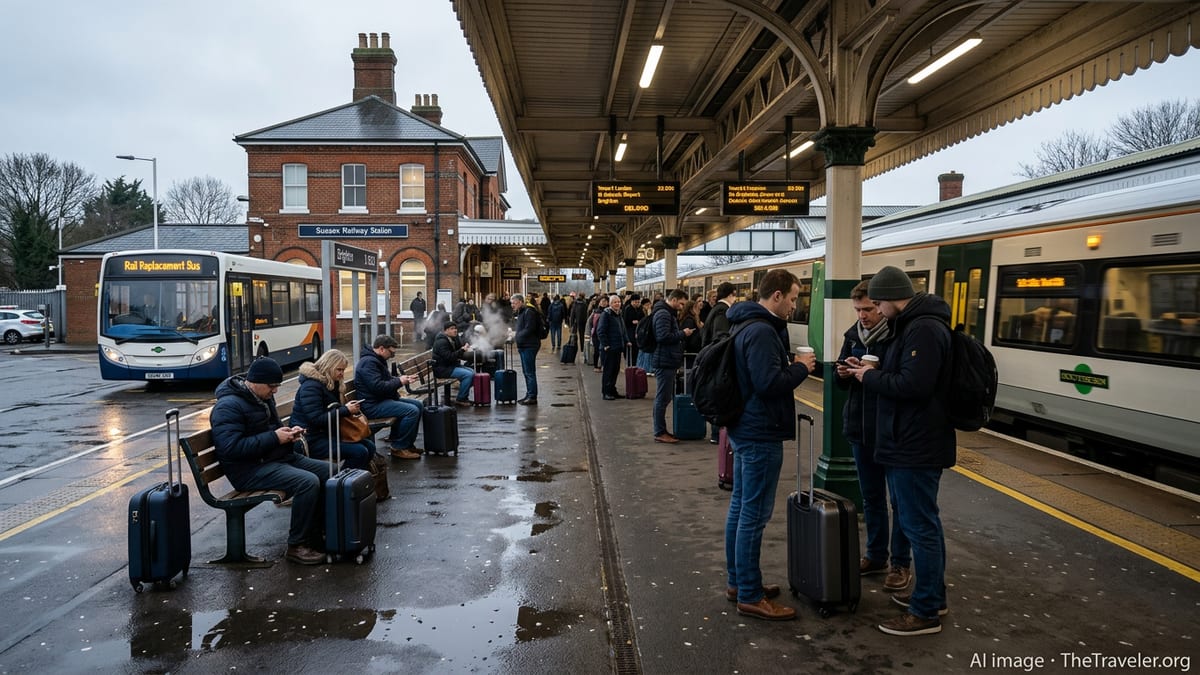
Passengers have been advised through operator updates to check before travelling, with cancellations and extended journey times expected into Monday. Some services are being rerouted around the affected corridor, while others are terminating short of usual destinations, requiring travellers to switch to alternative lines or local buses.
For many commuters and leisure travellers, the incident is the latest reminder of how quickly a relatively small fire can cascade into wide-reaching disruption when it intersects with busy rail hubs and interchanges in the capital’s east.
Dry conditions heighten risk of lineside fires
The blaze comes amid a period of hot, dry weather that has left grass verges, gardens and embankments highly susceptible to ignition. Recent weeks have seen a series of open-land and lineside fires around London, and fire services have repeatedly urged the public to take extra care with barbecues, discarded cigarettes and glass bottles.
Travel and safety experts note that railway embankments can be particularly exposed in such conditions. Sloped ground, dense shrubs, discarded debris and limited access points mean that once a fire takes hold, it can travel quickly and prove difficult to reach with standard appliances.
Past incidents have shown that even when flames are brought under control relatively swiftly, the residual impact on signalling equipment, power cables and trackside structures can extend disruption long after the last smoke has cleared. As a result, operators tend to keep lines closed until engineers have completed detailed inspections and any repairs.
Environmental groups and local campaigners have also drawn attention, in previous summers, to the cumulative effect of repeated heat-related fires on urban green spaces that line rail routes. Replanting, soil stability and biodiversity can all be affected when sections of embankment are repeatedly scorched.
Ongoing response and what travellers can expect next
As of Sunday evening, publicly available information suggests that firefighting operations are continuing, with crews expected to remain in place into the night to prevent any reignition. Once the main fronts are fully extinguished, teams typically carry out extensive damping down of soil, wooden structures and railway-side vegetation.
Railway engineers are likely to begin more detailed surveys once the area is declared safe, checking cabling, equipment cabinets and overhead structures where present. The timeline for full service restoration will depend on the extent of any damage uncovered and the complexity of required repairs.
For travellers planning journeys through east London and towards key hubs such as Stratford and Liverpool Street, transport bulletins indicate that short-notice alterations remain possible. Replacement buses, alternative Tube routes and different mainline paths may all form part of contingency plans while the corridor is fully assessed.
For neighbourhoods around Walthamstow, the incident will likely prompt renewed discussion about fire resilience in densely built districts bordering major transport infrastructure. Garden waste management, access routes for emergency vehicles and public awareness of fire risks in hot, dry spells are expected to feature in the debate once the immediate phase of the response has passed.