


Taksim Square is one of Istanbul’s main crossroads, linking hotels, nightlife, and Istiklal Street with the rest of the city. Whether you arrive at Istanbul Airport, Sabiha Gökçen or are already in the historic peninsula, there are several straightforward ways to reach Taksim using a mix of metro, funicular, airport buses and taxis. This guide focuses on practical, 2026-updated details so you can choose the easiest route from where you are starting, even with luggage in tow.
Get the latest updates straight to your inbox!
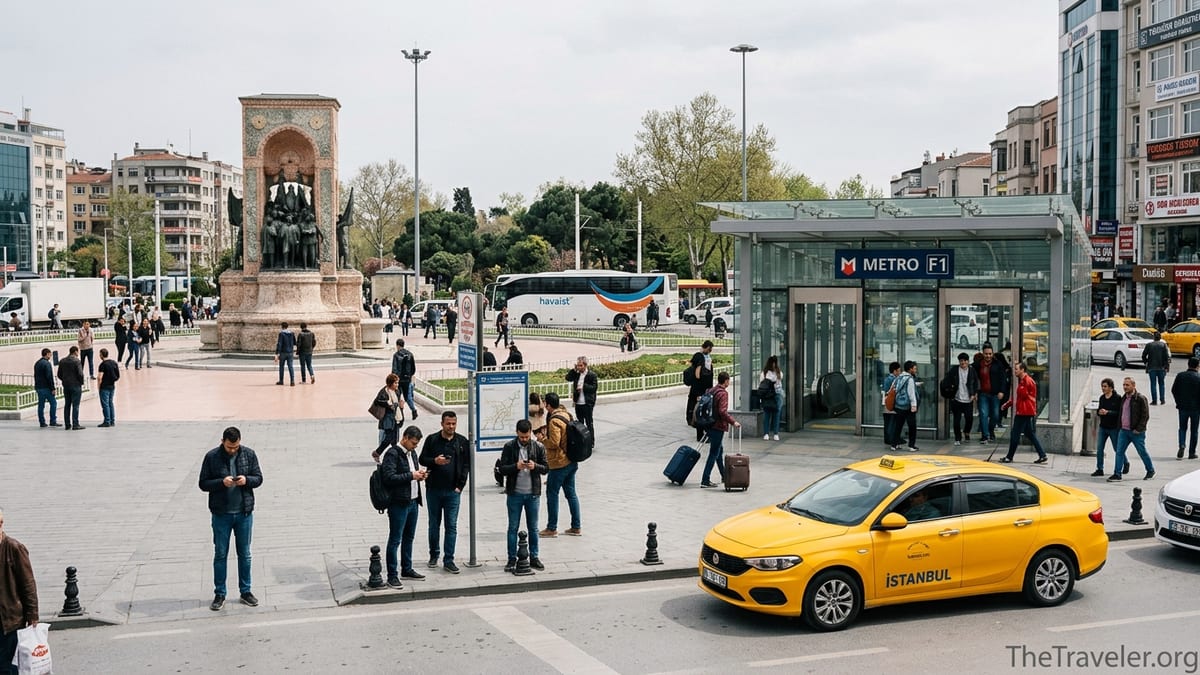
Understanding Where Taksim Square Fits in Istanbul
Taksim Square sits in the Beyoğlu district on the European side of Istanbul, just above the Golden Horn. Under the square you will find one of the city’s main transport hubs: Taksim station on the M2 metro line and the upper station of the F1 funicular from Kabataş. This underground complex means that once you reach Taksim by public transport, you emerge directly at or next to the square, a few steps from Istiklal Street and major hotels.
Because of this central location, most public transport planners and hotel transfer services treat Taksim as a key reference point. Airport buses from both Istanbul Airport (IST) and Sabiha Gökçen (SAW) list Taksim as a main stop, and many visitors heading onward to Cihangir, Galata, Karaköy or Nişantaşı will first route via Taksim. As you plan your trip into town, it helps to think of Taksim as your “base station” that you reach first, then connect onward by short taxi rides or a single metro stop.
In practical terms, if you tell any taxi driver or shuttle staff “Taksim Meydanı,” they will know exactly where to drop you. Many airport shuttle buses stop at the Gezi Park side of Taksim, near an M2 metro entrance, while others stop closer to the Atatürk Cultural Center. Once you are there, most central hotels in Beyoğlu are within a 10 to 15 minute walk.
Getting to Taksim by M2 Metro Line
The M2 metro is the green line running roughly north to south between Yenikapı and Hacıosman, passing under key centers such as Vezneciler (near the Grand Bazaar), Şişhane (for lower İstiklal and Galata), Taksim, Osmanbey and Levent. Taksim station sits right in the middle of the line, making it easy to reach from both the old city and the business districts. Trains are frequent, typically every few minutes during the day, and services extend into late evening, roughly around midnight, though exact hours vary slightly by day.
If you are staying around Sultanahmet or the Grand Bazaar, a common route is to take the T1 tram to Laleli or Aksaray, walk or ride one stop to Yenikapı metro station, then change to the M2 line in the direction of Hacıosman and get off at Taksim. For example, a traveler staying near the Blue Mosque might walk to Sultanahmet tram stop, ride to Laleli-Üniversite, walk ten minutes to Yenikapı, then ride the M2 four stops to Taksim. With an Istanbulkart, each leg costs only a modest amount in Turkish lira, and transfers within a short period are discounted.
From the northern business districts such as Levent, 4. Levent or Sanayi, you simply board the M2 in the direction of Yenikapı and exit at Taksim. A commuter staying in a hotel near Levent Plaza, for instance, can walk to Levent station, ride about ten minutes and emerge directly at Taksim Square without ever needing a taxi. This metro option is especially attractive during rush hour, when surface traffic on Büyükdere Avenue and over the Bosphorus bridges can be very slow.
Using the F1 Funicular from Kabataş to Taksim
The F1 funicular connects the seafront transport hub at Kabataş with Taksim Square in around 2 to 3 minutes. Kabataş itself is a busy interchange where the T1 tram from Sultanahmet terminates and where ferries arrive from Kadıköy and Üsküdar on the Asian side. Because of this, F1 is one of the most convenient ways to reach Taksim when you are arriving by tram from the historic peninsula or by ferry across the Bosphorus.
A typical journey from Sultanahmet to Taksim might look like this: you board the T1 tram at Sultanahmet in the direction of Kabataş, ride past Karaköy and Fındıklı, and get off at Kabataş, the final stop. From the tram platform you follow signs for the funicular, tap your Istanbulkart at the entrance, and board the next F1 vehicle. Within a couple of minutes you arrive at the upper station under Taksim Square and ascend via escalators or elevators to street level. Most of the route is step free, which makes it manageable with rolling suitcases.
F1 also matters if you are coming from the Asian side by ferry. For example, from Kadıköy pier you can take a city ferry to Kabataş, enjoying the Bosphorus views, then transfer directly to F1. A traveler staying in Moda might ride the Kadıköy tram or walk to the pier, take the ferry to Kabataş in about 20 minutes, then reach Taksim via the F1 in a few minutes more. This sea plus funicular combination avoids the road tunnels and bridge traffic and often feels more relaxed after a long day of sightseeing.
Airport Buses to Taksim from Istanbul Airport and Sabiha Gökçen
Istanbul Airport (IST) on the European side is connected to Taksim by both metro and official airport buses. In 2026, one of the main shuttle routes is a Havaist service from IST to Taksim, taking roughly 60 to 75 minutes depending on traffic and time of day, with an approximate fare a little over 100 lira per person. Buses depart from the lower level bus station at the airport and are clearly marked with their line code and destination. You can pay using Istanbulkart on board or buy a separate ticket from the Havaist counters and machines in the terminal.
Many visitors, especially those arriving late in the evening with larger luggage, prefer the Havaist bus over the metro for the first trip into the city. For instance, a couple landing at IST around 22:00 might grab a quick snack in the arrivals hall, follow signs to the bus station, and board the next Taksim-bound Havaist coach. They store their suitcases in the luggage hold, find assigned seats, and ride directly to Taksim without making transfers or navigating long underground corridors with bags.
Sabiha Gökçen Airport (SAW) on the Asian side is served by Havabus shuttle coaches running to both Kadıköy and Taksim. The Taksim coach typically takes around 60 to 90 minutes depending on traffic and currently costs several hundred lira per person, with fares updated periodically for inflation. The bus route usually runs SAW to Kadıköy or via key junctions, then across the Bosphorus bridge and onward to Zincirlikuyu and Taksim. Tickets are sold at a small Havabus kiosk or directly by the driver, often in cash or by bank card.
For a concrete example, a family of four arriving at SAW at 18:00 could wheel their luggage out of the terminal, look for the Havabus stand marked for Taksim, place their bags under the coach and pay the driver. Even if the total travel time ends up being 90 minutes due to bridge traffic, they still have a simple, one-vehicle ride that drops them at Taksim near Gezi Park. For this group, the cost is usually substantially lower than taking two separate taxis over the bridge, especially during peak evening hours.
Metro, Airport Metro and When Taxis Make Sense
In addition to buses, both airports now connect to the city’s metro network. From Istanbul Airport, the M11 line links the terminal with Gayrettepe station, where you can transfer to the M2 line to reach Taksim. A common route looks like this: you board M11 at the airport, ride to Gayrettepe, follow the transfer signs, then take the M2 in the Yenikapı direction and get off at Taksim a few stops later. For solo or budget travelers who are comfortable with transfers and escalators, this can be the cheapest and often the fastest option during daytime, since it avoids traffic entirely.
From Sabiha Gökçen, a metro line connects the airport to the M4 Kadıköy route. While there is no direct metro link from SAW to Taksim, a combination is possible: one route often used by independent travelers is SAW metro to a Marmaray connection, Marmaray under the Bosphorus to Yenikapı, then M2 to Taksim. This sequence is cheaper than a taxi and fully on rails, but with multiple transfers and lots of walking inside stations it is better suited to those carrying only backpacks or small suitcases.
Taxis remain a popular choice from both airports, particularly late at night or for small groups. From Istanbul Airport to Taksim, the ride typically takes 40 to 70 minutes depending on traffic and costs several times more than the Havaist fare, but if three or four people share the car the price per person can be reasonable. From Sabiha Gökçen, the taxi route crosses to the European side via one of the bridges or tunnels, and the distance is longer, so fares are notably higher.
For real-world context, imagine three friends landing at IST around midnight with large checked bags. Metro services are winding down and they are tired from a long flight. In this case, taking a yellow taxi from the official airport rank to Taksim can be worth the extra cost for a direct, door to door ride. Conversely, a solo traveler landing at 11:00 in the morning with one carry-on may find the M11 plus M2 combination both cheaper and as fast or faster than a taxi stuck in midday traffic.
Walking to Taksim from Galata, Karaköy and Nearby Areas
If you are already staying close by, walking to Taksim can be more pleasant than dealing with vehicles. From the Galata Tower area, for example, you can walk up İstiklal Street to the square in around 15 to 20 minutes at a relaxed pace. The route climbs gently, passing cafes, small boutiques, and side streets leading to Cihangir. Even with a small suitcase, this walk is manageable, though you will be pulling uphill part of the way.
From Karaköy, you have two main options. One is to ride the historic Tünel funicular from Karaköy up to the top of the hill at Tünel Square, then continue along İstiklal Street on foot to Taksim. The second is simply to walk via the steep streets of the neighborhood, which can be tiring with luggage. Many travelers split the difference: they take a short taxi ride from their hotel in Karaköy or Galata to Taksim when they first arrive with big bags, then walk back down later in the day when exploring the area with just a daypack.
From Beşiktaş, you can either walk or use a short combination of buses or a taxi. On foot, the route from Beşiktaş pier up to Taksim takes around 25 to 35 minutes depending on your pace and the exact streets you choose. It is a steady uphill walk past Dolmabahçe Palace and along Gümüşsuyu or through Maçka Park, which can be pleasant in cool weather but exhausting in summer with heavy luggage. In such cases, a quick taxi ride from Beşiktaş to Taksim is usually not too expensive and saves you the climb.
Istanbulkart, Tickets and Handling Luggage
Istanbulkart is the rechargeable contactless card used on almost all of Istanbul’s public transport network, including metro, trams, buses, funiculars and many ferries. At Istanbul Airport and Sabiha Gökçen you can find Istanbulkart vending machines or staffed kiosks in or near the arrivals level and at major metro and bus stations. A typical arrival routine might be to buy one card and load some credit, then tap for each ride. Groups can share a single physical card by tapping once per person at the barrier, with a short pause between taps, although discounted transfer fares do not always apply to every rider in that case.
For airport buses such as Havaist and Havabus, payment options vary slightly. Some Havaist routes accept Istanbulkart directly on board, while others use QR codes or tickets purchased from kiosks and machines. Havabus services from Sabiha Gökçen typically sell tickets on the spot through a small desk or directly via the driver. When you arrive, allow a few extra minutes to understand which system is in use and to buy or load what you need before boarding so you do not have to rush with baggage.
Managing luggage on these routes is generally straightforward, but each mode has its trade-offs. Airport buses have large underfloor luggage holds where you place bigger suitcases before getting on, so you only carry a small bag into the cabin. Metros and trams, by contrast, require you to keep your bags with you, lifting them on and off trains and sometimes navigating stairs or escalators. For example, the F1 funicular and M2 station at Taksim provide escalators and elevators, but during peak periods these can be crowded, so it helps to travel slightly outside rush hour if you are hauling heavy bags.
If you have oversized items like ski bags or bulky musical instruments, airport buses or taxis are usually more comfortable than the metro system. A musician arriving at IST with a large instrument case might prefer the Havaist coach to Taksim, where they can safely store the case underneath, and then a short taxi to their rehearsal space. Similarly, families with strollers often find it easier to use buses and taxis for the airport leg, switching to metro and trams only for shorter hops once they have settled into their hotel.
Choosing the Easiest Route by Starting Area
The “best” way to reach Taksim depends heavily on where you are starting, what time you travel, and how much luggage you carry. From Istanbul Airport, a simple rule of thumb is that metro plus M2 is generally fastest in light luggage daytime situations, while Havaist buses and taxis are more comfortable in late-night or heavy luggage scenarios. A solo budget traveler arriving at 11:00 could head straight to the M11 metro for a cheap and efficient ride, whereas a family of five landing at 23:30 might prefer a prebooked van or an official taxi to Taksim hotel door.
From Sabiha Gökçen, Havabus to Taksim is the most straightforward for first-time visitors. It avoids multiple changes, deposits luggage under the bus, and delivers you directly to the square. More complex combinations using metro and Marmaray are ideal for seasoned travelers familiar with Istanbul’s transport map who want to minimize costs and avoid road traffic. For example, a frequent visitor with only a cabin backpack might ride the SAW metro, change to Marmaray under the Bosphorus, then switch at Yenikapı to M2 and get off at Taksim, all paid by Istanbulkart.
If you are coming from within the city, your nearest rapid transit line usually dictates the choice. Guests staying around Sultanahmet often take T1 plus F1, or T1 to a Marmaray or M2 connection, while those in Şişli or Levent rely almost entirely on the M2. From Kadıköy and Üsküdar, ferry plus F1 via Kabataş is both scenic and reliable, and often less tiring than riding a bus through bridge traffic. In all cases, checking the time of day and allowing extra minutes for crowds at major interchanges like Yenikapı and Taksim will keep your transfer stress much lower.
For late arrivals or travelers worried about getting lost, arranging a hotel or private transfer from the airport to Taksim area can make sense despite the higher cost. After that first leg, you can familiarize yourself with the metro, funicular and tram network at your own pace. Many visitors adopt a mixed strategy: bus or taxi for the airport runs, then primarily metro, funicular and walking for daily sightseeing between Taksim, Galata, Karaköy and the old city.
The Takeaway
Reaching Taksim Square is rarely complicated once you match your route to your starting point and travel style. From Istanbul Airport, metro plus M2 and Havaist buses both work well; from Sabiha Gökçen, Havabus to Taksim is a reliable favorite; within the city, the M2 metro and F1 funicular from Kabataş are your main tools, with ferries and short walks filling the gaps.
Think in terms of comfort versus complexity: the more luggage you have and the later you arrive, the more attractive a direct bus or taxi becomes. Conversely, if you land in daytime with only a backpack, combining metro lines and the funicular is inexpensive, traffic free and reasonably quick. Whatever you choose, Taksim’s role as a central hub means that dozens of options converge there, so you are never far from a straightforward way to get in or out.
FAQ
Q1. What is the simplest way to get from Istanbul Airport to Taksim Square?
The simplest option for most first time visitors is usually the official Havaist airport bus to Taksim, which runs frequently, allows you to stow large luggage in the hold, and drops you close to the square without transfers.
Q2. Is metro or bus better from Istanbul Airport to Taksim?
The metro combination using M11 plus M2 is usually cheaper and can be faster when traffic is heavy, but involves at least one transfer and walking through large stations; the Havaist bus is more comfortable with luggage and at night, but takes longer when roads are congested.
Q3. How do I reach Taksim from Sabiha Gökçen Airport?
The most straightforward method is to use the Havabus coach from Sabiha Gökçen directly to Taksim, paying the driver or kiosk, then walking or taking a short taxi from the Taksim drop off to your hotel.
Q4. Can I walk from Galata or Karaköy to Taksim Square?
Yes, you can walk uphill from Galata or Karaköy to Taksim in about 15 to 30 minutes depending on your exact starting point; the route via İstiklal Street from Galata Tower is the most popular for pedestrians without heavy luggage.
Q5. How do I use the F1 funicular between Kabataş and Taksim?
From the T1 tram or ferry at Kabataş, follow signs for the funicular, tap your Istanbulkart at the entrance gates, board the next F1 car, and ride a couple of minutes up to the Taksim station beneath the square.
Q6. Is the M2 metro to Taksim safe and suitable with luggage?
The M2 line is widely used by commuters and visitors and is generally considered safe; it is fine with rolling suitcases as long as you can manage them on escalators and in crowds, though airport coaches or taxis are more comfortable with very large or multiple bags.
Q7. Where can I buy or top up an Istanbulkart for travel to Taksim?
You can usually buy and load Istanbulkart at machines or kiosks in airport terminals, at major metro and tram stations like Istanbul Airport, Yenikapı, Kabataş and Taksim itself, and at some newsstands and small shops displaying the Istanbulkart logo.
Q8. Are taxis from the airports to Taksim fixed price?
Standard yellow taxis operate on a meter rather than a fixed price, so the final fare depends on distance and traffic; to avoid disputes, always use the official taxi rank at the airport and check that the meter is running when you depart.
Q9. What is the best route from Sultanahmet to Taksim Square?
A common route is to take the T1 tram from Sultanahmet to Kabataş and then transfer to the F1 funicular up to Taksim; alternatively, you can use the tram plus a Metro or Marmaray connection if that better suits your hotel location.
Q10. How late do metro and funicular services to Taksim run?
Exact times vary by day, but the M2 metro and F1 funicular typically operate from early morning until around midnight; if you arrive later than that, use airport buses or taxis to reach Taksim instead.