


Taksim Square is the beating heart of modern Istanbul, a place where busy transport hubs meet strolling locals, late-night street food, and some of the city’s most famous landmarks. From here, İstiklal Avenue runs south toward the Golden Horn, Gezi Park offers a patch of green amid the concrete, and the red nostalgic tram clanks past crowds and street musicians. This compact area is where many first-time visitors get their first real sense of contemporary Istanbul.
Get the latest updates straight to your inbox!
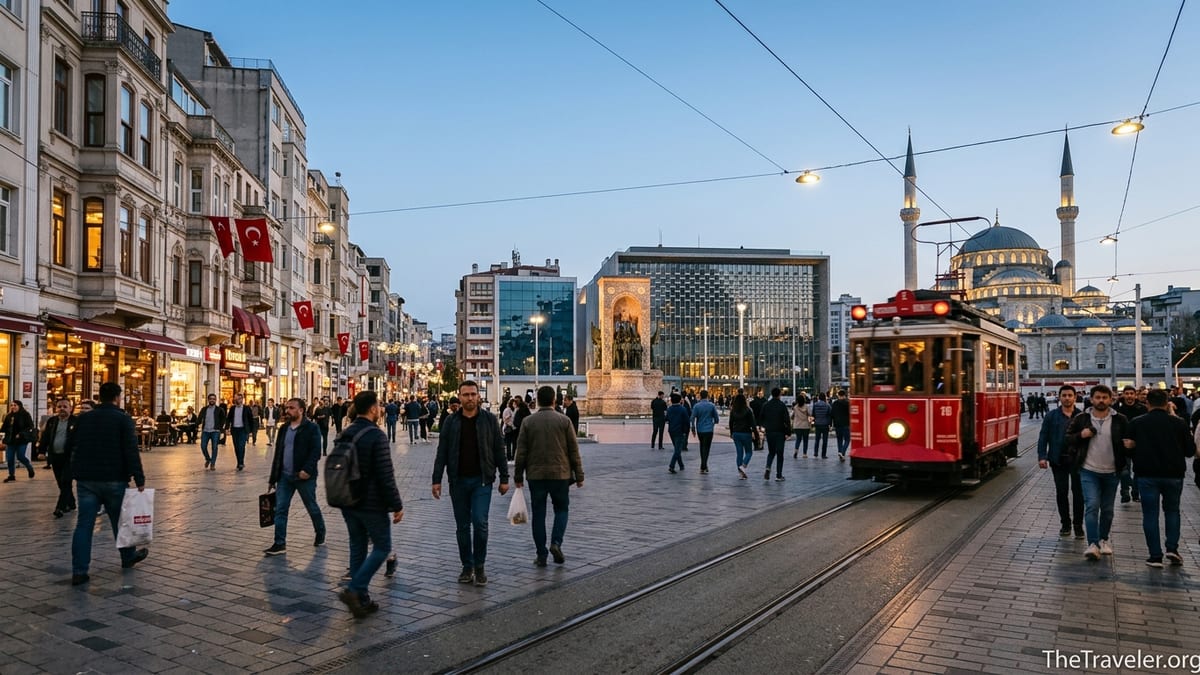
Getting Oriented in Taksim Square
Taksim Square sits at the northern end of İstiklal Avenue and is one of Istanbul’s main transport crossroads. The M2 metro line stops directly under the square, with trains running toward Şişli, Levent and Yenikapı, while the F1 funicular connects Taksim with Kabataş on the Bosphorus. From Kabataş you can change to ferries and the T1 tram for Sultanahmet, which makes Taksim a practical base for exploring both modern and historic Istanbul in a single day.
Above ground, the square can initially feel like a vast, slightly anonymous expanse of paving. Give your eyes a moment to adjust. On one side you will see the modern glass-and-stone Atatürk Cultural Center, on another the large Taksim Mosque, and on yet another the entrance to Gezi Park rising up a gentle slope. Streets radiate out toward Beyoğlu’s nightlife districts, residential neighborhoods like Cihangir, and major hotels such as The Marmara Taksim and other international chains that ring the square.
Most visitors use Taksim Square as a starting point for a walking route that links several of Istanbul’s signature experiences in a few hours. A practical sequence is to begin at the Republic Monument, continue into İstiklal Avenue for shopping and snacks, pause in a side-street café, then either keep walking downhill toward Galata Tower or cut over to Gezi Park for a breather before an evening performance or dinner. Because crowds are thick and surfaces are hard, comfortable shoes and a small daypack are more important here than in almost any other part of the city.
The Republic Monument: Story of Modern Turkey in Stone
At the literal and symbolic center of Taksim Square stands the Republic Monument, a roughly 12-meter-high stone and bronze structure unveiled in 1928 to mark the fifth anniversary of the Turkish Republic. Look closely and you will see two distinct faces. One side shows Mustafa Kemal Atatürk in military uniform, alongside key commanders from the War of Independence, while the other shows him in a Western-style suit as statesman and founder of the modern republic. Guides often use the monument to explain Turkey’s rapid early-20th-century transformation to first-time visitors.
Because so many national ceremonies, commemorations, and political gatherings traditionally focus on this spot, the area around the monument is often busy with state wreaths, TV cameras, or police units. On national holidays like Republic Day or Victory Day, you might find the square partly closed off or ringed with security barriers, so it is wise to allow extra time if you are visiting around late October or late August. On regular weekdays, however, the monument simply anchors the flow of life, surrounded by school groups taking photos and older couples sitting on the low railings for a rest.
This is a good place to pause, get your bearings and take photographs. If you stand on the side of the monument that faces south, you will look straight down İstiklal Avenue with the nostalgic tram tracks leading your eye into the distance. Turn slightly and you can frame the monument against the Taksim Mosque or the Atatürk Cultural Center. Because the square is open and often windy, light changes quickly; early morning and late afternoon are usually best for softer shadows and less glare.
Walking İstiklal Avenue: From Taksim to Tunel
İstiklal Avenue, or İstiklal Caddesi, begins at Taksim Square and runs roughly 1.4 kilometers downhill to Tunel Square near the historic funicular. For much of its length it is pedestrianized, surfaced with polished stone and lined with a dense mix of international chains, Turkish brands, historic passages, churches and small galleries. At busy times, especially Friday and Saturday evenings, the crowds can feel as dense as a music festival, with buskers, ice-cream vendors and spontaneous political or religious groups all sharing the same thoroughfare.
Most visitors will recognize global fashion names straight away, but it is worth seeking out Turkish brands if you want to shop with a sense of place. On the stretch just below Taksim, you might browse clothing at LC Waikiki or DeFacto, pick up home textiles at Madame Coco, or buy cosmetics in a branch of Gratis or Watsons. For a quick mall-style break with air conditioning and clean restrooms, step into Demirören İstiklal, a mid-sized shopping center set directly on the avenue and housing a mix of cinema, food court and familiar international retailers like Decathlon or Marks & Spencer.
As you walk south, try to balance big-name storefronts with the side streets and passages that give Beyoğlu its character. The Atlas, Hazzopulo and Çiçek (Flower) arcades still contain small cafés, tobacconists and old-school bars, even if some have become more tourist-oriented. A short detour down a side street might lead to a Greek Orthodox or Armenian church tucked between buildings, or to a quieter residential block where local children play football. You do not need a rigid plan here; the best approach is to wander a little, always returning to the main avenue when you are ready.
Time your walk so that you reach the southern end of İstiklal near sunset, when you can continue down Galip Dede Street toward Galata Tower and then on to Karaköy and the waterfront. The downhill route from Taksim through İstiklal to Galata is easier on the legs than walking uphill, and many locals recommend starting at Taksim, slowly descending via cafés and snack stops, then finishing with a Bosphorus-side drink in Karaköy or at the redeveloped Galataport cruise terminal.
The Nostalgic Tram: Iconic Ride, Practical Short-cut
The red nostalgic tram that runs along İstiklal Avenue is one of Istanbul’s most photographed symbols. Officially designated the T2 line, it normally trundles between Taksim Square and Tunel, ringing its bell as it threads through pedestrian crowds. The vehicles are restored early-20th-century tramcars, with wooden interiors and small open platforms at each end where, despite official warnings, energetic teenagers sometimes try to jump on and off for fun.
In practice, the tram is more about atmosphere than speed. The full journey from Taksim to Tunel usually takes around 15 to 20 minutes when operating, and it can be slightly slower than walking if the street is very busy. Fares are typically aligned with city tram prices and payable with the Istanbulkart transport card, though you should always check current information on ticket machines or station signs. At times of heightened security or on specific dates, services on the nostalgic tram may be suspended temporarily, so treat a ride as a bonus rather than something to schedule your entire day around.
Even when you do not ride it, the tram is part of the street’s rhythm. Photographers often wait near the tracks just below Taksim, where the tram emerges perfectly framed between shopfronts and overhead flags. If you prefer a quieter ride, aim for mid-morning on weekdays, when there are fewer passengers and you can lean against the wooden windows to watch İstiklal glide by. Families with children tend to appreciate the ride as a manageable, compact “attraction” that fits easily into a half-day walk.
Gezi Park and the Atatürk Cultural Center
On the northern edge of Taksim Square, steps lead up into Gezi Park, a relatively small but much-valued rectangle of trees, lawns and benches. For today’s visitors it is simply a rare green space in the dense city center, with joggers, dog walkers and office workers taking lunch breaks on sunny days. There are a few kiosks selling tea, simit and snacks around the perimeter, and the elevated position gives slightly cooler air in the evenings compared with the heat radiating off the square below.
Gezi Park is also remembered internationally for the large, nationwide protests that began here in 2013 over plans to rebuild an Ottoman-era barracks and commercial development on the site. While there is usually no visible sign of this history during an ordinary visit, the park and the surrounding streets can see heavy police presence or temporary closures on certain anniversaries or politically sensitive dates. It is sensible for travelers to keep an eye on local news in late May and early June, or around large demonstrations, and to avoid the area at times when public access is restricted.
Facing the square just below Gezi is the Atatürk Cultural Center, known locally as AKM, a modern glass-fronted building that reopened after a full reconstruction and now hosts opera, ballet, concerts, cinema screenings and festivals. Even if you are not planning to attend a performance, step inside the lobby to see exhibitions or simply use the building as a calm, air-conditioned escape from the square. Tickets for major events can sell quickly, but for lesser-known concerts or film screenings you can often purchase on the day, turning a day of sightseeing into an impromptu cultural evening in the same neighborhood.
Cafés, Street Food and Nightlife Around Taksim
The food scene around Taksim and İstiklal stretches from big international chains to tiny counter-only kebab stands. On the square itself you will find familiar fast-food names, but for a more local experience walk a few minutes down İstiklal or into the side streets toward Beyoğlu and Cihangir. Typical quick snacks include simit from mobile carts, roasted chestnuts in cooler months, grilled corn on cob, and small cones of Turkish ice cream, pulled and twisted theatrically by vendors.
One late-night classic specific to this area is the ıslak burger, or “wet burger,” sold in small storefronts right by the İstiklal entrance to Taksim. These garlicky, slider-sized beef patties are soaked in tomato-based sauce and kept in glass-steamed cabinets, ready to be handed over within seconds to club-goers and shift workers. Prices fluctuate with inflation, but you can usually expect an ıslak burger to cost roughly the same as a basic street kebab or less, making it an easy snack if you are walking back through the square after midnight.
For a sit-down meal or café break, look to the web of streets branching off İstiklal such as Asmalımescit, Nevizade, Cihangir or the blocks around Galatasaray Square. Here you will find meyhane-style restaurants serving meze and grilled fish, third-wave coffee bars with laptop-tapping regulars, and dessert specialists offering baklava, künefe or sütlaç. Prices vary widely: you might pay only a few euros equivalent for a simple döner plate at a side-street lokanta, but three to four times that for small plates and drinks at a fashionable bar terrace a few minutes away. Checking menus posted outside and watching where local office workers and students go at lunch is usually a reliable guide.
After dark, Beyoğlu’s nightlife spreads in multiple directions from Taksim. Live-music bars and clubs cluster along streets like Nevizade, Asmalımescit and around Tomtom and Çukurcuma, while quieter wine bars and cocktail spots are more common in Cihangir. Some venues enforce dress codes or minimum spending on weekend nights, and noise levels can be intense until early morning. If you prefer a calmer evening, consider an early dinner near Galatasaray or in Cihangir, then a slow stroll back up to the square for a last cup of tea from a street vendor before returning to your hotel.
Shopping: From Global Brands to Back-Street Finds
Between Taksim Square and Galata Tower, İstiklal Avenue offers one of Istanbul’s densest concentrations of shops. International mid-range fashion brands sit next to Turkish clothing chains, souvenir stores, electronics outlets and bookstores, while side passages hide vintage clothing, antiques and vinyl. Visitors who enjoy mall-style convenience tend to gravitate toward Demirören İstiklal, which offers several floors of retail, a cinema, cafés and reliable facilities such as restrooms and baby-changing rooms.
If you are looking for something distinctly Turkish, focus on textiles, ceramics, and specialty foods. Small design shops sell towels, dresses and scarves made from local cotton and linen, often labeled with brands based in Istanbul’s creative districts. Gourmet shops and delicatessens might offer vacuum-packed Turkish delight, baklava, tahini, nuts and dried fruits that can be transported easily in luggage. While the city’s best-known spice and food markets sit across the Golden Horn, prices on İstiklal can still be reasonable if you compare a few places and avoid the most aggressively touristic storefronts at the top of the avenue.
For lower-key, often better-value browsing, duck into the older passages and back streets between Taksim and Galatasaray. Here you may find second-hand bookshops stocked with English and French paperbacks, record stores with regional music, and small boutiques selling jewelry and handmade accessories. South of Galatasaray toward Tunel, Galip Dede Street is lined with music shops, souvenir stands, and a few independent design outlets, making it a pleasant route if you plan to continue on to Galata Tower.
Prices in Istanbul have shifted frequently in recent years due to currency fluctuations and inflation, so it is difficult to give precise numbers that will remain accurate. As a rough guide, expect mid-range clothing items on İstiklal to be comparable to or slightly cheaper than in many Western European capitals, while street food and simple café meals typically feel noticeably more affordable. Paying with a contactless bank card or regularly topping up an Istanbulkart and carrying some cash in small denominations is the most flexible approach.
Walking Routes Into Beyoğlu: Galata, Cihangir and Beyond
One of the best ways to understand Istanbul’s geography is to use Taksim as the upper anchor point and then walk downhill through Beyoğlu. The most straightforward route is to follow İstiklal Avenue from Taksim to Tunel, then continue down Galip Dede Street toward Galata Tower and finally into Karaköy at the waterfront. This walk can be done in under an hour if you move briskly, but most travelers stretch it into a half or full day by adding café stops, shopping and a tower visit.
Another option is to peel off İstiklal toward the west into Cihangir, a hilly district of narrow streets, small neighborhood parks and a dense concentration of cafés, brunch spots and vintage shops. From the Taksim side of the square, head toward Sıraselviler Street and then make your way downhill through Cihangir’s stepped lanes, eventually reaching the tram line or the Kabataş area on the Bosphorus. This route offers repeated viewpoints across the water toward the Old City and the Asian shore, especially around late afternoon when the light softens over the skyline.
To experience a different mood, you could walk from Taksim up through Gezi Park and then follow Cumhuriyet Caddesi toward Nişantaşı and Şişli, passing large hotels and embassies before reaching one of Istanbul’s main upscale shopping districts. This route feels less touristic and more business-oriented, with office workers, medical tourists and local residents frequenting cafés and bakeries. It makes a good contrast to the sometimes chaotic energy of İstiklal, especially if you enjoy observing everyday urban life beyond the main sights.
Whichever direction you choose, pay attention to steepness and paving. Many Beyoğlu streets are cobbled, uneven or sharply inclined, and can become slippery in rain. If you are traveling with small children or anyone with limited mobility, it may be more comfortable to combine a shorter walk with public transport. The M2 metro at Taksim and the F2 Tunel funicular at the southern end of İstiklal both provide step-free or elevator access to some extent, and taxis are easy to flag on main roads, though traffic can be slow at peak times.
The Takeaway
Taksim Square and İstiklal Avenue are less about individual blockbuster sights and more about a layered experience of Istanbul’s modern identity. The Republic Monument, Gezi Park, Atatürk Cultural Center and nostalgic tram each represent different chapters in the city’s story, from early republican reforms to recent political debates and ongoing cultural reinvention. Walk a few hundred meters in any direction and you shift from mall shopping to bohemian cafés, from chain restaurants to smoky meyhanes, from glossy hotel lobbies to steep residential backstreets.
For travelers, the area works best as a flexible base rather than a checklist. Start your day at the monument, follow the tram tracks down İstiklal, sample street food and coffee in side streets, detour through Cihangir or down to Galata, then return in the evening for nightlife or a performance at AKM. Stay attentive to local events and security measures, as the square sometimes reflects national tensions, but do not let that overshadow the everyday reality of families strolling, young couples posing for photos, and friends gathering after work.
If you give Taksim and İstiklal at least one unhurried afternoon and evening, you will leave with a clearer sense of how Istanbul lives today: noisy, occasionally challenging, but endlessly compelling. It is not always pretty in a postcard sense, yet it is exactly here, amid the tram bells and street vendors, that many visitors realize they want to return to the city long after their trip ends.
FAQ
Q1. Is Taksim Square safe for visitors, especially at night?
Taksim Square and İstiklal Avenue are generally busy and feel safe for most visitors, including at night, thanks to constant foot traffic and visible police presence. As in any major city, you should watch for pickpockets in crowds, avoid overly aggressive bar touts on side streets, and stay away from demonstrations or heavily policed areas when tensions are high.
Q2. How do I get to Taksim Square from Istanbul Airport or the Old City?
From Istanbul Airport, the most straightforward option is usually an airport bus or metro connection to the city followed by the M2 metro line to Taksim station. From the Old City around Sultanahmet, many visitors take the T1 tram to Kabataş and then switch to the F1 funicular, which emerges directly on Taksim Square. Taxis and ride-hailing services are widely available but can be slower at peak hours.
Q3. When is the best time of day to walk İstiklal Avenue?
Late morning and late afternoon into early evening are ideal for most travelers. In late morning, shops and cafés are open but crowds are thinner, making it easier to look around. Toward sunset and into the evening, the atmosphere becomes livelier with street musicians and illuminated façades, though it can be very crowded on weekends and public holidays.
Q4. Can I still ride the nostalgic tram from Taksim to Tunel?
The nostalgic tram normally runs along İstiklal Avenue between Taksim and Tunel using historic red tramcars. However, services can be suspended temporarily due to maintenance, security measures or special events. It is wise to check current notices on the day, and to regard a tram ride as a pleasant extra rather than a guaranteed part of your schedule.
Q5. What should I wear when visiting Taksim and İstiklal?
There is no formal dress code in this area, and you will see a wide range of styles from casual Western clothing to conservative outfits. Comfortable walking shoes are essential because surfaces are hard and distances add up quickly. In cooler months, a windproof jacket is useful on the exposed square, while in summer light, breathable fabrics and sun protection make walks more comfortable.
Q6. Are there good options for vegetarians and people with dietary restrictions?
Yes. While kebabs and meat dishes are common, you will find many vegetarian-friendly meze plates, lentil soups, gözleme with cheese or spinach, and salads in restaurants and lokantas around İstiklal. International chains and modern cafés usually label allergens more clearly and offer plant-based or gluten-free options, though it is still helpful to learn a few basic phrases in Turkish to explain your needs.
Q7. How expensive is food and shopping around Taksim compared with other parts of Istanbul?
Prices around Taksim and İstiklal are mixed. Street food and simple local eateries can be very good value, often cheaper than equivalent options in touristy parts of the Old City. Branded fashion, souvenirs on the main avenue, and rooftop bars tend to be priced at a premium. Exploring a couple of blocks away from the busiest stretches usually yields more affordable and often more authentic options.
Q8. Are there public restrooms and places to rest near Taksim Square?
Yes. Large shopping centers on İstiklal, such as Demirören, offer clean restrooms and seating areas, and many cafés are accustomed to visitors ordering a drink and resting for a while. In good weather, benches in Gezi Park provide a quieter place to sit. Public toilets also exist in and around the square, though quality varies, so many travelers prefer to use facilities in malls, cultural centers or restaurants.
Q9. What is a realistic amount of time to explore Taksim, İstiklal and Beyoğlu on foot?
If you walk directly from Taksim Square down İstiklal to Galata Tower, you could do it in under an hour. Most visitors, however, find that three to five hours allows time for shopping, café breaks and exploring side streets. A full day gives you space to add Gezi Park, a cultural stop at the Atatürk Cultural Center, and an extended walk onward to Karaköy or along the Bosphorus.
Q10. Are there any days or dates when I should avoid Taksim Square?
Certain national holidays, political anniversaries and protest dates can bring heavy security, closures or demonstrations to Taksim and nearby streets. Locals often recommend avoiding the square around major rallies or on days when authorities publicly restrict access. Checking recent local news or asking your hotel for up-to-date advice is the safest way to decide whether to reroute your plans on a particular day.