


More news on this day
Travelers are no longer entirely dependent on gate screens to know when their flight is in trouble. A mix of public aviation data, smarter flight-tracking apps, and a closer eye on aircraft movements is allowing passengers to spot likely delays well before an airline makes them official.
Get the latest news straight to your inbox!
Reading the early warning signs in public data
Several streams of public information now offer early hints that a departure will not run on time. Aviation agencies publish real time snapshots of congestion and delays across major airports, showing where traffic is building and how long average holdups are. When a hub begins to show mounting departure backlogs or recurrent ground stops, flights headed there later in the day are statistically more likely to be pushed back.
In the United States, federal transportation statistics compiled in monthly consumer reports show that a significant share of delays stem from air traffic control constraints, airport congestion, and late arriving aircraft. Recent analyses of national delay data indicate that previous disruptions in an aircraft’s daily rotation and carrier related issues together account for the bulk of late arrivals, making them key factors for passengers to watch.
These official datasets do not update in real time, but they reveal patterns that travelers can apply trip by trip. Routes and airports with a history of poor on time performance are more vulnerable when weather turns or traffic volumes surge. Looking up historical delay rates for specific carriers and hubs before booking can help set expectations and highlight which itineraries are more likely to wobble when conditions deteriorate.
The growing body of academic research on delay propagation backs this up. Studies using recent U.S. operational data describe how disruptions tend to ripple through the network, with short and medium delays affecting a substantial fraction of flights and extreme events cascading across aircraft rotations. For travelers, that means a problem on an aircraft’s first or second leg often does not stay isolated.
Tracking your incoming aircraft like an analyst
One of the clearest leading indicators of a delay is the status of the plane scheduled to operate your flight. Independent tracking services and airline apps allow passengers to follow that incoming aircraft throughout the day, using tail numbers or flight numbers to check whether it is running behind schedule on earlier segments.
When the inbound leg begins to slip by 30 minutes or more, the risk that your own departure will be delayed rises quickly, especially late in the day when turnaround buffers are thinner. Research on delay causes highlights late aircraft as a dominant factor, responsible for a large share of total arrival delay time. An aircraft that spends the morning chasing a delay is often still late by evening, dragging each subsequent departure with it.
Travelers can also watch for aircraft swaps or last minute schedule changes inside airline apps. A sudden change of equipment or a new estimated departure time that keeps drifting in small increments may point to operational challenges that have not yet been translated into a firm delay announcement. Combined with live tracking of the inbound flight, these subtle signals can provide a more realistic picture than a static gate display.
Even basic aircraft position maps can reveal trouble. If the inbound aircraft is holding, diverting, or taxiing slowly at a congested airport, the knock on effects often materialize as a delay for the next leg long before the airline updates passengers through formal channels.
Using smarter flight-tracking apps and predictive tools
Flight-tracking apps have moved well beyond simple position maps. Several services now tap into air traffic control information, historical delay records, and weather feeds to forecast disruptions. Some products apply machine learning models that weigh the two biggest drivers of holdups, such as late inbound aircraft and airspace constraints, to estimate how late a flight is likely to be before any official notice appears.
One popular consumer app introduced more advanced delay warnings in 2024, using real time air traffic control data and airport ground stop information to alert travelers when a long delay is likely, even if the airline is still advertising an on time departure. These systems monitor closed runways, taxiway congestion, and mandated flow control measures, translating raw operational data into simple risk assessments for individual flights.
Behind the scenes, airlines are also adopting predictive platforms sold by aviation data firms. Recent industry announcements describe carriers rolling out tools that merge schedule data with live flight status feeds to anticipate disruptions and coordinate responses. While these tools are aimed at operations teams, the same data often appears indirectly in more accurate departure estimates within airline apps.
Independent developers and research groups are testing similar ideas, building real time prediction engines that follow aircraft rotation chains, model airport congestion, and use advanced algorithms to estimate whether a flight will leave on time. For travelers, the immediate takeaway is that an app drawing on multiple operational data sources will usually provide a more honest early signal than a single timestamp on a boarding pass.
Watching weather and airspace constraints around your route
Weather remains one of the most visible and disruptive sources of delay, and its effects are rarely confined to a single airport. Meteorological bulletins and terminal forecasts give pilots and dispatchers minute by minute updates and short term projections; passengers can access simplified versions of the same information through aviation weather tools and mainstream forecast services.
When storms threaten a major hub, traffic managers may introduce measures to slow arrivals and departures for safety reasons. Programs that limit takeoffs from other airports bound for the affected hub can add hours to travel times. Public explanations of these initiatives emphasize that they are used when demand would otherwise exceed the safe capacity of available runways and airspace.
Travelers do not need to decode technical notices to spot the impact. A wave of holding patterns on flight tracking maps, a sudden drop in the rate of departures from a hub, or reports of a ground delay program affecting your destination are all clear warning signs. If your flight is scheduled into the teeth of an approaching line of storms or heavy snow at a busy airport, the odds of delay climb sharply even if the airline schedule still shows green.
Wider network disruptions can also matter. Large scale outages or operational incidents at a major carrier, such as the prolonged disruption one U.S. airline experienced in July 2024, can lead to cascading delays as aircraft and crews fall out of position. In such cases, passengers on later flights may see trouble first through tracking tools and airport congestion data rather than through immediate notifications from the airline.
Reading patterns at the airport on the day of travel
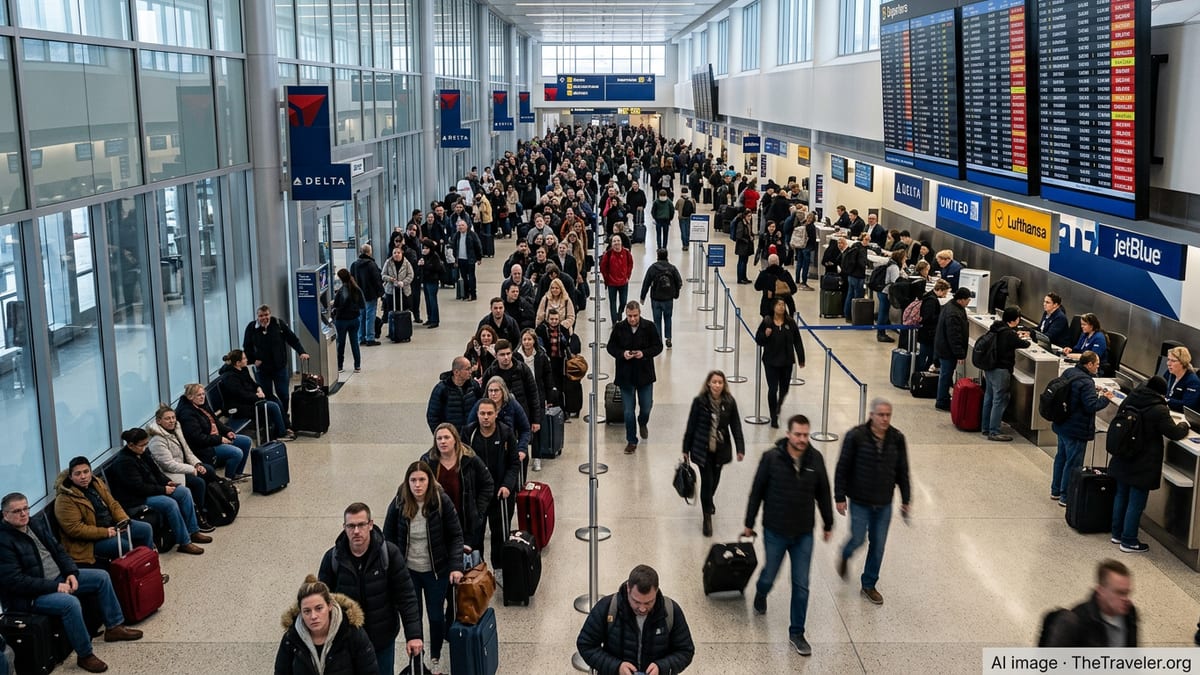
Once at the airport, situational awareness can offer additional clues that an official delay notice is imminent. Packed gate areas with few departures, long lines at customer service desks, or repeated boarding pauses on nearby flights often signal a broader operational crunch.
Departure boards that begin to fill with modest, 15 to 30 minute delays across several airlines usually reflect upstream issues in air traffic control, runway capacity, or weather that have not yet resolved. When these small pushes appear in clusters for flights sharing the same destination or region, it suggests a systemic constraint rather than an isolated maintenance problem.
Gate agents are often working with the same dynamic estimates that appear in internal systems and passenger apps. Even when announcements remain cautiously optimistic, frequent silent changes to the estimated departure time can indicate that the operation is waiting on a new slot from traffic control, a crew reaching legal duty limits, or an aircraft still en route. Watching how often that time stamp shifts can be more revealing than the wording of any announcement.
By combining these on the ground observations with insights from public data and modern flight tracking tools, travelers can build their own, more realistic picture of when a flight is likely to depart. While it will not prevent every disruption, seeing the signs early can make the difference between a rushed connection and a rebooked itinerary planned on your own terms.