


You probably care more about your phone’s signal than your hotel pillow these days. Maps, ride apps, translation, restaurant reviews, digital boarding passes and even hotel keys all live on your phone. Staying connected abroad has shifted from “nice to have” to “if this breaks, my whole trip gets harder.” Yet choosing the best way to get online overseas can still feel surprisingly confusing.
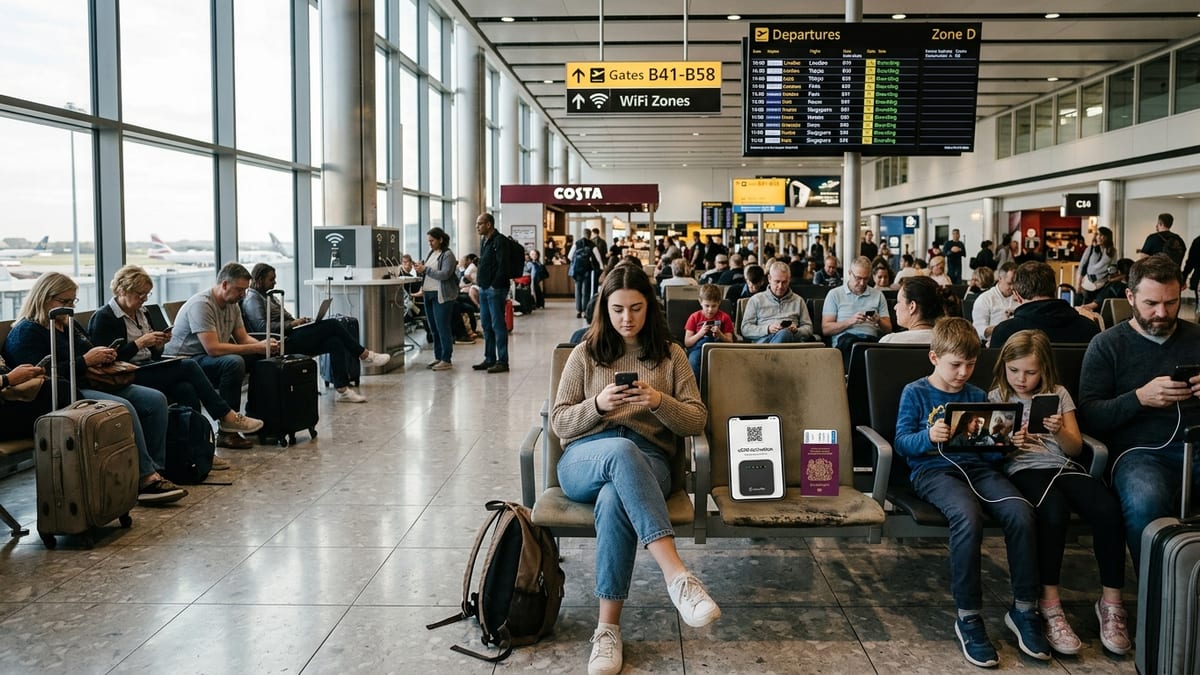
Why travel connectivity is more complicated than it seems
On paper, it looks simple. Your phone can either use your regular plan, a local plan in the country you visit or some kind of WiFi. In reality, each option hides tradeoffs that only appear once you are standing at an airport after a long flight or trying to summon a ride in a city you do not know.
The last few years have added new tools like travel eSIMs and affordable portable hotspots while roaming rules and data prices keep changing. In 2026, many US carriers still charge around 10 to 15 dollars per day for international day passes, which feels convenient until a two week trip suddenly adds well over 100 dollars to your bill just for the privilege of using your usual number abroad. At the same time, global and regional eSIMs for places like Europe or Asia now start at only a few euros for light data, which has shifted what “normal” looks like for connected travel.
On top of price, travelers juggle questions of coverage, speed, battery life, security and device compatibility. Someone on a three day city break in London does not have the same connectivity needs as a family on a monthlong road trip around New Zealand. A digital nomad working from Southeast Asia will think about backup options and upload speeds in a way a casual vacationer never will. The trick is to match the tool to the trip rather than chasing a single best answer.
Confusion also comes from timing. It is easy to read about eSIMs and hotspot rentals when you are planning at home, then default to airport roaming or free hotel WiFi the moment you land. The options that save the most money and stress often require a bit of preparation before departure, even if that preparation is as simple as checking whether your phone supports eSIM or downloading an app while you are still on your home network.
The main ways travelers stay connected today
Most travelers now choose between five broad options: travel eSIMs, local physical SIM cards, home carrier roaming, portable WiFi hotspots and public WiFi. In practice, many combine two or three of these rather than relying on only one. Each option shines in certain situations and becomes frustrating in others.
Travel eSIMs have grown incredibly quickly because they solve a classic airport problem. Instead of hunting for a kiosk after landing, you buy a data package in an app from providers like Airalo, Holafly, Ubigi or a regional specialist while you are still at home. Once you land in Paris, Tokyo or Cape Town the phone simply connects to a local partner network and you have data within minutes. Recent comparison guides show country and regional plans in 2026 starting at around the equivalent of 4 to 6 euros for a few gigabytes in places like Europe or Asia, with more generous bundles still often under what a single roaming day pass would cost.
Local physical SIM cards remain popular with budget conscious travelers and long stays. In many airports, especially in Asia and Europe, you will still see stands from local operators offering tourist SIMs with anywhere from 10 to 50 gigabytes of data plus local calls for a fixed price, often between 10 and 30 dollars depending on the country. This can be exceptional value for a two or three week trip in one country, but it requires that your phone is unlocked and that you are willing to swap tiny plastic cards, keep track of the original SIM and sometimes navigate paperwork like passport scans or local registration rules.
Roaming through your home carrier wins on simplicity. You keep your normal SIM and number, turn on roaming in your settings and everything “just works.” US carriers like Verizon, AT&T and T Mobile focus on international day passes that typically cost around 10 to 15 dollars per day and provide a fixed amount of high speed data before slowing you down. For a five day conference in London where your company pays the bill, that ease can be worth it. For a family of four on a 14 day vacation, the math quickly becomes uncomfortable, especially when a similar amount of data via eSIMs could cost a fraction of that total.
Portable WiFi hotspots occupy a middle ground between cellular data and WiFi. Rental companies at major airports offer small battery powered routers you carry with you, which connect to local 4G or 5G networks and broadcast a private WiFi network for your devices. Daily rental rates reported in travel tech guides for 2025 and 2026 often land between 5 and 10 dollars per day plus data, with unlimited options at the higher end. Some frequent travelers buy their own unlocked hotspot and simply insert a local data SIM on arrival, which can be economical for families or groups who travel together several times per year.
Public WiFi rounds out the set. Airports, hotels, cafes and trains increasingly offer free or at least easy to access networks. This works well for casual use like checking email or downloading offline maps, especially in cities where almost every cafe has a network. However, security reports and travel safety checklists published in 2025 and 2026 still flag airport and hotel WiFi as common targets for malicious “lookalike” networks and basic data snooping. Even when the risk of outright hacking is low, these networks can be unreliable, crowded and unsuitable for video calls or remote work.
What actually works best depending on your trip
For a short trip under a week in a single country, the best choice often comes down to how much time and attention you want to spend. If you are flying from New York to London for four days and need solid coverage for maps, rides and social media, an eSIM for the UK or a Europe regional eSIM is usually the sweet spot. You can install it before you leave, pay something in the range of 10 to 20 dollars for enough data for moderate use and keep your regular SIM active for texts and calls. Roaming with your home carrier can also work if your employer reimburses you or if your carrier includes a low cost roaming add on in your plan.
For longer stays in one country, especially outside Europe, a local SIM often delivers the best value. Consider a month in Thailand, Mexico or Turkey. Local operators in many of these destinations sell tourist SIMs with substantial data and local minutes at prices that look remarkably low compared with US or UK plans. A digital nomad who spends six weeks in Bangkok, for example, might pay the equivalent of 15 to 25 dollars for 30 days of generous 4G or 5G data from a Thai carrier while using a travel eSIM or roaming only during the arrival window until they can visit a shop.
Multi country trips change the equation again. A traveler moving across ten European countries over three weeks does not want to queue for a new SIM in every airport. Regional eSIMs and some physical multi country SIM products exist specifically for this scenario, letting you use one plan across 30 or more countries in Europe or another world region. Guides updated in 2026 point out that many of these regional plans now support 5G where available, although speeds and caps vary. For around 20 to 40 dollars you can often cover a multi week European itinerary on a single eSIM while avoiding repeated admin at each border.
Group travel and family trips reward solutions that share well. A portable hotspot or travel router can be especially practical when two parents and two teenagers all want to scroll their own feeds and stream on their own devices at the end of the day. Instead of buying four separate eSIMs, you rent or buy one hotspot and connect up to around 5 to 10 devices to its private WiFi. The tradeoff is one more gadget to charge and carry and the need for a backup plan if the device fails or gets lost.
For remote trips and outdoor adventures, coverage and reliability matter more than saving a few dollars. Road tripping in Iceland, driving across rural Australia or hiking in Patagonia will expose you to long stretches with weak or no cellular coverage, regardless of provider. In these cases, it can help to check coverage maps from both local carriers and your eSIM provider, download offline maps in advance and consider a mix of connectivity tools so that if one network fails you can fall back to another. Some adventure travelers also carry satellite messengers for emergencies, but that sits in a different category from everyday data and is priced accordingly.
Common connectivity challenges travelers face
Coverage gaps remain the most frustrating issue, even in 2026. City centers and tourist hotspots usually offer excellent 4G or 5G data, but rural areas, mountain regions and islands can still be patchy. It is common to see travelers in parts of southern Italy, rural Japan or Indonesia discover that their affordable travel eSIM works brilliantly in major cities but struggles in small villages where a competing local carrier has stronger towers. Since many eSIM providers rely on specific partner networks, reading which carrier they connect to and comparing with local coverage maps can save headaches later.
Device compatibility is another stumbling block. Most recent iPhone and high end Android models support eSIM, often with the ability to keep one physical SIM and one or more eSIMs active. However, some budget phones, older devices and certain regional variants still only support physical SIMs or limit how many eSIM profiles can be stored. Travelers who upgraded phones in the last few years are often surprised to learn that models sold in regions like the United States may be eSIM only, which means buying a local plastic SIM on arrival is no longer an option unless they also carry an older backup phone.
Data limits and speed throttling can catch travelers off guard too. Unlimited sounding offers from roaming plans, eSIMs or hotspots often contain caps where the first few gigabytes are high speed and the rest are slowed significantly. For light users who mainly message, check maps and browse, that may not matter. For someone who uploads large photo backups, streams high definition video or joins frequent video calls, those limits can turn a smooth connection into a frustrating trickle. Reading the fine print, especially about “fair use” policies and speed limits after a certain amount of data, pays off.
Finally, security concerns around public WiFi still deserve attention. Travel safety organizations and public WiFi guides published in 2025 and 2026 point out that while most mainstream websites now use encryption, airport and hotel networks continue to be targets for fake hotspots and snooping. Using a reputable VPN on laptops and phones, avoiding sensitive tasks like online banking on open cafe networks and preferring your own cellular data for anything involving payments or work accounts remains sensible. Some travelers carry small travel routers that plug into a hotel Ethernet port or act as secure middlemen between a sketchy hotel WiFi and their devices, adding a little extra peace of mind.
How to match connectivity to your travel style
Rather than asking “what is the best internet for travel,” it helps to ask “how do I actually use my phone on this specific trip.” Someone who mostly wants to send messages, check restaurant reviews and occasionally upload photos can happily live on a modest data plan and lean on hotel WiFi in the evenings. In that case, a small regional eSIM or even a local SIM with 5 to 10 gigabytes might be plenty, especially if you download city maps for offline use.
If you work remotely or need reliable video calls, you will want more redundancy. Combining a main solution such as a regional eSIM or local SIM with backup options like a low cost roaming add on or a second eSIM from another provider gives you the ability to switch when speeds drop. Many digital workers in 2026 describe carrying two phones or a phone and a hotspot so that if one provider has problems in a neighborhood, they simply tether from the other device and continue the call.
Frequent flyers who pass through multiple regions per year often settle on a routine. They might keep their home carrier’s basic roaming enabled only for incoming texts and two factor login codes, rely on a global or regional eSIM subscription for everyday data and pick up local SIMs only when they know a country has unusually cheap or fast deals. This mix avoids bill shock from heavy roaming, keeps their main number reachable and reduces time wasted searching for kiosks on every arrival.
Traveling with children changes priorities as well. Parents often care less about shaving the last few dollars off and more about guaranteed signal when a tired child needs a ride back to the hotel or a downloaded video for a long train ride. In practical terms, that can mean slightly overbuying data on a single robust plan and pairing it with a hotspot or generous tethering settings, rather than juggling several tiny plans that may run out mid day.
Common connectivity mistakes travelers make
One of the biggest mistakes is switching on roaming without checking what it actually costs today. Stories of travelers coming home to bills in the hundreds or even thousands of dollars still appear in 2026 when people use pay per use roaming or run through the “fair use” limit of their day pass without noticing. Taking ten minutes before departure to read your carrier’s current international rates for your destination can prevent unpleasant surprises.
Another common error is choosing the absolute cheapest option without considering reliability. Picking a low priced eSIM that only uses a secondary network in a country may save a few dollars but result in flaky coverage compared with a slightly more expensive option that partners with the main local carrier. Travelers on tight work schedules, like journalists covering an event or consultants presenting to clients, often discover that paying a little more for stronger networks is a better investment than chasing the lowest cost per gigabyte.
Many travelers also ignore compatibility until they are already abroad. Buying a physical SIM for a phone that is still carrier locked, or purchasing an eSIM that only supports data on devices with new modems, are avoidable headaches. Checking your phone’s unlock status, eSIM support and band compatibility with your destination’s networks is a dull pre trip task, but it is far easier than troubleshooting at midnight in a hotel lobby.
Overtrusting public WiFi is another trap. A recent survey referenced by business and tech media found that while a majority of travelers have used hotel or airport WiFi for work or personal tasks, a significant portion underestimated the risks or did not use any security tools. Even if the chance of a targeted attack is low, using open networks for online banking, password changes or work logins still creates unnecessary exposure, particularly when cellular data or a secured personal hotspot is available.
How to choose the right setup without overthinking it
The simplest way to make a good choice is to start with three questions: how long is the trip, how many countries are involved and how important is constant, fast data. Once you answer those, most of the complexity falls away. Short trip, one country, light use usually points toward either a small travel eSIM or a roaming add on if it is reasonably priced. Longer trip, one country and heavier use tilts toward a local SIM plus perhaps a small eSIM as a safety net for the arrival day.
For multi country itineraries, think regions instead of nations. A regional eSIM for Europe, Asia Pacific or the Middle East and North Africa can simplify a lot of bouncing around. If your trip crosses very different regions, such as a week in Japan followed by time in Australia and then the United Arab Emirates, you might combine two regional plans or a global plan that, while more expensive, offers the least friction. The goal is not to cover every hypothetical situation perfectly but to avoid obvious pain points like trying to buy a new SIM every three days.
Once you have a main connection option selected, layer simple safeguards on top. Download offline maps for the cities you will visit, save key booking confirmations where they are accessible without data and consider a basic VPN subscription if you plan to use public WiFi in airports or hotels frequently. These small steps mean that if your main data source fails for an afternoon, you are inconvenienced rather than stranded.
Finally, give yourself permission to pay a bit more for peace of mind when it makes sense. An extra 10 or 20 dollars spread across a ten day trip is a small price for knowing you will have solid signal for everything from ride hailing to last minute restaurant searches. The best travel connectivity solution is rarely the absolute cheapest. It is the one you barely have to think about while you are actually enjoying your journey.
FAQ
Q1. Is a travel eSIM really cheaper than roaming?
In many cases, yes, especially for trips longer than a few days. US and some other carriers often charge around 10 to 15 dollars per day for roaming passes, which adds up quickly over one or two weeks. By contrast, travel eSIM providers commonly sell country or regional packages for a fixed amount of data that can cover an entire trip for what a few days of roaming would cost. Prices vary by destination and usage, so very short stays or extremely light use may narrow the gap.
Q2. Should I still bother with a local SIM card in 2026?
Local SIMs remain a strong choice for longer stays in a single country or where tourist packages are especially generous. If you are spending a month in one place and expect to use your phone heavily for navigation, social media, streaming and hot spotting, a local SIM from a major carrier can deliver lots of high speed data and local calls at a good price. The tradeoff is the need to visit a shop or kiosk, handle registration and swap SIMs, which not every traveler wants to do.
Q3. Is public WiFi safe enough for regular use?
Public WiFi is generally fine for casual browsing, looking up attractions or downloading maps, especially since most websites now use encrypted connections by default. However, security experts and travel safety guides still advise caution for sensitive tasks like online banking, work logins or handling confidential information on open networks. Using a reputable VPN, checking you are on the legitimate hotel or cafe network and favoring your own cellular data for important tasks strike a sensible balance between convenience and safety.
Q4. What if my phone does not support eSIM?
If your phone is older or a budget model that lacks eSIM support, you are not locked out of good options. You can still use local physical SIM cards as long as the phone is unlocked, or rely on a portable WiFi hotspot that your phone connects to over WiFi. In some cases, it may even be worth using an inexpensive secondary device that supports eSIM, such as a newer mid range phone or dedicated hotspot, while keeping your main phone on your usual number.
Q5. How much data do I really need for a weeklong trip?
Usage varies widely, but many travelers find that 3 to 5 gigabytes is enough for a week if they mainly use maps, messaging, ride apps and light browsing while leaning on hotel WiFi for heavier tasks. If you expect to share lots of photos and videos in real time, stream video on cellular or join video calls, you might be more comfortable with 10 gigabytes or more. Checking your recent monthly usage at home and dividing by four can give a rough sense of what you use in a typical week.
Q6. Can I keep my home number for calls and still use a travel eSIM?
On most modern phones, yes. Many devices support dual SIM, which allows you to keep your home carrier’s SIM active for calls and texts while using a travel eSIM for data. In practice, you set the travel eSIM as the default for mobile data and choose whether calls and messages go through your home line, a local number or internet based apps. This is especially useful for receiving verification codes or important calls without relying on expensive roaming for everyday data.
Q7. Are portable WiFi hotspots worth it for solo travelers?
For solo travelers, a personal hotspot is often less necessary since a single eSIM or local SIM can directly power your phone and occasional tethering to a laptop. Portable hotspots become more attractive when sharing with several devices or people, such as a couple both working remotely or a family connecting multiple phones and tablets. If you value having a separate device for connectivity or your phone’s battery life is limited, a hotspot can still be handy, but it is not essential for everyone.
Q8. What should I do if I lose connectivity during an important moment?
This is where having a backup plan matters. Before your trip, download offline maps, save key reservations and consider adding a second connectivity option, such as a small pay as you go eSIM from another provider or a low tier roaming add on. If your main network drops during a crucial moment like finding your hotel late at night, you can switch data to the backup, connect briefly, solve the immediate problem and troubleshoot the main issue later when you are in a calmer situation.
Q9. How can I avoid bill shock from roaming charges?
The safest approach is to disable data roaming by default and only turn it on when you have a clear plan and know the rates. Reviewing your carrier’s current international options before departure, including any roaming passes or regional packages, lets you decide whether their offer is reasonable compared with eSIMs or local SIMs. Monitoring your data usage during the trip and setting alerts inside your phone’s settings or carrier app can also catch unexpected spikes before they become problems.
Q10. Is there a single best travel connectivity solution for everyone?
There is no universal winner because needs, budgets and trip styles differ. A weekend city breaker, a long term backpacker and a frequent business traveler will each value different things, from cost savings to rock solid reliability to minimal setup. Instead of chasing one perfect answer, focus on matching a simple, reliable main option to your specific trip and layering light backups for peace of mind. When you hardly notice your connectivity during the journey, you have probably chosen well.