


The Sistine Chapel is one of those places that almost everyone has seen in photographs but few people really experience. In 2026, with record visitor numbers and partial restoration work in progress, stepping into Michelangelo’s masterpiece can feel more like crowd control than quiet contemplation. Yet with smart planning, realistic expectations and a clear idea of what to look for, you can walk out feeling you have genuinely seen the Sistine Chapel, not just shuffled through it.
Get the latest updates straight to your inbox!
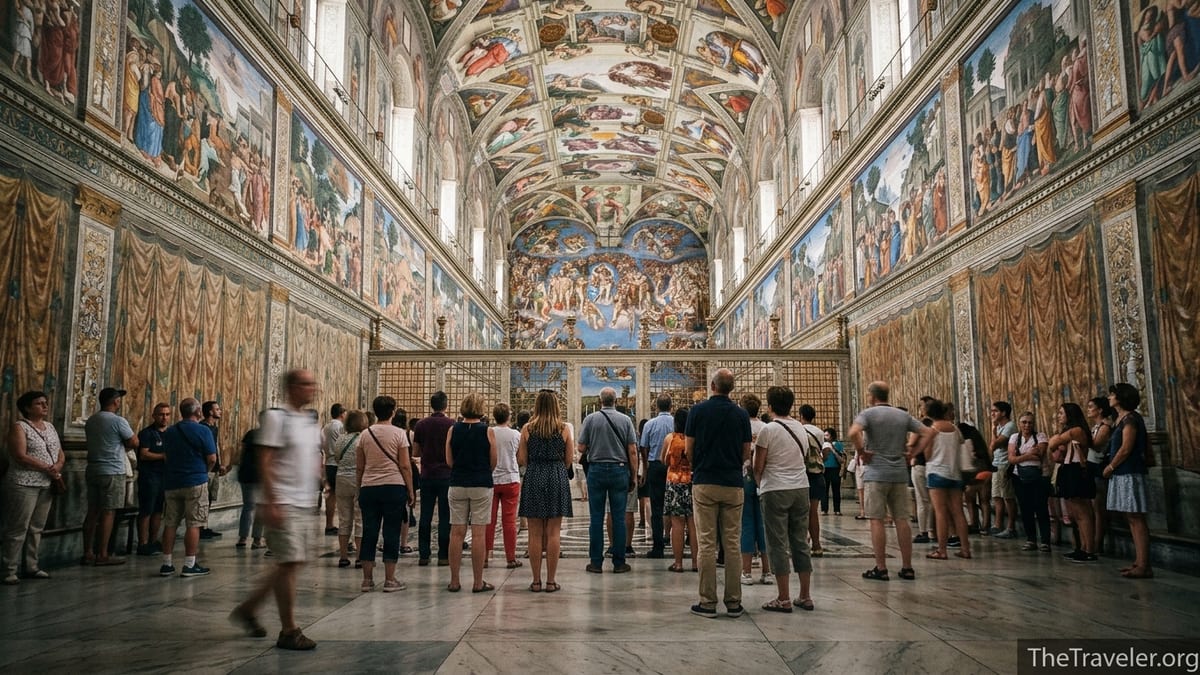
Know What You Are Walking Into in 2026
The Sistine Chapel is not a standalone attraction. It is the final stop on the Vatican Museums itinerary, inside Vatican City. You cannot buy a ticket “only for the Sistine Chapel.” Every visitor enters via the Vatican Museums, walks through a long sequence of galleries and then eventually reaches the chapel, which is still used as the pope’s private chapel and the site of papal conclaves. In 2024 the Vatican Museums welcomed around 6.8 million visitors, and 2026 is tracking at similar levels, so you should expect dense crowds, especially in high season.
Standard Vatican Museums tickets for 2026 cost about 20 euros at the door or 25 euros when booked in advance online with the 5 euro reservation fee. That basic ticket covers all the main collections, including the Raphael Rooms and the Sistine Chapel, and is enough for most travelers who are willing to do a bit of homework before they go. Third party “escorted entry” or “semi private” tickets can cost 70 to 130 euros per person, often bundling a guided tour and priority group entrance. These are not mandatory, but they can be worthwhile if you are short on time or nervous about navigating the crowds alone.
In 2026 there is also restoration work on the altar wall that carries Michelangelo’s Last Judgment. The chapel remains open, but some scaffolding and partial coverings may be visible around the altar area on certain dates. This does not ruin the experience, but it changes where you stand and what you can see clearly, so it is all the more important to arrive knowing the layout of the ceiling and side walls in advance.
The Vatican Museums and Sistine Chapel generally open from around 8 or 9 in the morning and close in the early evening, with later openings on some Fridays and Saturdays in peak season. There are regular closure days tied to Vatican holidays, and the last Sunday of each month has a free but extremely crowded opening. If you are planning a serious visit to the Sistine Chapel, avoid the free Sunday and aim for a paid day when you can control your time slot more carefully.
Choose the Right Ticket and Time of Day
Your ticket type and time of day will directly affect how much you actually see once you step inside the Sistine Chapel. A standard timed entrance ticket purchased on the official Vatican Museums site is enough for many travelers. It lets you bypass the ticket purchase line outside and walk into the security queue at your reserved time. In shoulder months like March or November, a 9:00 or 9:30 entry can mean reaching the Sistine Chapel by 10:00 with a manageable crowd. In peak months like May, June and September, the same time can already feel packed.
If you want quieter conditions to study the ceiling and narrative panels, look for early or late access. Official early entry tours and reputable third party operators often offer museum entry around 7:30 or 8:00, about half an hour before general public opening. These cost more, typically between 60 and 120 euros depending on group size and whether St Peter’s Basilica is included, but they can turn a chaotic experience into something close to contemplative. A common strategy in May 2026, for example, has been to book an 8:00 entrance, walk briskly through the galleries to the chapel, enjoy it with perhaps twenty to fifty others, then loop back through the museums at a slower pace.
Evening openings on certain Fridays and Saturdays, usually until about 10 or 10:30 at night, create another opportunity. These night visits tend to be less family oriented and a bit quieter, with cooler temperatures and softer artificial lighting. Travelers who visited in spring 2026 reported reaching the Sistine Chapel after 8 p.m. and finding it crowded but noticeably calmer than mid afternoon. For those who struggle with heat or have limited daytime hours in Rome, an evening slot can be a practical way to actually linger and look up.
Be cautious with very late afternoon entries, such as 5 p.m., if the museums close at 6 or 7 that day. Security lines, ticket checks and the 20 to 30 minute walk through the galleries mean you can easily end up with only a short window in the chapel before staff begin moving people toward the exit. If the Sistine Chapel is the heart of your visit, it is safer to book a mid morning, mid afternoon or evening slot that leaves at least two and a half hours from your entry time to closing.
Navigating the Museums So You Do Not Arrive Exhausted
One of the most common mistakes visitors make is treating the Vatican Museums like a warm up act to the Sistine Chapel, wandering through every room at a leisurely pace and stopping for endless photos. By the time they finally reach the chapel, they are hot, tired, and more focused on finding the exit than on Michelangelo’s frescoes. The walk from the museum entrance to the Sistine Chapel can take 20 to 30 minutes even at a steady pace, and many people easily spend three hours en route without realizing it.
If your priority is to absorb the Sistine Chapel’s details, plan your route in reverse. As you enter, follow the clearly marked signs toward the Capella Sistina, resisting the temptation to stop at every sculpture or gift shop. Pass through highlight spaces such as the Gallery of Maps and the Gallery of Tapestries without lingering too long. Once you reach the Raphael Rooms you may want to slow down, since these are the other major Renaissance fresco cycle in the complex. After you have taken in Raphael’s School of Athens and related rooms, continue directly to the chapel. Later, if you still have energy, you can backtrack through the museums to re visit specific sections.
Travelers who arrived for an 8:00 timed ticket in May 2026 and walked straight to the chapel reported entering it with only a few dozen others, then returning to tour the rest of the museums over the next three hours. By contrast, those who entered around 10:00 and explored every side gallery first often reached the chapel at midday, when staff estimated up to a thousand people were inside, with wall to wall bodies and very slow movement toward the exits.
Consider your physical comfort as seriously as your art interests. The Vatican Museums floors are hard stone, seating is limited and the Sistine Chapel itself has almost no seating available when crowds are heavy. Wear comfortable walking shoes, bring a light sweater or scarf for air conditioned and cooler sections, and eat a proper meal before your visit. There are cafeterias and snack bars inside the museums, but queues here also take time and can break your rhythm just when you want to approach the chapel with full concentration.
What to Look for: A Simple Visual Roadmap
Stepping into the Sistine Chapel can be visually overwhelming. The ceiling is approximately 40 meters long and covered with hundreds of figures, flanked by frescoes on the walls by Botticelli, Perugino, Ghirlandaio and others, and dominated at one end by Michelangelo’s Last Judgment. To avoid staring blankly upward without knowing what you are seeing, carry a simple visual roadmap in your head or on paper. A small laminated ceiling guide, available in many Rome bookshops for a few euros, can be more practical than relying on your phone in the semi dark, hushed space.
Start with the nine central ceiling panels that run down the middle. These depict stories from the Book of Genesis, from the Separation of Light and Darkness to the Drunkenness of Noah. The most famous of these is the Creation of Adam, where God and Adam reach out their hands toward one another, nearly touching. When you enter the chapel, walk toward the center until you are roughly beneath this panel and then look up. Noticing how tiny the actual gap between the fingers is, and how the surrounding figures twist and lean around the central gesture, makes the painting feel dramatically more alive than it does in photographs.
Then shift your gaze slightly outward to the massive seated prophets and sibyls along the sides of the ceiling. Look for the Libyan Sibyl, twisting her body to rise from her seat, or the muscular figure of Jonah near the altar end. These figures anchor the ceiling and help your eye travel from the smaller narrative scenes to the larger theological story Michelangelo wanted to convey about revelation and prophecy. Even if restoration scaffolding partly obscures the Last Judgment in early 2026, you can still connect the prophetic tension on the ceiling with the drama of salvation and damnation on the altar wall.
Finally, remember to lower your gaze to the side walls. On one side, you will see stories from the life of Moses; on the other, scenes from the life of Christ, painted by a team of Renaissance masters decades before Michelangelo arrived. Pausing at the Christ Giving the Keys to St Peter, for instance, adds context to the papal role in the chapel’s history. Even two or three minutes spent comparing a Moses panel with a Christ panel helps you appreciate how the chapel was conceived as a complete visual program, not just a famous ceiling.
Understanding the Rules: Silence, Dress Code and No Photos
The Sistine Chapel is still first and foremost a chapel, not a museum gallery. This is why stewards regularly call for silence, why there is a strict dress code, and why photography is not permitted. Guards will call out “Silenzio” at frequent intervals, sometimes every couple of minutes when the crowd noise swells. This can feel intrusive, but it reflects the Vatican’s attempt to maintain a minimal sense of prayerful atmosphere even when thousands of tourists pass through each day.
The dress code is similar to that for St Peter’s Basilica. Shoulders and knees must be covered for both men and women. In practice, this means no sleeveless tops, very short shorts or skirts above mid thigh. Lightweight linen trousers, midi skirts, t shirts with sleeves and a simple scarf or shawl for layering work well in Rome’s heat. Security staff at the museum entrance and occasionally near the chapel will turn away visitors dressed inappropriately, so it is safer to err on the conservative side. Packing a compact travel shawl or pashmina in your day bag is an easy insurance policy.
Photography is completely banned inside the Sistine Chapel, and staff enforce this actively. Travelers who tried to snap quick phone photos in recent years report being approached by guards, asked to delete images and given firm warnings. This rule is partly due to respect for the sacred space and partly an ongoing policy that dates back to restoration agreements. Rather than seeing it as an annoyance, treat the ban as a gift: it forces you to stop framing the ceiling through a screen and to actually look with your own eyes. Take as many photos as you like in the rest of the Vatican Museums, then put your phone away before you enter the chapel itself.
Audio guides and whisper headsets from guided tours are allowed, but you will not be able to play content out loud. If you are visiting independently, consider downloading a well reviewed audio guide or podcast episode about the Sistine Chapel the day before and listening to it quietly with one earbud in while you sit elsewhere in the museums. That way, when you step into the chapel you can simply look, already primed with the stories and symbols, without trying to follow complex commentary in a crowded space.
Guided Tours vs Exploring on Your Own
Whether you should book a guided tour for the Sistine Chapel depends on your learning style, budget and tolerance for structure. Official Vatican guided tours and reputable independent companies typically charge between 50 and 130 euros per adult for a three hour experience that includes key galleries, the Raphael Rooms and the chapel. Many also offer “priority group” entrance through a separate door, which can shave significant time off your wait during high season.
On a guided tour, you will not receive commentary inside the chapel itself, because speaking is restricted there. Instead, your guide will usually stop with the group at a poster or digital screen beforehand and give a detailed explanation of the ceiling, pointing out the Genesis scenes, prophets, sibyls and key figures. Some guides sketch rough diagrams or use laser pointers on reproductions. Then, once inside, you spend ten to twenty minutes looking in silence. For travelers who do not have time to research art history in advance, this structure can make a huge difference in how much they notice.
Independent visits, on the other hand, give you full control over pace and timing. You can choose to power walk to the chapel as soon as you enter, then double back to the museums, or you can linger in the Raphael Rooms and modern art collections before approaching the chapel in the late afternoon. You also save money; a basic timed museum ticket for 25 euros leaves more budget for a good guidebook or printed ceiling map. Some travelers in 2026 have combined approaches, buying the official ticket and supplementing it with a self guided audio tour downloaded in advance for a few dollars.
A hybrid option worth considering is a “Vatican Museums, Sistine Chapel & St Peter’s Basilica” tour, commonly priced around 90 to 130 euros. These tours typically include a knowledgeable guide, priority museum entry, commentary on the chapel from outside, silent viewing inside, and then use a special passage from the chapel directly into St Peter’s, which is closed to independent visitors. This can save you from queuing again on St Peter’s Square and is particularly efficient on hot summer days.
Building a Personal Connection: Before, During and After
Because the Sistine Chapel is so famous, it is easy to arrive with a sense of obligation rather than curiosity. One way to deepen your experience is to spend an hour or two before your trip engaging with the art in a more personal way. Watch a short documentary about the ceiling, read a chapter from a book on Michelangelo’s life, or visit a local museum that has Renaissance frescoes to practice “reading” compositions. Even looking at high resolution reproductions of the nine central Genesis scenes on your laptop at home can make them feel more familiar when you see them in person.
During your visit, give yourself permission to focus on just a few details instead of trying to absorb everything. For example, you might decide to pay special attention to the prophets and sibyls, noticing how each one’s posture and expression differs. Or you might trace the visual progression from the relatively ordered scenes above the chapel’s entrance to the more dynamic, almost chaotic drama of the Last Judgment at the altar end. Tuning in to one thread of the story helps anchor your attention in the midst of noise and motion.
Afterwards, reinforce your memories while they are still fresh. Once you exit the chapel and return to the museums or St Peter’s Basilica, jot a few notes in your phone: which panel surprised you, which color stood out, where you managed to find a moment of stillness. Later, perhaps back at your hotel, compare your impressions with a book or high quality reproductions. Many travelers report that this simple act of reflection turns what could have been a blur of frescoes into one of the most vivid memories of their time in Rome.
If you are traveling with children or teens, help them turn the visit into a story rather than a lecture. Before you go, choose one or two figures for them to “find” in the ceiling, such as the figure of God separating light from darkness, or Adam reclining on the earth. Once inside, let them point these out to you. Turning the chapel into a visual treasure hunt can be more engaging for younger visitors than a long explanation of Renaissance theology.
The Takeaway
Experiencing the Sistine Chapel without missing its most important details is less about secret hacks and more about deliberate choices. Choose a ticket and time of day that give you room to breathe, not just to tick a box. Navigate the Vatican Museums with the chapel as your destination, not an afterthought. Arrive with a simple visual roadmap in your head, so that the chaos of frescoes resolves into a story you can follow.
Once inside, respect the chapel’s rules of silence, modest dress and no photography, not only out of courtesy but because they create the conditions for real attention. Decide whether a guided tour, independent visit or hybrid approach best fits your style, and prepare just enough beforehand that the images on the ceiling feel like old acquaintances. Finally, take a moment after your visit to remember what you saw and how it made you feel. In a city rich with marvels, that quiet act of looking back may be what transforms your half hour under Michelangelo’s ceiling into a lasting encounter rather than a passing stop on a busy itinerary.
FAQ
Q1. How much time should I plan for the Vatican Museums and Sistine Chapel?
Most visitors should plan at least three hours from entry to exit, including walking through the museums. If the Sistine Chapel is your main focus, aim to reach it within the first 60 to 90 minutes, then spend the remaining time revisiting specific museum sections at a more relaxed pace.
Q2. What is the best time of day to visit the Sistine Chapel in 2026?
In 2026, early morning entries shortly after opening and evening openings on select Fridays and Saturdays tend to be the least crowded. Midday, especially between 11 a.m. and 2 p.m. in high season, is usually the busiest. If you want time to really look at the ceiling, avoid arriving at the chapel during those peak hours when possible.
Q3. Are skip the line or guided tour tickets worth the extra cost?
Skip the line tickets that simply guarantee a timed entrance are often worth the small surcharge over the basic door price because they save you from standing in the outdoor ticket queue. More expensive guided tours can be worthwhile if you value expert commentary, priority group entry and, in some cases, direct access from the Sistine Chapel into St Peter’s Basilica, which saves additional waiting time.
Q4. Can I take photos or videos inside the Sistine Chapel?
No. Photography and video are strictly forbidden inside the Sistine Chapel, regardless of whether you use a flash. Guards actively monitor the room and will ask you to put away your phone or camera and may insist that you delete any images. You are free to take photos in most other parts of the Vatican Museums.
Q5. What should I wear to be allowed into the Sistine Chapel?
You must follow the Vatican modesty dress code: shoulders and knees should be covered for all visitors. Avoid sleeveless tops, low cut shirts and very short shorts or skirts. Lightweight trousers, longer shorts that reach the knee, midi skirts and t shirts with sleeves are generally acceptable. Bringing a scarf or shawl makes it easy to adapt your outfit if needed.
Q6. Is the Sistine Chapel accessible for visitors with limited mobility?
The Vatican Museums provide routes that are more accessible for visitors using wheelchairs or with limited mobility, including elevators and adapted paths. However, the distance from the entrance to the Sistine Chapel is still significant. It is advisable to contact the Vatican Museums in advance or speak to staff at the entrance to ensure you follow the most suitable route and allow extra time for transfers and elevator waits.
Q7. Will restoration work in 2026 significantly affect my visit?
Ongoing conservation on the altar wall that holds the Last Judgment means you may see scaffolding or partial coverings in that area during portions of 2026. The chapel remains open, and the ceiling, side wall frescoes and overall space are still visible. While you may not get an unobstructed view of every detail on the altar wall, you can still meaningfully experience the chapel’s main artistic and spiritual elements.
Q8. Do I need a separate ticket for St Peter’s Basilica after visiting the Sistine Chapel?
There is no ticket fee to enter St Peter’s Basilica itself, but you must pass through a separate security line on St Peter’s Square unless you are on a tour that uses the special passage from the Sistine Chapel into the basilica. Many combination tours include both museum and basilica access to avoid duplicating queues. If you visit independently, plan additional time for basilica security and consider going early in the morning or later in the afternoon.
Q9. Can I bring children to the Sistine Chapel, and will they enjoy it?
Children are welcome in the Vatican Museums and Sistine Chapel, but the long walking distances, crowds and need for quiet can be challenging for younger kids. Many families find it helps to set simple goals, such as finding certain figures on the ceiling, and to keep the overall visit shorter. Bringing water, snacks for before or after the museums, and planning a rest break can make the experience more enjoyable for everyone.
Q10. How far in advance should I book tickets for the Vatican Museums and Sistine Chapel?
In busy months, tickets for popular time slots can sell out weeks in advance, especially for early entry and evening openings. As a general rule, try to book your timed entrance two to four weeks before your visit if you are traveling in spring, summer or early autumn. In quieter months such as January or November, you may find more last minute availability, but advance booking still provides peace of mind and a better choice of entry times.