


Almost everyone who walks into the Sistine Chapel does the same thing: their head snaps back, phones reach for forbidden photos, and all attention shoots straight to Michelangelo’s famous ceiling. Yet the room itself is a carefully scripted story where the ceiling is only one chapter. Around you, at eye level and even behind you as you shuffle toward the exit, are masterpieces and details that most visitors never really see. Understanding them can turn a rushed five minutes of neck-craning into one of the most powerful experiences of a trip to Rome.
Get the latest updates straight to your inbox!
The Chapel Is More Than Michelangelo
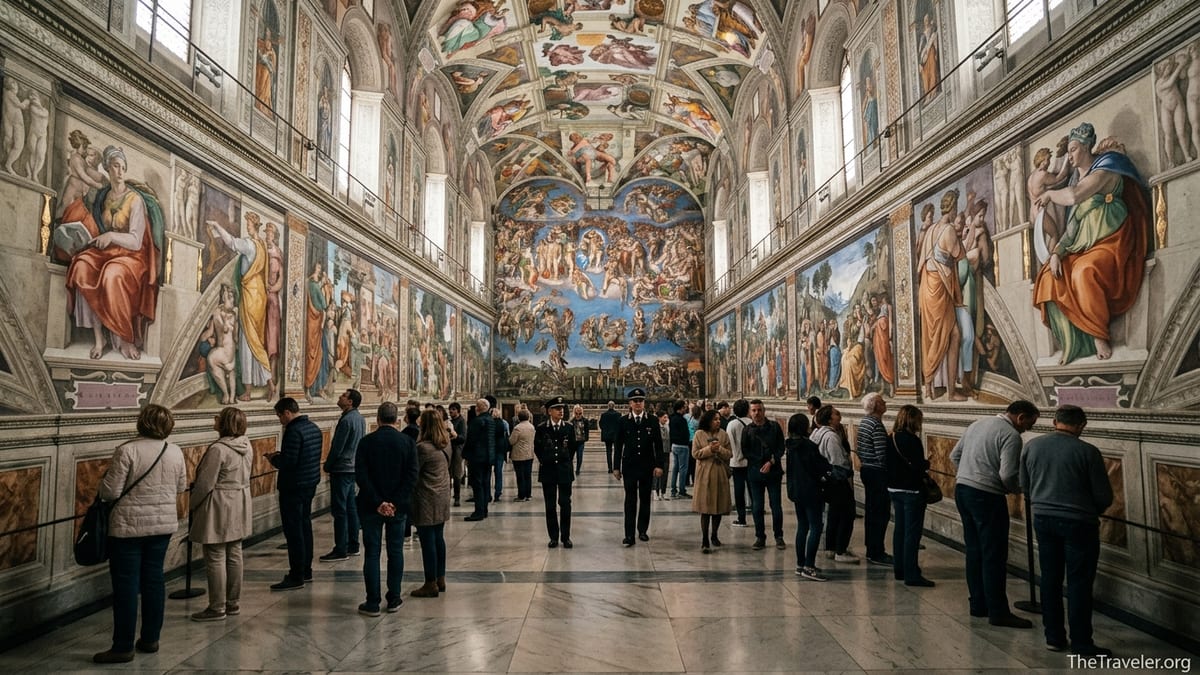
First-time visitors are often surprised by how small the Sistine Chapel feels in person. The space is roughly the size of a medium church nave, usually packed shoulder to shoulder with several hundred people. The rules are strict: no photos, no loud talking, keep moving toward the far end. In this crush, it is natural to look up where there is visual space, but doing so means missing the room’s original star attractions: the long side walls around you.
Decades before Michelangelo ever climbed his scaffolding, Pope Sixtus IV brought in a dream team of late 15th century painters to decorate those walls. Botticelli, Perugino, Ghirlandaio, Rosselli and their workshops created parallel narrative cycles of the Life of Moses on one side and the Life of Christ on the other. Today most people walk past them as blurred color in their peripheral vision while they hunt for the Creation of Adam overhead.
If you enter with a standard skip-the-line Vatican Museums ticket, by the time you reach the chapel you may already be overwhelmed by art. This is exactly why a bit of advance focus helps. Before you even step inside, know that the fun is not only on the ceiling. Once you are in the room, consciously force yourself to look straight ahead and along the walls first, and only then lift your eyes.
The Forgotten Stories on the Side Walls
The north and south walls of the chapel read like a visual Bible. On one side run scenes from the life of Christ, on the other from the life of Moses. They face each other deliberately. For example, Perugino’s Baptism of Christ parallels Moses’ journey in Egypt, while Botticelli’s Temptations of Christ echoes his Trials of Moses across the room. The message for 15th century cardinals was clear: the law of Moses and the life of Christ form a single story of salvation, fulfilled and entrusted to the Church.
Most modern visitors, jostled in the center of the room, never notice these pairings. If you stand near the middle and slowly pivot, you can pick them out. Look to one long wall for Christ’s Baptism and nearby the famous Handing of the Keys to Saint Peter, painted by Perugino, where Christ gives Peter a pair of golden keys in front of an ideal Renaissance square. Then turn to the opposite wall and find Moses receiving the tablets of the Law or leading the Israelites through the Red Sea under stormy skies painted by Botticelli and other masters.
Tour groups often mention only one or two of these scenes in passing. Yet pausing even for thirty seconds in front of a single fresco changes the experience. Imagine arriving at 8:30 a.m. with one of the earliest timed entries. The room is still busy, but you can usually slide to the side and stand near the painted barriers at the base of the walls. From there the storytelling becomes legible: Roman architecture woven into biblical scenes, portraits of contemporary Florentines in biblical dress, and even subtle nods to papal authority embedded in the compositions.
Reading Botticelli, Perugino and Ghirlandaio Up Close
For many visitors, this is the only time they will stand inches away from large original works by Botticelli or Ghirlandaio outside a museum label environment. Botticelli’s Trials of Moses, for example, stacks multiple episodes into a single landscape. You can trace Moses defending the daughters of Jethro at a well, receiving God’s call, and leading his people, all in one panoramic scene. Knowing that this was painted around 1481 to 1482, roughly a decade before Botticelli’s Birth of Venus, gives it extra weight for art lovers.
Across the room, Perugino’s Handing of the Keys to Saint Peter might be the most overlooked masterpiece in the chapel after the ceiling itself. Painted in luminous, calm colors, it stages the founding moment of the papacy in an open square framed by colonnades and triumphal arches. The central octagonal temple and precise tile patterns on the ground anticipate later Renaissance ideals of perspective. Spend a moment on the figures in the crowd: some are portraits of real people from the 1480s, preserved forever in this papal drama.
Ghirlandaio’s Vocation of the Apostles shows Christ calling the fishermen Peter and Andrew on a tranquil lake with boats and gentle hills beyond. The artist slips in contemporary Florentine clothing and hairstyles, just as he would later do in his frescoes in Florence’s Santa Maria Novella. A visitor who has taken guided walks in Florence and then stands here often feels a jolt of recognition: the same artist, the same faces, but now inside the Vatican’s most sacred ceremonial space.
Prophets, Sibyls and the “Supporting Cast” Around the Ceiling
Even among those who do look up, attention usually locks on the nine central Genesis scenes, especially the Creation of Adam. Yet some of Michelangelo’s most striking figures sit just off to the side in the triangular spandrels and lunettes above the windows, and along the long edges of the ceiling where colossal prophets and sibyls are enthroned. These figures are easier to appreciate if you step back toward either end of the room and look diagonally up, rather than staring straight overhead.
The twelve larger seated figures, alternating between Old Testament prophets and ancient sibyls, form a powerful ring around the central panels. They were understood in Michelangelo’s time as witnesses to the coming of Christ, drawn from both Jewish Scripture and classical tradition. Many visitors recognize only the Delphic Sibyl, famous from countless textbooks and reproductions, but each figure has a distinct personality. The Libyan Sibyl twists in a graceful spiral as she turns with a heavy book, while the prophet Jeremiah slumps forward in deep melancholy, his elbow on his knee, his forehead in his hand.
Closer to the walls, above the windows, the triangular sections show ancestors of Christ listed in the Gospel genealogies, portrayed as unexpectedly ordinary families. You can see parents leaning toward children, women stretching to adjust blankets, a grandfather dozing. In the noisy reality of the chapel, where guards regularly call for silence, these private, domestic moments are easy to miss. Yet they anchor the drama above in real human lives, an effect that becomes clear when you deliberately follow a row of lunettes from one end of the chapel to the other.
The Altar Wall and its Ongoing Restoration
At the far end of the chapel from the entrance rises Michelangelo’s Last Judgment, painted between 1536 and 1541, decades after the ceiling. Many visitors never see it properly. They either enter at the opposite end and are drawn instantly to the ceiling, or they find the altar wall partially obscured by crowds or, in 2026, by temporary restoration structures and a printed screen while conservators clean the surface.
This colossal fresco covers the entire altar wall with swirling figures of the resurrected, the saved and the damned. Christ appears at the center, a muscular, commanding figure, surrounded by saints and martyrs. To one side, the damned are dragged down by demons; below, Charon ferries souls and the judge Minos waits with a serpent coiled around him. Knowing that local tradition says the face of Minos resembles a papal master of ceremonies who criticized the work adds a very human layer to the scene.
Because the Last Judgment is currently undergoing an extensive conservation campaign, some visitors in 2026 will find parts of it veiled by scaffolding and a high-resolution reproduction while specialists remove the pale haze left by decades of micro-particles in the air. Museum announcements stress that the chapel will remain open, but it does mean that if you visited before 2026 and return in a few years, you may be seeing a noticeably brighter version of the same wall. For art-focused travelers, this is a rare chance to witness a globally important restoration in progress, similar to visiting Florence during the cleaning of Giotto’s bell tower or the façade of Santa Maria del Fiore.
The Entrance Wall, Tapestries and Painted Draperies
Another commonly overlooked area lies behind you when you first walk in: the entrance wall. Here the narrative cycles conclude with two later frescoes, the Resurrection of Christ and the Dispute over the Body of Moses, repainted in the 16th century after a section of wall collapsed and destroyed the earlier works. Most people only glance at them as they file out the door. If you can, pause just a moment before leaving and compare Christ rising from the tomb with Moses defended by an archangel. They mirror the dual structure of the side walls one last time.
Below the main narrative bands, the lower walls are painted to resemble rich hanging draperies in silver and gold. In the 16th century, Raphael designed a famous set of tapestries for the chapel showing scenes from the lives of Saint Peter and Saint Paul, which were hung over these painted hangings on special occasions. The originals are now preserved in the Vatican collections, but the illusionistic painted textiles remain. In low light, especially when the room is crowded, they read simply as patterned borders. Only when you stand near them and trace the folds and tassels do you realize how carefully they are painted.
Knowing this history adds meaning when you see reproductions of the Raphael tapestries in other museums, such as the Victoria and Albert Museum in London, then step into the Sistine Chapel and imagine them in situ. For many visitors, however, that connection never forms because they are understandably fixated on the ceiling. A few minutes of deliberate looking at eye level ties the entire space together, from the floor up.
Practical Tips to Actually See What Others Miss
None of this matters if you cannot move or see through the crowd. Practical planning makes the difference between fifteen frantic minutes and a genuinely contemplative visit. Booking an early timed entrance to the Vatican Museums, often around 8:00 or 8:30 in the morning, usually costs a bit more than a standard ticket through official channels or reputable tour operators, but it can mean entering the chapel when the density is lower. Some small-group tours also structure their visit so that you reach the Sistine Chapel twice, once at the start through a special route and again at the end, giving you a chance to focus on different elements each time.
Once inside, remember that you are allowed to stand along the side walls so long as you do not block passages. Many people cluster in the center under the Creation of Adam, leaving pockets of space nearer the frescoes by Botticelli and Perugino. Use those openings. Spend one or two minutes on a single wall scene, then another minute scanning the prophets and sibyls above, then finally let your eyes drift to the central Genesis panels.
Photography is strictly prohibited in the Sistine Chapel, and guards enforce this rule. Accepting that you will not take pictures can actually free you to look more carefully. Bring a small notebook or make mental notes to connect what you see with what you will read later. Several travelers report that the moments that stayed with them were not the famous textbook images, but small details: a prophet’s bare foot gripping an imaginary ledge, a child staring up at a parent in the lunettes, or the soft patterning of the painted draperies near the floor.
The Takeaway
The Sistine Chapel is one of the most reproduced rooms on earth, yet almost no one sees it as a whole. Most visitors will remember one square of ceiling where God’s and Adam’s fingers nearly touch and recall the noise of guards policing the crowd. What they often forget is that the ceiling floats above a complete, decades-earlier cycle of Renaissance frescoes that made the room a masterpiece long before Michelangelo arrived.
By shifting your attention to the side walls, the prophets and sibyls framing the ceiling, the family groups in the lunettes, the altar and entrance walls, and the faux textiles and historic tapestries at eye level, you begin to read the chapel as an integrated work of theology and politics. It becomes less a single famous image and more a carefully orchestrated environment designed to speak to cardinals gathered in conclave and, now, to millions of modern visitors.
On your visit, let everyone else aim imaginary photos at the forbidden ceiling. Take a few quiet steps toward the walls instead. Trace the story of Moses and Christ facing one another, find Botticelli’s crowded narratives and Perugino’s calm geometry, watch the sibyls turn and the prophets brood, and remember that for centuries the Sistine Chapel has been a living space of worship and decision-making, not just an image on a postcard.
FAQ
Q1. Is the Sistine Chapel open while the Last Judgment is being restored?
Yes. The Vatican has stated that the chapel remains open during the 2026 cleaning campaign, although parts of the altar wall may be covered by scaffolding and a printed screen.
Q2. Can I take photos inside the Sistine Chapel?
No. Photography and video are not allowed inside the chapel. Guards enforce this rule, so plan to focus on looking rather than taking pictures.
Q3. How much time should I plan to spend in the Sistine Chapel?
Most visitors spend about 15 to 30 minutes inside. If the room is not at full capacity and staff allow it, taking 20 minutes to slowly circle the edges lets you see the side walls properly.
Q4. What is the best time of day to visit to avoid crowds?
The chapel is busy all day, but early morning timed entries and some late afternoon slots can feel slightly less packed. Booking a specific entrance time to the Vatican Museums helps.
Q5. Where should I stand to see the wall frescoes better?
Move toward the side walls, just in front of the painted draperies, without blocking pathways. From there you can see Botticelli, Perugino and Ghirlandaio at eye level and look up at the prophets and sibyls.
Q6. Are the side-wall frescoes also by Michelangelo?
No. The side walls were painted about 25 years before Michelangelo by artists including Botticelli, Perugino, Ghirlandaio and Rosselli. Michelangelo painted the ceiling and the Last Judgment on the altar wall.
Q7. Why do the walls show both Moses and Christ?
The two narrative cycles were designed to face each other, presenting Moses and Christ as parts of a single story of salvation and underlining the continuity of Church authority from Old Testament to New.
Q8. Can I see the Raphael tapestries in the Sistine Chapel?
The original Raphael tapestries are now preserved in the Vatican collections and are displayed only on special occasions. On a normal visit you will see the painted imitation draperies that formed their backdrop.
Q9. Do I need a guided tour to appreciate what people usually miss?
A good guide or audio guide can help, but it is not essential. Arriving with a basic understanding of the side-wall stories and allowing yourself a few extra minutes along the walls already changes what you notice.
Q10. How can I prepare before visiting so I do not focus only on the ceiling?
Before your trip, look up images of the side-wall frescoes, especially the Handing of the Keys to Saint Peter, the Trials of Moses and the Vocation of the Apostles. Arrive determined to find these works first, then enjoy the ceiling afterward.